 (source)
|
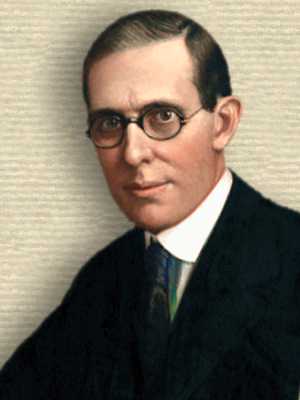
Charles F. Kettering
(29 Aug 1876 - 25 Nov 1958)
American engineer whose 140 patents included the electric starter, car lighting and ignition systems.
|
Science Quotes by Charles F. Kettering (67 quotes)
>> Click for Charles F. Kettering Quotes on | Achievement | Failure | Future | Idea | Inventor | Problem | Progress | Research | Success |
>> Click for Charles F. Kettering Quotes on | Achievement | Failure | Future | Idea | Inventor | Problem | Progress | Research | Success |
[At the funeral of Kettering’s researcher, Thomas Midgley, Jr., the minister intoned “We brought nothing into this world, and it is certain we can carry nothing out.” Afterwards Kettering commented:] It struck me then that in Midgley’s case it would have seemed so appropriate to have added, “But we can leave a lot behind for the good of the world.”
— Charles F. Kettering
As quoted in book review, T.A. Boyd, 'Charles F. Kettering: Prophet of Progress', Science (30 Jan 1959), 256.
99 percent of success is built on failure.
— Charles F. Kettering
A person must have a certain amount of intelligent ignorance to get anywhere.
— Charles F. Kettering
A problem well stated is a problem half-solved.
— Charles F. Kettering
A research problem is not solved by apparatus; it is solved in a man's head.
— Charles F. Kettering
An inventor fails 999 times, and if he succeeds once, he’s in. He treats his failures simply as practice shots.
— Charles F. Kettering
An inventor is simply a fellow who doesn’t take his education too seriously. You see, from the time a person is six years old until he graduates form college he has to take three or four examinations a year. If he flunks once, he is out. But an inventor is almost always failing. He tries and fails maybe a thousand times. It he succeeds once then he’s in. These two things are diametrically opposite. We often say that the biggest job we have is to teach a newly hired employee how to fail intelligently. We have to train him to experiment over and over and to keep on trying and failing until he learns what will work.
— Charles F. Kettering
In 'How Can We Develop Inventors?' presented to the Annual meeting of the American Society of Society Engineers. Reprinted in Mechanical Engineering (Apr 1944). Collected in Prophet of Progress: Selections from the Speeches of Charles F. Kettering (1961), 108.
Bankers regard research as most dangerous a thing that makes banking hazardous due to the rapid changes it brings about in industry.
— Charles F. Kettering
Address (1927), quoted in U.S. National Resources Committee Technology and Planning, Washington 1937, 5-6. Also U.S. Government Report, Technological Trends (1937), 63.
Believe and act as if it were impossible to fail.
— Charles F. Kettering
Every great improvement has come after repeated failures. Virtually nothing comes out right the first time. Failures, repeated failures, are finger posts on the road to achievement. One fails forward toward success.
— Charles F. Kettering
Every honest researcher I know admits he’s just a professional amateur. He’s doing whatever he’s doing for the first time. That makes him an amateur. He has sense enough to know that he’s going to have a lot of trouble, so that makes him a professional.
— Charles F. Kettering
…...
Every time you tear a leaf off a calendar, you present a new place for new ideas and progress.
— Charles F. Kettering
Great steps in human progress are made by things that don't work the way philosophy thought they should. If things always worked the way they should, you could write the history of the world from now on. But they don't, and it is those deviations from the normal that make human progress.
— Charles F. Kettering
High achievement always takes place in the framework of high expectation.
— Charles F. Kettering
I am not pleading with you to make changes, I am telling you you have got to make them—not because I say so, but because old Father Time will take care of you if you don’t change. Consequently, you need a procurement department for new ideas.
— Charles F. Kettering
As quoted in book review, T.A. Boyd, 'Charles F. Kettering: Prophet of Progress', Science (30 Jan 1959), 256.
I often say that research is a way of finding out what you are going to do when you can't keep on doing what you are doing now.
— Charles F. Kettering
'Industrial Prospecting', an address to the Founder Societies of Engineers (20 May 1935). In National Research Council, Reprint and Circular Series of the National Research Council (1933), No. 107, 1.
If I want to stop a research program I can always do it by getting a few experts to sit in on the subject, because they know right away that it was a fool thing to try in the first place.
— Charles F. Kettering
If we drove an automobile the way we try to run civilization, I think we would face backwards, looking through the back window, admiring where we came from, and not caring where we are going. If you want a good life you must look to the future. … I think it is all right to have courses in history. But history is the “gonest” thing in the world. … Let’s keep history, but let’s take a small part of the time and study where we are going. … We can do something about the unmade history.
— Charles F. Kettering
As quoted in book review, T.A. Boyd, 'Charles F. Kettering: Prophet of Progress', Science (30 Jan 1959), 256.
If you have always done it that way, it is probably wrong.
— Charles F. Kettering
If you want to kill any idea in the world, get a committee working on it.
— Charles F. Kettering
In America we can say what we think, and even if we can't think, we can say it anyhow.
— Charles F. Kettering
In many ways ideas are more important than people - they are much more permanent.
— Charles F. Kettering
Inventing is a combination of brains and materials. The more brains you use, the less material you need.
— Charles F. Kettering
It doesn't matter if you try and try and try again, and fail. It does matter if you try and fail, and fail to try again.
— Charles F. Kettering
It is not a disgrace to fail. Failing is one of the greatest arts in the world.
— Charles F. Kettering
It is not what we know that is important, it is what we do not know.
— Charles F. Kettering
It's amazing what ordinary people can do if they set out without preconceived notions.
— Charles F. Kettering
Keep on going and the chances are you will stumble on something, perhaps when you are least expecting it. I have never heard of anyone stumbling on something sitting down.
— Charles F. Kettering
Knowing is not understanding. There is a great difference between knowing and understanding: you can know a lot about something and not really understand it.
— Charles F. Kettering
My definition of an educated man is the fellow who knows the right thing to do at the time it has to be done. You can be sincere and still be stupid.
— Charles F. Kettering
My interest is in the future because I am going to spend the rest of my life there.
— Charles F. Kettering
Quoted in 'Thoughts on the Business of Life', Forbes (), 62, 34.
0 Reviews
Forbes Inc., 1948
No one would have crossed the ocean if he could have gotten off the ship in the storm.
— Charles F. Kettering
Quoted in 'Looking ahead with Boss Ket', Popular Mechanics (Feb 1935), 63, No. 2, 202.
Nothing ever built ... arose to touch the skies unless some man dreamed that it should, some man believed that it could, and some man willed that it must.
— Charles F. Kettering
Our imagination is the only limit to what we can hope to have in the future.
— Charles F. Kettering
People are very open-minded about new things - as long as they're exactly like the old ones.
— Charles F. Kettering
People see the wrongness in an idea much quicker that the rightness.
— Charles F. Kettering
People think of the inventor as a screwball, but no one asks the inventor what he thinks of other people.
— Charles F. Kettering
In Evan Esar, 20,000 Quips and Quotes, 443.
People think of the inventor as a screwball, but no one ever asks the inventor what he thinks of other people.
— Charles F. Kettering
Problems are the price of progress. Don’t bring me anything but trouble. Good news weakens me.
— Charles F. Kettering
Research is an organized method for keeping you reasonably dissatisfied with what you have.
— Charles F. Kettering
Research is industrial prospecting. The oil prospectors use every scientific means to find new paying wells. Oil is found by each one of a number of methods. My own group of men are prospecting in a different field, using every possible scientific means. We believe there are still things left to be discovered. We have only stumbled upon a few barrels of physical laws from the great pool of knowledge. Some day we are going to hit a gusher.
— Charles F. Kettering
'Industrial Prospecting', an address to the Founder Societies of Engineers (20 May 1935). In National Research Council, Reprint and Circular Series of the National Research Council (1933), No. 107, 1.
So long as new ideas are created, sales will continue to reach new highs.
— Charles F. Kettering
In Forbes (1946), 57, 46.
Suppose the results of a line of study are negative. It might save a lot of otherwise wasted money to know a thing won’t work. But how do you accurately evaluate negative results? ... The power plant in [the recently developed streamline trains] is a Diesel engine of a type which was tried out many [around 25] years ago and found to be a failure. … We didn’t know how to build them. The principle upon which it operated was sound. [Since then much has been] learned in metallurgy [and] the accuracy with which parts can be manufactured
When this type of engine was given another chance it was an immediate success [because now] an accuracy of a quarter of a tenth of a thousandth of an inch [prevents high-pressure oil leaks]. … If we had taken the results of past experience without questioning the reason for the first failure, we would never have had the present light-weight, high-speed Diesel engine which appears to be the spark that will revitalize the railroad business.
When this type of engine was given another chance it was an immediate success [because now] an accuracy of a quarter of a tenth of a thousandth of an inch [prevents high-pressure oil leaks]. … If we had taken the results of past experience without questioning the reason for the first failure, we would never have had the present light-weight, high-speed Diesel engine which appears to be the spark that will revitalize the railroad business.
— Charles F. Kettering
'Industrial Prospecting', an address to the Founder Societies of Engineers (20 May 1935). In National Research Council, Reprint and Circular Series of the National Research Council (1933), No. 107, 2-3.
The difference between intelligence and education is this: intelligence will make you a good living.
— Charles F. Kettering
The future can be anything we want it to be, providing we have the faith and that we realize that peace, no less than war, required 'blood and sweat and tears.'
— Charles F. Kettering
The only difference between a problem and a solution is that people understand the solution.
— Charles F. Kettering
The only incurable diseases are those the doctor’s don’t know how to cure.
— Charles F. Kettering
As quoted in book review, T.A. Boyd, 'Charles F. Kettering: Prophet of Progress', Science (30 Jan 1959), 255.
The only time you mustn't fail is the last time you try.
— Charles F. Kettering
The opportunities of man are limited only by his imagination. But so few have imagination that there are ten thousand fiddlers to one composer.
— Charles F. Kettering
The price of progress is trouble, and I don’t think the price is too high.
— Charles F. Kettering
As quoted in book review, T.A. Boyd, 'Charles F. Kettering: Prophet of Progress', Science (30 Jan 1959), 256.
The simplest way to assure sales is to keep changing the product the market for new things is indefinitely elastic. One of the fundamental purposes of advertising, styling, and research is to foster a healthy dissatisfaction.
— Charles F. Kettering
The world hates change, yet it is the only thing that has brought progress.
— Charles F. Kettering
The Wright brothers flew right through the smoke screen of impossibility.
— Charles F. Kettering
There exist limitless opportunities in every industry. Where there is an open mind, there will always be a frontier.
— Charles F. Kettering
There will always be a frontier where there is an open mind and a willing hand.
— Charles F. Kettering
Thinking is one thing no one has ever been able to tax.
— Charles F. Kettering
We are not at the end of our progress but at the beginning. We have but reached the shores of a great unexplored continent. We cannot turn back. … It is man’s destiny to ponder on the riddle
of existence and, as a by-product of his wonderment, to create a new life on this earth.
— Charles F. Kettering
As quoted in book review, T.A. Boyd, 'Charles F. Kettering: Prophet of Progress', Science (30 Jan 1959), 255.
We have reason not to be afraid of the machine, for there is always constructive change, the enemy of machines, making them change to fit new conditions.
We suffer not from overproduction but from undercirculation. You have heard of technocracy. I wish I had those fellows for my competitors. I'd like to take the automobile it is said they predicted could be made now that would last fifty years. Even if never used, this automobile would not be worth anything except to a junkman in ten years, because of the changes in men's tastes and ideas. This desire for change is an inherent quality in human nature, so that the present generation must not try to crystallize the needs of the future ones.
We have been measuring too much in terms of the dollar. What we should do is think in terms of useful materials—things that will be of value to us in our daily life.
We suffer not from overproduction but from undercirculation. You have heard of technocracy. I wish I had those fellows for my competitors. I'd like to take the automobile it is said they predicted could be made now that would last fifty years. Even if never used, this automobile would not be worth anything except to a junkman in ten years, because of the changes in men's tastes and ideas. This desire for change is an inherent quality in human nature, so that the present generation must not try to crystallize the needs of the future ones.
We have been measuring too much in terms of the dollar. What we should do is think in terms of useful materials—things that will be of value to us in our daily life.
— Charles F. Kettering
In 'Quotation Marks: Against Technocracy', New York Times (1 Han 1933), E4.
We must use the past as a guidepost, not as a hitching post.
— Charles F. Kettering
As quoted in book review, T.A. Boyd, 'Charles F. Kettering: Prophet of Progress', Science (30 Jan 1959), 255.
We need to teach the highly educated man that it is not a disgrace to fail and that he must analyze every failure to find its cause. He must learn how to fail intelligently, for failing is one of the greatest arts in the world.
— Charles F. Kettering
We should all be concerned about the future because we will have to spend the rest of our lives there.
— Charles F. Kettering
We work day after day, not to finish things; but to make the future better ... because we will spend the rest of our lives there.
— Charles F. Kettering
When I was research head of General Motors and wanted a problem solved, I’d place a table outside the meeting room with a sign: “Leave slide rules here.” If I didn’t do that, I'd find someone reaching for his slide rule. Then he’d be on his feet saying, “Boss, you can’t do it.”
— Charles F. Kettering
In Jacob Morton Braude, Speaker's Desk Book of Quips, Quotes, & Anecdotes (1966), 323.
Whenever you look at a piece of work and you think the fellow was crazy, then you want to pay some attention to that. One of you is likely to be, and you had better find out which one it is. It makes an awful lot of difference.
— Charles F. Kettering
You can send a message around the world in one-fifth of a second, yet it may take years for it to get from the outside of a man's head to the inside.
— Charles F. Kettering
You can’t have a better tomorrow if you are thinking about yesterday all the time.
— Charles F. Kettering
You will never stub your toe standing still. The faster you go, the more chance there is of stubbing your toe, but the more chance you have of getting somewhere.
— Charles F. Kettering
Quotes by others about Charles F. Kettering (3)
[Charles Kettering] is unique in that he combines in one individual the interest in pure science with the practical ability to apply knowledge in useful devices.
As quoted in book review, T.A. Boyd, 'Charles F. Kettering: Prophet of Progress', Science (30 Jan 1959), 256.
We have never had another man like him [Charles Kettering] in America. He is the most willing man to do things I have ever seen. Benjamin Franklin was a little like him. Both had horse sense and love of fun. If a fellow goes to school long enough he gets frozen in his thinking. He is not free any more. But Ket has always been free.
In book review, T.A. Boyd, 'Charles F. Kettering: Prophet of Progress', Science (30 Jan 1959), 256.
Charles Kettering ... said that from studying conventional text-books we fall into a rut and to escape from this takes as much effort as to solve the problem.
In W.I.B. Beveridge, The Art of Scientific Investigation (1957), 2.
See also:
- 29 Aug - short biography, births, deaths and events on date of Kettering's birth.
- Short Stories of Science and Invention - Index to A Collection of Radio Talks by Charles F. Kettering
- Charles Franklin Kettering: A Biography, by T. A. Boyd. - book suggestion.
 In science it often happens that scientists say, 'You know that's a really good argument; my position is mistaken,' and then they would actually change their minds and you never hear that old view from them again. They really do it. It doesn't happen as often as it should, because scientists are human and change is sometimes painful. But it happens every day. I cannot recall the last time something like that happened in politics or religion.
(1987) --
In science it often happens that scientists say, 'You know that's a really good argument; my position is mistaken,' and then they would actually change their minds and you never hear that old view from them again. They really do it. It doesn't happen as often as it should, because scientists are human and change is sometimes painful. But it happens every day. I cannot recall the last time something like that happened in politics or religion.
(1987) -- 




