 (source)
|
John F. Kennedy
(29 May 1917 - 22 Nov 1963)
American president who was 35th President of the U.S. (1961-63). During his term, he had to deal with the situation of Russian offensive nuclear weapons in Cuba, discovered in Oct 1962. By 1963, a test ban treaty was established to slow the arms race. He was assassinated later that year.
|
Science Quotes by John F. Kennedy (51 quotes)
… the United States was not built by those who waited and rested and wished to look behind them. This country was conquered by those who moved forward, and so will space.
— John F. Kennedy
From Address at Rice Stadium (12 Sep 1962). On website of John F. Kennedy Presidential Library and Museum. [This go-to-the-moon speech was largely written by presidential advisor and speechwriter Ted Sorensen.]
A Canadian newspaperman said yesterday that this is the President's “Easter egghead roll on the White House lawn.” I want to deny that!
[Welcoming Nobel Prize winners as his guests at a White House dinner.]
[Welcoming Nobel Prize winners as his guests at a White House dinner.]
— John F. Kennedy
Remarks at a dinner honoring Nobel Prize Winners of the Western Hemisphere (29 Apr 1962). From John T. Woolley and Gerhard Peters, The American Presidency Project [online].
A man does what he must—in spite of personal consequences, in spite of obstacles and dangers and pressures—and that is the basis of all human morality.
— John F. Kennedy
In Profiles in Courage (1956), 246.
As science, of necessity, becomes more involved with itself, so also, of necessity, it becomes more international. I am impressed to know that of the 670 members of this Academy [National Academy of Sciences], 163 were born in other lands.
— John F. Kennedy
From Address to the Centennial Convocation of the National Academy of Sciences (22 Oct 1963), 'A Century of Scientific Conquest.' Online at The American Presidency Project.
Ask not what your country can do for you; but what you can do for your country.
— John F. Kennedy
In Presidential Inaugural Address (20 Jan 1961). Collected in Let the Word Go Forth: The Speeches, Statements, and Writings of John F. Kennedy (1988), 14.
Books and libraries and the will to use them are among the most important tools our nation has to diffuse knowledge and to develop our powers of creative wisdom.
— John F. Kennedy
Statement on the Occasion of National Library Week (16 Apr 1961). In Public Papers of the Presidents of the United States: John F. Kennedy, 1961 (1962), 125.
But why, some say, the moon? Why choose this as our goal? And they may well ask; why climb the highest mountain? Why, 35 years ago, fly the Atlantic? Why does Rice play Texas?
— John F. Kennedy
From Address at Rice Stadium (12 Sep 1962). On website of John F. Kennedy Presidential Library and Museum. [This go-to-the-moon speech was largely written by presidential advisor and speechwriter Ted Sorensen.]
Change is the law of life. And those who look only to the past or the present are certain to miss the future.
— John F. Kennedy
Address in the Assembly Hall at the Paulskirche in Frankfurt, (25 Jun 1963). Collected in Public Papers of the Presidents of the United States: John F. Kennedy, 1963 (1964), 517.
Don't ever take a fence down until you know the reason why it was put up.
— John F. Kennedy
In a personal notebook (1945-46). Discussed in Hugh Rawson and Margaret Miner, The Oxford Dictionary of American Quotations (2005), 201, as possibly being a very brief paraphrase of a verse by Robert Frost from 'The Wall' (1914) (See Robert Frost quotations page on this site). Elsewhere, it has been suggested to be a summary paraphrase of a much longer passage in G.K. Chesterton, The Thing (1929). (See G.K. Chesterton quotations on this site.) Meanwhile, many collections of quotations incorrectly attribute the short quote as worded above directly to either Robert Frost or G.K. Chesterton.
Every inhabitant of this planet must contemplate the day when this planet may no longer be habitable. Every man, woman and child lives under a nuclear sword of Damocles, hanging by the slenderest of threads, capable of being cut at any moment by accident or miscalculation or by madness. The weapons of war must be abolished before they abolish us.
— John F. Kennedy
Address to the United Nations General Assembly, (25 Sep 1961). On U.S. Department of State website.
I am reminded of the great French Marshal Lyautey, who once asked his gardener to plant a tree. The gardener objected that the tree was slow-growing and would not reach maturity for a hundred years. The Marshal replied, “In that case, there is no time to lose, plant it this afternoon.”
— John F. Kennedy
Address at the University of California, Berkeley, California (23 March 1962), in Public Papers of the Presidents of the United States: John F. Kennedy (1962), 266. Kennedy used this story several times. The indicated source, Marshal Lyautey, has not been verified. Contact Webmaster if you know a primary source.
I am sorry to say that there is too much point to the wisecrack that life is extinct on other planets because their scientists were more advanced than ours.
— John F. Kennedy
From Speech (11 Dec 1959) at Washington, D.C., 'Disarmament', printed in President John F. Kennedy, A Grand and Global Alliance (1968), 1.
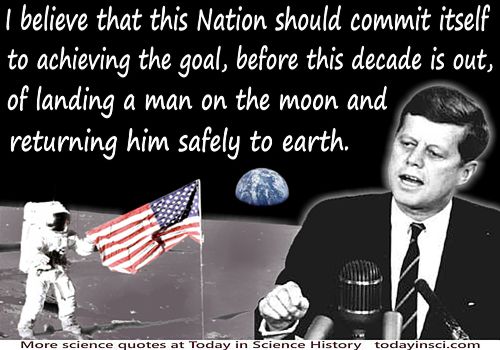
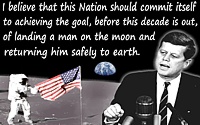
I believe that this Nation should commit itself to achieving the goal, before this decade is out, of landing a man on the moon and returning him safely to earth.
— John F. Kennedy
Address to Joint Session of Congress, on Urgent National Needs (25 May 1961). On web site of John F. Kennedy Presidential Library and Museum. Also in Vital Speeches of the Day (15 Jun 1961), Vol. 27, No. 17, 518-9.
I know few significant questions of public policy which can safely be confided to computers. In the end, the hard decisions inescapably involve imponderables of intuition, prudence, and judgment.
— John F. Kennedy
From Address to the Centennial Convocation of the National Academy of Sciences (22 Oct 1963), 'A Century of Scientific Conquest.' Online at The American Presidency Project.
I once heard a physicist and an editor discussing science news. The editor said, “If you told me that the world was flat, I’d put it in banner headlines.” The physicist replied, “I hope you’d also print a denial.” I cite that story … about the role of science in our society … that science is front-page news.
— John F. Kennedy
From Draft of Science Speech for Presidential Campaign (1960), held by the John F. Kennedy Presidential Library and Museum. Digital Identifier: JFKCAMP1960-0993-005.
In the final analysis, our most basic common link is that we all inhabit this small planet. We all breathe the same air. We all cherish our children's future. And we are all mortal.
— John F. Kennedy
Commencement Address at American University, Washington, D.C. (Jun 1963). In Steven Cohen, Understanding Environmental Policy (2006), Preface, xi. Also on web site of John F. Kennedy Presidential Library and Museum.
In the years since man unlocked the power stored up within the atom, the world has made progress, halting, but effective, toward bringing that power under human control. The challenge may be our salvation. As we begin to master the destructive potentialities of modern science, we move toward a new era in which science can fulfill its creative promise and help bring into existence the happiest society the world has ever known.
— John F. Kennedy
From Address to the Centennial Convocation of the National Academy of Sciences (22 Oct 1963), 'A Century of Scientific Conquest.' Online at The American Presidency Project.
It had long since come to my attention that people of accomplishment rarely sat back and let things happen to them. They went out and happened to things.
— John F. Kennedy
…...
It is an unfortunate fact that we can secure peace only by preparing for war.
— John F. Kennedy
…...
It is for these reasons that I regard the decision last year to shift our efforts in space from low to high gear as among the most important decisions that will be made during my incumbency in the office of the Presidency.
— John F. Kennedy
Address at Rice University in Houston (12 Sep 1962). On website of John F. Kennedy Presidential Library and Museum. [This go-to-the-moon speech was largely written by presidential advisor and speechwriter Ted Sorensen.]
Let both sides seek to invoke the wonders of science instead of its terrors. Together let us explore the stars, conquer the deserts, eradicate disease, tap the ocean depths, and encourage the arts and commerce.
— John F. Kennedy
From Inaugural Address (20 Jan 1961). As quoted in Elizabeth Sirimarco, The Cold War (2005), 45.
Malthus argued a century and a half ago that man, by using up all his available resources, would forever press on the limits of subsistence, thus condemning humanity to an indefinite future of misery and poverty. We can now begin to hope and, I believe, know that Malthus was expressing not a law of nature, but merely the limitation then of scientific and social wisdom. The truth or falsity of his prediction will depend now, with the tools we have, on our own actions, now and in the years to come.
— John F. Kennedy
From Address to the Centennial Convocation of the National Academy of Sciences (22 Oct 1963), 'A Century of Scientific Conquest'. Online at The American Presidency Project.
Man is still the most extraordinary computer of all.
— John F. Kennedy
Remarks upon presenting the NASA Distinguished Service Medal to astronaut L. Gordon Cooper, in the Flower Garden, at the White House, Washington, D.C. (21 May 1963). From John T. Woolley and Gerhard Peters, The American Presidency Project [online].
Man, in his quest for knowledge and progress, is determined and cannot be deterred. The exploration of space will go ahead, whether we join in or not, and it is one of the great adventures of all time, and no nation which expects to be the leader of other nations can expect to stay behind in this race for space.
— John F. Kennedy
Address at Rice University in Houston (12 Sep 1962). On website of John F. Kennedy Presidential Library and Museum.
Many years ago the great British explorer George Mallory, who was to die on Mount Everest, was asked why did he want to climb it. He said, “Because it is there.” Well, space is there, and we’re going to climb it, and the moon and the planets are there, and new hopes for knowledge and peace are there. And, therefore, as we set sail we ask God’s blessing on the most hazardous and dangerous and greatest adventure on which man has ever embarked.
— John F. Kennedy
From Address at Rice Stadium (12 Sep 1962). On website of John F. Kennedy Presidential Library and Museum. [This go-to-the-moon speech was largely written by presidential advisor and speechwriter Ted Sorensen.]
Now is the time to take longer strides—time for a new American enterprise—time for this nation to take a clearly leading role in space achievement, which in many ways may hold the key to our future on earth.
— John F. Kennedy
Address to Joint Session of Congress, on Urgent National Needs (25 May 1961). On web site of John F. Kennedy Presidential Library and Museum. Also in Vital Speeches of the Day (15 Jun 1961), Vol. 27, No. 17, 518-9.
Perhaps scientists have been the most international of all professions in their outlook... Every time you scientists make a major invention, we politicians have to invent a new institution to cope with it—and almost invariably, these days, it must be an international institution.
— John F. Kennedy
From Address to the Centennial Convocation of the National Academy of Sciences (22 Oct 1963), 'A Century of Scientific Conquest'. Online at The American Presidency Project.
Science contributes to our culture in many ways, as a creative intellectual activity in its own right, as the light which has served to illuminate man's place in the universe, and as the source of understanding of man's own nature.
— John F. Kennedy
From Address to the Centennial Convocation of the National Academy of Sciences (22 Oct 1963), 'A Century of Scientific Conquest.' Online at The American Presidency Project.
Science is no longer what one man says. The likes of Newton, Pascal and Einstein may live again. But the need for intense specialization has combined with the need for huge facilities to make group work imperative. Los Alamos, Brookhaven, and the Institute for Advanced Studies are symbols of the change. The world of science is no longer a world of lonely geniuses. It is a collection of communities.
— John F. Kennedy
From Draft of Science Speech for Presidential Campaign (1960), held by the John F. Kennedy Presidential Library and Museum. Digital Identifier: JFKCAMP1960-0993-005.
Scientists alone can establish the objectives of their research, but society, in extending support to science, must take account of its own needs. As a layman, I can suggest only with diffidence what some of the major tasks might be on your scientific agenda, but … First, I would suggest the question of the conservation and development of our natural resources. In a recent speech to the General Assembly of the United Nations, I proposed a world-wide program to protect land and water, forests and wildlife, to combat exhaustion and erosion, to stop the contamination of water and air by industrial as well as nuclear pollution, and to provide for the steady renewal and expansion of the natural bases of life.
— John F. Kennedy
From Address to the Centennial Convocation of the National Academy of Sciences (22 Oct 1963), 'A Century of Scientific Conquest'. Online at The American Presidency Project.
Some people see things as they are and say why. I dream things that never were and say why not?
— John F. Kennedy
…...
The American, by nature, is optimistic. He is experimental, an inventor and a builder who builds best when called upon to build greatly. Arouse his will to believe in himself, give him a great goal to believe in, and he will create the means to reach it.
— John F. Kennedy
Given with date 1 Jan 1960 in Brian M. Thomsen, The Dream That Will Not Die: Inspiring Words of John, Robert, and Edward Kennedy (2010), 79. Webmaster has not seen a primary document for this quote. Although it is widely circulated, the origin is usually never cited. If you know the primary source, please contact Webmaster.
The eyes of the world now look into space, to the moon and to the planets beyond, and we have vowed that we shall not see it governed by a hostile flag of conquest, but by a banner of freedom and peace. We have vowed that we shall not see space filled with weapons of mass destruction, but with instruments of knowledge and understanding.
— John F. Kennedy
Address at Rice University in Houston (12 Sep 1962). On website of John F. Kennedy Presidential Library and Museum. [This go-to-the-moon speech was largely written by presidential advisor and speechwriter Ted Sorensen.]
The future does not belong to those who are content with today, apathetic toward common problems and their fellow man alike, timid and fearful in the face of bold projects and new ideas. Rather, it will belong to those who can blend passion, reason and courage in a personal commitment to the great enterprises and ideals of American society.
— John F. Kennedy
…...
The greater our knowledge increases the more our ignorance unfolds.
— John F. Kennedy
From Address at Rice Stadium (12 Sep 1962). On website of John F. Kennedy Presidential Library and Museum. [This go-to-the-moon speech was largely written by presidential advisor and speechwriter Ted Sorensen.]
The problems of the world cannot possibly be solved by skeptics or cynics whose horizons are limited by the obvious realities. We need men who can dream of things that never were.
— John F. Kennedy
From Address (Jun 1963) to the Irish Parliament, Dublin, as collected in Public Papers of the Presidents of the United States: John F. Kennedy (1964), 537.
The science of weapons and war has made us all one world and one human race with one common destiny.
— John F. Kennedy
Address Before the 18th General Assembly of the United Nations, 20 Sep 1963. In Edward C. Luck, Mixed Messages: American Politics and International Organization, 1919-1999 (1999), 41.
The supreme reality of our time is…our common vulnerability on this planet.
— John F. Kennedy
Address Before Irish Parliament, Dublin (28 Jun 1963). In Arthur Meier Schlesinger, A Thousand Days: John F. Kennedy in the White House (2002), 901.
The world is a very different one now. For man holds in his mortal hands the power to abolish all forms of human poverty, and all forms of human life.
— John F. Kennedy
Inaugural address (1961). Robert G. Torricelli and Andrew Carroll, In Our Own words: Extraordinary Speeches of the American Century (1999), 222.
This is the most extraordinary collection of talent, of human knowledge, that has ever been gathered together at the White House, with the possible exception of when Thomas Jefferson dined alone.
[Welcoming Nobel Prize winners as his guests at a White House dinner.]
[Welcoming Nobel Prize winners as his guests at a White House dinner.]
— John F. Kennedy
Remarks at a dinner honoring Nobel Prize Winners of the Western Hemisphere (29 Apr 1962).
This nation has tossed its cap over the wall of space, and we have no choice but to follow it.
— John F. Kennedy
Remarks in San Antonio at the Dedication of the Aerospace Medical Health Center, San Antonio (21 Nov 1963), Collected in Public Papers of the Presidents: John F. Kennedy (1964), 883. According to the JFK Library web site, the original anecdote from which Kennedy derived this comparison is in Frank O’Connor, An Only Child, (1961), 180, which reads, “I had tossed my cap over the wall of life, and I knew I must follow it, wherever it had fallen.”
Those who came before us made certain that this country rode the first waves of the industrial revolution, the first waves of modern invention, and the first wave of nuclear power, and this generation does not intend to founder in the backwash of the coming age of space. We mean to be a part of it—we mean to lead it.
— John F. Kennedy
Address at Rice University in Houston (12 Sep 1962). On website of John F. Kennedy Presidential Library and Museum. [This go-to-the-moon speech was largely written by presidential advisor and speechwriter Ted Sorensen.]
Truth is a tyrant-the only tyrant to whom we can give our allegiance. The service of truth is a matter of heroism.
— John F. Kennedy
Letter to Monsignor Schieder regarding Catholic Youth Week. On web site of John F. Kennedy Presidential Library and Museum.
We all came from the sea. And it is an interesting biological fact that all of us have, in our veins the exact same percentage of salt in our blood that exists in the ocean, and, therefore, we have salt in our blood, in our sweat, in our tears.
— John F. Kennedy
Speech at the America’s Cup Dinner (14 Sep 1962).
We are tied to the ocean. And when we go back to the sea, whether it is to sail or to watch it we are going back from whence we came.
— John F. Kennedy
Speech at the America’s Cup Dinner (14 Sep 1962).
We believe that when men reach beyond this planet, they should leave their national differences behind them.
— John F. Kennedy
…...
We choose to go to the moon. We choose to go to the moon in this decade... not because they are easy but because they are hard.
— John F. Kennedy
From Address at Rice Stadium (12 Sep 1962). On website of John F. Kennedy Presidential Library and Museum. [This go-to-the-moon speech was largely written by presidential advisor and speechwriter Ted Sorensen.]
We depend upon science for prosperity for it supplies the new products and processes indispensable to our growing economy. We depend upon science for peace, for it supplies the weapons by which we defend the free world, and deter a reckless aggressor.
— John F. Kennedy
From Draft of Science Speech for Presidential Campaign (1960), held by the John F. Kennedy Presidential Library and Museum. Digital Identifier: JFKCAMP1960-0993-005.
We go into space because whatever mankind must undertake, free men must fully share.
— John F. Kennedy
…...
We set sail on this new sea because there is new knowledge to be gained, and new rights to be won, and they must be won and used for the progress of all people. For space science, like nuclear science and technology, has no conscience of its own. Whether it will become a force for good or ill depends on man, and only if the United States occupies a position of preeminence can we help decide whether this new ocean will be a sea of peace or a new terrifying theater of war.
— John F. Kennedy
Address at Rice University in Houston (12 Sep 1962). On website of John F. Kennedy Presidential Library and Museum. [This go-to-the-moon speech was largely written by presidential advisor and speechwriter Ted Sorensen.]
We will not act prematurely or unnecessarily risk the costs of worldwide nuclear war in which even the fruits of victory would be ashes in our mouth. But neither will we shrink from that risk at any time it must be faced.
— John F. Kennedy
(1962) From address televised during the Cuban missile crisis (22 Oct 1962). As quoted in The Uncommon Wisdom of JFK: A Portrait in His Own Words 92003), 89.
Quotes by others about John F. Kennedy (2)
Scientists constantly get clobbered with the idea that we spent 27 billion dollars on the Apollo programs, and are asked “What more do you want?” We didn't spend it; it was done for political reasons. ... Apollo was a response to the Bay of Pigs fiasco and to the successful orbital flight of Yuri Gagarin. President Kennedy's objective was not to find out the origin of the moon by the end of the decade; rather it was to put a man on the moon and bring him back, and we did that.
Quoted by Dennis Meredith, in 'Carl Sagan's Cosmic Connection and Extraterrestrial Life-Wish', Science Digest (Jun 1979), 85, 38 & 89. Reproduced in Carl Sagan and Tom Head, Conversations With Sagan (2006), 55-56.
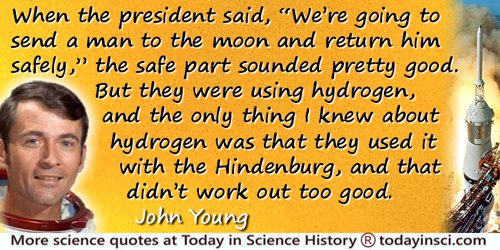
When the president said, “We’re going to send a man to the moon and return him safely,” the safe part sounded pretty good. But they were using hydrogen, and the only thing I knew about hydrogen was that they used it with the Hindenburg, and that didn’t work out too good.
Interview (30 Sep 2004) with Morley Safer at luncheon after official reopening of Rocket Park. As quoted in Corey Kilgannon, 'The Rocket Park Reopens, And Cronkite Reminisces', New York Times (1 Oct 2004), B6.
See also:
- John F. Kennedy - We choose to go to the moon
- John F Kennedy - Quote and its context - Landing a man on the moon - Address (25 May 1961)
- John F Kennedy - Quote and its context - “Landing a man on the moon” - Address (25 May 1961) - Illustrated large 800x600 px
- The Nation’s Space Effort - Speech by Pres. John F. Kennedy, Rice University, Houston, Texas (12 Sep 1962).
 In science it often happens that scientists say, 'You know that's a really good argument; my position is mistaken,' and then they would actually change their minds and you never hear that old view from them again. They really do it. It doesn't happen as often as it should, because scientists are human and change is sometimes painful. But it happens every day. I cannot recall the last time something like that happened in politics or religion.
(1987) --
In science it often happens that scientists say, 'You know that's a really good argument; my position is mistaken,' and then they would actually change their minds and you never hear that old view from them again. They really do it. It doesn't happen as often as it should, because scientists are human and change is sometimes painful. But it happens every day. I cannot recall the last time something like that happened in politics or religion.
(1987) -- 





