 (source)
|
Baron William Thomson Kelvin
(26 Jun 1824 - 17 Dec 1907)
Irish physicist, mathematician and engineer , born as William Thomson in Ireland, he became an influential physicist, mathematician and engineer who has been described as the Newton of his era.
|
Science Quotes by Baron William Thomson Kelvin (55 quotes)
>> Click for Baron William Thomson Kelvin Quotes on | Discovery | Mathematics | Measurement |
>> Click for Baron William Thomson Kelvin Quotes on | Discovery | Mathematics | Measurement |
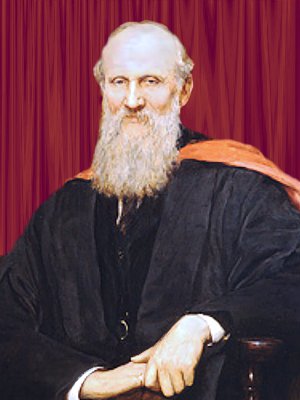
Lord Kelvin
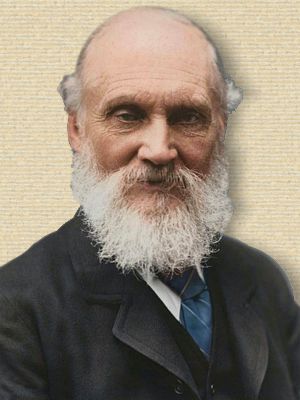
Lord Kelvin (c. 1900)
From a photograph
From a photograph
[Referring to Fourier’s mathematical theory of the conduction of heat] … Fourier's great mathematical poem…
— Baron William Thomson Kelvin
In W. Thomson and P. G. Tait, Treatise on Natural Philosophy. Reprinted as Principles of Mechanics and Dynamics (2000), 470.
~~[Misquote]~~ Fourier is a mathematical poem.
— Baron William Thomson Kelvin
Seen in various books and on the web. This seems to be a misquote based on Kelvin’s reference to Fourier’s mathematical theory of the conduction of heat as “Fourier's great mathematical poem.” More information on the latter quote on the Lord Kelvin Quotes page on this website.
~~[Misquoted]~~ Heavier than air flying machines are impossible.
— Baron William Thomson Kelvin
A viral quote with no known authentic source in these words. At best, it is consistent with quotes expressing doubt that are documented. For example, the quote which begins “I am afraid I am not in the flight for ‘aerial navigation’…” on the Lord Kelvin Quotes page of this website.
A great reform in geological speculation seems now to have become necessary. … It is quite certain that a great mistake has been made—that British popular geology at the present time is in direct opposition to the principles of Natural Philosophy.
— Baron William Thomson Kelvin
From Sir W. Thomson, Address (27 Feb 1868), to the Geological Society of Glasgow, 'On Geological Time', Transactions of the Geological Society of Glasgow 3, collected in Popular Lectures and Addresses (1894), Vol. 2, 10 & 44. As Epigraph in Thomas Henry Huxley, 'Geological Reform' (1869), Collected Essays: Discourses, Biological and Geological (1894), 306.
A perfect thermo-dynamic engine is such that, whatever amount of mechanical effect it can derive from a certain thermal agency; if an equal amount be spent in working it backwards, an equal reverse thermal effect will be produced.
— Baron William Thomson Kelvin
'Thomson on Carnot’s Motive Power of Heat' (appended to 'Réflexions sur la puissance motrice du feu' (1824) translated by R.H. Thurston) in Reflections on the Motive Power of Fire, and on Machines Fitted to Develop that Power (1890), 139.
Accurate and minute measurement seems to the non-scientific imagination, a less lofty and dignified work than looking for something new. But nearly all the grandest discoveries of science have been but the rewards of accurate measurement and patient long-continued labour in the minute sifting of numerical results.
— Baron William Thomson Kelvin
Presidential inaugural address, to the General Meeting of the British Association, Edinburgh (2 Aug 1871). In Report of the Forty-First Meeting of the British Association for the Advancement of Science (1872), xci.
Considering it as thus established, that heat is not a substance, but a dynamical form of mechanical effect, we perceive that there must be an equivalence between mechanical work and heat, as between cause and effect.
— Baron William Thomson Kelvin
In 'On the Dynamical Theory of Heat, with Numerical Results Deduced from Mr. Joule's Equivalent of a Thermal Unit, and M. Regnault's Observations on Steam' (1851). In Mathematical and Physical Papers (1882-1911), Vol. 1, 175.
Do not imagine that mathematics is harsh and crabbed, and repulsive to common sense. It is merely the etherealisation of common sense.
— Baron William Thomson Kelvin
'The Six Gateways of Knowledge', Presidential Address to the Birmingham and Midland Institute, Birmingham (3 Oct 1883). In Popular Lectures and Addresses (1891), Vol. 1, 280.
Fourier’s Theorem … is not only one of the most beautiful results of modern analysis, but it may be said to furnish an indispensable instrument in the treatment of nearly every recondite question in modern physics. To mention only sonorous vibrations, the propagation of electric signals along a telegraph wire, and the conduction of heat by the earth’s crust, as subjects in their generality intractable without it, is to give but a feeble idea of its importance.
— Baron William Thomson Kelvin
In William Thomson and Peter Guthrie Tait, Treatise on Natural Philosophy (1867), Vol. 1, 28.
I am afraid I am not in the flight for “aerial navigation”. I was greatly interested in your work with kites; but I have not the smallest molecule of faith in aerial navigation other than ballooning or of expectation of good results from any of the trials we hear of. So you will understand that I would not care to be a member of the aëronautical Society.
— Baron William Thomson Kelvin
Letter (8 Dec 1896) to Baden Powell. This is the full text of the letter. An image of the handwritten original is on the zapatopi.net website
I am never content until I have constructed a mechanical model of the subject I am studying. If I succeed in making one, I understand. Otherwise, I do not. [Attributed; source unverified.]
— Baron William Thomson Kelvin
Note: Webmaster has been unable to verify this quotation allegedly from his Baltimore Lectures. Is is widely quoted, usually without citation. A few instances indicate the quote came from a guest lecture, Johns Hopkins University, Baltimore (1884). The lecture notes were published in Baltimore Lectures on Molecular Dynamics and the Wave Theory of Light (1904). Webmaster has found no citation giving a page number, and has been unable to find the quote in that text. Anyone with more specific information, please contact Webmaster.
I can never satisfy myself until I can make a mechanical model of a thing. If I can make a mechanical model, I can understand it. As long as I cannot make a mechanical model all the way through I cannot understand.
— Baron William Thomson Kelvin
From stenographic report by A.S. Hathaway of the Lecture 20 Kelvin presented at Johns Hopkins University, Baltimore, on 'Molecular Dynamics and the Wave Theory of Light' (1884), 270-271. (Hathaway was a Mathematics fellow there.) This remark is not included in the first typeset publication—a revised version, printed twenty years later, in 1904, as Lord Kelvin’s Baltimore Lectures on Molecular Dynamics and the Wave Theory of Light. The original notes were reproduced by the “papyrograph” process. They are excerpted in Pierre Maurice Marie Duhem, Essays in the History and Philosophy of Science (1996), 55.
I have no satisfaction in formulas unless I feel their arithmetical magnitude.
— Baron William Thomson Kelvin
From Lecture 7, (7 Oct 1884), in Baltimore Lectures on Molecular Dynamics and the Wave Theory of Light (1904), 76.
I have not the smallest molecule of faith in aerial navigation other than ballooning.
— Baron William Thomson Kelvin
From letter (8 Dec 1896) to Baden Powell. The full text of the letter, which begins “I am afraid I am not in the flight for “aerial navigation.”…, is on the Lord Kelvin Quotes page of this website.
I need scarcely say that the beginning and maintenance of life on earth is absolutely and infinitely beyond the range of sound speculation in dynamical science.
— Baron William Thomson Kelvin
In lecture, 'The Sun's Heat' delivered to the Friday Evening Discourse in Physical Science at the Royal Institution in London. Collected in Popular Lectures and Addresses (1889), Vol. 1, 415.
If, then, the motion of every particle of matter in the universe were precisely reversed at any instant, the course of nature would be simply reversed for ever after. The bursting bubble of foam at the foot of a waterfall would reunite and descend into the water; the thermal motions would reconcentrate their energy, and throw the mass up the fall in drops re-forming into a close column of ascending water. Heat which had been generated by the friction of solids and dissipated by conduction, and radiation, and radiation with absorption, would come again to the place of contact, and throw the moving body back against the force to which it had previously yielded. Boulders would recover from the mud materials required to rebuild them into their previous jagged forms, and would become reunited to the mountain peak from which they had formerly broken away. And if also the materialistic hypothesis of life were true, living creatures would grow backwards, with conscious knowledge of the future but no memory of the past, and would become again unborn.
— Baron William Thomson Kelvin
In 'The Kinetic Theory of the Dissipation of Energy', Nature (1874), 9, 442.
In all cases when a particular agent or cause is to be studied, experiments should be arranged in such a way as to lead if possible to results depending on it alone ; or, if this cannot be done, they should be arranged so as to increase the effects due to the cause to be studied till these so far exceed the unavoidable concomitants, that the latter may be considered as only disturbing, not essentially modifying the effects of the principal agent.
— Baron William Thomson Kelvin
In William Thomson and Peter Guthrie Tait, Treatise on Natural Philosophy (1867), Vol. 1, 305.
In general the actions which we see ever taking place around us are complex, or due to the simultaneous action of many causes. When, as in astronomy, we endeavour to ascertain these causes by simply watching their effects, we observe; when, as in our laboratories, we interfere arbitrarily with the causes or circumstances of a phenomenon, we are said to experiment.
— Baron William Thomson Kelvin
In William Thomson and Peter Guthrie Tait, Treatise on Natural Philosophy (1867), Vol. 1, 305.
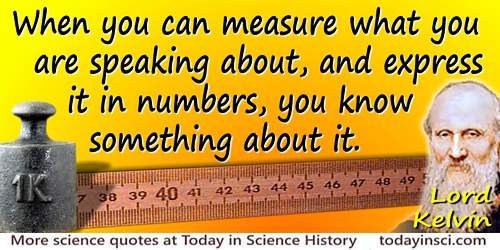
In physical science a first essential step in the direction of learning any subject is to find principles of numerical reckoning and practicable methods for measuring some quality connected with it. I often say that when you can measure what you are speaking about, and express it in numbers, you know something about it; but when you cannot measure it, when you cannot express it in numbers, your knowledge is of a meagre and unsatisfactory kind; it may be the beginning of knowledge, but you have scarcely in your thoughts advanced to the stage of science, whatever the matter may be.
Often seen quoted in a condensed form: If you cannot measure it, then it is not science.
Often seen quoted in a condensed form: If you cannot measure it, then it is not science.
— Baron William Thomson Kelvin
From lecture to the Institution of Civil Engineers, London (3 May 1883), 'Electrical Units of Measurement', Popular Lectures and Addresses (1889), Vol. 1, 80-81.
It is impossible for a self-acting machine, unaided by any external agency, to convey heat from one body to another at a higher temperature.
— Baron William Thomson Kelvin
In 'On the Dynamical Theory of Heat, with Numerical Results Deduced from Mr Joule's Equivalent of a Thermal Unit, and M. Regnault's Observations on Steam' (1851). In Mathematical and Physical Papers (1882), Vol. 1, 181.
It seems to me, he says, that the test of “Do we or not understand a particular subject in physics?” is, “Can we make a mechanical model of it?” I have an immense admiration for Maxwell’s model of electromagnetic induction. He makes a model that does all the wonderful things that electricity docs in inducing currents, etc., and there can be no doubt that a mechanical model of that kind is immensely instructive and is a step towards a definite mechanical theory of electromagnetism.
— Baron William Thomson Kelvin
From stenographic report by A.S. Hathaway of the Lecture 20 Kelvin presented at Johns Hopkins University, Baltimore, on 'Molecular Dynamics and the Wave Theory of Light' (1884), 132. (Hathaway was a Mathematics fellow there.) This remark is not included in the first typeset publication—a revised version, printed twenty years later, in 1904, as Lord Kelvin’s Baltimore Lectures on Molecular Dynamics and the Wave Theory of Light. The original notes were reproduced by the “papyrograph” process. They are excerpted in Pierre Maurice Marie Duhem, Essays in the History and Philosophy of Science (1996), 54-55.
It would be a very wonderful, but not an absolutely incredible result, that volcanic action has never been more violent on the whole than during the last two or three centuries; but it is as certain that there is now less volcanic energy in the whole earth than there was a thousand years ago, as it is that there is less gunpowder in a ‘Monitor’ after she has been seen to discharge shot and shell, whether at a nearly equable rate or not, for five hours without receiving fresh supplies, than there was at the beginning of the action.
— Baron William Thomson Kelvin
In 'On the Secular Cooling of the Earth', Transactions of the Royal Society of Edinburgh (1864), 23, 159.
Let nobody be afraid of true freedom of thought. Let us be free in thought and criticism; but, with freedom, we are bound to come to the conclusion that science is not antagonistic to religion, but a help to it.
— Baron William Thomson Kelvin
Quoted in Arthur Holmes, 'The Faith of the Scientist', The Biblical World (1916), 48 7.
Mathematics is the only good metaphysics.
— Baron William Thomson Kelvin
Quoted in E. T. Bell, Men of Mathematics, xvii.
Mathematics is the only true metaphysics.
— Baron William Thomson Kelvin
Silvanus Phillips Thompson, Life of Lord Kelvin (1910), 10. In Robert Édouard Moritz, Memorabilia Mathematica; Or, The Philomath's Quotation-book (1914)
Mechanical action may be derived from heat, and heat may be generated by mechanical action, by means of forces either acting between contiguous parts of bodies, or due to electric excitation; but in no other way known, or even conceivable, in the present state of science. Hence thermo-dynamics falls naturally into two divisions, of which the subjects are respectively, the relation of heat to the forces acting between contiguous parts of bodies, and the relation of heat to electrical agency.
— Baron William Thomson Kelvin
In 'On the Dynamical Theory of Heat, with Numerical Results Deduced from Mr Joule's Equivalent of a Thermal Unit, and M. Regnault's Observations on Steam' (1851). Part VI, 'Thermo Electric Currents' (1854). In Mathematical and Physical Papers (1882), Vol. 1, 232.
Nothing can be more fatal to progress than a too confident reliance upon mathematical symbols; for the student is only too apt to take the easier course, and consider the formula and not the fact as the physical reality.
— Baron William Thomson Kelvin
In William Thomson and Peter Guthrie Tait, Treatise on Natural Philosophy (1867), Vol. 1, viii.
Oersted would never have made his great discovery of the action of galvanic currents on magnets had he stopped in his researches to consider in what manner they could possibly be turned to practical account; and so we would not now be able to boast of the wonders done by the electric telegraphs. Indeed, no great law in Natural Philosophy has ever been discovered for its practical implications, but the instances are innumerable of investigations apparently quite useless in this narrow sense of the word which have led to the most valuable results.
— Baron William Thomson Kelvin
From Silvanus Phillips Thompson, 'Introductory Lecture to the Course on Natural Philosophy', The Life of Lord Kelvin (1910), Vol. 1, Appendix to Chap. 5, 249.
One word characterises the most strenuous of the efforts for the advancement of science that I have made perseveringly during fifty-five years; that word is failure. I know no more of electric and magnetic force, or of the relation between ether, electricity and ponderable matter, or of chemical affinity, than I knew and tried to teach to my students of natural philosophy fifty years ago in my first session as Professor.
— Baron William Thomson Kelvin
Address (16 Jun 1896), at Celebration for his Jubilee as Professor, at Glasgow University. Printed in The Electrician (19 Jun 1896), 37, 247.
Overwhelming evidences of an intelligence and benevolent intention surround us, show us the whole of nature through the work of a free will and teach us that all alive beings depend on an eternal creator-ruler.
— Baron William Thomson Kelvin
…...
Questions of personal priority, however interesting they may be to the persons concerned, sink into insignificance in the prospect of any gain of deeper insight into the secrets of nature.
— Baron William Thomson Kelvin
As quoted in Silvanus Phillips Thompson, The Life of Lord Kelvin (1910), Vol. 2, 602.
Science is bound by the everlasting law of honour, to face fearlessly every problem which can fairly be presented to it. If a probable solution, consistent with the ordinary course of nature, can be found, we must not invoke an abnormal act of Creative Power.
— Baron William Thomson Kelvin
From Inaugural Address of the President (2 Aug 1871) to the Edinburgh meeting of the British Association. Published in Chemical News and Journal of Industrial Science (4 Aug 1871), 24, 55.
Scientific wealth tends to accumulate according to the law of compound interest. Every addition to knowledge of the properties of matter supplies the physical scientist with new instrumental means for discovering and interpreting phenomena of nature, which in their turn afford foundations of fresh generalisations, bringing gains of permanent value into the great storehouse of natural philosophy.
— Baron William Thomson Kelvin
From Inaugural Address of the President to British Association for the Advancement of Science, Edinburgh (2 Aug 1871). Printed in The Chemical News (4 Aug 1871), 24, No. 610., 53.
Simplification of modes of proof is not merely an indication of advance in our knowledge of a subject, but is also the surest guarantee of readiness for farther progress.
— Baron William Thomson Kelvin
In Lord Kelvin and Peter Guthrie Tait Elements of Natural Philosophy (1873), Preface.
Some people say they cannot understand a million million. Those people cannot understand that twice two makes four. That is the way I put it to people who talk to me about the incomprehensibility of such large numbers. I say finitude is incomprehensible, the infinite in the universe is comprehensible. Now apply a little logic to this. Is the negation of infinitude incomprehensible? What would you think of a universe in which you could travel one, ten, or a thousand miles, or even to California, and then find it comes to an end? Can you suppose an end of matter or an end of space? The idea is incomprehensible. Even if you were to go millions and millions of miles the idea of coming to an end is incomprehensible. You can understand one thousand per second as easily as you can understand one per second. You can go from one to ten, and then times ten and then to a thousand without taxing your understanding, and then you can go on to a thousand million and a million million. You can all understand it.
— Baron William Thomson Kelvin
In 'The Wave Theory of Light' (1884), Popular Lectures and Addresses (1891), Vol. 1, 322.
The ‘Doctrine of Uniformity’ in Geology, as held by many of the most eminent of British Geologists, assumes that the earth’s surface and upper crust have been nearly as they are at present in temperature, and other physical qualities, during millions of millions of years. But the heat which we know, by observation, to be now conducted out of the earth yearly is so great, that if this action has been going on with any approach to uniformity for 20,000 million years, the amount of heat lost out of the earth would have been about as much as would heat, by 100 Cent., a quantity of ordinary surface rock of 100 times the earth’s bulk. This would be more than enough to melt a mass of surface rock equal in bulk to the whole earth. No hypothesis as to chemical action, internal fluidity, effects of pressure at great depth, or possible character of substances in the interior of the earth, possessing the smallest vestige of probability, can justify the supposition that the earth’s upper crust has remained nearly as it is, while from the whole, or from any part, of the earth, so great a quantity of heat has been lost.
— Baron William Thomson Kelvin
In 'The “Doctrine of Uniformity” in Geology Briefly Refuted' (1866), Popular Lectures and Addresses (1891), Vol. 2, 6-7.
The following general conclusions are drawn from the propositions stated above, and known facts with reference to the mechanics of animal and vegetable bodies:—
There is at present in the material world a universal tendency to the dissipation of mechanical energy.
Any restoration of mechanical energy, without more than an equivalent of dissipation, is impossible in inanimate material processes, and is probably never effected by means of organized matter, either endowed with vegetable life, or subjected to the will of an animated creature.
Within a finite period of time past the earth must have been, and within a finite period of time to come the earth must again be, unfit for the habitation of man as at present constituted, unless operations have been, or are to be performed, which are impossible under the laws to which the known operations going on at present in the material world are subject.
There is at present in the material world a universal tendency to the dissipation of mechanical energy.
Any restoration of mechanical energy, without more than an equivalent of dissipation, is impossible in inanimate material processes, and is probably never effected by means of organized matter, either endowed with vegetable life, or subjected to the will of an animated creature.
Within a finite period of time past the earth must have been, and within a finite period of time to come the earth must again be, unfit for the habitation of man as at present constituted, unless operations have been, or are to be performed, which are impossible under the laws to which the known operations going on at present in the material world are subject.
— Baron William Thomson Kelvin
In 'On a Universal Tendency in Nature to the Dissipation of Mechanical Energy', Proceedings of the Royal Society of Edinburgh, 1852, 3, 141-142. In Mathematical and Physical Papers (1882-1911), Vol. 1, 513-514.
The idea of an atom has been so constantly associated with incredible assumptions of infinite strength, absolute rigidity, mystical actions at a distance, and individuality, that chemists and many other reasonable naturalists of modern times, losing all patience with it, have dismissed it to the realms of metaphysics, and made it smaller than ‘anything we can conceive.’ But if atoms are inconceivably small, why are not all chemical actions infinitely swift? Chemistry is powerless to deal with this question, and many others of paramount importance, if barred by the hardness of its fundamental assumptions, from contemplating the atom as a real portion of matter occupying a finite space, and forming not an immeasurably small constituent of any palpable body.
— Baron William Thomson Kelvin
Sir William Thomson and Peter Guthrie Tait, A Treatise on Natural Philosophy (1883), Vol. I, Part 2, 495.
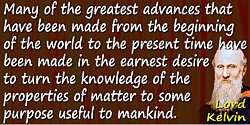
The life and soul of science is its practical application, and just as the great advances in mathematics have been made through the desire of discovering the solution of problems which were of a highly practical kind in mathematical science, so in physical science many of the greatest advances that have been made from the beginning of the world to the present time have been made in the earnest desire to turn the knowledge of the properties of matter to some purpose useful to mankind.
— Baron William Thomson Kelvin
From 'Electrical Units of Measurement', a lecture delivered at the Institution of Civil Engineers, London (3 May 1883), Popular Lectures and Addresses Vol. 1 (1891), 86-87.
The only census of the senses, so far as I am aware, that ever before made them more than five, was the Irishman's reckoning of seven senses. I presume the Irishman's seventh sense was common sense; and I believe that the possession of that virtue by my countrymen—I speak as an Irishman.
— Baron William Thomson Kelvin
In 'The Six Gateways of Knowledge', Presidential Address to the Birmingham and Midland Institute, Birmingham (3 Oct 1883), collected in Popular Lectures and Addresses (1891), Vol. 1, 260. Although biographies are found referring to Kelvin as being a Scottish scientist, because of his lifetime career spent in Glasgow, note that here Kelvin self-identifies as being Irish.
The result would inevitably be a state of universal rest and death, if the universe were finite and left to obey existing laws. But it is impossible to conceive a limit to the extent of matter in the universe; and therefore science points rather to an endless progress, through an endless space, of action involving the transformation of potential energy into palpable motion and thence into heat, than to a single finite mechanism, running down like a clock, and stopping for ever.
— Baron William Thomson Kelvin
In 'On the Age of the Sun's Heat' (1862), Popular Lectures and Addresses (1891), Vol. 1, 349-50.
The science which investigates the action of Force is called, by the most logical writers, Dynamics. It is commonly, but erroneously, called Mechanics; a term employed by Newton in its true sense, the Science of Machines, and the art of making them.
— Baron William Thomson Kelvin
As co-author with Peter Guthrie Tait. Opening paragraph, Chap. 1, Elements of Natural Philosophy (1872, 1902), 1.
The vortex theory [of the atom] is only a dream. Itself unproven, it can prove nothing, and any speculations founded upon it are mere dreams about dreams.
— Baron William Thomson Kelvin
Quoted in Henry Smith Williams, 'Some Unsolved Scientific Problems', Harper's New Monthly Magazine (1899-1900), Vol. 100, 779.
The whole theory of the motive power of heat is founded on the two following propositions, due respectively to Joule, and to Carnot and Clausius.
PROP. I. Joule).—When equal quantities of mechanical effect are produced by any means whatever from purely thermal sources, or lost in purely thermal effects, equal quantities of heat are put out of existence or are generated.
PROP. II. (Carnot and Clausius).—If an engine be such that, when it is worked backwards, the physical and mechanical agencies in every part of its motions are all reversed, it produces as much mechanical effect as can be produced by any thermo-dynamic engine, with the same temperatures of source and refrigerator, from a given quantity of heat.
PROP. I. Joule).—When equal quantities of mechanical effect are produced by any means whatever from purely thermal sources, or lost in purely thermal effects, equal quantities of heat are put out of existence or are generated.
PROP. II. (Carnot and Clausius).—If an engine be such that, when it is worked backwards, the physical and mechanical agencies in every part of its motions are all reversed, it produces as much mechanical effect as can be produced by any thermo-dynamic engine, with the same temperatures of source and refrigerator, from a given quantity of heat.
— Baron William Thomson Kelvin
In 'On the Dynamical Theory of Heat, with Numerical Results Deduced from Mr Joule's Equivalent of a Thermal Unit, and M. Regnault's Observations on Steam' (1851). In Mathematical and Physical Papers (1882), Vol. 1, 178.
There can be but one opinion as to the beauty and utility of this analysis of Laplace; but the manner in which it has been hitherto presented has seemed repulsive to the ablest mathematicians, and difficult to ordinary mathematical students.[Co-author with Peter Guthrie Tait.]
— Baron William Thomson Kelvin
In William Thomson Baron Kelvin, Peter Guthrie Tait, Treatise on Natural Philosophy (1879), Vol. 1, Preface, vii.
There cannot be a greater mistake than that of looking superciliously upon practical applications of science. The life and soul of science is its practical application .
— Baron William Thomson Kelvin
In Lecture 'Electrical Units of Measurement' delivered at the Institution of Civil Engineers (3 May 1883). Collected in Popular Lectures and Addresses (1889), Vol. 1, 79.
There is nothing new to be discovered in physics now. All that remains is more and more precise measurement.
— Baron William Thomson Kelvin
Webmaster has searched for a primary print source without success. Walter Isaacson likewise found no direct evidence, as he reports in Einstein (2007), 575. However, these sentences are re-quoted in a variety of books and other sources (often citing them as a remark reportedly made by Kelvin in an Address at the British Association for the Advancement of Science in 1900). Although the quote appears noteworthy, it is not included in the major biographical work, the two volumes by Silvanus P. Thomson, The Life of Lord Kelvin (1976). The quote is included here so that this caveat should be read with it.
To take one of the simplest cases of the dissipation of energy, the conduction of heat through a solid—consider a bar of metal warmer at one end than the other and left to itself. To avoid all needless complication, of taking loss or gain of heat into account, imagine the bar to be varnished with a substance impermeable to heat. For the sake of definiteness, imagine the bar to be first given with one half of it at one uniform temperature, and the other half of it at another uniform temperature. Instantly a diffusing of heat commences, and the distribution of temperature becomes continuously less and less unequal, tending to perfect uniformity, but never in any finite time attaining perfectly to this ultimate condition. This process of diffusion could be perfectly prevented by an army of Maxwell’s ‘intelligent demons’* stationed at the surface, or interface as we may call it with Prof. James Thomson, separating the hot from the cold part of the bar.
* The definition of a ‘demon’, according to the use of this word by Maxwell, is an intelligent being endowed with free will, and fine enough tactile and perceptive organisation to give him the faculty of observing and influencing individual molecules of matter.
* The definition of a ‘demon’, according to the use of this word by Maxwell, is an intelligent being endowed with free will, and fine enough tactile and perceptive organisation to give him the faculty of observing and influencing individual molecules of matter.
— Baron William Thomson Kelvin
In 'The Kinetic Theory of the Dissipation of Energy', Nature (1874), 9, 442.
We cannot, of course, give a definition of matter which will satisfy the metaphysician, but the naturalist may be content to know matter as that which can be perceived by the senses, or as that which can be acted upon by, or can exert, force.
— Baron William Thomson Kelvin
In William Thomson and Peter Guthrie Tait, Treatise on Natural Philosophy (1867), Vol. 1, 161.
We may consequently regard it as certain that, neither by natural agencies of inanimate matter, nor by the operations arbitrarily effected by animated Creatures, can there be any change produced in the amount of mechanical energy in the Universe.
— Baron William Thomson Kelvin
In Draft of 'On a Universal Tendency … ', PA 137, Kelvin Collection, Cambridge Univ Library. As cited in Crosbie Smith, The Science of Energy: A Cultural History of Energy Physics in Victorian Britain (1998), 139.
When ‘thermal agency’ is thus spent in conducting heat through a solid, what becomes of the mechanical effect which it might produce? Nothing can be lost in the operations of nature—no energy can be destroyed.
— Baron William Thomson Kelvin
In 'An Account of Carnot's Theory of the Motive Power of Heat; with Numerical Results Deduced from Regnault's Experiments on Steam' (1849). In Mathematical and Physical Papers (1882-1911), Vol. 1, 118.
When, in an experiment, all known causes being allowed for, there remain certain unexplained effects (excessively slight it may be), these must be carefully investigated, and every conceivable variation of arrangement of apparatus, etc., tried ; until, if possible, we manage so to exaggerate the residual phenomenon as to be able to detect its cause. It is here, perhaps, that in the present state of science we may most reasonably look for extensions of our knowledge
— Baron William Thomson Kelvin
In William Thomson and Peter Guthrie Tait, Treatise on Natural Philosophy (1867), Vol. 1, 306.
Work done on any system of bodies (in Newton’s statement, the parts of any machine) has its equivalent in work done against friction, molecular forces, or gravity, if there be no acceleration; but if there be acceleration, part of the work is expended in overcoming the resistance to acceleration, and the additional kinetic energy developed is equivalent to the work so spent.
— Baron William Thomson Kelvin
In William Thomson and Peter Guthrie Tait, Treatise on Natural Philosophy (1867), Vol. 1, 186.
X-rays will prove to be a hoax.
— Baron William Thomson Kelvin
In Marc J. Madou, Fundamentals of Microfabrication: the Science of Miniaturization (2nd ed., 2002), 325.
You, in this country [the USA], are subjected to the British insularity in weights and measures; you use the foot, inch and yard. I am obliged to use that system, but must apologize to you for doing so, because it is so inconvenient, and I hope Americans will do everything in their power to introduce the French metrical system. ... I look upon our English system as a wickedly, brain-destroying system of bondage under which we suffer. The reason why we continue to use it, is the imaginary difficulty of making a change, and nothing else; but I do not think in America that any such difficulty should stand in the way of adopting so splendidly useful a reform.
— Baron William Thomson Kelvin
Journal of the Franklin Institute, Nov 1884, 118, 321-341
Quotes by others about Baron William Thomson Kelvin (19)
The saying often quoted from Lord Kelvin… that “where you cannot measure your knowledge is meagre and unsatisfactory,” as applied in mental and social science, is misleading and pernicious. This is another way of saying that these sciences are not science in the sense of physical science and cannot attempt to be such without forfeiting their proper nature and function. Insistence on a concretely quantitative economics means the use of statistics of physical magnitudes, whose economic meaning and significance is uncertain and dubious. (Even wheat is approximately homogeneous only if measured in economic terms.) And a similar statement would even apply more to other social sciences. In this field, the Kelvin dictum very largely means in practice, “if you cannot measure, measure anyhow!”
'What is Truth' in Economics? (1956), 166.
When Lord Kelvin was in this country [U.S.], he said that nothing interested him so much as Mr. Hewitt's work and his vacuum lamp.
Referring to the mercury lamp invention.
Referring to the mercury lamp invention.
Quoting Kelvin in McClure's Magazine (Jun 1903). In Albert Shaw (Ed.), The American Monthly Review of Reviews (1903), 27, 724.
Geologists have not been slow to admit that they were in error in assuming that they had an eternity of past time for the evolution of the earth’s history. They have frankly acknowledged the validity of the physical arguments which go to place more or less definite limits to the antiquity of the earth. They were, on the whole, disposed to acquiesce in the allowance of 100 millions of years granted to them by Lord Kelvin, for the transaction of the whole of the long cycles of geological history. But the physicists have been insatiable and inexorable. As remorseless as Lear’s daughters, they have cut down their grant of years by successive slices, until some of them have brought the number to something less than ten millions. In vain have the geologists protested that there must somewhere be a flaw in a line of argument which tends to results so entirely at variance with the strong evidence for a higher antiquity, furnished not only by the geological record, but by the existing races of plants and animals. They have insisted that this evidence is not mere theory or imagination, but is drawn from a multitude of facts which become hopelessly unintelligible unless sufficient time is admitted for the evolution of geological history. They have not been able to disapprove the arguments of the physicists, but they have contended that the physicists have simply ignored the geological arguments as of no account in the discussion.
'Twenty-five years of Geological Progress in Britain', Nature, 1895, 51, 369.
I came into the room, which was half dark, and presently spotted Lord Kelvin in the audience and realised that I was in for trouble at the last part of my speech dealing with the age of the earth, where my views conflicted with his. To my relief, Kelvin fell fast asleep, but as I came to the important point, I saw the old bird sit up, open an eye and cock a baleful glance at me! Then a sudden inspiration came, and I said Lord Kelvin had limited the age of the earth, provided no new source was discovered. That prophetic utterance refers to what we are now considering tonight, radium! Behold! the old boy beamed upon me.
The italicized phrase refers to “no new source” of energy. Concerning a Lecture by Rutherford, at the Royal Institution, dealing with the energy of subterranean radium, which had an effect prolonging the heat of the Earth. Arthur S. Eve wrote that Rutherford “used to tell humorous stories about this lecture long afterwards:” — followed by the subject quote above, as its own paragraph. As given in Arthur S. Eve, Rutherford: Being the Life and Letters of the Rt. Hon. Lord Rutherford, O.M. (1939), 107. The story lacks quotation marks, and thus should be regarded as perhaps Eve’s own words giving a faithful recollection, rather than Rutherford’s verbatim words. (However, note that the style used throughout the book is to omit quotation marks from their own separate paragraph.)
Lord Kelvin was so satisfied with this triumph of science that he declared himself to be as certain of the existence of the ether as a man can be about anything.... “When you can measure what you are speaking about, and express it in numbers, you know something about it....” Thus did Lord Kelvin lay down the law. And though quite wrong, this time he has the support of official modern Science. It is NOT true that when you can measure what you are speaking about, you know something about it. The fact that you can measure something doesn't even prove that that something exists.... Take the ether, for example: didn't they measure the ratio of its elasticity to its density?
In Science is a Sacred Cow (1950), 69-70; 85.
You and I are just about fit to mend his pens.
[About the young William Thomson (later Lord Kelvin.)]
[About the young William Thomson (later Lord Kelvin.)]
Remark by Ellis to the mathematician Harvey Goodwin, both examiners, comparing William Thomson's mathematical prowess while still a student at the time of sitting the Tripos Examination (1845). As quoted by Harvey Goodwin in 'A Biographical Memoir', the introduction to Robert Leslie Ellis, William Walton (ed), The Mathematical and Other Writings of Robert Leslie Ellis (1863), xix.
Why are atoms so small? ... Many examples have been devised to bring this fact home to an audience, none of them more impressive than the one used by Lord Kelvin: Suppose that you could mark the molecules in a glass of water, then pour the contents of the glass into the ocean and stir the latter thoroughly so as to distribute the marked molecules uniformly throughout the seven seas; if you then took a glass of water anywhere out of the ocean, you would find in it about a hundred of your marked molecules.
What is life?: the Physical Aspect of the Living Cell (1944). Collected in What is Life? with Mind And Matter & Autobiographical Sketches (1967, 1992), 6-7.
The age of the earth was thus increased from a mere score of millions [of years] to a thousand millions and more, and the geologist who had before been bankrupt in time now found himself suddenly transformed into a capitalist with more millions in the bank than he knew how to dispose of … More cautious people, like myself, too cautious, perhaps, are anxious first of all to make sure that the new [radioactive] clock is not as much too fast as Lord Kelvin’s was too slow.
1921 British Association for the Advancement of Science symposium on 'The Age of the Earth'. In Nature (1921), 108, 282.
The story is told of Lord Kelvin, a famous Scotch physicist of the last century, that after he had given a lecture on atoms and molecules, one of his students came to him with the question, “Professor, what is your idea of the structure of the atom.”
“What,” said Kelvin, “The structure of the atom? Why, don’t you know, the very word ‘atom’ means the thing that can’t be cut. How then can it have a structure?”
“That,” remarked the facetious young man, “shows the disadvantage of knowing Greek.”
“What,” said Kelvin, “The structure of the atom? Why, don’t you know, the very word ‘atom’ means the thing that can’t be cut. How then can it have a structure?”
“That,” remarked the facetious young man, “shows the disadvantage of knowing Greek.”
As described in 'Assault on Atoms' (Read 23 Apr 1931 at Symposium—The Changing World) Proceedings of the American Philosophical Society (1931), 70, No. 3, 219.
Dear Mr. Bell: … Sir Wm. Thomson … speaks with much enthusiasm of your achievement. What yesterday he would have declared impossible he has today seen realized, and he declares it the most wonderful thing he has seen in America. You speak of it as an embryo invention, but to him it seems already complete, and he declares that, before long, friends will whisper their secrets over the electric wire. Your undulating current he declares a great and happy conception.
Letter to Alexander Graham Bell (25 Jun 1876). Quoted in Alexander Graham Bell, The Bell Telephone: The Deposition of Alexander Graham Bell, in the Suit Brought by the United States to Annul the Bell Patents (1908), 101. Note: William Thomson is better known as Lord Kelvin.
I believe that the useful methods of mathematics are easily to be learned by quite young persons, just as languages are easily learned in youth. What a wondrous philosophy and history underlie the use of almost every word in every language—yet the child learns to use the word unconsciously. No doubt when such a word was first invented it was studied over and lectured upon, just as one might lecture now upon the idea of a rate, or the use of Cartesian co-ordinates, and we may depend upon it that children of the future will use the idea of the calculus, and use squared paper as readily as they now cipher. … When Egyptian and Chaldean philosophers spent years in difficult calculations, which would now be thought easy by young children, doubtless they had the same notions of the depth of their knowledge that Sir William Thomson might now have of his. How is it, then, that Thomson gained his immense knowledge in the time taken by a Chaldean philosopher to acquire a simple knowledge of arithmetic? The reason is plain. Thomson, when a child, was taught in a few years more than all that was known three thousand years ago of the properties of numbers. When it is found essential to a boy’s future that machinery should be given to his brain, it is given to him; he is taught to use it, and his bright memory makes the use of it a second nature to him; but it is not till after-life that he makes a close investigation of what there actually is in his brain which has enabled him to do so much. It is taken because the child has much faith. In after years he will accept nothing without careful consideration. The machinery given to the brain of children is getting more and more complicated as time goes on; but there is really no reason why it should not be taken in as early, and used as readily, as were the axioms of childish education in ancient Chaldea.
In Teaching of Mathematics (1902), 14.
Once when lecturing to a class he [Lord Kelvin] used the word “mathematician,” and then interrupting himself asked his class: “Do you know what a mathematician is?” Stepping to the blackboard he wrote upon it:— [an integral expression equal to the square root of pi]
Then putting his finger on what he had written, he turned to his class and said: “A mathematician is one to whom that is as obvious as that twice two makes four is to you. Liouville was a mathematician.”
Then putting his finger on what he had written, he turned to his class and said: “A mathematician is one to whom that is as obvious as that twice two makes four is to you. Liouville was a mathematician.”
In Life of Lord Kelvin (1910), 1139.
Tait dubbed Maxwell dp/dt, for according to thermodynamics dp/dt = JCM (where C denotes Carnot’s function) the initials of (J.C.) Maxwell’s name. On the other hand Maxwell denoted Thomson by T and Tait by T'; so that it became customary to quote Thomson and Tait’s Treatise on Natural Philosophy as T and T'.
In Bibliotheca Mathematica (1903), 3, 187. As cited in Robert Édouard Moritz, Memorabilia Mathematica; Or, The Philomath’s Quotation-Book (1914), 178. [Note: Thomson is William Thomson, later Lord Kelvin. —Webmaster.]
Not seldom did he [Sir William Thomson], in his writings, set down some mathematical statement with the prefacing remark “it is obvious that” to the perplexity of mathematical readers, to whom the statement was anything but obvious from such mathematics as preceded it on the page. To him it was obvious for physical reasons that might not suggest themselves at all to the mathematician, however competent.
As given in Life of Lord Kelvin (1910), Vol. 2, 1136. [Note: William Thomson, later became Lord Kelvin —Webmaster]
Again and again in reading even his [William Thomson] most abstract writings one is struck by the tenacity with which physical ideas control in him the mathematical form in which he expressed them. An instance of this is afforded by … an example of a mathematical result that is, in his own words, “not instantly obvious from the analytical form of my solution, but which we immediately see must be the case by thinking of the physical meaning of the result.”
As given in Life of Lord Kelvin (1910), Vol. 2, 1136. The ellipsis gives the reference to the quoted footnote, to a passage in his Mathematical and Physical Papers, Vol. 1, 457. [Note: William Thomson, later became Lord Kelvin. —Webmaster]
The following is one of the many stories told of “old Donald McFarlane” the faithful assistant of Sir William Thomson.
The father of a new student when bringing him to the University, after calling to see the Professor [Thomson] drew his assistant to one side and besought him to tell him what his son must do that he might stand well with the Professor. “You want your son to stand weel with the Profeessorr?” asked McFarlane. “Yes.” “Weel, then, he must just have a guid bellyful o’ mathematics!”
The father of a new student when bringing him to the University, after calling to see the Professor [Thomson] drew his assistant to one side and besought him to tell him what his son must do that he might stand well with the Professor. “You want your son to stand weel with the Profeessorr?” asked McFarlane. “Yes.” “Weel, then, he must just have a guid bellyful o’ mathematics!”
As given in Life of Lord Kelvin (1910), Vol. 1, 420, footnote. [Note: William Thomson, later became Lord Kelvin. —Webmaster]
The following story (here a little softened from the vernacular) was narrated by Lord Kelvin himself when dining at Trinity Hall:
A certain rough Highland lad at the university had done exceedingly well, and at the close of the session gained prizes both in mathematics and in metaphysics. His old father came up from the farm to see his son receive the prizes, and visited the College. Thomson was deputed to show him round the place. “Weel, Mr. Thomson,” asked the old man, “and what may these mathematics be, for which my son has getten a prize?” “I told him,” replied Thomson, “that mathematics meant reckoning with figures, and calculating.” “Oo ay,” said the old man, “he’ll ha’ getten that fra’ me: I were ever a braw hand at the countin’.” After a pause he resumed: “And what, Mr. Thomson, might these metapheesics be?” “I endeavoured,” replied Thomson, “to explain how metaphysics was the attempt to express in language the indefinite.” The old Highlander stood still and scratched his head. “Oo ay: may be he’ll ha’ getten that fra’ his mither. She were aye a bletherin’ body."
A certain rough Highland lad at the university had done exceedingly well, and at the close of the session gained prizes both in mathematics and in metaphysics. His old father came up from the farm to see his son receive the prizes, and visited the College. Thomson was deputed to show him round the place. “Weel, Mr. Thomson,” asked the old man, “and what may these mathematics be, for which my son has getten a prize?” “I told him,” replied Thomson, “that mathematics meant reckoning with figures, and calculating.” “Oo ay,” said the old man, “he’ll ha’ getten that fra’ me: I were ever a braw hand at the countin’.” After a pause he resumed: “And what, Mr. Thomson, might these metapheesics be?” “I endeavoured,” replied Thomson, “to explain how metaphysics was the attempt to express in language the indefinite.” The old Highlander stood still and scratched his head. “Oo ay: may be he’ll ha’ getten that fra’ his mither. She were aye a bletherin’ body."
As given in Life of Lord Kelvin (1910), Vol. 2, 1124, footnote. [Note: William Thomson, later became Lord Kelvin. —Webmaster]
Lord Kelvin, unable to meet his classes one day, posted the following notice on the door of his lecture room, “Professor Thomson will not meet his classes today.” The disappointed class decided to play a joke on the professor. Erasing the “c” they left the legend to read, “Professor Thomson will not meet his lasses today.” When the class assembled the next day in anticipation of the effect of their joke, they were astonished and chagrined to find that the professor had outwitted them. The legend of yesterday was now found to read, “Professor Thomson will not meet his asses today.”
From Address (2 Nov 1908) at the University of Washington. Footnote: E.T. Bell attributes the same anecdote to J.S. Blackie, Professor of Greek at Aberdeen and Edinburgh. As quoted and cited in Robert Édouard Moritz, Memorabilia Mathematica; Or, The Philomath’s Quotation-Book (1914), 180.
Lord Kelvin had, in a manner hardly and perhaps never equalled before, except by Archimedes, the power of theorizing on the darkest, most obscure, and most intimate secrets of Nature, and at the same time, and almost in the same breath, carrying out effectively and practically some engineering feat, or carrying to a successful issue some engineering invention. He was one of the leaders in the movement which has compelled all modern engineers worthy of the name to be themselves men not merely of practice, but of theory, to carry out engineering undertakings in the spirit of true scientific inquiry and with an eye fixed on the rapidly growing knowledge of the mechanics of Nature, which can only be acquired by the patient work of physicists and mathematicians in their laboratories and studies.
In Speech (May 1921) to the Institute of Civil Engineers, to award the newly created Kelvin Medal. As quoted in Sarah Knowles Bolton, 'Lord Kelvin', Famous Men of Science (1889, Revised Ed. 1926), 316-317.
See also:
- 26 Jun - short biography, births, deaths and events on date of Kelvin's birth.
- William Thomson Kelvin - context of quote “I have no satisfaction in formulas” - Medium image (500 x 250 px)
- William Thomson Kelvin - context of quote “I have no satisfaction in formulas” - Large image (800 x 400 px)
- William Thomson Kelvin - context of quote “Mathematics is … etherealisation of common sense” - Medium image (500 x 250 px)
- William Thomson Kelvin - context of quote “Mathematics is … etherealisation of common sense” - Large image (800 x 400 px)
- William Thomson Kelvin - context of quote “Measure … and express in numbers” - Medium image (500 x 250 px)
- William Thomson Kelvin - context of quote “Measure … and express in numbers” - Large image (800 x 400 px)
- William Thomson Kelvin - context of quote “Imaginary difficulty of making a change” - Medium image (500 x 250 px)
- William Thomson Kelvin - context of quote “Imaginary difficulty of making a change” - Large image (800 x 400 px)
- William Thomson Kelvin - context of quote “Questions of personal priority” - Medium image (500 x 250 px)
- William Thomson Kelvin - context of quote “Questions of personal priority” - Large image (800 x 400 px)
- William Thomson Kelvin - context of quote “Science is not antagonistic to religion” - Medium image (500 x 250 px)
- William Thomson Kelvin - context of quote “Science is not antagonistic to religion” - Large image (800 x 400 px)
- William Thomson Kelvin - context of quote “Simplification of modes of proof” - Medium image (500 x 250 px)
- William Thomson Kelvin - context of quote “Simplification of modes of proof” - Large image (800 x 400 px)
- William Thomson Kelvin - context of quote “Mathematics is the only true metaphysics” - Medium image (500 x 250 px)
- William Thomson Kelvin - context of quote “Mathematics is the only true metaphysics” - Large image (800 x 400 px)
- A Kelvin Biography - with more background on Kelvin’s early scholarship in mathematics and his life’s work, from Famous Men of Science.
- Lord Kelvin Biography - one of the earliest pages written for this site.
- A Kelvin Biography - with more background on Kelvin’s early scholarship in mathematics and his life’s work, from Famous Men of Science.
- William Thomson Kelvin - context of quote “Make a mechanical model” - Medium image (500 x 250 px)
- William Thomson Kelvin - context of quote “Make a mechanical model” - Large image (800 x 400 px)
- William Thomson Kelvin - context of quote “Many of the greatest advances” - Medium image (500 x 250 px)
- William Thomson Kelvin - context of quote “Many of the greatest advances” - Large image (800 x 400 px)
- William Thomson Kelvin - context of quote “The rewards of accurate measurement” - Medium image (500 x 250 px)
- William Thomson Kelvin - context of quote “The rewards of accurate measurement” - Large image (800 x 400 px)
- Excellent Kelvin Biography history at the BBC education site for the Local Heroes TV series.
- Construction details for "Kelvin's Thunderstorm" - Lord Kelvin's water-drop electrostatic generator..
- Kelvin at three different ages - a photo gallery across his life.
- Collection of pictures of Kelvin at different ages - at the MacTutor site.
- Informative Biography of Kelvin - with additional resources at the MacTutor site.
- History of Submarine Cables - a 150 Year History of Submarine Cables.
- Timeline of Atlantic Cables - 1856 to 2015.
- Lord Kelvin's Conjecture Disproved - A modern improvement on Kelvin's 1887 geometrical conjecture.
- Degrees Kelvin: A Tale of Genius, Invention, and Tragedy, by David Lindley. - book suggestion.
- Booklist for William Thomson.
 In science it often happens that scientists say, 'You know that's a really good argument; my position is mistaken,' and then they would actually change their minds and you never hear that old view from them again. They really do it. It doesn't happen as often as it should, because scientists are human and change is sometimes painful. But it happens every day. I cannot recall the last time something like that happened in politics or religion.
(1987) --
In science it often happens that scientists say, 'You know that's a really good argument; my position is mistaken,' and then they would actually change their minds and you never hear that old view from them again. They really do it. It doesn't happen as often as it should, because scientists are human and change is sometimes painful. But it happens every day. I cannot recall the last time something like that happened in politics or religion.
(1987) -- 




