 (source)
|
Samuel Johnson
(18 Sep 1709 - 13 Dec 1784)
English essayist whose enormous literary output included the first great critique of Shakespeare (1765), and his Dictionary of the English Language (1755). From the scope of his work, he has been various described as poet, dramatist, journalist, satirist, biographer, essayist, lexicographer, editor, translator, critic, parliamentary reporter, political writer, story writer, sermon writer, travel writer and social anthropologist, prose stylist and conversationalist. He was buried in Westminster Abbey, near the memorial to Shakespeare.
|
Science Quotes by Samuel Johnson (45 quotes)
… the truth is that the knowledge of external nature and of the sciences which that knowledge requires or includes, is not the great or the frequent business of the human mind. Whether we provide for action or conversation, whether we wish to be useful or pleasing, the first requisite is the religious and moral knowledge of right and wrong; the next is an acquaintance with the history of mankind, and with those examples which may be said to embody truth, and prove by events the reasonableness of opinions. Prudence and justice are virtues, and excellencies, of all times and of all places; we are perpetually moralists, but we are geometricians only by chance. Our intercourse with intellectual nature is necessary; our speculations upon matter are voluntary, and at leisure. Physical knowledge is of such rare emergence, that one man may know another half his life without being able to estimate his skill in hydrostatics or astronomy; but his moral and prudential character immediately appears.
— Samuel Johnson
In Lives of the Poets (1779-81).
...a man estimable for his learning, amiable for his life, and venerable for his piety. Arbuthnot was a man of great comprehension, skilful in his profession, versed in the sciences, acquainted with ancient literature, and able to animate his mass of knowledge by a bright and active imagination; a scholar with great brilliance of wit; a wit who, in the crowd of life, retained and discovered a noble ardour of religious zeal.
— Samuel Johnson
The Lives of the English Poets (1826), vol. 2, 257.
[Boswell]: Sir Alexander Dick tells me, that he remembers having a thousand people in a year to dine at his house: that is, reckoning each person as one, each time that he dined there.
[Johnson]: That, Sir, is about three a day.
[Boswell]: How your statement lessens the idea.
[Johnson]: That, Sir, is the good of counting. It brings every thing to a certainty, which before floated in the mind indefinitely.
[Johnson]: That, Sir, is about three a day.
[Boswell]: How your statement lessens the idea.
[Johnson]: That, Sir, is the good of counting. It brings every thing to a certainty, which before floated in the mind indefinitely.
— Samuel Johnson
Entry for Fri 18 Apr 1783. In George Birkbeck-Hill (ed.), Boswell's Life of Johnson (1934-50), Vol. 4, 204.
Goldsmith: If you put a tub full of blood into a stable, the horses are like to go mad.
Johnson: I doubt that.
Goldsmith: Nay, sir, it is a fact well authenticated.
Thrale: You had better prove it before you put it into your book on natural history. You may do it in my stable if you will.
Johnson: Nay, sir, I would not have him prove it. If he is content to take his information from others, he may get through his book with little trouble, and without much endangering his reputation. But if he makes experiments for so comprehensive a book as his, there would be no end to them; his erroneous assertions would then fall upon himself: and he might be blamed for not having made experiments as to every particular.
Johnson: I doubt that.
Goldsmith: Nay, sir, it is a fact well authenticated.
Thrale: You had better prove it before you put it into your book on natural history. You may do it in my stable if you will.
Johnson: Nay, sir, I would not have him prove it. If he is content to take his information from others, he may get through his book with little trouble, and without much endangering his reputation. But if he makes experiments for so comprehensive a book as his, there would be no end to them; his erroneous assertions would then fall upon himself: and he might be blamed for not having made experiments as to every particular.
— Samuel Johnson
In James Boswell, The Life of Samuel Johnson, LL.D.: Comprehending an Account of His Studies and Numerous Works (1785, 1830), 229-230.
Hoc age ['do this'] is the great rule, whether you are serious or merry; whether ... learning science or duty from a folio, or floating on the Thames. Intentions must be gathered from acts.
— Samuel Johnson
In James Boswell, The Life of Samuel Johnson (1821), 139.
A cucumber should be well sliced and dressed with pepper and vinegar, and then thrown out, as good for nothing.
— Samuel Johnson
In James Boswell, John Wilson Croker, The Life of Samuel Johnson, LL.D.: Including a Journal of a Tour to the Hebrides (1831), Vol. 2, 516.
Academies have been instituted to guard the avenues of their languages, to retain fugitives, and repulse intruders; but their vigilance and activity have hitherto been vain; sounds are too volatile and subtile for legal restraints; to enchain syllables, and to lash the wind, are equally the undertakings of pride, unwilling to measure its desires by its strength.
— Samuel Johnson
From Dictionary of the English Language (1818), Vol. 1, Preface, xxiii. Note: Subtile means subtle.
Agriculture not only gives riches to a nation, but the only riches she can call her own.
— Samuel Johnson
As quoted in Edwin Davies (ed.), Other Men's Minds, Or, Seven Thousand Choice Extracts on History, Science, Philosophy, Religion (1800), 18.
Among those whom I could never pursuade to rank themselves with idlers, and who speak with indignation of my morning sleeps and nocturnal rambles, one passes the day in catching spiders, that he may count their eyes with a microscope; another exhibits the dust of a marigold separated from the flower with a dexterity worthy of Leuwenhoweck himself. Some turn the wheel of electricity; some suspend rings to a lodestone, and find that what they did yesterday, they can do again to-day.—Some register the changes of the wind, and die fully convinced that the wind is changeable.—There are men yet more profound, who have heard that two colorless liquors may produce a color by union, and that two cold bodies will grow hot of they are mingled: they mingle them, and produce the effect expected, say it is strange, and mingle them again.
— Samuel Johnson
In Tryon Edwards, A Dictionary of Thoughts (1908), 243.
As to the Christian religion, Sir, … there is a balance in its favor from the number of great men who have been convinced of its truth after a serious consideration of the question. Grotius was an acute man, a lawyer, a man accustomed to examine evidence, and he was convinced. Grotius was not a recluse, but a man of the world, who surely had no bias on the side of religion. Sir Isaac Newton set out an infidel, and came to be a very firm believer.
— Samuel Johnson
(1763). In George Birkbeck Hill (ed.), Boswell’s Life of Johnson (1799), Vol. 1, 524.
Between men of different studies and professions, may be observed a constant reciprocation of reproaches. The collector of shells and stones derides the folly of him who pastes leaves and flowers upon paper, pleases himself with colours that are perceptibly fading, and amasses with care what cannot be preserved. The hunter of insects stands amazed that any man can waste his short time upon lifeless matter, while many tribes of animals yet want their history. Every one is inclined not only to promote his own study, but to exclude all others from regard, and having heated his imagination with some favourite pursuit, wonders that the rest of mankind are not seized with the same passion.
— Samuel Johnson
From 'Numb. 83, Tuesday, January 1, 1750', The Rambler (1756), Vol. 2, 150.
Books have always a secret influence on the understanding; we cannot at pleasure obliterate ideas; he that reads books of science, thogh without any fixed desire of improvement, will grow more knowing…
— Samuel Johnson
In Samuel Johnson and W. Jackson Bate (Ed.), ',The Adventurer, No. 137, Tuesday, 26 Febraury 1754.' The Selected Essays from the Rambler, Adventurer, and Idler (1968), 273.
Criticism, though dignified from the earliest ages by the labours of men eminent for knowledge and sagacity, has not yet attained the certainty and stability of science.
— Samuel Johnson
In Samuel Austin Allibone, Prose Quotations from Socrates to Macaulay (1880), 151.
Even those to whom Providence has allotted greater strength of understanding, can expect only to improve a single science. In every other part of learning, they must be content to follow opinions, which they are not able to examine; and, even in that which they claim as peculiarly their own, can seldom add more than some small particle of knowledge, to the hereditary stock devolved to them from ancient times, the collective labour of a thousand intellects.
— Samuel Johnson
In Samuel Johnson and W. Jackson Bate (Ed.), ',The Rambler, No. 121, Tuesday, 14 May 1751.' The Selected Essays from the Rambler, Adventurer, and Idler (1968), 172.
Few things are impossible to diligence and skill.
— Samuel Johnson
From Rasselas: A Tale (1809), 45.
Great works are performed, not by strength, but by perserverance. He that shall walk, with vigour, three hours a day, will pass, in seven years, a space equal to the circumference of the globe.
— Samuel Johnson
As quoted, without citation, in John Walker, A Fork in the Road: Answers to Daily Dilemmas from the Teachings of Jesus Christ (2005), 179.
I am not yet so lost in lexicography, as to forget that words are the daughters of the earth, and that things are the sons of heaven. Language is only the instrument of science, and words are but the signs of ideas: I wish, however, that the instrument might be less apt to decay, and that signs might be permanent, like the things which they denote.
— Samuel Johnson
'Preface', A Dictionary of the English Language (1755), Vol. 1.
I have found you an argument: but I am not obliged to find you an understanding.
— Samuel Johnson
In James Boswell, The Life of Samuel Johnson (1784, 1791), Vol. 2, 514.
I think Dr. Arbuthnot the first man among the wits of the age. He was the most universal genius, being an excellent physician, a man of deep learning, and a man of much humour.
— Samuel Johnson
As quoted, without citation in John Dennis, The Age of Pope (1894, 1926), 176. In James Boswell’s Life of Johnson, “the wits of the age” is written as “them” meaning, from the context, the wits of the age of Queen Anne (1702-1714).
I will venture to say there is more learning and science within the circumference of ten miles from where we now sit [in London], than in all the rest of the kingdom.
— Samuel Johnson
In James Boswell, The Life of Samuel Johnson (1820), Vol. 1, 267.
If a man has a science to learn he must regularly and resolutely advance.
— Samuel Johnson
Quoted in James Boswell, The Life of Samuel Johnson, LL.D. (1826), Vol. 3, 35.
If Newton had flourished in ancient Greece, he would have been worshipped as a Divinity.
— Samuel Johnson
A remark overheard by Sir William Jones, as reported in James Boswell (ed.), The Life of Samuel Johnson (1824), Vol. 2, 112, footnote.
It is so very difficult for a sick man not to be a scoundrel.
— Samuel Johnson
…...
Knowledge always desires increase; it is like fire which must first be kindled by some external agent, but which will afterward propagate itself.
— Samuel Johnson
…...
Knowledge is more than equivalent to force.
— Samuel Johnson
In Hialmer Day Gould, New Practical Spelling (1905), 15.
Language is only the instrument of science, and words are but the signs of ideas.
— Samuel Johnson
In 'Preface to the English Dictionary', The Works of Samuel Johnson (1810), Vol. 2, 37.
Languages are the pedigrees of nations.
— Samuel Johnson
In The life of Samuel Johnson: Including A Journal of a Tour to the Hebrides (1832), 397.
Learn the leading precognita of all things—no need to turn over leaf by leaf, but grasp the trunk hard and you will shake all the branches.
Advice cherished by Samuel Johnson that that, if one is to master any subject, one must first discover its general principles.
Advice cherished by Samuel Johnson that that, if one is to master any subject, one must first discover its general principles.
— Samuel Johnson
Advice from Rev. Cornelius Ford, a distant cousin, quoted in John P. Hardy, Samuel Johnson: A Critical Study (1979), 29.
Life is not the object of Science: we see a little, very little; And what is beyond we can only conjecture.
— Samuel Johnson
In Samuel Johnson and William P. Page (ed.), 'Causes Which Produce Diversity of Opinion', The Life and Writings of Samuel Johnson (1840), Vol. 2, 244.
No place affords a more striking conviction of the vanity of human hopes than a publick library; for who can see the wall crouded on every side by mighty volumes, the works of laborious meditation, and accurate inquiry, now scarcely known but by the catalogue, and preserved only to encrease the pomp of learning, without considering how many hours have been wasted in vain endeavours, how often imagination has anticipated the praises of futurity, how many statues have risen to the eye of vanity, how many ideal converts have elevated zeal, how often wit has exulted in the eternal infamy of his antagonists, and dogmatism has delighted in the gradual advances of his authority, the immutability of his decrees, and the perpetuity of his power.
Non unquam dedit
Documenta fors majora, quam fragili loco
Starent superbi.
Seneca, Troades, II, 4-6
Insulting chance ne'er call'd with louder voice,
On swelling mortals to be proud no more.
Of the innumerable authors whose performances are thus treasured up in magnificent obscurity, most are forgotten, because they never deserved to be remembered, and owed the honours which they have once obtained, not to judgment or to genius, to labour or to art, but to the prejudice of faction, the stratagem of intrigue, or the servility of adulation.
Nothing is more common than to find men whose works are now totally neglected, mentioned with praises by their contemporaries, as the oracles of their age, and the legislators of science. Curiosity is naturally excited, their volumes after long enquiry are found, but seldom reward the labour of the search. Every period of time has produced these bubbles of artificial fame, which are kept up a while by the breath of fashion and then break at once and are annihilated. The learned often bewail the loss of ancient writers whose characters have survived their works; but perhaps if we could now retrieve them we should find them only the Granvilles, Montagus, Stepneys, and Sheffields of their time, and wonder by what infatuation or caprice they could be raised to notice.
It cannot, however, be denied, that many have sunk into oblivion, whom it were unjust to number with this despicable class. Various kinds of literary fame seem destined to various measures of duration. Some spread into exuberance with a very speedy growth, but soon wither and decay; some rise more slowly, but last long. Parnassus has its flowers of transient fragrance as well as its oaks of towering height, and its laurels of eternal verdure.
Non unquam dedit
Documenta fors majora, quam fragili loco
Starent superbi.
Seneca, Troades, II, 4-6
Insulting chance ne'er call'd with louder voice,
On swelling mortals to be proud no more.
Of the innumerable authors whose performances are thus treasured up in magnificent obscurity, most are forgotten, because they never deserved to be remembered, and owed the honours which they have once obtained, not to judgment or to genius, to labour or to art, but to the prejudice of faction, the stratagem of intrigue, or the servility of adulation.
Nothing is more common than to find men whose works are now totally neglected, mentioned with praises by their contemporaries, as the oracles of their age, and the legislators of science. Curiosity is naturally excited, their volumes after long enquiry are found, but seldom reward the labour of the search. Every period of time has produced these bubbles of artificial fame, which are kept up a while by the breath of fashion and then break at once and are annihilated. The learned often bewail the loss of ancient writers whose characters have survived their works; but perhaps if we could now retrieve them we should find them only the Granvilles, Montagus, Stepneys, and Sheffields of their time, and wonder by what infatuation or caprice they could be raised to notice.
It cannot, however, be denied, that many have sunk into oblivion, whom it were unjust to number with this despicable class. Various kinds of literary fame seem destined to various measures of duration. Some spread into exuberance with a very speedy growth, but soon wither and decay; some rise more slowly, but last long. Parnassus has its flowers of transient fragrance as well as its oaks of towering height, and its laurels of eternal verdure.
— Samuel Johnson
The Rambler, Number 106, 23 Mar 1751. In W. J. Bate and Albrecht B. Strauss (eds.), The Rambler (1969), Vol. 2, 200-1.
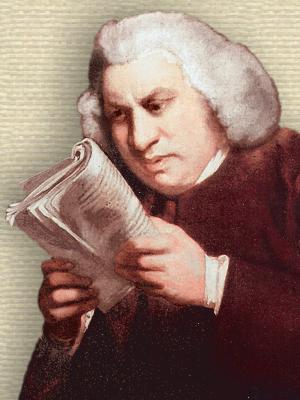
No, Sir, I am not a botanist; and (alluding, no doubt, to his near sightedness) should I wish to become a botanist, I must first turn myself into a reptile.
— Samuel Johnson
Quoted in James Boswell, The Life of Samuel Johnson, LL.D. (1820), Vol. 1, 177.
Nothing has more retarded the advancement of learning than the disposition of vulgar minds to ridicule and vilify what they cannot comprehend.
— Samuel Johnson
The Rambler, Number 117, 30 Apr 1751. In W. J. Bate and Albrecht B. Stranss (eds.), The Rambler (1969), Vol. 2, 258-9.
Nothing has tended more to retard the advancement of science than the disposition in vulgar minds to vilify what they cannot comprehend.
— Samuel Johnson
In Maturin Murray Ballou, Treasury of Thought (1894), 459.
People have now a-days got a strange opinion that every thing should be taught by lectures. Now, I cannot see that lectures can do as much good as reading the books from which the lectures are taken.
— Samuel Johnson
Entry for Feb 1776. In George Birkbeck-Hill (ed.), Boswell's Life of Johnson (1934-50), Vol. 2, 7.
Sir, the reason is very plain; knowledge is of two kinds. We know a subject ourselves, or we know where we can find information upon it.
— Samuel Johnson
In James Boswell, The Life of Samuel Johnson, LL.D. (1820), Vol. 1, 418.
The chief art of learning, as Locke has observed, is to attempt but little at a time. The widest excursions of the mind are made by short flights frequently repeated; the most lofty fabrics of science are formed by the continued accumulation of single propositions.
— Samuel Johnson
'The Need For General Knowledge,' Rambler No. 137 (9 Jul 1751). In Samuel Johnson, Donald Greene (ed.), Samuel Johnson (1984), 223.
The mathematicians are well acquainted with the difference between pure science, which has only to do with ideas, and the application of its laws to the use of life, in which they are constrained to submit to the imperfections of matter and the influence of accidents.
— Samuel Johnson
In Samuel Johnson and W. Jackson Bate (Ed.), ',The Rambler, No. 14, Saturday, 5 May 1750.' The Selected Essays from the Rambler, Adventurer, and Idler (1968), 40.
The philosopher may very justly be delighted with the extent of his views, the artificer with the readiness of his hands, but let the one remember that without mechanical performance, refined speculation is an empty dream, and the other that without theoretical reasoning, dexterity is little more than brute instinct.
— Samuel Johnson
In 'The Rambler' (17 Apr 1750), No. 9. Collected in The Rambler (1763), Vol. 1, 48.
The roads of science are narrow, so that they who travel them, must wither follow or meet one another…
— Samuel Johnson
In Samuel Johnson and W. Jackson Bate (Ed.), ',The Rambler, No. 121, Tuesday, 14 May 1751.' The Selected Essays from the Rambler, Adventurer, and Idler (1968), 172.
The use of traveling is to regulate the imagination by reality, and instead of thinking how things may be, to see them as they are.
— Samuel Johnson
…...
There prevails among men of letters, an opinion, that all appearance of science is particularly hateful to Women; and that therefore whoever desires to be well received in female assemblies, 'must qualify himself by a total rejection of all that is serious, rational, or important; must consider argument or criticism as perpetually interdicted; and devote all his attention to trifles, and all his eloquence to compliment.
— Samuel Johnson
The Rambler, Number 173, 12 Nov 1751. In W. J. Bate and Albrecht B. Strauss (eds.), The Rambler (1969), Vol. 3, 152-3.
Three ways have been taken to account for it [racial differences]: either that they are the posterity of Ham, who was cursed; or that God at first created two kinds of men, one black and another white; or that by the heat of the sun the skin is scorched, and so gets the sooty hue. This matter has been much canvassed among naturalists, but has never been brought to any certain issue.
— Samuel Johnson
In James Boswell, London Journal, 1762-1763, as First Published in 1950 from the Original Manuscript (1956), 251.
To expect that the intricacies of science will be pierced by a careless glance, or the eminences of fame ascended without labour, is to expect a peculiar privilege, a power denied to the rest of mankind; but to suppose that the maze is inscrutable to diligence, or the heights inaccessible to perseverance, is to submit tamely to the tyranny of fancy, and enchain the mind in voluntary shackles.
— Samuel Johnson
'The Need For General Knowledge,' Rambler No. 137 (9 Jul 1751). In Samuel Johnson, Donald Greene (ed.), Samuel Johnson (1984), 223.
To mean understandings, it is sufficient honour to be numbered amongst the lowest labourers of learning; but different abilities must find different tasks. To hew stone, would have been unworthy of Palladio; and to have rambled in search of shells and flowers, had but ill suited with the capacity of Newton.
— Samuel Johnson
From 'Numb. 83, Tuesday, January 1, 1750', The Rambler (1756), Vol. 2, 154. (Italian architect Palladio, 1509-80, is widely considered the most influential in the history of Western architecture.)
You may translate books of science exactly. ... The beauties of poetry cannot be preserved in any language except that in which it was originally written.
— Samuel Johnson
Quoted in James Boswell, The Life of Samuel Johnson, LL.D. (1826), Vol. 3, 29.
Quotes by others about Samuel Johnson (7)
After we came out of the church, we stood talking for some time together of Bishop Berkeley’s ingenious sophistry to prove the non-existence of matter, and that every thing in the universe is merely ideal. I observed, that though we are satisfied his doctrine is not true, it is impossible to refute it. I never shall forget the alacrity with which Johnson answered, striking his foot with mighty force against a large stone, till he rebounded from it, “I refute it thus.”
In Boswell’s Life of Johnson (1820), Vol. 1, 218.
The stone that Dr. Johnson once kicked to demonstrate the reality of matter has become dissipated in a diffuse distribution of mathematical probabilities. The ladder that Descartes, Galileo, Newton, and Leibniz erected in order to scale the heavens rests upon a continually shifting, unstable foundation.
Mathematics in Western Culture (1953), 382.
He [Samuel Johnson] bid me always remember this, that after a system is well settled upon positive evidence, a few objections ought not to shake it. “The human mind is so limited that it cannot take in all parts of a subject; so that there may be objections raised against anything. There are objections against a plenum, and objections against a vacuum. Yet one of them must certainly be true.”
Note: Whereas vacuum means devoid of matter, plenum regards a space with matter throughout.
Even happiness itself may become habitual. There is a habit of looking at the bright side of things, and also of looking at the dark side. Dr. Johnson has said that the habit of looking at the best side of a thing is worth more to a man than a thousand pounds a year. And we possess the power, to a great extent, of so exercising the will as to direct the thoughts upon objects calculated to yield happiness and improvement rather than their opposites.
In Self-help: With Illustrations of Character and Conduct (1859, 1861), 405-406.
Perhaps the strongest bond of sympathy between mathematics and poetry, however, is the endless invention of each. Dr. Johnson remarked, “The essence of poetry is invention; such invention as, by producing something unexpected, surprises and delights”; but he might have said the same of mathematics.
In 'The Poetry of Mathematics', The Mathematics Teacher (May 1926), 19, No. 5, 295.
When Dr. Johnson felt, or fancied he felt, his fancy disordered, his constant recurrence was to the study of arithmetic.
In In Life of Johnson (1871), Vol. 2, 264.
A physicist will tell me that this armchair is made of vibrations and that it’s not really here at all. But when Samuel Johnson was asked to prove the material existence of reality, he just went up to a big stone and kicked it. I'm with him.
Commenting on string theory. From 'Interview: Of Mind and Matter: David Attenborough Meets Richard Dawkins', The Guardian (11 Sep 2010).
See also:
- Samuel Johnson - The Thirst for the Curiosities of Science - from The Rambler (1 Jan 1750)
 In science it often happens that scientists say, 'You know that's a really good argument; my position is mistaken,' and then they would actually change their minds and you never hear that old view from them again. They really do it. It doesn't happen as often as it should, because scientists are human and change is sometimes painful. But it happens every day. I cannot recall the last time something like that happened in politics or religion.
(1987) --
In science it often happens that scientists say, 'You know that's a really good argument; my position is mistaken,' and then they would actually change their minds and you never hear that old view from them again. They really do it. It doesn't happen as often as it should, because scientists are human and change is sometimes painful. But it happens every day. I cannot recall the last time something like that happened in politics or religion.
(1987) -- 





