 (source)
|
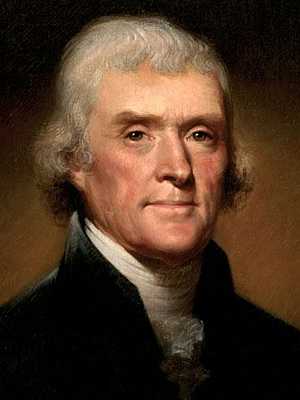
Thomas Jefferson
(13 Apr 1743 - 4 Jul 1826)
American statesman, astronomer, scholar and inventor who wrote the Declaration of Independence (1776) and organized the Lewis and Clark expedition (1803). His only full-length book, Notes on the State of Virginia contains an outline of the geography, flora and fauna of Virginia, and established his reputation as a scholar and a pioneering American scientist.
|
Science Quotes by Thomas Jefferson (66 quotes)
>> Click for Thomas Jefferson Quotes on | Chemistry | Life | Medicine | Science |
>> Click for Thomas Jefferson Quotes on | Chemistry | Life | Medicine | Science |
“On doit etre etonné ([Abbé Raynal]says) que l'Amerique n’ait pas encore produit un bon poëte, un habile mathematicien, un homme de génie dans un seul art, ou une seule science.” …“America has not yet produced one good poet.” When we shall have existed as a people as long as the Greeks did before they produced a Homer, the Romans a Virgil, the French a Racine and Voltaire, the English a Shakespeare and Milton, should this reproach be still true, we will enquire from what unfriendly causes it has proceeded, that the other countries of Europe and quarters of the earth shall not have inscribed any name in the roll of poets. But neither has America produced “one able mathematician, one man of genius in a single art or a single science.” … In physics we have produced a [Benjamin] Franklin, than whom no one of the present age has made more important discoveries, nor has enriched philosophy with more, or more ingenious solutions of the phaenomena, of nature. … [The quadrant invented by Godfrey, an American also, and with the aid of which the European nations traverse the globe, is called Hadley’s quadrant.] … We have supposed Mr. [David] Rittenhouse second to no astronomer living: that in genius he must be the first, because he is self-taught. As an artist he has exhibited as great a proof of mechanical genius as the world has ever produced. … We therefore suppose, that this reproach is as unjust as it is unkind; and that, of the geniuses which adorn the present age, America contributes its full share. [Compared to the much larger populations of European countries.]
— Thomas Jefferson
The reference given by Jefferson for the original reproach by Abbé Raynal, an ellipsis above, is “7. Hist. Philos. p. 92. ed. Maestricht. 1774”. The original remark written in French, translates as: “One must be amazed that America has not yet produced a good poet, an able mathematician, one man of genius in a single art, or a single science.” Jefferson uses parts of it in English, to introduce his rebuttal. From Thomas Jefferson, Notes on the State of Virginia (1787), 107-110. A footnote adds that: “In a later edition of the Abbé Raynal’s work, he has withdrawn his censure…”
[Concerning] mr Kirwan’s charming treatise on manures. Science never appears so beautiful as when applied to the uses of human life, nor any use of it so engaging as agriculture & domestic economy.
— Thomas Jefferson
Letter (23 Mar 1798) from Jefferson in Philadelphia to William Strickland. In The Papers of Thomas Jefferson: 1 January 1798 to 31 January 1799 (2003), 211. Jefferson was thanking Strickland, who had sent him a copy of Kirwan’s treatise.
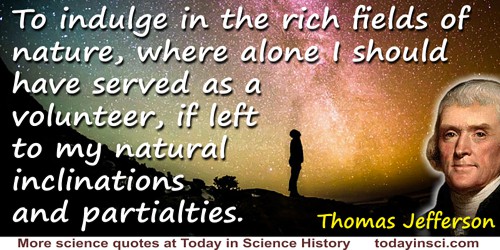
[Writing this letter] has permitted me, for a moment, to abstract myself from the dry and dreary waste of politics, into which I have been impressed by the times on which I happened, and to indulge in the rich fields of nature, where alone I should have served as a volunteer, if left to my natural inclinations and partialties.
— Thomas Jefferson
In letter to Caspar Wistar (21 Jun 1807), collected in Thomas Jefferson Randolph (ed.), Memoir, Correspondence, And Miscellanies, From The Papers Of Thomas Jefferson (1829), Vol. 4, 94.
~~[Misattributed - NOT by Jefferson]~~ I am a great believer in Luck. The harder I work, the more of it I seem to have.
— Thomas Jefferson
This wording of the quote was written down by Coleman Cox in Listen to This (1922), VII. The quote is often seen, despite having no known source, attributed to Thomas Jefferson. Also seen as “I find that the harder I work, the more luck I seem to have.” Historians of Jefferson have stated that neither these words nor variants exist in his written works. Included here to provide it together the notice of misattribution. Also see the Coleman Cox Quotes page on this website.
A patient pursuit of facts, and cautious combination and comparison of them, is the drudgery to which man is subjected by his Maker, if he wishes to attain sure knowledge.
— Thomas Jefferson
In 'Productions Mineral, Vegetable and Animal', Notes on the State of Virginia (1787), 112.
A schism has taken place among the chemists. A particular set of them in France have undertaken to remodel all the terms of the science, and to give every substance a new name, the composition, and especially the termination of which, shall define the relation in which it stands to other substances of the same family, But the science seems too much in its infancy as yet, for this reformation; because in fact, the reformation of this year must be reformed again the next year, and so on, changing the names of substances as often as new experiments develop properties in them undiscovered before. The new nomenclature has, accordingly, been already proved to need numerous and important reformations. ... It is espoused by the minority here, and by the very few, indeed, of the foreign chemists. It is particularly rejected in England.
— Thomas Jefferson
Letter to Dr. Willard (Paris, 1788). In Thomas Jefferson and John P. Foley (ed.), The Jeffersonian Cyclopedia (1900), 135. From H.A. Washington, The Writings of Thomas Jefferson (1853-54). Vol 3, 15.
As for France and England, with all their pre-eminence in science, the one is a den of robbers, and the other of pirates. If science produces no better fruits than tyranny, murder, rapine, and destitution of national morality, I would rather wish our country to be ignorant, honest, and estimable as our neighboring savages are.
— Thomas Jefferson
Letter (21 Jan 1812) to John Adams. Collected in Thomas Jefferson Randolph (ed.), Memoirs, Correspondence and Private Papers (1829), Vol. 4, 173.
Botany here is but an object of amusement, a great one indeed and in which all our family mingles more or less. mr Randolph is our leader, and a good one. my mind has been so long ingrossed by other objects, that those I loved most have escaped from it, and none more than botany.
— Thomas Jefferson
Letter (22 Oct 1810) from Jefferson at Monticello to Benjamin Smith Barton.
Botany is the school for patience, and it’s amateurs learn resignation from daily disappointments.
— Thomas Jefferson
In letter to Madame de Tessé (25 Apr 1788). In Thomas Jefferson Correspondence: Printed from the Originals (1916), 7. The errant apostrophe in “it’s” appears in more than one texts checked by Webmaster.
But indeed, the English generally have been very stationary in latter times, and the French, on the contrary, so active and successful, particularly in preparing elementary books, in the mathematical and natural sciences, that those who wish for instruction, without caring from what nation they get it, resort universally to the latter language.
— Thomas Jefferson
Letter (29 Jan 1824) to Patrick K. Rodgers. Collected in Andrew A. Lipscomb (ed.), The Writings of Thomas Jefferson (1904), Vol. 16, 2.
But the dreams about the modes of creation, enquiries whether our globe has been formed by the agency of fire or water, how many millions of years it has cost Vulcan or Neptune to produce what the fiat of the Creator would effect by a single act of will, is too idle to be worth a single hour of any man’s life.
— Thomas Jefferson
Letter (2 May 1826) to Doctor John P. Emmet. Collected in The Writings of Thomas Jefferson (1854), Vol. 7, 443.
Chemistry is yet, indeed, a mere embryon. Its principles are contested; experiments seem contradictory; their subjects are so minute as to escape our senses; and their result too fallacious to satisfy the mind. It is probably an age too soon to propose the establishment of a system.
— Thomas Jefferson
Letter to Rev. James Madison (Paris, 19 Jul 1788). In Thomas Jefferson and John P. Foley (ed.), The Jeffersonian Cyclopedia (1900), 135. From H.A. Washington, The Writings of Thomas Jefferson (1853-54). Vol 2, 431.
Delay is preferable to error.
— Thomas Jefferson
Letter to George Washington (16 May 1792).
Embrace those sciences which give to retired life usefulness, ornament or amusement.
— Thomas Jefferson
In letter to Caspar Wistar (21 Jun 1807), collected in The Works of Thomas Jefferson (2010), Vol. 10, 423.
Error of opinion may be tolerated where reason is left free to combat it.
— Thomas Jefferson
From his First Inaugural Address (4 Mar 1801). In Annals of the Congress of the United States (1801), 11, 583.
Even in Europe a change has sensibly taken place in the mind of man. Science has liberated the ideas of those who read and reflect, and the American example has kindled feelings of right in the people. An insurrection has consequently begun of science talents and courage against rank and birth, which have fallen into contempt. It has failed in its first effort, because the mobs of the cities, the instrument used for its accomplishment, debased by ignorance, poverty and vice, could not be restrained to rational action. But the world will soon recover from the panic of this first catastrophe.
— Thomas Jefferson
Letter to John Adams (Monticello, 1813). In Thomas Jefferson and John P. Foley (ed.), The Jeffersonian Cyclopedia (1900), 49. From Paul Leicester Ford (ed.), The Writings of Thomas Jefferson (1892-99). Vol 4, 439.
Every son of science feels a strong & disinterested desire of promoting it in every part of the earth.
— Thomas Jefferson
In letter (3 Feb 1803) from Jefferson in Washington to Marc Auguste Pictet.
For I agree with you that there is a natural aristocracy among men. The grounds of this are virtue and talents.
— Thomas Jefferson
Letter to John Adams, 28 Oct 1813. In Paul Witstach (ed.), Correspondence of John Adams and Thomas Jefferson 1812-1826 (1925), 92.
Freedom, the first-born of science.
— Thomas Jefferson
To Monsieur d'Ivernois. In Thomas Jefferson, Richard Holland Johnston, Thomas Jefferson Memorial Association of the United States, The Writings of Thomas Jefferson, Vol. 19, iii.
He who made us would have been a pitiful bungler if he had made the rules of our moral conduct a matter of science. For one man of science, there are thousands who are not. … State a moral case to a ploughman and a professor. The former will decide it as well, and often better than the latter, because he has not been led astray by artificial rules.
— Thomas Jefferson
Letter to Peter Carr (10 Aug 1787). Quoted in James H. Hutson (ed.), The Founders on Religion: A Book of Quotations (2009), 147-148; citing edited by In Boyd, Papers of Thomas Jefferson, 12:14-15.
I am for encouraging the progress of science in all it’s branches.
— Thomas Jefferson
Letter (26 Jan 1799) from Jefferson in Philadelphia to Elbridge Gerry. The original includes the apostrophe in “it’s.”
I am pleased, however, to see the efforts of hypothetical speculation, because by the collisions of different hypotheses, truth may be elicited and science advanced in the end.
— Thomas Jefferson
Letter (5 Sep 1822) to Mr. George F. Hopkins. Collected in The Writings of Thomas Jefferson: Correspondence (1854), Vol. 7, 260.
I could more easily believe that two Yankee professors would lie than that stones would fall from heaven.
— Thomas Jefferson
on a report on a meteorite shower which fell in Weston, Connecticut in 1807, in Our Stone-pelted Planet by H. H. Nininger (1933).
I do not know whether you are fond of chemical reading. There are some things in this science worth reading.
— Thomas Jefferson
Letter to Mr. Rittenhouse (Paris, 1786). In Thomas Jefferson and John P. Foley (ed.), The Jeffersonian Cyclopedia (1900), 135. From H.A. Washington, The Writings of Thomas Jefferson (1853-54). Vol 1, 517.
I have given up newspapers in exchange for Tacitus & Thucydides, for Newton & Euclid; & I find myself much the happier.
— Thomas Jefferson
From Letter to John Adams, (21 Jan 1812). Collected in J. Jefferson Looney (ed.), The Papers of Thomas Jefferson, Retirement Series, Vol. 4. (2007), 429.
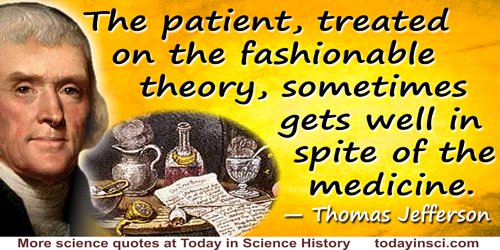
I have lived myself to see the disciples of Hoffman, Boerhaave, Stalh, Cullen, Brown, succeed one another like the shifting figures of a magic lanthern, and their fancies, like the dresses of the annual doll-babies from Paris, becoming from their novelty, the vogue of the day, and yielding to the next novelty their ephemeral favor. The patient, treated on the fashionable theory, sometimes gets well in spite of the medicine.
— Thomas Jefferson
In letter to Caspar Wistar (21 Jun 1807), collected in Thomas Jefferson Randolph (ed.), Memoir, Correspondence, And Miscellanies, From The Papers Of Thomas Jefferson (1829), Vol. 4, 93.
I have never thought a boy should undertake abstruse or difficult sciences, such as Mathematics in general, till fifteen years of age at soonest. Before that time they are best employed in learning the languages, which is merely a matter of memory.
— Thomas Jefferson
Letter to Ralph Izard (17 July 1788).
I have wished to see chemistry applied to domestic objects, to malting, for instance, brewing, making cider, to fermentation and distillation generally, to the making of bread, butter, cheese, soap, to the incubation of eggs, &c.
— Thomas Jefferson
Letter to Thomas Cooper (Monticello, 1812). In Thomas Jefferson and John P. Foley (ed.), The Jeffersonian Cyclopedia (1900), 135. From H.A. Washington, The Writings of Thomas Jefferson (1853-54). Vol 6, 73.
I heard there the nightingale in all its perfection: and I do not hesitate to pronounce that in America it would be deemed a bird of the third rank only, our mocking-bird and fox-coloured thrush being unquestionably superior to it.
— Thomas Jefferson
Letter (21 Jun 1785) to Mrs. John (Abigail) Adams. Collected in Paul Leicester Ford (ed.), The Writings of Thomas Jefferson: 1784-1787 (1894), 63.
In the spring of 1760, [I] went to William and Mary college, where I continued two years. It was my great good fortune, and what probably fixed the destinies of my life, that Dr. William Small of Scotland, was then Professor of Mathematics, a man profound in most of the useful branches of science, with a happy talent of communication, correct and gentlemanly manners, and an enlarged and liberal mind. He, most happily for me, became soon attached to me, and made me his daily companion when not engaged in the school; and from his conversation I got my first views of the expansion of science, and of the system of things in which we are placed.
— Thomas Jefferson
In Thomas Jefferson and Andrew Adgate Lipscomb (ed.), The Writings of Thomas Jefferson (1904), Vol. 1, 3.
Indeed, we need not look back half a century to times which many now living remember well, and see the wonderful advances in the sciences and arts which have been made within that period. Some of these have rendered the elements themselves subservient to the purposes of man, have harnessed them to the yoke of his labors and effected the great blessings of moderating his own, of accomplishing what was beyond his feeble force, and extending the comforts of life to a much enlarged circle, to those who had before known its necessaries only.
— Thomas Jefferson
From paper 'Report of the Commissioners Appointed to Fix the Site of the University of Virginia' (Dec 1818), reprinted in Annual Report of the Board of Visitors of the University of Virginia for the Fiscal Year Ending May 31, 1879 (1879), 10. Collected in Commonwealth of Virginia, Annual Reports of Officers, Boards, and Institutions of the Commonwealth of Virginia, for the Year Ending September 30, 1879 (1879).
It be urged that the wild and uncultivated tree, hitherto yielding sour and bitter fruit only, can never be made to yield better; yet we know that the grafting art implants a new tree on the savage stock, producing what is most estimable in kind and degree. Education, in like manner, engrafts a new man on the native stock, and improves what in his nature was vicious and perverse into qualities of virtue and social worth.
— Thomas Jefferson
From paper 'Report of the Commissioners Appointed to Fix the Site of the University of Virginia', included in Annual Report of the Board of Visitors of the University of Virginia for the Fiscal Year Ending May 31, 1879 (1879), 10. Collected in Commonwealth of Virginia, Annual Reports of Officers, Boards, and Institutions of the Commonwealth of Virginia, for the Year Ending September 30, 1879 (1879).
It is always better to have no ideas than false ones; to believe nothing than to believe what is wrong.
— Thomas Jefferson
In Letter (19 Jul 1788) to James Madison. Collected in Thomas Jefferson Randolph, Memoirs, Correspondence, and Private Papers of Thomas Jefferson (1829), Vol. 2, 223.
It is well known, that on the Ohio, and in many parts of America further north, tusks, grinders, and skeletons of unparalleled magnitude are found in great numbers, some lying on the surface of the earth, and some a little below it ... But to whatever animal we ascribe these remains, it is certain that such a one has existed in America, and that it has been the largest of all terrestrial beings.
— Thomas Jefferson
Notes on the State of Virginia (1782), 71, 77.
Let the farmer for evermore be honored in his calling, for they who labor in the earth are the chosen people of God.
— Thomas Jefferson
In Tryon Edwards (ed.), A Dictionary of Thoughts: Being a Cyclopedia of Laconic Quotations (1891), 11.
Nature has not arranged her productions on a single and direct line. They branch at every step, and in every direction, and he who attempts to reduce them into departments is left to do it by the lines of his own fancy.
— Thomas Jefferson
In Letter (22 Feb 1814) to Dr. John Manners. Collected in The Writings of Thomas Jefferson (1905), Vol 13, 99.
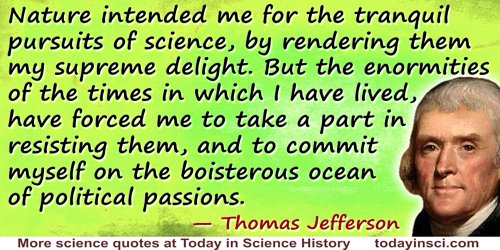
Nature intended me for the tranquil pursuits of science, by rendering them my supreme delight. But the enormities of the times in which I have lived, have forced me to take a part in resisting them, and to commit myself on the boisterous ocean of political passions.
— Thomas Jefferson
Letter to Pierre Samuel Du Pont de Nemours (2 Mar 1809). In Thomas Jefferson and John P. Foley (ed.) The Jeffersonian Cyclopedia (1990), 766.
No body can desire more ardently than myself to concur in whatever may promote useful science, and I view no science with more partiality than Natural history.
— Thomas Jefferson
Letter (24 May 1807) from Jefferson in Washington to G.C. de la Coste.
No knowledge can be more satisfactory to a man than that of his own frame, its parts, their functions and actions.
— Thomas Jefferson
Letter (7 Oct 1814) to Thomas Cooper. Collected in The Writings of Thomas Jefferson: Correspondence (1854), 390.
Of all the departments of science no one seems to have been less advanced for the last hundred years than that of meteorology.
— Thomas Jefferson
Letter (5 Sep 1822) to George F. Hopkins. Collected in The Writings of Thomas Jefferson (1854), Vol. 7, 259.
One of the most successful physicians I have ever known, has assured me, that he used more bread pills, drops of colored water, and powders of hickory ashes, than of all other medicines put together. It was certainly a pious fraud.
— Thomas Jefferson
In letter to Caspar Wistar (21 Jun 1807), collected in Thomas Jefferson Randolph (ed.), Memoir, Correspondence, And Miscellanies, From The Papers Of Thomas Jefferson (1829), Vol. 4, 93.
Our civil rights have no dependence on our religious opinions, any more than our opinions in physics or geometry.
— Thomas Jefferson
In A Bill for Establishing Religious Freedom (State of Virginia, 1779). Jefferson declared he had drafted it in 1777, but it was not until he had just taken office as governor of Virginia that the Bill was presented to the General Assembly of Virginia, by Harvie, on 12 Jun 1779. It was not passed, though a broadside was printed (privately?) and circulated for the consideration of the people. It was eventually passed 16 Dec 1785.
Ploughing deep, your recipe for killing weeds, is also the recipe for almost every good thing in farming. … We now plough horizontally following the curvatures of the hills and hollows, on the dead level, however crooked the lines may be. Every furrow thus acts as a reservoir to receive and retain the waters, all of which go to the benefit of the growing plant, instead of running off into streams … In point of beauty nothing can exceed that of the waving lines and rows winding along the face of the hills and vallies.
— Thomas Jefferson
In letter (17 Apr 1813) from Jefferson at Monticello to Charles Willson Peale. Collected in The Jefferson Papers: 1770-1826 (1900), 178-180.
Reason and free inquiry are the only effectual agents against error.
— Thomas Jefferson
Thomas Jefferson and Albert Ellery Bergh (ed.), The Writings of Thomas Jefferson (1905), Vols 1, 221.

Speaking one day to Monsieur de Buffon, on the present ardor of chemical inquiry, he affected to consider chemistry but as cookery, and to place the toils of the laboratory on the footing with those of the kitchen. I think it, on the contrary, among the most useful of sciences, and big with future discoveries for the utility and safety of the human race.
— Thomas Jefferson
Letter to Rev. James Madison (Paris, 19 Jul 1788). In Thomas Jefferson and John P. Foley (ed.), The Jeffersonian Cyclopedia (1900), 135. From H.A. Washington, The Writings of Thomas Jefferson (1853-54). Vol 2, 431.
That the enthusiasm which characterizes youth should lift its parricide hands against freedom and science would be such a monstrous phenomenon as I cannot place among possible things in this age and country.
[Expressing confidence in the next generation to preserve the freedom of the human mind, and of the press, which grew out of America's Declaration of Independence.]
[Expressing confidence in the next generation to preserve the freedom of the human mind, and of the press, which grew out of America's Declaration of Independence.]
— Thomas Jefferson
Letter to a student, William Green Mumford (18 Jun 1799), In Merrill D. Peterson, Thomas Jefferson and the New Nation (1970), 616.
The attempt of Lavoisier to reform chemical nomenclature is premature. One single experiment may destroy the whole filiation of his terms; and his string of sulphates, sulphites, and sulphures, may have served no end than to have retarded the progress of science by a jargon, from the confusion of which time will be requisite to extricate us.
— Thomas Jefferson
Letter to Rev. James Madison (Paris, 1788). In Thomas Jefferson and John P. Foley (ed.), The Jeffersonian Cyclopedia (1900), 135. From H.A. Washington, The Writings of Thomas Jefferson (1853-54). Vol 2, 432.
The colleges of Edinburgh and Geneva as seminaries of science, are considered as the two eyes of Europe. While Great Britain and America give the preference to the former, all other countries give it to the latter.
— Thomas Jefferson
Letter to Wilson Nicholas (Monticello, Nov 1794). In Thomas Jefferson and John P. Foley (ed.), The Jeffersonian Cyclopedia (1900), 5. From Paul Leicester Ford (ed.), The Writings of Thomas Jefferson (1892-99). Vol 6, 513.
The contradictory experiments of chemists leave us at liberty to conclude what we please. My conclusion is, that art has not yet invented sufficient aids to enable such subtle bodies [air, light, &c.] to make a well-defined impression on organs as blunt as ours; that it is laudable to encourage investigation but to hold back conclusion.
— Thomas Jefferson
Letter to Rev. James Madison (Paris, 19 Jul 1788). In Thomas Jefferson and John P. Foley (ed.), The Jeffersonian Cyclopedia (1900), 135. From H.A. Washington, The Writings of Thomas Jefferson (1853-54). Vol 2, 431.
The greatest service which can be rendered any country is to add an useful plant to its culture; especially, a bread grain; next in value to bread is oil.
— Thomas Jefferson
In Memoir, Correspondence, and Miscellanies from the Papers of T. Jefferson (1829), Vol. 1, 144.
The inexperienced and presumptuous band of medical tyros let loose upon the world destroys more of human life in one year than all the Robin Hoods, Cartouches, and Macheaths do in a century.
— Thomas Jefferson
In letter to Caspar Wistar (21 Jun 1807). Memoir, Correspondence, And Miscellanies, From The Papers Of Thomas Jefferson (1829), Vol. 4, 93. (Jefferson regards Robin Hood as a villain, on a par with with Cartouche, an 18th-century highwayway, and Macheath, the cutthroat in John Gay’s Beggar’s Opera.)
The main object of all science is the freedom and happiness of man.
— Thomas Jefferson
Letter (26 Jan 1810) to General Kosciusko. Collected in Thomas Jefferson Randolph (ed.), Memoirs, Correspondence and Private Papers (1829), Vol. 4, 145.
The main objects of all science, the freedom and happiness of man. … [are] the sole objects of all legitimate government.
— Thomas Jefferson
From Letter to General Thaddeus Kosciusko (26 Feb 1810), Andrew A. Lipscomb, The Writings of Thomas Jefferson (1904), Vol. 12, 369-70. A plaque with this quotation, with the first phrase omitted, is in the stairwell of the pedestal of the Statue of Liberty.
The moment a person forms a theory, his imagination sees, in every object, only the traits which favor that theory.
— Thomas Jefferson
In Letter (20 Sep 1787) to Charles Thompson. Collected in Thomas Jefferson Randolph, Memoirs, Correspondence, and Private Papers of Thomas Jefferson (1829), Vol. 2, 223.
The more ignorant we become the less value we set on science, and the less inclination we shall have to seek it.
— Thomas Jefferson
Letter from Jefferson at Monticello to John Adams (27 May 1795).
The naturalists, you know, distribute the history of nature into three kingdoms or departments: zoology, botany, mineralogy. Ideology, or mind, however, occupies so much space in the field of science, that we might perhaps erect it into a fourth kingdom or department. But inasmuch as it makes a part of the animal construction only, it would be more proper to subdivide zoology into physical and moral.
— Thomas Jefferson
Letter (24 Mar 1824) to Mr. Woodward. Collected in The Writings of Thomas Jefferson: Correspondence (1854), 339.
The new chemistry indeed has given us a new principle of the generation of rain, by proving water to be a composition of different gases, and has aided our theory of meteoric lights.
— Thomas Jefferson
Letter (5 Sep 1822) to George F. Hopkins. Collected in The Writings of Thomas Jefferson (1854), Vol. 7, 260.
The ocean … like the air, is the common birth-right of mankind.
— Thomas Jefferson
Reply (29 Feb 1808) to public address by the Society of Tammany, or Columbian Order, No. 1, of the City of New York, collected in H.A. Washington (ed.), The Writings of Thomas Jefferson, Vol. 8 (1854), 127.
The only sure foundations of medicine are, an intimate knowledge of the human body, and observation on the effects of medicinal substances on that. The anatomical and clinical schools, therefore, are those in which the young physician should be formed. If he enters with innocence that of the theory of medicine, it is scarcely possible he should come out untainted with error. His mind must be strong indeed, if, rising above juvenile credulity, it can maintain a wise infidelity against the authority of his instructors, and the bewitching delusions of their theories.
— Thomas Jefferson
In letter to Caspar Wistar (21 Jun 1807), collected in Thomas Jefferson Randolph (ed.), Memoir, Correspondence, And Miscellanies, From The Papers Of Thomas Jefferson (1829), Vol. 4, 93.
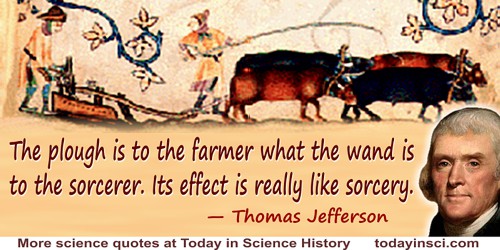
The plough is to the farmer what the wand is to the sorcerer. Its effect is really like sorcery.
— Thomas Jefferson
Jefferson to Charles Willson Peale, Monticello (17 Apr 1813). Epigraph in Edwin Morris Betts (ed.) Thomas Jefferson's Farm Book (1953), 47.
The science of calculation … is indispensable as far as the extraction of the square and cube roots: Algebra as far as the quadratic equation and the use of logarithms are often of value in ordinary cases: but all beyond these is but a luxury; a delicious luxury indeed; but not to be indulged in by one who is to have a profession to follow for his subsistence.
— Thomas Jefferson
In Letter (18 Jun 1799) to William G. Munford. On founders.archives.gov website.
There is not a sprig of grass that shoots uninteresting to me.
— Thomas Jefferson
Letter (23 Dec 1790) to Martha Jefferson Randolph. Collected in B.L. Rayner (ed.), Sketches of the Life, Writings, and Opinions of Thomas Jefferson (1832), 192.
To learn… the ordinary arrangement of the different strata of minerals in the earth, to know from their habitual colocations and proximities, where we find one mineral; whether another, for which we are seeking, may be expected to be in its neighborhood, is useful.
— Thomas Jefferson
In The Writings of Thomas Jefferson (1854), Vol. 7, 443.
We are not afraid to follow truth wherever it may lead, nor to tolerate any error so long as reason is left free to combat it.
— Thomas Jefferson
Letter to William Roscoe (27 Dec 1820).
With your talents and industry, with science, and that steadfast honesty which eternally pursues right, regardless of consequences, you may promise yourself every thing—but health, without which there is no happiness. An attention to health then should take place of evey other object. The time necessary to secure this by active exercises, should be devoted to it in preference to every other pursuit.
— Thomas Jefferson
Letter to Tomas Mann Randolph, Jr., (6 Jul 1787), In Thomas Jefferson and Paul Leicester Ford (ed.) The Works of Thomas Jefferson (1904), Vol. 5, 300.
Julian P. Boyd (Ed.), The Papers of Thomas Jefferson (1955), Vol. 11, 558.
You have heard of the new chemical nomenclature endeavored to be introduced by Lavoisier, Fourcroy, &c. Other chemists of this country, of equal note, reject it, and prove in my opinion that it is premature, insufficient and false. These latter are joined by the British chemists; and upon the whole, I think the new nomenclature will be rejected, after doing more harm than good. There are some good publications in it, which must be translated into the ordinary chemical language before they will be useful.
— Thomas Jefferson
Letter to Dr. Currie (Paris, 1788). In Thomas Jefferson and John P. Foley (ed.), The Jeffersonian Cyclopedia (1900), 135. From H.A. Washington, The Writings of Thomas Jefferson (1853-54). Vol 2, 544.
Quotes by others about Thomas Jefferson (5)
This is the most extraordinary collection of talent, of human knowledge, that has ever been gathered together at the White House, with the possible exception of when Thomas Jefferson dined alone.
[Welcoming Nobel Prize winners as his guests at a White House dinner.]
[Welcoming Nobel Prize winners as his guests at a White House dinner.]
Remarks at a dinner honoring Nobel Prize Winners of the Western Hemisphere (29 Apr 1962).
While the Jeffersonian did not flatly deny the Creator’s power to perform miracles, he admired His refusal to do so.
In The Lost World of Thomas Jefferson (1948, 1993), 41.
Jefferson refused to pin his hopes on the occasional success of honest and unambitious men; on the contrary, the great danger was that philosophers would be lulled into complacence by the accidental rise of a Franklin or a Washington. Any government which made the welfare of men depend on the character of their governors was an illusion.
In The Lost World of Thomas Jefferson (1948, 1993), 178.
~~[Misattributed - NOT by Jefferson]~~ I am a great believer in Luck. The harder I work, the more of it I seem to have.
This wording of the quote was written down by Coleman Cox in Listen to This (1922), VII. The quote is often seen, despite having no known source, attributed to Thomas Jefferson. Also seen as “I find that the harder I work, the more luck I seem to have.” Historians of Jefferson have stated that neither these words nor variants exist in his written works. Included here to provide it together the notice of misattribution. Also see the Coleman Cox Quotes page on this website.
[Thomas Jefferson] played a major role in one of the great tragedies of recent World history, a tragedy which he so elegantly mourned: the dispossession and decimation of the first Americans.
In 'Preface', Jefferson and the Indians: The Tragic Fate of the First Americans (1999), viii. In this book, Wallace writes about the (im-?)balance between Jefferson’s intention to be a benevolent leader, and having a great national appetite for expansion of the American nation.

See also:
- 13 Apr - short biography, births, deaths and events on date of Jefferson's birth.
- Thomas Jefferson - context of quote “To indulge in the rich fields of nature” - Medium image (500 x 250 px)
- Thomas Jefferson - context of quote “To indulge in the rich fields of nature” - Large image (800 x 400 px)
- Thomas Jefferson - context of quote “The plough ... is really like sorcery” - Medium image (500 x 250 px)
- Jefferson As A Man Of Science - Preface to The Writings of Thomas Jefferson, Vol. 19.
- Thomas Jefferson - context of quote “The plough ... is really like sorcery” - Large image (800 x 400 px)
- Thomas Jefferson on Education and Science from a report on establishing the University of Virginia (1818).
- Thomas Jefferson - context of quote “Chemistry … among the most useful of sciences” - Medium image (500 x 250 px)
- Thomas Jefferson - context of quote “Chemistry … among the most useful of sciences” - Large image (800 x 400 px)
- Thomas Jefferson - context of quote “The patient … sometimes gets well in spite of the medicine. ” - Medium image (500 x 250 px)
- Thomas Jefferson - context of quote “The patient … sometimes gets well in spite of the medicine. ” - Large image (800 x 400 px)
- Thomas Jefferson on Quack Medicine - from Letter to Dr. Caspar Wistar (1807)
- Thomas Jefferson - context of quote “Nature intended me for the tranquil pursuits of science” - Medium image (500 x 250 px)
- Thomas Jefferson - context of quote “Nature intended me for the tranquil pursuits of science” - Large image (800 x 400 px)
- Thomas Jefferson - context of quote “The ocean ... like the air, is the common birthright of mankind” - Medium image (500 x 250 px)
- Thomas Jefferson - context of quote “The ocean ... like the air, is the common birthright of mankind” - Large image (800 x 400 px)
- Thomas Jefferson: Scientist, by Edwin Thomas Martin. - book suggestion.
 In science it often happens that scientists say, 'You know that's a really good argument; my position is mistaken,' and then they would actually change their minds and you never hear that old view from them again. They really do it. It doesn't happen as often as it should, because scientists are human and change is sometimes painful. But it happens every day. I cannot recall the last time something like that happened in politics or religion.
(1987) --
In science it often happens that scientists say, 'You know that's a really good argument; my position is mistaken,' and then they would actually change their minds and you never hear that old view from them again. They really do it. It doesn't happen as often as it should, because scientists are human and change is sometimes painful. But it happens every day. I cannot recall the last time something like that happened in politics or religion.
(1987) -- 





