 (source)
|
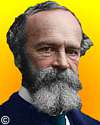
William James
(11 Jan 1842 - 26 Aug 1910)
American psychologist and philosopher who has been called 'Father of American Psychology' but later in life pursued philosophy, became one of founders of pragmatism, and wrote seminal works including The Meaning of Truth (1909).
|
‘Be not afraid of life. Believe that life is worth living, and your belief will help create the fact.
— William James
Quoted in Kim Lim (ed.), 1,001 Pearls of Spiritual Wisdom: Words to Enrich, Inspire, and Guide Your Life (2014), 245
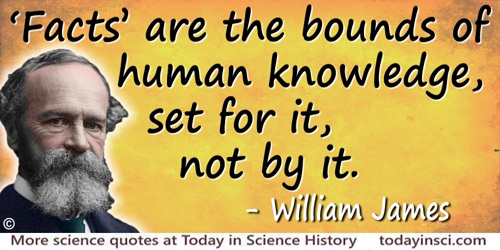
“Facts” are the bounds of human knowledge, set for it, not by it.
— William James
'On Some Hegelisms' (1882). In The Will to Believe and Other Essays in Popular Philosophy (1897), 271.
Theories thus become instruments, not answers to enigmas, in which we can rest. We don’t lie back upon them, we move forward, and, on occasion, make nature over again by their aid.
— William James
Pragmatism, a New Name for Some Old Ways of Thinking: Popular Lectures on Philosophy (1907), 53.
~~[Attributed]~~ A great many people think they are thinking when they are merely rearranging their prejudices.
— William James
Attributed without citation in Clifton Fadiman, American Treasury, 1455-1955 (1955), 719.
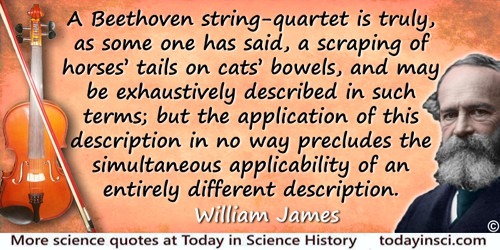
A Beethoven string-quartet is truly, as some one has said, a scraping of horses’ tails on cats’ bowels, and may be exhaustively described in such terms; but the application of this description in no way precludes the simultaneous applicability of an entirely different description.
— William James
In The Sentiment of Rationality (1882, 1907), 76.
All our scientific and philosophic ideals are altars to unknown gods.
— William James
'The Dilemma of Determinism' (1884). In The Will to Believe and Other Essays in Popular Philosophy (1897), 147.
Common-sense contents itself with the unreconciled contradiction, laughs when it can, and weeps when it must, and makes, in short, a practical compromise, without trying a theoretical solution.
— William James
From Essay, 'German Pessimism', a book review (of Der Modern Pessimismus by Edmund Pfleiderer) in Nation (7 Oct 1875), 21, No. 536, 233. Reprinted in Ralph Barton Perry (ed.), Collected Essays and Reviews by William James (1920), 17.
Consciousness… does not appear to itself chopped up in bits. Such words as “chain” or “train” do not describe it fitly as it presents itself in the first instance. It is nothing jointed; it flows. A “river” or a “stream” are the metaphors by which it is most naturally described. In talking of it hereafter, let us call it the stream of thought, of consciousness, or of subjective life.
Source of the expression “stream of consciousness”.
Source of the expression “stream of consciousness”.
— William James
The Principles of Psychology (1890), Vol. 1, 239.
Could the young but realize how soon they will become mere walking bundles of habits, they would give more heed to their conduct while in the plastic state. We are spinning our own fates, good or evil, and never to be undone.
— William James
'The Laws of Habit', The Popular Science Monthly (Feb 1887), 451.
Every perception is an acquired perception.
— William James
In 'The Perception of “Things”', The Principles of Psychology (1890), Vol. 2, 78.
First... a new theory is attacked as absurd; then it is admitted to be true, but obvious and insignificant; finally it is seen to be so important that its adversaries claim that they themselves discovered it.
— William James
'Pragmatism's Conception of Truth', in Pragmatism: A New Name for some Old Ways of Thinking, Popular Lectures on Philosophy (1907), 198.
For this we must make automatic and habitual, as early as possible, as many useful actions as we can, and guard against the growing into ways that are likely to be disadvantageous to us, as we should guard against the plague?
— William James
'The Laws of Habit', The Popular Science Monthly (Feb 1887), 434.
From a pragmatic point of view, the difference between living against a background of foreigness (an indifferent Universe) and one of intimacy (a benevolent Universe) means the difference between a general habit of wariness and one of trust.
— William James
…...
Genius, in truth, means little more than the faculty of perceiving in an unhabitual way.
— William James
In Psychology (1904), 328.
Habit is thus the enormous fly-wheel of society, its most precious conservative agent. It alone is what keeps us all within the bounds of ordinance, and saves the children of fortune from the envious uprisings of the poor. It alone prevents the hardest and most repulsive walks of life from being deserted by those brought up to tread therein.
— William James
'The Laws of Habit', The Popular Science Monthly (Feb 1887), 447.
I have to forge every sentence in the teeth of irreducible and stubborn facts.
— William James
Letter to his brother Henry James, while William was writing his Principles of Psychology. As quoted in 'The Origins of Modern Science', Science and the Modern World (1926, 2011), 3.
In practical talk, a man’s common sense means his good judgement, his freedom from eccentricity, his gumption.
— William James
In Lecture (1907/1908), 'Pragmatism and Common Sense', collected in 'Lecture 5: Pragmatism and Common Sense', Pragmatism: A New Name for Some Old Ways of Thinking (1907, 1910), 171.
Man lives for science as well as bread.
— William James
In Essay, 'Vivisection' (1875), reprinted in Essays, Comments, and Reviews (1987), 11.
Man, biologically considered, and whatever else he may be into the bargain, is simply the most formidable of all the beasts of prey, and, indeed, the only one that preys systematically on its own species.
— William James
From 'Remarks at The Peace Banquet' (7 Oct 1904), Boston, on the closing day of the World’s Peace Congress. Printed in Atlantic Monthly (Dec 1904), 845-846. Collected in Essays in Religion and Morality (1982), Vol. 9, 121.
Many persons nowadays seem to think that any conclusion must be very scientific if the arguments in favor of it are derived from twitching of frogs’ legs—especially if the frogs are decapitated—and that—on the other hand—any doctrine chiefly vouched for by the feelings of human beings—with heads on their shoulders—must be benighted and superstitious.
— William James
'Lowell Lectures on “The Brain and the Mind” (1876)' collected in Manuscript Lectures (1988), 29. [Note: Although Encarta book of Quotations (2000), 475, cites Pragmatism: A New Name for Old Ways of Thinking (1907), Webmaster is unable to find the subject quote in that source.]
Nature in her unfathomable designs had mixed us of clay and flame, of brain and mind, that the two things hang indubitably together and determine each other’s being but how or why, no mortal may ever know.
— William James
Principles of Psychology (1918), 200.
Objective evidence and certitude are doubtless very fine ideals to play with, but where on this moonlit and dream-visited planet are they found?
— William James
'The Will to Believe' (1896). In The Will to Believe and Other Essays in Popular Philosophy (1897), 14.
Our natural way of thinking about these coarser emotions is that the mental perception of some fact excites the mental affection called the emotion, and that this latter state of mind gives rise to the bodily expression. My theory, on the contrary, is that the bodily changes follow directly the perception of the exciting fact, and that our feeling of the same changes as they occur IS the emotion. Common-sense says, we lose our fortune, are sorry and weep; we meet a bear, are frightened and run; we are insulted by a rival, are angry and strike. The hypothesis here to be defended says that this order of sequence is incorrect, that the one mental state is not immediately induced by the other, that the bodily manifestations must first be interposed between, and that the more rational statement is that we feel sorry because we cry, angry because we strike, afraid because we tremble, and not that we cry, strike, or tremble, because we are sorry, angry, or fearful, as the case may be. Without the bodily states following on the perception, the latter would be purely cognitive in form, pale, colorless, destitute of emotional warmth. We might then see the bear, and judge it best to run, receive the insult and deem it right to strike, but we should not actually feel afraid or angry.
— William James
The Principles or Psychology (1890), Vol. 2, 449-50.
Our science is a drop, our ignorance a sea. Whatever else be certain, this at least is certain—that the world of our present natural knowledge is enveloped in a larger world of some sort of whose residual properties we at present can frame no positive idea.
— William James
In Address to Harvard Young Men’s Christian Association, 'Is Life Worth Living?', collected in The Will to Believe and other Essays in Popular Philosophy, (1897, 2006), 54. Published earlier in International Journal of Ethics (Oct 1895).
Plasticity, then, in the wide sense of the word, means the possession of a structure weak enough to yield to an influence, but strong enough not to yield all at once. Each relatively stable phase of equilibrium in such a structure is marked by what we may call a new set of habits. Organic matter, especially nervous tissue, seems endowed with a very extraordinary degree of plasticity of this sort ; so that we may without hesitation lay down as our first proposition the following, that the phenomena of habit in living beings are due to plasticity of the organic materials of which their bodies are composed.
— William James
'The Laws of Habit', The Popular Science Monthly (Feb 1887), 434.
Round about the accredited and orderly facts of every science there ever floats a sort of dust-cloud of exceptional observations, of occurrences minute and irregular and seldom met with, which it always proves more easy to ignore than to attend to … Anyone will renovate his science who will steadily look after the irregular phenomena, and when science is renewed, its new formulas often have more of the voice of the exceptions in them than of what were supposed to be the rules.
— William James
In 'The Hidden Self', Scribner’s Magazine (1890), Vol. 7, 361.
Science as such assuredly has no authority, for she can only say what is, not what is not.
— William James
'Is Life Worth Living?' (1895). In The Will to Believe and Other Essays in Popular Philosophy (1897), 56.
Science can tell us what exists; but to compare the worths, both of what exists and of what does not exist, we must consult not science, but what Pascal calls our heart.
— William James
'The Will to Believe' (1896). In The Will to Believe and Other Essays in Popular Philosophy (1897), 22.
Science, like life, feeds on its own decay. New facts burst old rules; then newly divined conceptions bind old and new together into a reconciling law.
— William James
The Will to Believe and Other Essays in Popular Philosophy, 1910
The art of being wise is the art of knowing what to overlook.
— William James
In The Principles of Psychology (1918), Vol. 2, 369.
The deepest principle of human nature is the craving to be appreciated.
— William James
From Letter (6 Apr 1896) to his class at Radcliffe College, Cambridge, collected in Henry James (ed.), The Letters of William James (1920), Vol. 2, 33. He expressed his gratitude for a gift of a potted azalea at Easter, which caused him “extreme pleasure” for being appreciated, in a way he had not experience before.
The first effect of the mind growing cultivated is that processes once multiple get to be performed in a single act. Lazarus has called this the progressive “condensation” of thought. ... Steps really sink from sight. An advanced thinker sees the relations of his topics is such masses and so instantaneously that when he comes to explain to younger minds it is often hard ... Bowditch, who translated and annotated Laplace's Méchanique Céleste, said that whenever his author prefaced a proposition by the words “it is evident,” he knew that many hours of hard study lay before him.
— William James
In The Principles of Psychology (1918), Vol. 2, 369-370.
The first thing the intellect does with an object is to class it along with something else. But any object that is infinitely important to us and awakens our devotion feels to us also as if it must be sui generis and unique. Probably a crab would be filled with a sense of personal outrage if it could hear us class it without ado or apology as a crustacean, and thus dispose of it. 'I am no such thing,' it would say; 'I am MYSELF, MYSELF alone.
— William James
The Varieties of Religious Experience: A Study in Human Nature (1902), 9.
The function of ignoring, of inattention, is as vital a factor in mental progress as the function of attention itself.
— William James
In The Principles of Psychology (1918), Vol. 2, 371.
The God whom science recognizes must be a God of universal laws exclusively, a God who does a wholesale, not a retail business. He cannot accommodate his processes to the convenience of individuals.
— William James
The Varieties of Religious Experience: A Study in Human Nature (1902), 493-5.
The great use of a life is to spend it for something that outlasts it.
— William James
In Letter to W. Lutoslawski (13 Nov 1900). Collected in Ralph Barton Perry (ed.), The Thought and Character of William James: As Revealed in Unpublished Correspondence and Notes, Together with His Published Writings Vol.2 (1935), 289. Footnote for cite of Letter from The Thought and Character of William James: Briefer Version (1948, 1964), 247.
The history of philosophy is to a great extent that of a certain clash of human temperaments… I will write these traits down in two columns. I think you will practically recognize the two types of mental make-up that I mean if I head the columns by the titles “tender-minded” and “tough-minded” respectively.
THE TENDER-MINDED. Rationalistic (going by “principles”), Intellectualistic, Idealistic, Optimistic, Religious, Free-willist, Monistic, Dogmatical.
THE TOUGH-MINDED. Empiricist (going by “facts”), Sensationalistic, Materialistic, Pessimistic, Irreligious, Fatalistic, Pluralistic, Sceptical.
THE TENDER-MINDED. Rationalistic (going by “principles”), Intellectualistic, Idealistic, Optimistic, Religious, Free-willist, Monistic, Dogmatical.
THE TOUGH-MINDED. Empiricist (going by “facts”), Sensationalistic, Materialistic, Pessimistic, Irreligious, Fatalistic, Pluralistic, Sceptical.
— William James
'The Present Dilemma in Philosophy', in Pragmatism: A New Way for Some Old Ways of Thinking, Popular Lectures on Philosophy (1907), 6, 12.
The mind, in short, works on the data it receives very much as a sculptor works on his block of stone. In a sense the statue stood there from eternity. But there were a thousand different ones beside it, and the sculptor alone is to thank for having extricated this one from the rest. Just so with the world of each of us, howsoever different our several views of it may be, all lay embedded in the primordial chaos of sensations, which gave the mere matter to the thought of all of us indifferently.
— William James
In 'The Stream of Thought', The Principles of Psychology (1890), Vol. 1, 288.
The self-same atoms which, chaotically dispersed, made the nebula, now, jammed and temporarily caught in peculiar positions, form our brains; and the “evolution” of brains, if understood, would be simply the account of how the atoms came to be so caught and jammed.
— William James
Principles of Psychology (1918), 146.
The traditional psychology talks like one who should say a river consists of nothing but pailsful, spoonsful, quartpotsful, barrelsful, and other moulded forms of water. Even were the pails and the pots all actually standing in the stream, still between them the free water would continue to flow. It is just this free water of consciousness that psychologists resolutely overlook. Every definite image in the mind is steeped and dyed in the free water that flows round it. With it goes the sense of its relations, near and remote, the dying echo of whence it came to us, the dawning sense of whither it is to lead.
— William James
'On Some Omissions of Introspective Psychology', Mind (1884), 9, 16.
The union of the mathematician with the poet, fervor with measure, passion with correctness, this surely is the ideal.
— William James
From review by James on W.K. Clifford, Lectures and Essays in The Nation (1879), 29, No. 749, 312. In Collected Essays and Reviews (1920), 138.
There can be no final truth in ethics any more than in physics, until the last man has had his experience and his say.
— William James
In 'The Moral Philosopher and the Moral Life,' The Will to Believe and Other Essays in Popular Philosophy (1910).
We [may] answer the question: “Why is snow white?” by saying, “For the same reason that soap-suds or whipped eggs are white”—in other words, instead of giving the reason for a fact, we give another example of the same fact. This offering a similar instance, instead of a reason, has often been criticised as one of the forms of logical depravity in men. But manifestly it is not a perverse act of thought, but only an incomplete one. Furnishing parallel cases is the necessary first step towards abstracting the reason imbedded in them all.
— William James
In The Principles of Psychology (1918), Vol. 2, 363-364.
We are all ready to be savage in some cause. The difference between a good man and a bad one is the choice of the cause.
— William James
From Letter (24 Dec 1895)) to To E. L. Godkin, collected in Henry James (ed.), The Letters of William James (1920), Vol. 2, 28.
We are once for all adapted to the military status. A millennium of peace would not breed the fighting disposition out of our bone and marrow, and a function so ingrained and vital will never consent to die without resistance, and will always find impassioned apologists and idealizers.
— William James
From 'Remarks at The Peace Banquet' (7 Oct 1904), Boston, on the closing day of the World’s Peace Congress. Printed in Atlantic Monthly (Dec 1904), 845-846. Collected in Essays in Religion and Morality (1982), Vol. 9, 121.
We have to be ready to live today by what truth we can get today and be ready tomorrow to call it falsehood.
— William James
Pragmatism (1907, 2008), 98.
Whatever universe a professor believes in must at any rate be a universe that lends itself to lengthy discourse. A universe definable in two sentences is something for which the professorial intellect has no use. No faith in anything of that cheap kind!
— William James
First of eight lectures on ‘Pragmatism: A New Name For an Old Way of Thinking’ given at the Lowell Institute, Boston and the Departments of Philosophy and Psychology, Columbia University. In The Popular Science Monthly (Mar 1907), 193.
When the first mathematical, logical, and natural uniformities, the first laws, were discovered, men were so carried away by the clearness, beauty and simplification that resulted, that they believed themselves to have deciphered authentically the eternal thoughts of the Almighty.
— William James
From Lecture (Nov 1906) at the Lowell Institute, Boston. Published in 'The Present Dilemma in Philosophy',Pragmatism: A New Name for Some Old Ways of Thinking: Popular Lectures on Philosophy (1907), 56.
When two minds of a high order, interested in kindred subjects, come together, their conversation is chiefly remarkable for the summariness of its allusions and the rapidity of its transitions. Before one of them is half through a sentence the other knows his meaning and replies. ... His mental lungs breathe more deeply, in an atmosphere more broad and vast...
— William James
In The Principles of Psychology (1918), Vol. 2, 370.
Quotes by others about William James (1)
Philosophers no longer write for the intelligent, only for their fellow professionals. The few thousand academic philosophers in the world do not stint themselves: they maintain more than seventy learned journals. But in the handful that cover more than one subdivision of philosophy, any given philosopher can hardly follow more than one or two articles in each issue. This hermetic condition is attributed to “technical problems” in the subject. Since William James, Russell, and Whitehead, philosophy, like history, has been confiscated by scholarship and locked away from the contamination of general use.
In The Culture We Deserve (1989), 9.
See also:
- 11 Jan - short biography, births, deaths and events on date of James's birth.
 In science it often happens that scientists say, 'You know that's a really good argument; my position is mistaken,' and then they would actually change their minds and you never hear that old view from them again. They really do it. It doesn't happen as often as it should, because scientists are human and change is sometimes painful. But it happens every day. I cannot recall the last time something like that happened in politics or religion.
(1987) --
In science it often happens that scientists say, 'You know that's a really good argument; my position is mistaken,' and then they would actually change their minds and you never hear that old view from them again. They really do it. It doesn't happen as often as it should, because scientists are human and change is sometimes painful. But it happens every day. I cannot recall the last time something like that happened in politics or religion.
(1987) -- 




