 (source)
|
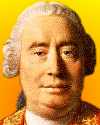
David Hume
(26 Apr 1711 - 25 Aug 1776)
Scottish philosopher and economist who is known for his philosophical skepticism and influenced metaphysical thought. Among other works, he authored A Treatise of Human Nature (1739-40) and History of England (1754-62). He was on the staff of British embassy in Paris (1763-66) and undersecretary of state (1767-68).
|
Science Quotes by David Hume (28 quotes)
'Tis certain that a serious attention to the sciences and liberal arts softens and humanizes the temper, and cherishes those fine emotions in which true virtue and honor consist. It rarely, very rarely happens that a man of taste and learning is not, at least, an honest man, whatever frailties may attend him.
— David Hume
Essay XVIII, 'The Sceptic', Essays and Treatises on Several Subjects (1742, New ed. 1767), Vol. 1, 193.
That the Sun will not rise Tomorrow is no less intelligible a Proposition and implies no more contradiction than the Affirmation that it will rise. We should in vain, therefore, attempt to demonstrate its falsehood.
— David Hume
An Enquiry Concerning Human Understanding (1748), 48.
A Miracle is a Violation of the Laws of Nature; and as a firm and unalterable Experience has established these Laws, the Proof against a Miracle, from the very Nature of the Fact, is as entire as any Argument from Experience can possibly be imagined. Why is it more than probable, that all Men must die; that Lead cannot, of itself, remain suspended in the Air; that Fire consumes Wood, and is extinguished by Water; unless it be, that these Events are found agreeable to the Laws of Nature, and there is required a Violation of these Laws, or in other Words, a Miracle to prevent them? Nothing is esteem'd a Miracle, if it ever happen in the common Course of Nature... There must, therefore, be a uniform Experience against every miraculous Event, otherwise the Event would not merit that Appellation. And as a uniform Experience amounts to a Proof, there is here a direct and full Proof, from the Nature of the Fact, against the Existence of any Miracle; nor can such a Proof be destroy'd, or the Miracle render'd credible, but by an opposite Proof, which is superior.
— David Hume
An Enquiry Concerning Human Understanding (1748), 180-181.
All knowledge degenerates into probability.
— David Hume
A Treatise on Human Nature (1739-40), ed. L. A. Selby-Bigge (1888), book 1, part 4, section 1, 180.
All knowledge resolves itself into probability. ... In every judgment, which we can form concerning probability, as well as concerning knowledge, we ought always to correct the first judgment deriv’d from the nature of the object, by another judgment, deriv’d from the nature of the understanding.
— David Hume
In A treatise of Human Nature (1888), 181-182.
All the sciences have a relation, greater or less, to human nature; and...however wide any of them may seem to run from it, they still return back by one passage or another. Even Mathematics, Natural Philosophy, and Natural Religion, are in some measure dependent on the science of MAN; since they lie under the cognizance of men, and are judged of by their powers and faculties.
— David Hume
A Treatise on Human Nature (1739-40), ed. L. A. Selby-Bigge (1888), introduction, xix.
Be a Philosopher; but, amidst all your Philosophy, be still a Man.
— David Hume
An Enquiry Concerning Human Understanding (1748), 7.
But the life of a man is of no greater importance to the universe than that of an oyster.
— David Hume
'On Suicide' (written 1755, published postumously). In Essays On Suicide And The Immortality Of The Soul: (1777, New Ed. 1799), 7.
Generally speaking, the errors in religion are dangerous; those in philosophy only ridiculous.
— David Hume
A Treatise on Human Nature (1739-40), ed. L. A. Selby-Bigge (1888), book 1, part 4, section 7, 272.
If ... the past may be no Rule for the future, all Experience becomes useless and can give rise to no Inferences or Conclusions.
— David Hume
An Enquiry Concerning Human Understanding (1748), 65.
If we take in our hand any Volume; of Divinity or School Metaphysics, for Instance; let us ask, Does it contain any abstract Reasoning concerning Quantity or Number? No. Does it contain any experimental Reasoning concerning Matter of Fact and Existence? No. Commit it then to the Flames: For it can contain nothing but Sophistry and Illusion.
— David Hume
An Enquiry Concerning Human Understanding (1748), 256.
In all matters of opinion and science ... the difference between men is ... oftener found to lie in
generals than in particulars; and to be less in reality than in appearance. An explication of the
terms commonly ends the controversy, and the disputants are surprised to find that they had been
quarrelling, while at bottom they agreed in their judgement.
— David Hume
Dissertation IV, 'Of the Standard of Taste', Four Dissertations (1757), 204.
In reality, all Arguments from Experience are founded on the Similarity which we discover among natural Objects, and by which we are induc'd to expect effects similar to those which we have found to follow from such Objects. And tho' none but a Fool or Madman will ever pretend to dispute the Authority of Experience, or to reject that great Guide of human Life, it may surely be allow'd a Philosopher to have so much Curiosity at least as to examine the Principle of human Nature, which gives this mighty Authority to Experience, and makes us draw Advantage from that Similarity which Nature has plac'd among different Objects. From Causes which appear similar we expect similar Effects. This is the Sum of our experimental Conclusions.
— David Hume
An Enquiry Concerning Human Understanding (1748), 63.
It must, however, be confessed that this species of scepticism, when more moderate, may be understood in a very reasonable sense, and is a necessary preparative to the study of philosophy by preserving a proper impartiality in our judgments and weaning our mind from all those prejudices which we may have imbibed from education or rash opinion.
— David Hume
From 'An Inquiry Concerning Human Understanding', Sec. 7, Pt. 1, collected in Essays and Treatises on Various Subjects: With a Brief Sketch of the (1849), 85.
It seems to me, that the only Objects of the abstract Sciences or of Demonstration is Quantity and Number, and that all Attempts to extend this more perfect Species of Knowledge beyond these Bounds are mere Sophistry and Illusion.
— David Hume
An Enquiry Concerning Human Understanding (1748), 252.
Look round the world, contemplate the whole and every part of it: you will find it to be nothing but one great machine, subdivided into an infinite number of lesser machines, which again admit of subdivisions to a degree beyond what human senses and faculties can trace and explain. All these various machines, and even their most minute parts, are adjusted to each other with an accuracy which ravishes into admiration all men who have ever contemplated them. The curious adapting of means to ends, throughout all nature, resembles exactly, though it much exceeds, the productions of human contrivance-of human design, thought, wisdom, and intelligence.
— David Hume
Dialogues Concerning Natural Religion (1779), 47-48.
Look round this universe. What an immense profusion of beings, animated and organized, sensible and active! You admire this prodigious variety and fecundity. But inspect a little more narrowly these living existences, the only beings worth regarding. How hostile and destructive to each other! How insufficient all of them for their own happiness! How contemptible or odious to the spectator! The whole presents nothing but the idea of a blind Nature, inpregnated by a great vivifying principle, and pouring forth from her lap, without discernment or parental care, her maimed and abortive children.
— David Hume
In Dialogues Concerning Natural Religion (1779), 219-220.
Reason is, and ought only to be the slave of the passions, and can never pretend to any other office than to serve and obey them.
— David Hume
A Treatise on Human Nature (1739-40), ed. L. A. Selby-Bigge (1888), book 2, part 3, section 3, 415.
The anatomist presents to the eye the most hideous and disagreeable objects, but his science is useful to the painter in delineating even a Venus or a Helen.
— David Hume
Inquiry Concerning the Human Understanding collected in The Philosophical Works of David Hume (1826), Vol. 4, 8.
The sweetest and most inoffensive path of life leads through the avenues of science and learning; and whoever can either remove any obstruction in this way, or open up any new prospect, ought, so far, to be esteemed a benefactor to mankind.
— David Hume
…...
There is nothing, in itself, valuable or despicable, desirable or hateful, beautiful or deformed; but that these attributes arise from the particular constitution and fabric of human sentiment and affection.
— David Hume
Essay XVIII, 'The Sceptic', Essays and Treatises on Several Subjects (1742, New ed. 1767), Vol. 1, 184.
Tho' there be no such Thing as Chance in the World; our Ignorance of the real Ccause of any Event has the same Influence on the Understanding, and begets a like Species of Belief or Opinion.
— David Hume
An Enquiry Concerning Human Understanding (1748), 93.
Tis evident that all reasonings concerning matter of fact are founded on the relation of cause and effect, and that we can never infer the existence of one object from another, unless they be connected together, either mediately or immediately... Here is a billiard ball lying on the table, and another ball moving toward it with rapidity. They strike; and the ball which was formerly at rest now acquires a motion. This is as perfect an instance of the relation of cause and effect as any which we know, either by sensation or reflection.
— David Hume
An Abstract of A Treatise on Human Nature (1740), ed. John Maynard Keynes and Piero Sraffa (1938), 11.
To consider the matter aright, reason is nothing but a wonderful and unintelligible instinct in our souls, which carries us along a certain train of ideas, and endows them with particular qualities, according to their particular situations and relations. This instinct, 'tis true, arises from past observation and experience; but can anyone give the ultimate reason, why past experience and observation produces such an effect, any more than why nature alone should produce it?
— David Hume
A Treatise on Human Nature (1739-40), ed. L. A. Selby-Bigge (1888), book 1, part 3, section 16, 179.
We have no other notion of cause and effect, but that of certain objects, which have always conjoin’d together, and which in all past instances have been found inseparable. We cannot penetrate into the reason of the conjunction. We only observe the thing itself, and always find that from the constant conjunction the objects acquire an union in the imagination.
— David Hume
A Treatise on Human Nature (1739-40), ed. L. A. Selby-Bigge (1888), book 1, part 3, section 6, 93.
We need only reflect on what has been prov'd at large, that we are never sensible of any connexion betwixt causes and effects, and that 'tis only by our experience of their constant conjunction, we can arrive at any knowledge of this relation.
— David Hume
A Treatise on Human Nature (1739-40), ed. L. A. Selby-Bigge (1888), book 1, part 4, section 165, 247.
What is possible can never be demonstrated to be false; and 'tis possible the course of nature may change, since we can conceive such a change. Nay, I will go farther, and assert, that he could not so much as prove by any probable arguments, that the future must be conformable to the past. All probable arguments are built on the supposition, that there is this conformity betwixt the future and the past, and therefore can never prove it. This conformity is a matter of fact, and if it must be proved, will admit of no proof but from experience. But our experience in the past can be a proof of nothing for the future, but upon a supposition, that there is a resemblance betwixt them. This therefore is a point, which can admit of no proof at all, and which we take for granted without any proof.
— David Hume
An Abstract of A Treatise on Human Nature (1740), ed. John Maynard Keynes and Piero Sraffa (1938), 15.
While Newton seemed to draw off the veil from some of the mysteries of nature, he showed at the same time the imperfections of the mechanical philosophy; and thereby restored her ultimate secrets to that obscurity, in which they ever did and ever will remain.
— David Hume
The History Of Great Britain, Containing the Commonwealth and the Reigns of Charles II. and James II. (2nd ed. 1759), Vol. 2, 450.
Quotes by others about David Hume (7)
We hold these truths to be self-evident.
Franklin's edit to the assertion of religion in Thomas Jefferson's original wording, “We hold these truths to be sacred and undeniable” in a draft of the Declaration of Independence changes it instead into an assertion of rationality. The scientific mind of Franklin drew on the scientific determinism of Isaac Newton and the analytic empiricism of David Hume and Gottfried Leibniz. In what became known as “Hume's Fork” the latters' theory distinguished between synthetic truths that describe matters of fact, and analytic truths that are self-evident by virtue of reason and definition.
Franklin's edit to the assertion of religion in Thomas Jefferson's original wording, “We hold these truths to be sacred and undeniable” in a draft of the Declaration of Independence changes it instead into an assertion of rationality. The scientific mind of Franklin drew on the scientific determinism of Isaac Newton and the analytic empiricism of David Hume and Gottfried Leibniz. In what became known as “Hume's Fork” the latters' theory distinguished between synthetic truths that describe matters of fact, and analytic truths that are self-evident by virtue of reason and definition.
As explained by Walter Isaacson in Benjamin Franklin: An American Life (2004), 312.
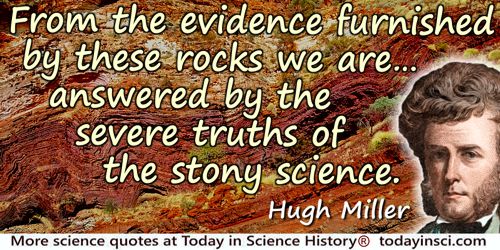
No true geologist holds by the development hypothesis;—it has been resigned to sciolists and smatterers;—and there is but one other alternative. They began to be, through the miracle of creation. From the evidence furnished by these rocks we are shut down either to belief in miracle, or to something else infinitely harder of reception, and as thoroughly unsupported by testimony as it is contrary to experience. Hume is at length answered by the severe truths of the stony science.
The Foot-prints of the Creator: Or, The Asterolepis of Stromness (1850, 1859), 301.
The existing premises, wholly altered by geologic science, are no longer those of Hume. The foot-print in the sand—to refer to his happy illustration—does now stand alone. Instead of one, we see many footprints, each in turn in advance of the print behind it, and on a higher level.
Lecture to the Edinburgh Philosophical Institution, 'Geology in its Bearings on the Two Theologies, Part 1', collected in The Testimony of the Rocks: or, Geology in Its Bearings on the Two Theologies, Natural and Revealed (1857), 223.
The late Mr. David Hume, in his posthumous works, places the powers of generation much above those of our boasted reason; and adds, that reason can only make a machine, as a clock or a ship, but the power of generation makes the maker of the machine; … he concludes, that the world itself might have been generated, rather than created; that is, it might have been gradually produced from very small beginnings, increasing by the activity of its inherent principles, rather than by a sudden evolution of the whole by the Almighty fiat.—What a magnificent idea of the infinite power of THE GREAT ARCHITECT! THE CAUSE OF CAUSES! PARENT OF PARENTS! ENS ENTIUM!
For if we may compare infinities, it would seem to require a greater infinity of power to cause the causes of effects, than to cause the effects themselves.
For if we may compare infinities, it would seem to require a greater infinity of power to cause the causes of effects, than to cause the effects themselves.
'Generation', Zoonomia (1794), Vol. 1, 509. Note that this passage was restated in a 1904 translation of a book by August Weismann. That rewording was given in quotation marks and attributed to Erasumus Darwin without reference to David Hume. In the reworded form, it is seen in a number of later works as a direct quote made by Erasmus Darwin. For that restated form see the webpage for August Weismann. Webmaster has checked the quotation on this webpage in the original Zoonomia, and is the only verbatim form found so far.
The Chinese, who aspire to be thought an enlightened nation, to this day are ignorant of the circulation of the blood; and even in England the man who made that noble discovery lost all his practice in the consequence of his ingenuity; and Hume informs us that no physician in the United Kingdom who had attained the age of forty ever submitted to become a convert to Harvey’s theory, but went on preferring numpsimus to sumpsimus to the day of his death.
Reflection 352, in Lacon: or Many things in Few Words; Addressed to Those Who Think (1820), 164-165.
The barrenness of doubt had to make itself felt before it could be supplanted by knowledge. It was not until Hume, by carrying scepticism to its uttermost extent, had shown its unsatisfactory character and vain results, that the germs of scientific method, implanted by Bacon and Descartes, could develop and bear fruit in the positive philosophy of Comte.
In 'Mr. Buckle’s Fallacies', Darwinism and Other Essays (1893), 190.
Science has never shaken off the impress of its origin In the historical revolt of the later Renaissance, It has remained predominately an anti-rationalistic movement, based on a naive faith. What reasoning it has wanted it borrowed from mathematics, which is a surviving relic of Greek rationalism, following the deductive method. Science repudiated Philosophy. In other words, it never cared to justify its faith or explain its meaning; it has remained blandly indifferent to its refutation by Hume.
In Science and the Modern World: Lowell Lectures, 1925 (1926), 23-24.
 In science it often happens that scientists say, 'You know that's a really good argument; my position is mistaken,' and then they would actually change their minds and you never hear that old view from them again. They really do it. It doesn't happen as often as it should, because scientists are human and change is sometimes painful. But it happens every day. I cannot recall the last time something like that happened in politics or religion.
(1987) --
In science it often happens that scientists say, 'You know that's a really good argument; my position is mistaken,' and then they would actually change their minds and you never hear that old view from them again. They really do it. It doesn't happen as often as it should, because scientists are human and change is sometimes painful. But it happens every day. I cannot recall the last time something like that happened in politics or religion.
(1987) -- 




