 (source)
|
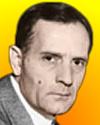
Edwin Powell Hubble
(20 Nov 1889 - 28 Sep 1953)
American astronomer who is considered the founder of extragalactic astronomy and who provided the first evidence of the expansion of the universe. Hubble measured distances to galaxies and their redshifts, and in 1929 he published the velocity-distance relation which is the basis of modern cosmology.
|
Science Quotes by Edwin Powell Hubble (26 quotes)
[A scientist] naturally and inevitably … mulls over the data and guesses at a solution. [He proceeds to] testing of the guess by new data—predicting the consequences of the guess and then dispassionately inquiring whether or not the predictions are verified.
— Edwin Powell Hubble
From manuscript on Francis Bacon as a scientist (1942), Edwin Hubble collection, Box 2, Huntington Library, San Marino, California. As cited by Norriss S. Hetherington in 'Philosophical Values and Observation in Edwin Hubble's Choice of a Model of the Universe', Historical Studies in the Physical Sciences (1982), 13, No. 1, 42.
Astronomy, the type specimen of pure science.
— Edwin Powell Hubble
The Nature of Science and Other Lectures (1954), 5.
Equipped with his five senses, man explores the universe around him and calls the adventure science.
— Edwin Powell Hubble
In The Nature of Science, and Other Lectures (1954), 6.
Eventually, we reach … the utmost limits of our telescopes. There, we measure shadows, and we search among ghostly errors of measurement for landmarks that are scarcely more substantial.
— Edwin Powell Hubble
In Realm of the Nebulae: The Silliman Memorial Lectures Series (1936), 201-202. The lecture series was delivered at Yale University in Fall 1935. Part of a longer quote on this page that begins: “The explorations of space…”.
From our home on the Earth, we look out into the distances and strive to imagine the sort of world into which we were born. Today, we have reached far into space. Our immediate neighborhood we know rather intimately. But with increasing distance our knowledge fades … The search will continue. The urge is older than history. It is not satisfied and will not be suppressed.
— Edwin Powell Hubble
In 'From Our Home On The Earth', The Land (1946), 5, 145. As cited on the webpage of the Edwin Powell Hubble Papers.
I chucked the law for astronomy, and I knew that even if I were second-rate or third-rate, it was astronomy that mattered.
— Edwin Powell Hubble
As quoted in Nicholas U. Mayall, Biographical Memoir, 'Edwin Powell Hubble: 1889—1953', Memoirs of the National Academy of Sciences (1970), Vol. 41, 179.
Knowledge has been accumulating at an ever increasing rate, and knowledge, once it is available, can be used for evil as well as for good. It was inevitable that a day would come when the expanding body of knowledge would sweep across the danger level. That day, as you know, has come—and passed. Knowledge is already available by means of which men could wreck the civilization of the world—and the growth of knowledge continues faster than ever before.
— Edwin Powell Hubble
The Nature of Science and Other Lectures (1954), 4.
Mathematicians deal with possible worlds, with an infinite number of logically consistent systems. Observers explore the one particular world we inhabit. Between the two stands the theorist. He studies possible worlds but only those which are compatible with the information furnished by observers. In other words, theory attempts to segregate the minimum number of possible worlds which must include the actual world we inhabit. Then the observer, with new factual information, attempts to reduce the list further. And so it goes, observation and theory advancing together toward the common goal of science, knowledge of the structure and observation of the universe.
— Edwin Powell Hubble
Lecture to Sigma Xi, 'The Problem of the Expanding Universe' (1941), printed in Sigma Xi Quarterly (1942), 30, 104-105. Reprinted in Smithsonian Institution Report of the Board of Regents (1943), 97, 123. As cited by Norriss S. Hetherington in 'Philosophical Values and Observation in Edwin Hubble's Choice of a Model of the Universe', Historical Studies in the Physical Sciences (1982), 13, No. 1, 63.
Observations always involve theory.
— Edwin Powell Hubble
In The Realm of the Nebulae (1936), 35.
Past time is finite, future time is infinite.
— Edwin Powell Hubble
The Observational Approach to Cosmology (1937), 62.
Positive, objective knowledge is public property. It can be transmitted directly from one person to another, it can be pooled, and it can be passed on from one generation to the next. Consequently, knowledge accumulates through the ages, each generation adding its contribution. Values are quite different. By values, I mean the standards by which we judge the significance of life. The meaning of good and evil, of joy and sorrow, of beauty, justice, success-all these are purely private convictions, and they constitute our store of wisdom. They are peculiar to the individual, and no methods exist by which universal agreement can be obtained. Therefore, wisdom cannot be readily transmitted from person to person, and there is no great accumulation through the ages. Each man starts from scratch and acquires his own wisdom from his own experience. About all that can be done in the way of communication is to expose others to vicarious experience in the hope of a favorable response.
— Edwin Powell Hubble
The Nature of Science and Other Lectures (1954), 7.
Science deals with judgments on which it is possible to obtain universal agreement. These judgments do not concern individual facts and events, but the invariable association of facts and events known as the laws of science. Agreement is secured by observation and experiment—impartial courts of appeal to which all men must submit if they wish to survive. The laws are grouped and explained by theories of ever increasing generality. The theories at first are ex post facto—merely plausible interpretations of existing bodies of data. However, they frequently lead to predictions that can be tested by experiments and observations in new fields, and, if the interpretations are verified, the theories are accepted as working hypotheses until they prove untenable. The essential requirements are agreement on the subject matter and the verification of predictions. These features insure a body of positive knowledge that can be transmitted from person to person, and that accumulates from generation to generation.
— Edwin Powell Hubble
From manuscript on English Science in the Renaissance (1937), Edwin Hubble collection, Box 2, Huntington Library, San Marino, California. As cited by Norriss S. Hetherington in 'Philosophical Values and Observation in Edwin Hubble's Choice of a Model of the Universe', Historical Studies in the Physical Sciences (1982), 13, No. 1, 41. (Hetherington comments parenthetically that the references to court, judgment and appeal may be attributable to his prior experiences as a Rhodes Scholar reading Roman law at Oxford, and to a year's practice as an attorney in Louisville, Kentucky.)
Science is the one human activity that is truly progressive. The body of positive knowledge is transmitted from generation to generation.
— Edwin Powell Hubble
In The Realm of the Nebulae (1936), 1.
Scientists in general are not very articulate; they work in comparative seclusion and they do not cultivate the art of persuasion. But now a new era has emerged, and reticence is no longer a virtue.
— Edwin Powell Hubble
The Nature of Science and Other Lectures (1954), 3.
The essential characteristic of science is the simple idea of attempting “to ascertain objective truth without regard to personal desires.”
— Edwin Powell Hubble
The Nature of Science and Other Lectures (1954), 8.
The explorations of space end on a note of uncertainty. And necessarily so. … We know our immediate neighborhood rather intimately. With increasing distance our knowledge fades, and fades rapidly. Eventually, we reach the dim boundary—the utmost limits of our telescopes. There, we measure shadows, and we search among ghostly errors of measurement for landmarks that are scarcely more substantial. The search will continue. Not until the empirical resources are exhausted, need we pass on to the dreamy realms of speculation.
— Edwin Powell Hubble
From conclusion of The Silliman Memorial Lectures Series delivered at Yale University (Fall 1935). Collected in The Realm of the Nebulae: The Silliman Memorial Lectures Series (1936), 201-202.
The first notions of law and order in the universe were found in the heavens. When the same ideas were dragged down from the skies to the earth, Physics was born.
— Edwin Powell Hubble
The Nature of Science and Other Lectures (1954), 5.
The general acceptance of the validity of science is a very recent phenomenon. As late as 1880, Huxley complained that “no reply to a troublesome argument tells so well as calling its author a ‘mere scientific specialist.’”
— Edwin Powell Hubble
The Nature of Science and Other Lectures (1954), 3.
The history of astronomy is a history of receding horizons.
— Edwin Powell Hubble
In The Realm of the Nebulae (1936), 21.
The methods of science may be described as the discovery of laws, the explanation of laws by theories, and the testing of theories by new observations. A good analogy is that of the jigsaw puzzle, for which the laws are the individual pieces, the theories local patterns suggested by a few pieces, and the tests the completion of these patterns with pieces previously unconsidered. … The scientist likes to fancy … that sufficient pieces may be assembled to indicate eventually the entire pattern of the puzzle, and thus to reveal the structure and behavior of the physical universe as it appears to man.
— Edwin Powell Hubble
The Nature of Science and Other Lectures (1954), 11.
The realm of science is the public domain of positive knowledge. The world of values is the private domain of personal convictions. These two realms, together, form the universe in which we spend our lives; they do not overlap.
— Edwin Powell Hubble
The Nature of Science and Other Lectures (1954), 6-7.
The scientist explores the world of phenomena by successive approximations. He knows that his data are not precise and that his theories must always be tested. It is quite natural that he tends to develop healthy skepticism, suspended judgment, and disciplined imagination.
— Edwin Powell Hubble
In Commencement Address, California Institute of Technology (10 Jun 1938), 'Experiment and Experience'. Collected in abridged form in The Huntington Library Quarterly (Apr 1939), 2, No. 3, 245
The subject matter of science has been described as “judgments on which it is possible to obtain universal agreement.” These judgments do not concern individual events, which can be witnessed only by a few persons at most. They are the invariable association of events or properties which are known as the laws of science. Agreement is obtained by observation and experiment—a court of appeal to which men of all races and creeds must submit if they wish to survive.
— Edwin Powell Hubble
The Nature of Science and Other Lectures (1954), 8. Norriss S. Hetherington comments parenthetically that the references to court, judgment and appeal may be attributable to his prior experiences as a Rhodes Scholar reading Roman law at Oxford, and to a year’s practice as an attorney in Louisville, Kentucky. As stated in Norriss S. Hetherington, 'Philosophical Values and Observation in Edwin Hubble’s Choice of a Model of the Universe', Historical Studies in the Physical Sciences (1982), 13, No. 1, 41.
The whole thing is so much bigger than I am, and I can't understand it, so I just trust myself to it; and forget about it.
— Edwin Powell Hubble
Reply to a “deeply depressed” friend’s question about his belief in a Creator of the universe. As quoted in Gale E. Christianson, Edwin Hubble: Mariner of the Nebulae (1996), 183.
We do not know why we are born into the world, but we can try to find out what sort of a world it is—at least in its physical aspects.
— Edwin Powell Hubble
As quoted in Gale E. Christianson, Edwin Hubble: Mariner of the Nebulae (1996), 183. Cited as from Edwin P. Hubble Manuscript Collection, Henry Huntington Library. San Manno, California, in writings of Grace Burke Hubble on E.P H. Characteristics, 2: 82(9). Box 7, 23.
Wisdom cannot be directly transmitted, and does not readily accumulate through the ages.
— Edwin Powell Hubble
From manuscript on English Science in the Renaissance (1937), Edwin Hubble collection, Box 2, Huntington Library, San Marino, California. As cited by Norriss S. Hetherington in 'Philosophical Values and Observation in Edwin Hubble's Choice of a Model of the Universe', Historical Studies in the Physical Sciences (1982), 13, No. 1, 41.
Quotes by others about Edwin Powell Hubble (3)
Hubble's observations suggested that there was a time, called the big bang, when the universe was infinitesimally small and infinitely dense. Under such conditions all the laws of science, and therefore all ability to predict the future, would break down. If there were events earlier than this time, then they could not affect what happens at the present time. Their existence can be ignored because it would have no observational consequences. One may say that time had a beginning at the big bang, in the sense that earlier times simply would not be defined. It should be emphasized that this beginning in time is very different from those that had been considered previously. In an unchanging universe a beginning in time is something that has to be imposed by some being outside the universe; there is no physical necessity for a beginning. One can imagine that God created the universe at literally any time in the past. On the other hand, if the universe is expanding, there may be physical reasons why there had to be a beginning. One could still imagine that God created the universe at the instant of the big bang, or even afterwards in just such a way as to make it look as though there had been a big bang, but it would be meaningless to suppose that it was created before the big bang. An expanding universe does not preclude a creator, but it does place limits on when he might have carried out his job!
A Brief History of Time: From the Big Bang to Black Holes (1988), 8-9.
Scientists come in two varieties, hedgehogs and foxes. I borrow this terminology from Isaiah Berlin (1953), who borrowed it from the ancient Greek poet Archilochus. Archilochus told us that foxes know many tricks, hedgehogs only one. Foxes are broad, hedgehogs are deep. Foxes are interested in everything and move easily from one problem to another. Hedgehogs are only interested in a few problems that they consider fundamental, and stick with the same problems for years or decades. Most of the great discoveries are made by hedgehogs, most of the little discoveries by foxes. Science needs both hedgehogs and foxes for its healthy growth, hedgehogs to dig deep into the nature of things, foxes to explore the complicated details of our marvelous universe. Albert Einstein and Edwin Hubble were hedgehogs. Charley Townes, who invented the laser, and Enrico Fermi, who built the first nuclear reactor in Chicago, were foxes.
In 'The Future of Biotechnology', A Many-Colored Glass: Reflections on the Place of Life in the Universe (2007), 1.
Picture yourself during the early 1920's inside the dome of the [Mount Wilson Observatory]. …
[Milton] Humason is showing [Harlow] Shapley stars he had found in the Andromeda Nebula that appeared and disappeared on photographs of that object. The famous astronomer very patiently explains that these objects could not be stars because the Nebula was a nearby gaseous cloud within our own Milky Way system. Shapley takes his handkerchief from his pocket and wipes the identifying marks off the back of the photographic plate.
Of course, Hubble came along in 1924 and showed that it was just these Cepheid variable stars in the Andromeda Nebula which proved it was a separate galaxy system.
Of course, Hubble came along in 1924 and showed that it was just these Cepheid variable stars in the Andromeda Nebula which proved it was a separate galaxy system.
In Quasars, Redshifts and Controversies (1998), 168. Arp writes that this was “a piece of real history which I happen to know because it was told to me by one of the participants. It dramatically illustrate the critical role of discordant evidence.”
See also:
- 20 Nov - short biography, births, deaths and events on date of Hubble's birth.
 In science it often happens that scientists say, 'You know that's a really good argument; my position is mistaken,' and then they would actually change their minds and you never hear that old view from them again. They really do it. It doesn't happen as often as it should, because scientists are human and change is sometimes painful. But it happens every day. I cannot recall the last time something like that happened in politics or religion.
(1987) --
In science it often happens that scientists say, 'You know that's a really good argument; my position is mistaken,' and then they would actually change their minds and you never hear that old view from them again. They really do it. It doesn't happen as often as it should, because scientists are human and change is sometimes painful. But it happens every day. I cannot recall the last time something like that happened in politics or religion.
(1987) -- 





