 (source)
|
Elias Howe
(9 Jul 1819 - 3 Oct 1867)
American inventor who developed a commercially successful sewing machine.
|
Elias Howe
Biography from A History of American Manufactures (1866)
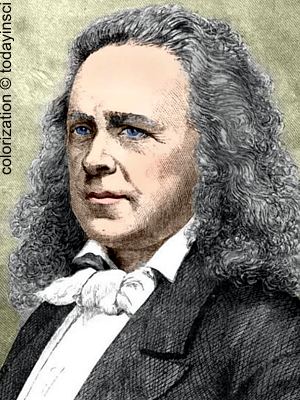
Elias Howe, Jr., the author of one of the great inventions of modern times, the Sewing Machine, was born in Spencer, Massachusetts, in 1819. His father was a farmer and a miller; and young Howe aided him in these pursuits, attending school in the winter, until he was seventeen years old, when he was apprenticed to learn the art of the machinist. When be had attained his majority he married, and not long after he conceived the idea of making a machine that would sew, at which be diligently labored in all spare hours after the day's labor. At one time, while in Lowell, he earned but fifty cents a day, and when his wages were increased to sixty-two and a half cents he states that he felt about as well pleased as he has ever felt since. For the years he experimented on the various movements of the machine, and on the 10th of September, 1846, while residing at Cambridgeport, he obtained his first patent for the first practical Sewing Machine. “Singularly enough,” says an English chronicler, “his fellow-countrymen did not at once see the merit of his invention, and its introduction to the public was first made in, England. Shortly after his patent was obtained he sent over a machine to this country, and disposed of the English patent to Mr. Thomas, for, we believe, £200! Mr. Howe himself visited this country soon after the arrival of his machine, and superintended its adaptation to the work required to be done by Mr. Thomas—staymaking. Beyond the £200, we do not see that poor Howe did any good for himself over here; for in 1849 he returned again to America, so poorly off that he was obliged to work his way home before the mast.”
On his return to the United Stares he became involved in a number of expensive lawsuits to establish the validity of his patent, and it was not until 1853 that he granted his first license. Thenceforward, however, fortune began to smile upon him, and in 1855 he had repurchased all the patents he had sold during his season of adversity. He received a royalty upon every Sewing Machine manufactured in the United States, and his income from this source was, for some time, not less than $250,000 a year—a large prize for an humble mechanic to win, but yet incomparably trifling compared with the benefit conferred upon the world by the gift. of his labor-saving machine.
In 1863 he organized a Company, of which he was President until his decease in 1867, and erected a large Sewing manufactory at Bridgeport, Connecticut. See Manufactures of Bridgeport. Vol. III.
- 9 Jul - short biography, births, deaths and events on date of Howe's birth.
- Large color picture of Elias Howe (600 x 800 px)
- Elias Howe Biography from Great Fortunes and How They Were Made (1871).
- The First Howe Sewing Machine - Large Picture (800 x 850 px)
- Elias Howe: Inventive Boy, by Jean Corcoran. - book suggestion.





