 (source)
|
Jonathan Carter Hornblower
(5 Jul 1753 - Mar 1815)
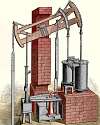
English mining engineer who invented the first compound steam engine. The term “compound” refers to the system of two cylinders, whereby exhaust steam from the first cylinder is fed to a second cylinder to provide additional power.
|
Jonathan Hornblower's Family Biographies
from Dictionary of National Biography (1901)
JONATHAN HORNBLOWER, (1717-1800), engineer, belonged to a family which for two generations had shown much inventive genius. His father, Joseph Hornblower (1692?-1761), born at Brosely, Shropshire, made the acquaintance of Newcomen when the latter was building a machine at Wolverhampton in 1712, and went to Cornwall in 1725 to erect a Newcomen engine at Wheal Rose, near Truro; he afterwards erected similar engines at Wheal Bury and Polgooth, and in 1748 settled at Salem, Chacewater, and died at Bristol in 1761.
Jonathan went to Cornwall to succeed his father as engineer in 1745, and finally settled at Chacewater in 1765. He was engaged in the construction of engines, and began putting together Tresavean engine on 20 Jan 1766. He died at Whitehall, near Scorrier, Cornwall, in 1780, leaving two sons.
Josiah's second brother, Josiah (1729?-1809), went with him to Cornwall, and assisted him as engineer until he emigrated to America in May 1753. There he obtained reputation as an engineer and mathematician, and became a magistrate, a member of the legislature, and Speaker of the House of Assembly, New Jersey, U.S.A. He died at Belleville, N.J. in January 1809.
Jonathan's four elder sons assisted him as engineers. The eldest, Jabez Carter Hornblower (1744-1814), born at Broseley 21 May 1744, was at first bred to the law by his grandfather Carter, but at the age of nineteen became an engineer working with his father, and in 1775 went to Holland to build engines for the Dutch government, and afterwards to Sweden. In 1788 he became bankrupt while in business in Gloucester. He contrived an improved machine for glazing calicoes, which he patented 4 Feb 1800, and wrote on the“Steam Engine” in Pantologia (1813), partly edited by Dr. Olinthus Gilbert Gregory. He died in London on 11 Jul 1814. Jethro Hornblower (1746-1820), third son of Jonathan, patented, 15 Nov. 1798, “A new method of making patterns.”
Jonathan Carter Hornblower (1753-1815), the most distinguished engineer of the family was Jonathan's fourth son. He was born at Chacewater on 5 July 1753, and is known as the inventor of the “double-beat valve.” It was principally with him and his father that Watt had to compete when Watt's new engine with separate condensers was introduced into Cornwall. Watt employed Johnathan Carter and his four sons to assist in the erection of several engines, and after mastering the details, which gave the condensing machine advantages over Newcomen's invention in dealing with large masses of water, the Hornblowers resolved to contrive a steam engine to outrival that of Watt. “They have laboured” (letter from Watt to Boulton, 16 July 1781) “to evade our act, have long had a copy of our specification ... they pretend to condense the steam in the cylinder, but I have heard they do it in a separate vessel.” “It is no less” (ib. 19 Nov. 1791) “than our double cylinder engine worked upon our principle of expansion.” The machine patented 13 July 1781 by Jonathan Carter Hornblower was described as a “Machine of [sic] Engine for raising Water and other liquids and for other purposes by means of Fire and Steam.” It had two cylinders, and both piston rods were attached at the same end of the working-beam. The machine became the subject of a lawsuit for infringement of Watt's patent. Experts pronounced it to be essentially based on Watt's expansion principle, and in 1799 the court of king's bench decided finally against Hornblower' for using a “separate condenser and air-pump.” The singular merit of Hornblower's patent was that it anticipated the principle of the compound engine, which, owing to the infringement of Watt's patent, thus remained undeveloped till it was rediscovered afterwards by Woolf. Hornblower's machine was the first attempt at using steam expansively. Dr. Olinthus Gregory, in the “Treatise of Mechanics,” 1806, appears to defend Hornblower, and (II, 381, &c.) introduces a statement of his claims as an independent inventor, with strictures on Watt and his friends. In a subsequent edition Dr. Gregory expressed different views, and a writer in the “Edinburgh Review” (January 1809) shows that Hornblower's own account of his contrivance is decisive as to his infringement of Watt's patent.
In 1798 and 1805 Hornblower printed in London descriptions of a “new invented machine or rotatative engine” and “new invented [steam] wheel or engine.” Both inventions he patented in those years. He wrote also “Description of a Machine for communicating Motion at a Distance,” Bristol, 1786. To Nicholson's Journal he contributed various essays, including “Description of an Hydraulic Bellows,” 1802; “Of a Measuring Screw,” 1803; “Account of a Machine for Sweeping Chimneys by a Blast of Air,” 1804; “On the Measure of Forces by Horse Power,” 1805; “On the Measure of Mechanical Power,” &c. Hornblower amassed a considerable fortune as an engineer in Cornwall, and died at Penryn in March 1815, leaving two daughters.
[Yesterday and To-Day, by Cyrus Redding (whose mother was Jonathan Hornblower's eldest daughter), i. 131-6; Woodcroft's Alph. Index of Patentees, p.265; Stuart's Hist. of the Steam Engine, p.141, &c. and Anecd. of the Steam Engine, pp.334, 363, &c.; Boase and Courtney's Bibl. Cornub. i. 253, 254, iii. 1235.]
- 5 Jul - short biography, births, deaths and events on date of Hornblower's birth.
- Abstract from Jonathan Carter Hornblower's U.K. Patent No. 1298 (13 Jul 1781) for his Compound Steam Engine.
- Jonathan Hornblower's Compound Steam Engine - Large Color Picture
- Jonathan Hornblower - Compound Steam Engine - from Stuart's Descriptive History of the Steam Engine (1829)
- The Most Powerful Idea in the World: A Story of Steam, Industry, and Invention, by William Rosen. - book suggestion.
- Booklist for Steam Engine History.





