 (source)
|
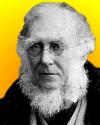
Sir Joseph Dalton Hooker
(30 Jun 1817 - 10 Dec 1911)
English botanist and explorer.
|
Science Quotes by Sir Joseph Dalton Hooker (10 quotes)
All I ever aim to do is to put the Development hypothesis in the same coach as the creation one. It will only be a question of who is to ride outside & who in after all.
— Sir Joseph Dalton Hooker
Letter to Asa Gray (31 May 1859). Quoted in A. Hunter Dupree, Asa Gray: American Botanist, Friend of Darwin (1988), 265. Originally published as Asa Gray: 1810-1888 (1959).
From my earliest childhood I nourished and cherished the desire to make a creditable journey in a new country, and write such a respectable account of its natural history as should give me a niche amongst the scientific explorers of the globe I inhabit, and hand my name down as a useful contributor of original matter.
— Sir Joseph Dalton Hooker
Letter to Charles Darwin (1854), in Francis Darwin, More Letters of Charles Darwin (1903).
I am above the forest region, amongst grand rocks & such a torrent as you see in Salvator Rosa's paintings vegetation all a scrub of rhodods. with Pines below me as thick & bad to get through as our Fuegian Fagi on the hill tops, & except the towering peaks of P. S. [perpetual snow] that, here shoot up on all hands there is little difference in the mt scenery—here however the blaze of Rhod. flowers and various colored jungle proclaims a differently constituted region in a naturalists eye & twenty species here, to one there, always are asking me the vexed question, where do we come from?
— Sir Joseph Dalton Hooker
Letter to Charles Darwin (24 Jun 1849). Quoted in The Correspondence of Charles Darwin (1988), Vol. 4, 1847-1850, 242.
I expect to think that I would rather be author of your book [The Origin of Species] than of any other on Nat. Hist. Science.
— Sir Joseph Dalton Hooker
Letter to Darwin (12 Dec 1859). Quoted in Leonard Huxley, Life and Letters of Sir Joseph Dalton Hooker (1918), Vol. 1, 511.
I was aware of Darwin's views fourteen years before I adopted them and I have done so solely and entirely from an independent study of the plants themselves.
— Sir Joseph Dalton Hooker
Letter to W.H. Harvey (c. 1860), in L. Huxley, Life and Letters of Sir Joseph Dalton Hooker (1918), Vol. 1, 520. As cited in Charles Coulston Gillispie, Dictionary of Scientific Biography (1972), 490, footnote 3.
In [David] Douglas's success in life ... his great activity, undaunted courage, singular abstemiousness, and energetic zeal, at once pointed him out as an individual eminently calculated to do himself credit as a scientific traveler.
— Sir Joseph Dalton Hooker
In 'Extracts from A Brief Memoir of the Life of David Douglas' (1834), in W.F. Wilson (ed.), David Douglas, Botanist at Hawaii (1919), 12.
It is difficult to conceive a grander mass of vegetation:—the straight shafts of the timber-trees shooting aloft, some naked and clean, with grey, pale, or brown bark; others literally clothed for yards with a continuous garment of epiphytes, one mass of blossoms, especially the white Orchids Caelogynes, which bloom in a profuse manner, whitening their trunks like snow. More bulky trunks were masses of interlacing climbers, Araliaceae, Leguminosae, Vines, and Menispermeae, Hydrangea, and Peppers, enclosing a hollow, once filled by the now strangled supporting tree, which has long ago decayed away. From the sides and summit of these, supple branches hung forth, either leafy or naked; the latter resembling cables flung from one tree to another, swinging in the breeze, their rocking motion increased by the weight of great bunches of ferns or Orchids, which were perched aloft in the loops. Perpetual moisture nourishes this dripping forest: and pendulous mosses and lichens are met with in profusion.
— Sir Joseph Dalton Hooker
Himalayan Journals (1854), vol. 1, 110-1.
Plants, in a state of nature, are always warring with one another, contending for the monopoly of the soil,—the stronger ejecting the weaker,—the more vigorous overgrowing and killing the more delicate. Every modification of climate, every disturbance of the soil, every interference with the existing vegetation of an area, favours some species at the expense of others.
— Sir Joseph Dalton Hooker
(With Thomas Thomson) Flora Indica: A Systematic Account of the Plants of British India (1855), 41.
The modern system of elevating every minor group, however trifling the characters by which it is distinguished, to the rank of genus, evinces, we think, a want of appreciation of the true value of classification. The genus is the group which, in consequence of our system of nomenclature, is kept most prominently before the mind, and which has therefore most importance attached to it ... The rashness of some botanists is productive of still more detrimental effects to the science in the case of species; for though a beginner may pause before venturing to institute a genus, it rarely enters into his head to hesitate before proposing a new species.
— Sir Joseph Dalton Hooker
(With Thomas Thomson) Flora Indica: A Systematic Account of the Plants of British India (1855),10-11.
These parsons are so in the habit of dealing with the abstractions of doctrines as if there was no difficulty about them whatever, so confident, from the practice of having the talk all to themselves for an hour at least every week with no one to gainsay a syllable they utter, be it ever so loose or bad, that they gallop over the course when their field is Botany or Geology as if we were in the pews and they in the pulpit ... There is a story somewhere of an Englishman, Frenchman, and German being each called on to describe a camel. The Englishman immediately embarked for Egypt, the Frenchman went to the Jardin des Plantes, and the German shut himself up in his study and thought it out!
— Sir Joseph Dalton Hooker
Letter to Asa Gray (29 Mar 1857). Quoted in Leonard Huxley, Life and Letters of Sir Joseph Dalton Hooker (1918), Vol. 1, 477.
Quotes by others about Sir Joseph Dalton Hooker (2)
Much of the geographical work of the past hundred years... has either explicitly or implicitly taken its inspiration from biology, and in particular Darwin. Many of the original Darwinians, such as Hooker, Wallace, Huxley, Bates, and Darwin himself, were actively concerned with geographical exploration, and it was largely facts of geographical distribution in a spatial setting which provided Darwin with the germ of his theory.
'Darwin's Impact on Geography', Annals of the Association of American Geographers (1966), 56, 683.
The one who stays in my mind as the ideal man of science is, not Huxley or Tyndall, Hooker or Lubbock, still less my friend, philosopher and guide Herbert Spencer, but Francis Galton, whom I used to observe and listen to—I regret to add, without the least reciprocity—with rapt attention. Even to-day. I can conjure up, from memory’s misty deep, that tall figure with its attitude of perfect physical and mental poise; the clean-shaven face, the thin, compressed mouth with its enigmatical smile; the long upper lip and firm chin, and, as if presiding over the whole personality of the man, the prominent dark eyebrows from beneath which gleamed, with penetrating humour, contemplative grey eyes. Fascinating to me was Francis Galton’s all-embracing but apparently impersonal beneficence. But, to a recent and enthusiastic convert to the scientific method, the most relevant of Galton’s many gifts was the unique contribution of three separate and distinct processes of the intellect; a continuous curiosity about, and rapid apprehension of individual facts, whether common or uncommon; the faculty for ingenious trains of reasoning; and, more admirable than either of these, because the talent was wholly beyond my reach, the capacity for correcting and verifying his own hypotheses, by the statistical handling of masses of data, whether collected by himself or supplied by other students of the problem.
In My Apprenticeship (1926), 134-135.
See also:
- 30 Jun - short biography, births, deaths and events on date of Hooker's birth.
- Sir Joseph Dalton Hooker: Traveller and Plant Collector, by Ray Desmond. - book suggestion.
- Booklist for Joseph Hooker.
 In science it often happens that scientists say, 'You know that's a really good argument; my position is mistaken,' and then they would actually change their minds and you never hear that old view from them again. They really do it. It doesn't happen as often as it should, because scientists are human and change is sometimes painful. But it happens every day. I cannot recall the last time something like that happened in politics or religion.
(1987) --
In science it often happens that scientists say, 'You know that's a really good argument; my position is mistaken,' and then they would actually change their minds and you never hear that old view from them again. They really do it. It doesn't happen as often as it should, because scientists are human and change is sometimes painful. But it happens every day. I cannot recall the last time something like that happened in politics or religion.
(1987) -- 




