 (source)
|
Thomas Hobbes
(5 Apr 1588 - 4 Dec 1679)
British philosopher was an intellectual remembered primarily for his political thinking, but had wide-ranging interests, including in mathematics attempting unsuccessfully to square the circle, and holding views on the physics of Leibniz and Robert Boyle.
|
Science Quotes by Thomas Hobbes (22 quotes)
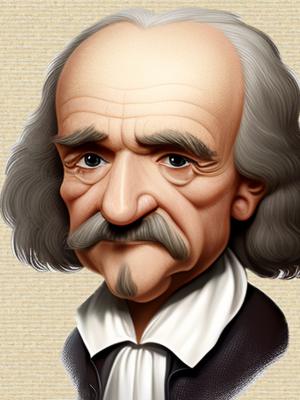
Caricature of Thomas Hobbes
based on portrait by John Michael Wright (1617–1694)
based on portrait by John Michael Wright (1617–1694)
~~[Paraphrase?]~~ There is more in Mersenne than in all the universities together.
— Thomas Hobbes
As an epigraph, without citation, in George F. Simmons Calculus Gems, (1992), 93. Webmaster has searched and as yet cannot find a primary source where Hobbes wrote the subject quote with this wording. (Can you help?) However, it can be found in narrative form, not as a quote, in Stanley Victor Keeling, Descartes (1934), 6. Keeling describes, without quotation marks—Mersenne, that delightful and obliging figure in whom, according to Hobbes, there was more than in all the universities together. In Keeling’s words, Mersenne was able to put into touch the “most learned and stimulating correspondents in science and philosophy, and who facilitated exchanges of ideas.”
A Law of Nature, (Lex Naturalis) is a Precept, or generall Rule, found out by Reason, by which a man is forbidden to do, that, which is destructive of his life, or taketh away the means of preserving the same; and to omit, that, by which he thinketh it may be best preserved.
— Thomas Hobbes
In Leviathan (1651), 64. Hobbes is identifying a precept of morality that men should naturally observe, as contrasted with a law set by politics of government.
And as to the faculties of the mind, setting aside the arts grounded upon words, and especially that skill of proceeding upon generall, and infallible rules, called Science; which very few have, and but in few things; as being not a native faculty, born within us; nor attained, (as Prudence,) while we look after somewhat else.
— Thomas Hobbes
Leviathan (1651), ed. C. B. Macpherson (1968), Part 1, Chapter 13, 183.
Between true science and erroneous doctrines, ignorance is in the middle.
— Thomas Hobbes
In Leviathan (1651).
Between true science and erroneous doctrines, ignorance is in the middle.
— Thomas Hobbes
In Leviathan (1651).
By this we may understand, there be two sorts of knowledge, whereof the one is nothing else but sense, or knowledge original (as I have said at the beginning of the second chapter), and remembrance of the same; the other is called science or knowledge of the truth of propositions, and how things are called, and is derived from understanding.
— Thomas Hobbes
The Elements of Law: Natural and Politic (1640), Ferdinand Tonnies edn. (1928), Part 1, Chapter 6, 18-9.
Fear of things invisible is the natural seed of that which every one in himself calleth religion.
— Thomas Hobbes
Leviathan. In Marc J. Madou, Fundamentals of Microfabrication: the Science of Miniaturization (2nd ed., 2002), 183.
For between true Science, and erroneous Doctrines, Ignorance is in the middle. Naturall sense and imagination, are not subject to absurdity. Nature it selfe cannot erre: and as men abound in copiousnesses of language; so they become more wise, or more mad than ordinary. Nor is it possible without Letters for any man to become either excellently wise, or (unless his memory be hurt by disease, or ill constitution of organs) excellently foolish. For words are wise men's counters, they do but reckon by them; but they are the money of fools that value them by the authority of an Aristotle, a Cicero, or a Thomas, or any other Doctor whatsoever, if but a man.
— Thomas Hobbes
Leviathan (1651), ed. C. B. Macpherson (1968), Part 1, Chapter 4, 106.
In Geometry, (which is the only Science that it hath pleased God hitherto to bestow on mankind,) men begin at settling the significations of their words; which settling of significations, they call Definitions; and place them in the beginning of their reckoning.
— Thomas Hobbes
Leviathan (1651), ed. C. B. Macpherson (1968), Part 1, Chapter 4, 105.
Mr. Hobbes told me that the cause of his Lordship's [Francis Bacon's] death was trying an Experiment: viz. as he was taking the aire in a Coach with Dr. Witherborne (a Scotchman, Physitian to the King) towards High-gate, snow lay on the ground, and it came into my Lord's thoughts, why flesh might not be preserved in snow, as in Salt. They were resolved they would try the Experiment presently. They alighted out of the Coach and went into a poore woman's house at the bottom of Highgate hill, and bought a Hen, and made the woman exenterate it, and then stuffed the body with Snow, and my Lord did help to doe it himselfe. The Snow so chilled him that he immediately fell so extremely ill, that he could not return to his Lodging.
— Thomas Hobbes
John Aubrey, Brief Lives (1680), edited by Oliver Lawson Dick (1949), 16.
Nature itself cannot err.
— Thomas Hobbes
In Leviathan (1651).
Science is the knowledge of Consequences, and dependance of one fact upon another.
— Thomas Hobbes
Leviathan (1651), ed. C. B. Macpherson (1968), Part 1, Chapter 5, 115.
Scientia potentia est, sed parva; quia scientia egregia rara est, nec proinde apparens nisi paucissimis, et in paucis rebus. Scientiae enim ea natura est, ut esse intelligi non possit, nisi ab illis qui sunt scientia praediti.
— Thomas Hobbes
De Homine, cap. x. In Thomas Hobbes and William Molesworth, Thomæ Hobbes Malmesburiensis Opera Philosophica (1841), Vol. 3, 69.
So that in the nature of man, we find three principal causes of quarrel. First, competition; secondly, diffidence; thirdly, glory.
— Thomas Hobbes
In Leviathan: Or, The Matter, Form and Power of a Commonwealth, Ecclesiastical and Civil (1886), 64.
That wee have of Geometry, which is the mother of all Naturall Science, wee are not indebted for it to the Schools.
— Thomas Hobbes
Leviathan (1651), ed. C. B. Macpherson (1968), Part 4, Chapter 46, 686.
The end of knowledge is power ... the scope of all speculation is the performing of some action or thing to be done.
— Thomas Hobbes
De Corp, EW, i, I, 1, 6, 7. In Jean Hampton, Hobbes and the social contract tradition (1988), 46. Hampton indicates that this quote is 'after Bacon' and in a footnote, that 'Hobbes was Bacon's secretary as a young man and had philosophical discussions with him (Aubrey 1898, 331).'
The errors of definitions multiply themselves according as the reckoning proceeds; and lead men into absurdities, which at last they see but cannot avoid, without reckoning anew from the beginning.
— Thomas Hobbes
In Thomas Hobbes and William Molesworth (ed.) Leviathan: Or the Matter, Form and Power of a Commonwealth Ecclesiastical and Civil (1839), Vol. 3, 24.
The most noble and profitable invention of all other, was that of SPEECH, consisting of Names or Appellations, and their Connexion; whereby men register their Thoughts; recall them when they are past; and also declare them one to another for mutuall utility and conversation; without which, there had been amongst men, neither Commonwealth, nor Society, nor Contract, nor Peace, no more than amongst Lyons, Bears, and Wolves.
— Thomas Hobbes
Leviathan (1651), ed. C. B. Macpherson (1968), Part 1, Chapter 4, 100.
To understand this for sense it is not required that a man should be a geometrician or a logician, but that he should be mad.
— Thomas Hobbes
In Thomas Hobbes and William Molesworth (ed.), 'Considerations Upon the Answer of Doctor Wallis to the Three Papers of Mr. Hobbes', Leviathan: Or the Matter, Form and Power of a Commonwealth Ecclesiastical and Civil (1845), Vol. 7, 445. What Hobbes refers to as “this” is described as “that the volume generated by revolving the region under 1/x from 1 to infinity has finite volume,” in In Nicholas J. Rose Mathematical Maxims and Minims (1988).
Whatsoever accidents Or qualities our sense make us think there be in the world, they are not there, but are seemings and apparitions only. The things that really are in the world without us, are those motions by which these seemings are caused. And this is the great deception of sense, which also is by sense to be corrected. For as sense telleth me, when I see directly, that the colour seemeth to be in the object; so also sense telleth me, when I see by reflection, that colour is not in the object.
— Thomas Hobbes
The Elements of Law: Natural and Politic (1640), Ferdinand Tonnies edn. (1928), Part 1, Chapter 2, 6.
Whatsoever therefore is consequent to a time of Warre, where every man is Enemy to every man; the same is consequent to the time, wherein men live without other security, than what their own strength, and their own invention shall furnish them withall. In such condition, there is no place for Industry; because the fruit thereof is uncertain: and consequently no Culture of the Earth; no Navigation, nor use of the commodities that may be imported by Sea; no commodious Building; no Instruments of moving, and removing, such things as require much force; no Knowledge of the face of the Earth; no account of Time; no Arts; no Letters; no Society; and which is worst of all, continual fear, and danger of violent death; And the life of man, solitary, poore, nasty, brutish, and short.
— Thomas Hobbes
Leviathan (1651), ed. C. B. Macpherson (1968), Part 1, Chapter 13, 186.
Why may we not say, that all Automata (Engines that move themselves by springs and wheeles as doth a watch) have an artificiall life? For what is the Heart, but a Spring; and the Nerves, but so many Strings; and the Joynts, but so many Wheeles, giving motion to the whole Body, such as was intended by the Artificer? Art goes yet further, imitating the rationall and most excellent worke of Nature, Man. For by Art is created the great LEVIATHAN called a COMMON-WEALTH, or STATE, (in latine CIVITAS) which is but an Artificiall Man; though of greater stature and strength than the Naturall, for whose protection and defence it was intended; and in which, the Soveraignty is an Artificiall Soul, as giving life and motion to the whole body.
— Thomas Hobbes
Leviathan (1651), ed. C. B. Macpherson (1968), Part I, Introduction, 81.
Quotes by others about Thomas Hobbes (2)
If I may paraphrase Hobbes's well-known aphorism, I would say that 'books are the money of Literature, but only the counters of Science.'
'Universities: Actual and Ideal' (1874). In Collected Essays (1893), Vol. 3, 213.
He had read much, if one considers his long life; but his contemplation was much more than his reading. He was wont to say that if he had read as much as other men he should have known no more than other men.
From 'Thomas Hobbes', in Andrew Clark (ed.) Brief Lives (1898), Vol. 1, 349.
 In science it often happens that scientists say, 'You know that's a really good argument; my position is mistaken,' and then they would actually change their minds and you never hear that old view from them again. They really do it. It doesn't happen as often as it should, because scientists are human and change is sometimes painful. But it happens every day. I cannot recall the last time something like that happened in politics or religion.
(1987) --
In science it often happens that scientists say, 'You know that's a really good argument; my position is mistaken,' and then they would actually change their minds and you never hear that old view from them again. They really do it. It doesn't happen as often as it should, because scientists are human and change is sometimes painful. But it happens every day. I cannot recall the last time something like that happened in politics or religion.
(1987) -- 





.jpg)