 (source)
|
Sir William Herschel
(15 Nov 1738 - 25 Aug 1822)
German-English astronomer who initiated sidereal astronomy for the systematic observation of the heavens.
|
Science Quotes by Sir William Herschel (11 quotes)
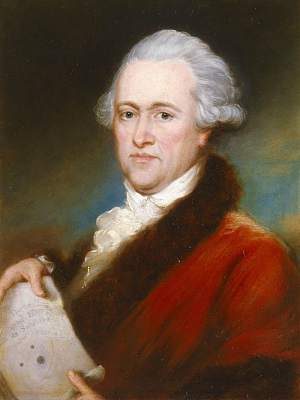
William Herschel holding document showing 'The Georgian Planet With Its Satellites'
... finding that in [the Moon] there is a provision of light and heat; also in appearance, a soil proper for habitation fully as good as ours, if not perhaps better who can say that it is not extremely probable, nay beyond doubt, that there must be inhabitants on the Moon of some kind or other?
— Sir William Herschel
Letter to Astronomer Royal, Nevil Maskelyne (1780). Quoted in Patrick Moore, Patrick Moore on the Moon (2006), 144.
Coelorum perrupit claustra.
(He broke through the barriers of the heavens.)
(He broke through the barriers of the heavens.)
— Sir William Herschel
Epitaph for William Herschel in Upton Church, where he is buried. Quoted in G. J. Whitrow, The Structure of the Universe: An Introduction to Cosmology (1959), 16. Also on memorial tile in Westminster Abbey.
I have looked further into space than ever human being did before me. I have observed stars of which the light, it can be proved, must take two million years to reach the earth.
— Sir William Herschel
Having identified Uranus (1781), the first planet discovered since antiquity. Quoted in Constance Anne Lubbock, The Herschel Chronicle: the Life-story of William Herschel and his Sister, Caroline Herschel (1933), 336.
I have tried to improve telescopes and practiced continually to see with them. These instruments have play'd me so many tricks that I have at last found them out in many of their humours.
— Sir William Herschel
Quoted in Constance Anne Lubbock, The Herschel Chronicle: the Life-story of William Herschel and his Sister, Caroline Herschel (1933), 102.
It will be found that those contained in one article [class of nebulae], are so closely allied to those in the next, that there is perhaps not so much difference between them, if I may use the comparison, as there would be in an annual description of the human figure, were it given from the birth of a child till he comes to be a man in his prime.
— Sir William Herschel
'Astronomical Observations... ' Philosophical Transactions (1811), 101, 271.
The phenomena of nature, especially those that fall under the inspection of the astronomer, are to be viewed, not only with the usual attention to facts as they occur, but with the eye of reason and experience.
— Sir William Herschel
'An Account of Three Volcanoes on the Moon', read before the Royal Society, Philosophical Transactions (1787). Reprinted in Edward Polehampton, The Gallery of Nature and Art; or, a Tour Through Creation and Science (1815), 183.
The undevout astronomer must be mad.
[A favorite maxim, from Edward Young.]
[A favorite maxim, from Edward Young.]
— Sir William Herschel
As attributed in William Joseph Federer, America's God and Country: Encyclopedia of Quotations (1996), 291. But the line is from Edward Young, The Complaint: or, Night-Thoughts on Life, Death, and Immortality (1742, 1750), 'Night 9', 260: “It calls Devotion! genuine growth of night / Devotion! Daughter of Astronomy! / An undevout astronomer is mad.”
There is not perhaps another object in the heavens that presents us with such a variety of extraordinary phenomena as the planet Saturn: a magnificent globe, encompassed by a stupendous double ring: attended by seven satellites: ornamented with equatorial belts: compressed at the poles: turning upon its axis: mutually eclipsing its ring and satellites, and eclipsed by them: the most distant of the rings also turning upon its axis, and the same taking place with the farthest of the satellites: all the parts of the system of Saturn occasionally reflecting light to each other: the rings and moons illuminating the nights of the Saturnian: the globe and satellites enlightening the dark parts of the rings: and the planet and rings throwing back the sun's beams upon the moons, when they are deprived of them at the time of their conjunctions. (1805)
— Sir William Herschel
Quoted in John Vose, A System of Astronomy: On the Principles of Copernicus (1827), 66-67.
We may also draw a very important additional conclusion from the gradual dissolution of the milky way; for the state into which the incessant action of the clustering power [presumably, gravity] has brought it at present, is a kind of chronometer that may be used to measure the time of its past and future existence; and although we do not know the rate of going of this mysterious chronometer, it is nevertheless certain, that since the breaking up of the parts of the milky way affords a proof that it cannot last for ever, it equally bears witness that its past duration cannot be admitted to the infinite.
— Sir William Herschel
'Astronomical Observations... ' Philosophical Transactions (1814), 104, 284.
We need not hesitate to admit that the Sun is richly stored with inhabitants.
— Sir William Herschel
Philosophical Transactions of the Royal Society of London, from their commencement in 1665 to the year 1800. Vol. 17: From 1791 to 1796 (1809), 490.
Quoted in Edward Polehampton and John Mason Good The Gallery of Nature and Art (1818), 58.
We see it [the as-yet unseen, probable new planet, Neptune] as Columbus saw America from the coast of Spain. Its movements have been felt, trembling along the far-reaching line of our analysis with a certainty hardly inferior to that of ocular demonstration.
— Sir William Herschel
Address to the British Association, Southampton (10 Sep 1845). Quoted in Memoirs of the Royal Astronomical Society (1847), 16, 400.
Quotes by others about Sir William Herschel (3)
Herschel removed the speckled tent-roof from the world and exposed the immeasurable deeps of space, dim-flecked with fleets of colossal suns sailing their billion-leagued remoteness.
'The Secret History of Eddypus', in Mark Twain and David Ketterer (ed.), Tales of Wonder (2003), 223.
What caused me to undertake the catalog was the nebula I discovered above the southern horn of Taurus on September 12, 1758, while observing the comet of that year. ... This nebula had such a resemblance to a comet in its form and brightness that I endeavored to find others, so that astronomers would not confuse these same nebulae with comets just beginning to shine. I observed further with suitable refractors for the discovery of comets, and this is the purpose I had in mind in compiling the catalog.
After me, the celebrated Herschel published a catalog of 2000 which he has observed. This unveiling the sky, made with instruments of great aperture, does not help in the perusal of the sky for faint comets. Thus my object is different from his, and I need only nebulae visible in a telescope of two feet [focal length].
After me, the celebrated Herschel published a catalog of 2000 which he has observed. This unveiling the sky, made with instruments of great aperture, does not help in the perusal of the sky for faint comets. Thus my object is different from his, and I need only nebulae visible in a telescope of two feet [focal length].
Connaissance des Temps for 1800/1801. In Charles Coulston Gillespie (ed.), Dictionary of Scientific Biography (1974), Vol. 9, 330.
[Pechblende] einer eigenthümlichen, selbstständigen metallischen Substanz bestehe. Es fallen folglich auch deren bisherige Benennungen, als: Ресhblende Eisenpecherz, hinweg, welche nun durch einen neuen ausschliessend bezeichnenden Namen zu ersetzen sind. Ich habe dazu den Namen: Uranerz (Uranium) erwählt; zu einigem Andenken, dass die chemische Ausfindung dieses neuen Metallkörpers in die Epoche der astronomischen. Entdeckung des Planeten Uranus gefallen sei.
[Pitchblende] consists of a peculiar, distinct, metallic substance. Therefore its former denominations, pitch-blende, pitch-iron-ore, &c. are no longer applicable, and must be supplied by another more appropriate name.—I have chosen that of uranite, (Uranium), as a kind of memorial, that the chemical discovery of this new metal happened in the period of the astronomical discovery of the new planet Uranus.
[Pitchblende] consists of a peculiar, distinct, metallic substance. Therefore its former denominations, pitch-blende, pitch-iron-ore, &c. are no longer applicable, and must be supplied by another more appropriate name.—I have chosen that of uranite, (Uranium), as a kind of memorial, that the chemical discovery of this new metal happened in the period of the astronomical discovery of the new planet Uranus.
In original German edition, Beiträge Zur Chemischen Kenntniss Der Mineralkörper (1797), Vol. 2, 215. English edition, translator not named, Analytical Essays Towards Promoting the Chemical Knowledge of Mineral Substances (1801), 491. The new planet was discovered on 13 Mar 1781 by William Herschel, who originally named it Georgium Sidus (George's Star) to honour King George III.
See also:
- 15 Nov - short biography, births, deaths and events on date of Herschel's birth.
- William Herschel: Discovery of Uranus - from The Library of Original Sources(1907).
- Booklist for William Herschel.
 In science it often happens that scientists say, 'You know that's a really good argument; my position is mistaken,' and then they would actually change their minds and you never hear that old view from them again. They really do it. It doesn't happen as often as it should, because scientists are human and change is sometimes painful. But it happens every day. I cannot recall the last time something like that happened in politics or religion.
(1987) --
In science it often happens that scientists say, 'You know that's a really good argument; my position is mistaken,' and then they would actually change their minds and you never hear that old view from them again. They really do it. It doesn't happen as often as it should, because scientists are human and change is sometimes painful. But it happens every day. I cannot recall the last time something like that happened in politics or religion.
(1987) -- 




