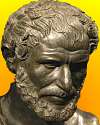
 (source)
|
Heraclitus
(c. 540 B.C. - c. 475 B.C.)
Greek philosopher who is thought of as perhaps the most significant philosopher of ancient Greece until Socrates and Plato. Heraclitus regarded fire as the primordial origin of matter and held the idea that a constant state of change is the fundamental nature of the world and the universe. (aka Heraklitus or Heracleitus)
|
Science Quotes by Heraclitus (12 quotes)
phusis kruptesthai philei
Nature loves to hide.
Nature loves to hide.
— Heraclitus
Sentence Fragment 123. Themistius, Orations 5.69b . As translated in Presocratic Reflexivity: The Construction of Philosophical Discourse (1996), 234.
Everything flows and nothing abides; everything gives way and nothing stays fixed.
— Heraclitus
…...
Eyes and ears are bad witnesses for men who have barbarian souls.
— Heraclitus
Heraclitus, fr. 107. Trans. R. W. Sharples.
Heraclitus somewhere says that all things are in process and nothing stays still, and likening existing things to the stream of a river he says that you would not step twice into the same river.
— Heraclitus
Plato, Cratylus 402A. In G. S. Kirk, J. E. Raven, and M. Schofield (eds.), The Presocratic Philosophers: A Critical History with a Selection of Texts (1983),195.
Heraclitus son of Bloson (or, according to some, of Herakon) of Ephesus. This man was at his prime in the 69th Olympiad. He grew up to be exceptionally haughty and supercilious, as is clear also from his book, in which he says: “Learning of many things does not teach intelligence; if so it would have taught Hesiod and Pythagoras, and again Xenophanes and Hecataeus.” … Finally he became a misanthrope, withdrew from the world, and lived in the mountains feeding on grasses and plants. However, having fallen in this way into a dropsy he came down to town and asked the doctors in a riddle if they could make a drought out of rainy weather. When they did not understand he buried himself in a cow-stall, expecting that the dropsy would be evaporated off by the heat of the manure; but even so he failed to effect anything, and ended his life at the age of sixty.
— Heraclitus
Diogenes Laertius 9.1. In G. S. Kirk, E. Raven, and M. Schofield (eds.), The Presocratic philosophers: A Critical History with a Selection of Texts (1983), 181.
Nature is accustomed to hide itself.
— Heraclitus
Heraclitus, fr. 123. Trans. R. W. Sharples.
Nature loves to hide.
— Heraclitus
…...
Physicians who cut, burn, stab, and rack the sick, demand a fee for it which they do not deserve to get.
— Heraclitus
Fragment R.P. 47c, quoted in John Burnet, Early Greek Philosophy (1908), 151.
The Universe, that is the All, is made neither of gods nor of men, but ever has been and ever will be an eternal living Fire, kindling and extinguishing in destined measure, a game which Zeus plays with himself.
— Heraclitus
Translation as an epigraph in Ludwig Büchner, Force and Matter: Or, Principles of the Natural Order of the Universe (1891), 1. Various alternate translations can be found, including: “The unchanging order of all things was made neither by a god nor a man, but it has always been, is, and will be, the living fire, which is kindled arid extinguished in regular succession.” In K. O. Müller, History of the Literature of Ancient Greece (1840), Vol. 1, 245.
Things of which there is sight, hearing, apprehension, these I prefer.
— Heraclitus
Heraclitus, fr. 55. Trans. R. W. Sharples.
To God all things are fair and good and right, but men hold some things wrong and some right.
— Heraclitus
Fragment R.P. 45, quoted in John Burnet, Early Greek Philosophy (1908), 151.
Unless you expect the unexpected you will never find it, for it is hard to discover and hard to attain.
— Heraclitus
As quoted in Peter Pešic, Labyrinth: A Search for the Hidden Meaning of Science (2001), 2.
Quotes by others about Heraclitus (3)
Science and mathematics [are] much more compelling and exciting than the doctrines of pseudoscience, whose practitioners were condemned as early as the fifth century B.C. by the Ionian philosopher Heraclitus as “night walkers, magicians, priests of Bacchus, priestesses of the wine-vat, mystery-mongers.” But science is more intricate and subtle, reveals a much richer universe, and powerfully evokes our sense of wonder. And it has the additional and important virtue—to whatever extent the word has any meaning—of being true.
Broca's Brain: Reflections on the Romance of Science (1979, 1986), 76.
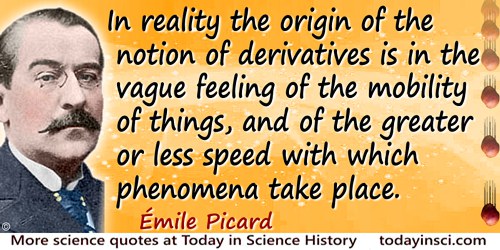
In reality the origin of the notion of derivatives is in the vague feeling of the mobility of things, and of the greater or less speed with which phenomena take place; this is well expressed by the terms fluent and fluxion, which were used by Newton and which we may believe were borrowed from the
ancient mathematician Heraclitus.
From address to the section of Algebra and Analysis, International Congress of Arts and Sciences, St. Louis (22 Sep 1904), 'On the Development of Mathematical Analysis and its Relation to Certain Other Sciences,' as translated by M.W. Haskell in Bulletin of the American Mathematical Society (May 1905), 11, 407.
Thales thought that water was the primordial substance of all things. Heraclitus of Ephesus… thought that it was fire. Democritus and his follower Epicurus thought that it was the atoms, termed by our writers “bodies that cannot be cut up” or, by some “indivisibles.” The school of the Pythagoreans added air and the earthy to the water and fire. Hence, although Democritus did not in a strict sense name them, but spoke only of indivisible bodies, yet he seems to have meant these same elements, because when taken by themselves they cannot be harmed, nor are they susceptible of dissolution, nor can they be cut up into parts, but throughout time eternal they forever retain an infinite solidity.
In De Architectura, Book 2, Chap 2, Sec. 1. As translated in Morris Hicky Morgan (trans.), Vitruvius: The Ten Books on Architecture (1914), 42.
 In science it often happens that scientists say, 'You know that's a really good argument; my position is mistaken,' and then they would actually change their minds and you never hear that old view from them again. They really do it. It doesn't happen as often as it should, because scientists are human and change is sometimes painful. But it happens every day. I cannot recall the last time something like that happened in politics or religion.
(1987) --
In science it often happens that scientists say, 'You know that's a really good argument; my position is mistaken,' and then they would actually change their minds and you never hear that old view from them again. They really do it. It doesn't happen as often as it should, because scientists are human and change is sometimes painful. But it happens every day. I cannot recall the last time something like that happened in politics or religion.
(1987) -- 





