 (source)
|
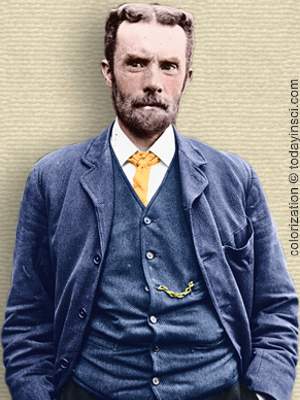
Oliver Heaviside
(18 May 1850 - 3 Feb 1925)
English physicist and electrical engineer who predicted the existence of the ionosphere. Now known as the Heaviside layer, it was demonstrated in the 1920s when radio pulses were bounced far beyond the horizon.
|
Science Quotes by Oliver Heaviside (23 quotes)
After … the general experimental knowledge has been acquired, accompanied with just a sufficient amount of theory to connect it together…, it becomes possible to consider the theory by itself, as theory. The experimental facts then go out of sight, in a great measure, not because they are unimportant, but because … they are fundamental, and the foundations are always hidden from view in well-constructed buildings.
— Oliver Heaviside
In Electromagnetic Theory (1892), Vol. 2, 1.
As to the need of improvement there can be no question whilst the reign of Euclid continues. My own idea of a useful course is to begin with arithmetic, and then not Euclid but algebra. Next, not Euclid, but practical geometry, solid as well as plane; not demonstration, but to make acquaintance. Then not Euclid, but elementary vectors, conjoined with algebra, and applied to geometry. Addition first; then the scalar product. Elementary calculus should go on simultaneously, and come into vector algebraic geometry after a bit. Euclid might be an extra course for learned men, like Homer. But Euclid for children is barbarous.
— Oliver Heaviside
Electro-Magnetic Theory (1893), Vol. 1, 148. In George Edward Martin, The Foundations of Geometry and the Non-Euclidean Plane (1982), 130.
Electric and magnetic forces. May they live for ever, and never be forgot, if only to remind us that the science of electromagnetics, in spite of the abstract nature of its theory, involving quantities whose nature is entirely unknown at the present, is really and truly founded on the observations of real Newtonian forces, electric and magnetic respectively.
— Oliver Heaviside
From 'Electromagnetic Theory, CXII', The Electrician (23 Feb 1900), Vol. 44, 615.
Facts are of not much use, considered as facts. They bewilder by their number and their apparent incoherency. Let them be digested into theory, however, and brought into mutual harmony, and it is another matter.
— Oliver Heaviside
From article 'Electro-magnetic Theory II', in The Electrician (16 Jan 1891), 26, No. 661, 331.
However absurd it may seem, I do in all seriousness hereby declare that I am animated mainly by philanthropic motives. I desire to do good to my fellow creatures, even to the Cui bonos.
— Oliver Heaviside
In Electrical Papers (1882), Vol. I; Preface, vi-vii.
I remember my first look at the great treatise of Maxwell’s when I was a young man… I saw that it was great, greater and greatest, with prodigious possibilities in its power… I was determined to master the book and set to work. I was very ignorant. I had no knowledge of mathematical analysis (having learned only school algebra and trigonometry which I had largely forgotten) and thus my work was laid out for me. It took me several years before I could understand as much as I possibly could. Then I set Maxwell aside and followed my own course. And I progressed much more quickly… It will be understood that I preach the gospel according to my interpretation of Maxwell.
— Oliver Heaviside
From translations of a letter (24 Feb 1918), cited in Paul J. Nahin, Oliver Heaviside: The Life, Work, and Times of an Electrical Genius of the Victorian Age (2002), 24. Nahin footnotes that the words are not verbatim, but are the result of two translations. Heaviside's original letter in English was quoted, translated in to French by J. Bethenode, for the obituary he wrote, "Oliver Heaviside", in Annales des Posies Telegraphs (1925), 14, 521-538. The quote was retranslated back to English in Nadin's book. Bethenode footnoted that he made the original translation "as literally as possible in order not to change the meaning." Nadin assures that the retranslation was done likewise. Heaviside studyied Maxwell's two-volume Treatise on Electricity and Magnetism.
In working out physical problems there should be, in the first place, no pretence of rigorous formalism. The physics will guide the physicist along somehow to useful and important results, by the constant union of physical and geometrical or analytical ideas. The practice of eliminating the physics by reducing a problem to a purely mathematical exercise should be avoided as much as possible. The physics should be carried on right through, to give life and reality to the problem, and to obtain the great assistance which the physics gives to the mathematics.
— Oliver Heaviside
In Electromagnetic Theory (1892), Vol. 2, 5.
Logic can be patient, for it is eternal.
— Oliver Heaviside
Quoted without citation in Desmond MacHale, Comic Sections (1993), 146.
Mathematics is an experimental science, and definitions do not come first, but later on.
— Oliver Heaviside
In 'On Operators in Physical Mathematics, part II', Proceedings of the Royal Society of London (15 Jun 1893), 54, 121.
Mathematics is of two kinds, Rigorous and Physical. The former is Narrow: the latter Bold and Broad. To have to stop to formulate rigorous demonstrations would put a stop to most physico-mathematical inquiries. Am I to refuse to eat because I do not fully understand the mechanism of digestion?
— Oliver Heaviside
As quoted by Charles Melbourne Focken in Dimensional Methods and Their Applications (1953), 17.
Maxwell Redressed.
— Oliver Heaviside
Heaviside’s comment on his more compact, efficient, clarifying reformulation of Maxwell’s equations, as they are now generally seen. In undated note on the back of p.5 of Heaviside’s manuscript of 'Theory of Voltaic Action'. Box 14, OH-IEE. As cited in Bruce J. Hunt, The Maxwellians (2005), 108.
Now, in the development of our knowledge of the workings of Nature out of the tremendously complex assemblage of phenomena presented to the scientific inquirer, mathematics plays in some respects a very limited, in others a very important part. As regards the limitations, it is merely necessary to refer to the sciences connected with living matter, and to the ologies generally, to see that the facts and their connections are too indistinctly known to render mathematical analysis practicable, to say nothing of the complexity.
— Oliver Heaviside
From article 'Electro-magnetic Theory II', in The Electrician (16 Jan 1891), 26, No. 661, 331.
Ohm (a distinguished mathematician, be it noted) brought into order a host of puzzling facts connecting electromotive force and electric current in conductors, which all previous electricians had only succeeded in loosely binding together qualitatively under some rather vague statements. Even as late as 20 years ago, “quantity” and “tension” were much used by men who did not fully appreciate Ohm's law. (Is it not rather remarkable that some of Germany's best men of genius should have been, perhaps, unfairly treated? Ohm; Mayer; Reis; even von Helmholtz has mentioned the difficulty he had in getting recognised. But perhaps it is the same all the world over.)
— Oliver Heaviside
Ohm found that the results could be summed up in such a simple law that he who runs may read it, and a schoolboy now can predict what a Faraday then could only guess at roughly. By Ohm's discovery a large part of the domain of electricity became annexed by Coulomb's discovery of the law of inverse squares, and completely annexed by Green's investigations. Poisson attacked the difficult problem of induced magnetisation, and his results, though differently expressed, are still the theory, as a most important first approximation. Ampere brought a multitude of phenomena into theory by his investigations of the mechanical forces between conductors supporting currents and magnets. Then there were the remarkable researches of Faraday, the prince of experimentalists, on electrostatics and electrodynamics and the induction of currents. These were rather long in being brought from the crude experimental state to a compact system, expressing the real essence. Unfortunately, in my opinion, Faraday was not a mathematician. It can scarely be doubted that had he been one, he would have anticipated much later work. He would, for instance, knowing Ampere's theory, by his own results have readily been led to Neumann’s theory, and the connected work of Helmholtz and Thomson. But it is perhaps too much to expect a man to be both the prince of experimentalists and a competent mathematician.
— Oliver Heaviside
From article 'Electro-magnetic Theory II', in The Electrician (16 Jan 1891), 26, No. 661, 331.
Should I refuse a good dinner simply because I do not understand the process of digestion?
— Oliver Heaviside
In Electromagnetic Theory (1892), Vol. 2, 9. With this quote, he illustrates that testing a mathematically complex theory and getting accurate results has significance, even while rigorous logic in the theory is not yet plain. The mathematician may not be satisfied. The physicist meanwhile sees value based on experimental results, but does still stay aware that the theory may not be infallible.
The following story is true. There was a little boy, and his father said, “Do try to be like other people. Don’t frown.” And he tried and tried, but could not. So his father beat him with a strap; and then he was eaten up by lions. Reader, if young, take warning by his sad life and death. For though it may be an honour to be different from other people, if Carlyle’s dictum about the 30 million be still true, yet other people do not like it. So, if you are different, you had better hide it, and pretend to be solemn and wooden-headed. Until you make your fortune. For most wooden-headed people worship money; and, really, I do not see what else they can do. In particular, if you are going to write a book, remember the wooden-headed. So be rigorous; that will cover a multitude of sins. And do not frown.
— Oliver Heaviside
From 'Electromagnetic Theory, CXII', The Electrician (23 Feb 1900), Vol. 44, 615.
The series is divergent, therefore we may be able to do something with it.
— Oliver Heaviside
Epigraph without citation, in Morris Kline (ed.), Mathematical Thought From Ancient to Modern Times (1990), Vol. 3, 107.
The study of the theory of a physical science should be preceded by some general experimental acquaintance therewith, in order to secure the inimitable advantage of a personal acquaintance with something real and living.
— Oliver Heaviside
Opening sentence of Electromagnetic Theory (1892), Vol. 2, 1.
Theory always tends to become abstract as it emerges successfully from the chaos of facts by the processes of differentiation and elimination, whereby the essentials and their connections become recognised, whilst minor effects are seen to be secondary or unessential, and are ignored temporarily, to be explained by additional means.
— Oliver Heaviside
In Electromagnetic Theory (1892), Vol. 2, 1.
Theory is the essence of facts. Without theory scientific knowledge would be only worthy of the madhouse.
— Oliver Heaviside
From article 'Electro-magnetic Theory II', in The Electrician (16 Jan 1891), 26, No. 661, 331.
There is no absolute scale of size in the Universe, for it is boundless towards the great and also boundless towards the small.
— Oliver Heaviside
As restated by D'Arcy Wentworth Thompson, in On Growth and Form (1917, 1959), 24. Note that Thompson does not uses quotation marks when he gives this as what “Oliver Heaviside used to say.”
Waves from moving sources: Adagio. Andante. Allegro moderato
— Oliver Heaviside
Title of article in The Electrician (23 Feb 1900). Collected in Electromagnetic Theory (1912), Vol. 3, 1.
We do not dwell in the Palace of Truth. But, as was mentioned to me not long since, “There is a time coming when all things shall be found out.” I am not so sanguine myself, believing that the well in which Truth is said to reside is really a bottomless pit.
— Oliver Heaviside
From 'Electromagnetic Theory, I' in The Electrician (2 Jan 1891), 26, 257.
Quotes by others about Oliver Heaviside (2)
Maxwell, like every other pioneer who does not live to explore the country he opened out, had not had time to investigate the most direct means of access to the country, or the most systematic way of exploring it. This has been reserved for Oliver Heaviside to do. Maxwell’s treatise is cumbered with the débris of his brilliant lines of assault, of his entrenched camps, of his battles. Oliver Heaviside has cleared those away, has opened up a direct route, has made a broad road, and has explored a considerable tract of country.
Book Review of Heaviside’s Electrical Papers in The Electrician (11 Aug 1893). Collected in Joseph Larmore (ed.), The Scientific Writings of the Late George Francis FitzGerald (1902), 294.
When the 1880s began. Maxwell’s theory was virtually a trackless jungle. By the second half of the decade, guided by the principle of energy flow. Poynting, FitzGerald, and above all Heaviside had succeeded in taming and pruning that jungle and in rendering it almost civilized.
In The Maxwellians (2008), 128.
See also:
- 18 May - short biography, births, deaths and events on date of Heaviside's birth.
- Oliver Heaviside: The Life, Work, and Times of an Electrical Genius of the Victorian Age, by Paul J Nahin. - book suggestion.
- BooklistBooks by Oliver Heaviside.
 In science it often happens that scientists say, 'You know that's a really good argument; my position is mistaken,' and then they would actually change their minds and you never hear that old view from them again. They really do it. It doesn't happen as often as it should, because scientists are human and change is sometimes painful. But it happens every day. I cannot recall the last time something like that happened in politics or religion.
(1987) --
In science it often happens that scientists say, 'You know that's a really good argument; my position is mistaken,' and then they would actually change their minds and you never hear that old view from them again. They really do it. It doesn't happen as often as it should, because scientists are human and change is sometimes painful. But it happens every day. I cannot recall the last time something like that happened in politics or religion.
(1987) -- 





