 (source)
|
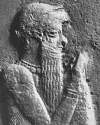
Hammurabi
(flourished 1796 B.C. - )
Babylonian king who was the sixth and best-known ruler of the 1st (Amorite) dynasty of Babylon, reigning c. 1792-1750 B.C. His set of laws, though not the most ancient in human history, are notable for being the best preserved. A stele containing the Code of Hammurabi was discovered by Egyptologist Gustave Jéquier (Dec 1901).
|
Science Quotes by Hammurabi (1 quote)
If a physician make a large incision with an operating knife and cure it, or if he open a tumor (over the eye) with an operating knife, and saves the eye, he shall receive ten shekels in money. …
If a physician make a large incision with an operating knife, and kill him, or open a tumor with an operating knife, and cut out the eye, his hands shall be cut off. ...
If a physician heal the broken bone or diseased soft part of a man, the patient shall pay the physician five shekels in money.
[The Code of Hammurabi (a king of ancient Babylon), the earliest well-preserved ancient law code, circa 1760 B.C.]
If a physician make a large incision with an operating knife, and kill him, or open a tumor with an operating knife, and cut out the eye, his hands shall be cut off. ...
If a physician heal the broken bone or diseased soft part of a man, the patient shall pay the physician five shekels in money.
[The Code of Hammurabi (a king of ancient Babylon), the earliest well-preserved ancient law code, circa 1760 B.C.]
— Hammurabi
In L. W. King (trans.), The Code of Hammurabi (1910), 22, No. 215, 218 and 221.
Quotes by others about Hammurabi (1)
The Babylonian and Assyrian civilizations have perished; Hammurabi, Sargon and Nebuchadnezzar are empty names; yet Babylonian mathematics is still interesting, and the Babylonian scale of 60 is still used in Astronomy.
In A Mathematician's Apology (1940, 2012), 80.
 In science it often happens that scientists say, 'You know that's a really good argument; my position is mistaken,' and then they would actually change their minds and you never hear that old view from them again. They really do it. It doesn't happen as often as it should, because scientists are human and change is sometimes painful. But it happens every day. I cannot recall the last time something like that happened in politics or religion.
(1987) --
In science it often happens that scientists say, 'You know that's a really good argument; my position is mistaken,' and then they would actually change their minds and you never hear that old view from them again. They really do it. It doesn't happen as often as it should, because scientists are human and change is sometimes painful. But it happens every day. I cannot recall the last time something like that happened in politics or religion.
(1987) -- 




