 (source)
|
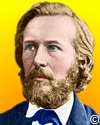
Ernst Haeckel
(16 Feb 1834 - 9 Aug 1919)
German naturalist and biologist who separated the animal kingdom into unicellar and multicellular organisms, and was an enthusiastic supporter of Darwin’s theories.
|
Science Quotes by Ernst Haeckel (18 quotes)
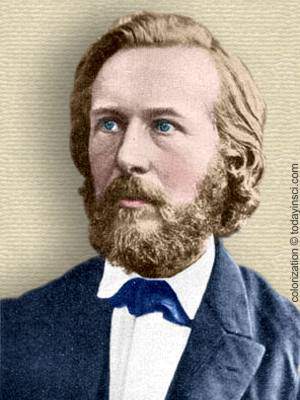
[Other than fossils,] the most important of these other records of creation is, without doubt, ontogeny, that is, the history of the developmment of the organic individual (embryology and motamorphology). It briefly repeats in great and marked features the series of forms which the ancestors of the respective individuals have passed through from the beginning of their tribe. We have designated the palaeontological history of the development of the ancestors of a living form as the history of a tribe, or phylogeny, and we may therefore thus enunciate this exceedingly important biogenetic fundamental principle: “Ontogeny is a short and quick repetition, or recapitulation, of Phylogeny, determined by the laws of Inheritance and Adaptation.”
— Ernst Haeckel
In Ernst Haeckel and E. Ray Lankester (trans.), The History of Creation (1876), Vol. 2, 33. Seen shortened to “Ontogeny recapitulates phylogeny.” This was Haeckel's (incorrect) answer to the vexing question of his time: what is the relationship between individual development (ontogeny) and the evolution of species and lineages (phylogeny)?
Die Phylogenese ist die mechanische Ursache cler Ontogenese.
Phylogenesis is the mechanical cause of ontogenesis.
Phylogenesis is the mechanical cause of ontogenesis.
— Ernst Haeckel
Anthropogenie oder Entwickelungsgeschichte des Menschen (1874), 7.
Where faith commences, science ends. Both these arts of the human mind must be strictly kept apart from each other. Faith has its origin in the poetic imagination; knowledge, on the other hand, originates in the reasoning intelligence of man. Science has to pluck the blessed fruits from the tree of knowledge, unconcerned whether these conquests trench upon the poetical imaginings of faith or not.
— Ernst Haeckel
In Ernst Haeckel and E. Ray Lankester (trans.), The History of Creation (1880), Vol. 1, 9.
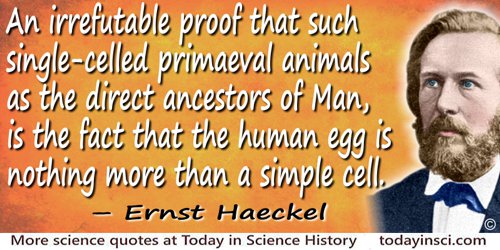
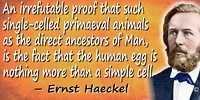
An irrefutable proof that such single-celled primaeval animals really existed as the direct ancestors of Man, is furnished according to the fundamental law of biogeny by the fact that the human egg is nothing more than a simple cell.
— Ernst Haeckel
Natürlche Schöpfungsgeschichte, trans. E. R. Lankester, The History of Creation (1892), Vol. 2, 381.
In consequence of Darwin's reformed Theory of Descent, we are now in a position to establish scientifically the groundwork of a non-miraculous history of the development of the human race. ... If any person feels the necessity of conceiving the coming into existence of this matter as the work of a supernatural creative power, of the creative force of something outside of matter, we have nothing to say against it. But we must remark, that thereby not even the smallest advantage is gained for a scientific knowledge of nature. Such a conception of an immaterial force, which as the first creates matter, is an article of faith which has nothing whatever to do with human science.
— Ernst Haeckel
In Ernst Haeckel and E. Ray Lankester (trans.), The History of Creation (1880), Vol. 1, 6-9.
In the course of individual development, inherited characters appear, in general, earlier than adaptive ones, and the earlier a certain character appears in ontogeny, the further back must lie in time when it was acquired by its ancestors.
— Ernst Haeckel
Allgemeine Entwickelungsgeschichte der Organismen (1866), Vol. 2, 298. Trans. Stephen Jay Gould, Ontogeny and Phylogeny (1977), 81.
It is, however, a most astonishing but incontestable fact, that the history of the evolution of man as yet constitutes no part of general education. Indeed, our so-called “educated classes” are to this day in total ignorance of the most important circumstances and the most remarkable phenomena which Anthropogeny has brought to light.
— Ernst Haeckel
From Oliver Joseph Thatcher, The Library Of Original Sources (1907), 345.
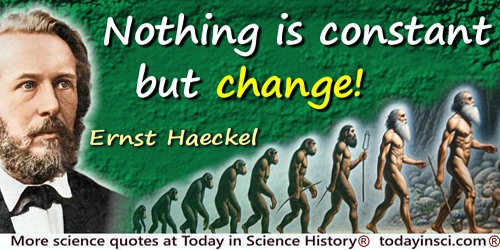
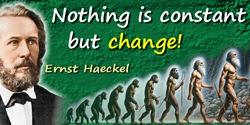
Nothing is constant but change! All existence is a perpetual flux of “being and becoming!” That is the broad lesson of the evolution of the world.
— Ernst Haeckel
As translated by Joseph McCabe in Haeckel's The Wonders of Life: a Popular Study of Biological Philosophy (1904), 100.
Ontogeny recapitulates phylogeny.
— Ernst Haeckel
Shortened expression of the original statement in Ernst Haeckel and E. Ray Lankester (trans.), The History of Creation (1876), Vol. 2, 33. The original paragraph is elsewhere on this webpage with comment that Haeckel was incorrect.
Phylogeny and ontogeny are, therefore, the two coordinated branches of morphology. Phylogeny is the developmental history [Entwickelungsgeschichte] of the abstract, genealogical individual; ontogeny, on the other hand, is the developmental history of the concrete, morphological individual.
— Ernst Haeckel
Allgemeine Entwickelungsgeschichte der Organismen (1866), Vol. 1, 60. Trans. Stephen Jay Gould, Ontogeny and Phylogeny (1977), 80.
The ancestors of the higher animals must be regarded as one-celled beings, similar to the Amœbæ which at the present day occur in our rivers, pools, and lakes. The incontrovertible fact that each human individual develops from an egg, which, in common with those of all animals, is a simple cell, most clearly proves that the most remote ancestors of man were primordial animals of this sort, of a form equivalent to a simple cell. When, therefore, the theory of the animal descent of man is condemned as a “horrible, shocking, and immoral” doctrine, tho unalterable fact, which can be proved at any moment under the microscope, that the human egg is a simple cell, which is in no way different to those of other mammals, must equally be pronounced “horrible, shocking, and immoral.”
— Ernst Haeckel
Translated from his Ueber die Entstehung und den Stammbaum des Menschengeschlechts, (1873), Vol. 2, as an epigraph to Chap. 6, The Evolution of Man, (1879), Vol 1, 120-121.
The belief in the immortality of the human soul is a dogma which is in hopeless contradiction with the most solid empirical truths of modern science.
— Ernst Haeckel
In Wonders of Life (1904), 66.
The cell never acts; it reacts.
— Ernst Haeckel
Generelle Morphology (1866).
The History of Evolution of Organisms consists of two kindred and closely connected parts: Ontogeny, which is the history of the evolution of individual organisms, and Phylogeny, which is the history of the evolution of organic tribes. Ontogency is a brief and rapid recapitulation of Phylogeny, dependent on the physiological functions of Heredity (reproduction) and Adaptation (nutrition). The individual organism reproduces in the rapid and short course of its own evolution the most important of the changes in form through which its ancestors, according to laws of Heredity and Adaptation, have passed in the slow and long course of their palaeontological evolution.
— Ernst Haeckel
Translated from his Generelle Morphologie (1866) as an epigraph to Chap. 1, The Evolution of Man, (1886), Vol 1, 1-2.
The nucleus has to take care of the inheritance of the heritable characters, while the surrounding cytoplasm is concerned with accommodation or adaptation to the environment.
— Ernst Haeckel
Generelle Morphologie (1866), Vol. 1, 287-8. Trans. Ernst Mayr, The Growth of Biological Thought: Diversity, Evolution and Inheritance (1982), 672.
The soul of man is—objectively considered—essentially similar to that of all other vertebrates; it is the physiological action or function of the brain.
— Ernst Haeckel
In Wonders of Life (1904), 12.
The succession of individuals, connected by reproduction and belonging to a species, makes it possible for the specific form itself to last for ages. In the end, however, the species is temporary; it has no “eternal life.” After existing for a certain period, it either dies or is converted by modification into other forms.
— Ernst Haeckel
As translated by Joseph McCabe in Haeckel's The Wonders of Life: a Popular Study of Biological Philosophy (1904), 248.
We may now give the following more precise expression to our chief law of biogeny:— The evolution of the foetus (or ontogenesis) is a condensed and abbreviated recapitulation of the evolution of the stem (or phylogenesis); and this recapitulation is the more complete in proportion as the original development (or palingenesis) is preserved by a constant heredity; on the other hand, it becomes less complete in proportion as a varying adaptation to new conditions increases the disturbing factors in the development (or cenogenesis).
— Ernst Haeckel
The Evolution of Man. Translated from the 5th edition of Anthropogenie by Joseph McCabe (1910), 8.
See also:
- 16 Feb - short biography, births, deaths and events on date of Haeckel's birth.
- Ernst Haeckel - Context of “Nothing is Constant” illustrated quote - Large 800px
- Ernst Haeckel - Evolution - from The Library Of Original Sources (1907).
- The Tragic Sense of Life: Ernst Haeckel and the Struggle over Evolutionary Thought, by Robert J. Richards. - book suggestion.
- Booklist for Ernst Haeckel.
 In science it often happens that scientists say, 'You know that's a really good argument; my position is mistaken,' and then they would actually change their minds and you never hear that old view from them again. They really do it. It doesn't happen as often as it should, because scientists are human and change is sometimes painful. But it happens every day. I cannot recall the last time something like that happened in politics or religion.
(1987) --
In science it often happens that scientists say, 'You know that's a really good argument; my position is mistaken,' and then they would actually change their minds and you never hear that old view from them again. They really do it. It doesn't happen as often as it should, because scientists are human and change is sometimes painful. But it happens every day. I cannot recall the last time something like that happened in politics or religion.
(1987) -- 





