 (source)
|
Stephen Jay Gould
(10 Sep 1941 - 20 May 2002)
American palaeontologist, evolutionary biologist, science historian and author who was a frequent and popular speaker on the sciences. His published work includes both scholarly study and many prize-winning popular collections of essays.
|
Science Quotes by Stephen Jay Gould (222 quotes)
>> Click for Stephen Jay Gould Quotes on | Evolution | Fact | Science | Theory |
>> Click for Stephen Jay Gould Quotes on | Evolution | Fact | Science | Theory |
[Martin Gardner is] the single brightest beacon defending rationality and good science against the mysticism and anti-intellectualism that surround us.
— Stephen Jay Gould
As quoted in Kendrick Frazier, 'A Mind at Play: An Interview with Martin Gardner', Skeptical Inquirer (Mar/Apr 1998), 22, No. 2, 36.
A complete theory of evolution must acknowledge a balance between ‘external’ forces of environment imposing selection for local adaptation and ‘internal’ forces representing constraints of inheritance and development. Vavilov placed too much emphasis on internal constraints and downgraded the power of selection. But Western Darwinians have erred equally in practically ignoring (while acknowledging in theory) the limits placed on selection by structure and development–what Vavilov and the older biologists would have called ‘laws of form.’
— Stephen Jay Gould
…...
A hot topic of late, expressed most notably in Bernie Siegel’s best-selling books, has emphasized the role of positive attitude in combating such serious diseases as cancer. From the depths of my skeptical and rationalist soul, I ask the Lord to protect me from California touchie-feeliedom.
— Stephen Jay Gould
…...
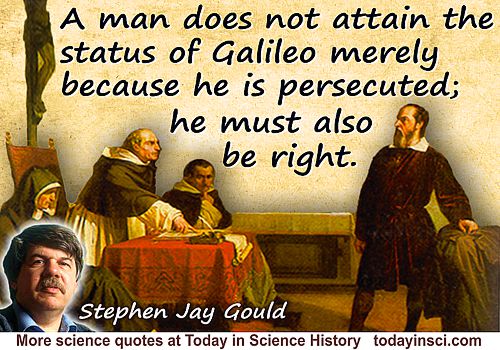
A man does not attain the status of Galileo merely because he is persecuted; he must also be right.
— Stephen Jay Gould
In essay 'Velikovsky in Collision', Natural History (Mar 1975), collected in Ever Since Darwin: Reflections in Natural History (1977, 1992), 154.
A very sincere and serious freshman student came to my office with a question that had clearly been troubling him deeply. He said to me, ‘I am a devout Christian and have never had any reason to doubt evolution, an idea that seems both exciting and well documented. But my roommate, a proselytizing evangelical, has been insisting with enormous vigor that I cannot be both a real Christian and an evolutionist. So tell me, can a person believe both in God and in evolution?’ Again, I gulped hard, did my intellectual duty, a nd reassured him that evolution was both true and entirely compatible with Christian belief –a position that I hold sincerely, but still an odd situation for a Jewish agnostic.
— Stephen Jay Gould
…...
All interesting issues in natural history are questions of relative frequency, not single examples. Everything happens once amidst the richness of nature. But when an unanticipated phenomenon occurs again and again–finally turning into an expectation–then theories are overturned.
— Stephen Jay Gould
…...
All versions written for nonscientists speak of fused males as the curious tale of the anglerfish–just as we so often hear about the monkey swinging through the trees, or the worm burrowing through soil. But if nature teaches us any lesson, it loudly proclaims life’s diversity. There ain’t no such abstraction as the clam, the fly, or the anglerfish. Ceratioid anglerfishes come in nearly 100 species, and each has its own peculiarity.
— Stephen Jay Gould
…...
Although species may be discrete, they have no immutable essence. Variation is the raw material of evolutionary change. It represents the fundamental reality of nature, not an accident about a created norm. Variation is primary; essences are illusory. Species must be defined as ranges of irreducible variation.
— Stephen Jay Gould
…...
Always be suspicious of conclusions that reinforce uncritical hope and follow comforting traditions of Western thought.
— Stephen Jay Gould
From The Flamingo's Smile (1987), 401.
Among people I have met, the few whom I would term “great” all share a kind of unquestioned, fierce dedication; an utter lack of doubt about the value of their activities (or at least an internal impulse that drives through any such angst); and above all, a capacity to work (or at least to be mentally alert for unexpected insights) at every available moment of every day of their lives.
— Stephen Jay Gould
From The Lying Stones of Marrakech: Penultimate Reflections in Natural History (2000), 76.
An individual can’t be judged by his group mean.
— Stephen Jay Gould
…...
An old paleontological in joke proclaims that mammalian evolution is a tale told by teeth mating to produce slightly altered descendant teeth.
— Stephen Jay Gould
…...
And yet I think that the Full House model does teach us to treasure variety for its own sake–for tough reasons of evolutionary theory and nature’s ontology, and not from a lamentable failure of thought that accepts all beliefs on the absurd rationale that disagreement must imply disrespect. Excellence is a range of differences, not a spot. Each location on the range can be occupied by an excellent or an inadequate representative– and we must struggle for excellence at each of these varied locations. In a society driven, of ten unconsciously, to impose a uniform mediocrity upon a former richness of excellence–where McDonald’s drives out the local diner, and the mega-Stop & Shop eliminates the corner Mom and Pop–an understanding and defense of full ranges as natural reality might help to stem the tide and preserve the rich raw material of any evolving system: variation itself.
— Stephen Jay Gould
…...
And, in this case, science could learn an important lesson from the literati–who love contingency for the same basic reason that scientists tend to regard the theme with suspicion. Because, in contingency lies the power of each person, to make a difference in an unconstrained world bristling with possibilities, and nudgeable by the smallest of unpredictable inputs into markedly different channels spelling either vast improvement or potential disaster.
— Stephen Jay Gould
…...
Antiessentialist thinking forces us to view the world differently. We must accept shadings and continua as fundamental. We lose criteria for judgment by comparison to some ideal: short people, retarded people, people of other beliefs, colors, and religions are people of full status.
— Stephen Jay Gould
…...
Anton Chekhov wrote that ‘one must not put a loaded rifle on stage if no one is thinking of firing it.’ Good drama requires spare and purposive action, sensible linking of potential causes with realized effects. Life is much messier; nothing happens most of the time. Millions of Americans (many hotheaded) own rifles (many loaded), but the great majority, thank God, do not go off most of the time. We spend most of real life waiting for Godot, not charging once more unto the breach.
— Stephen Jay Gould
…...
Anyone who does not grasp the close juxtaposition of the vulgar and the scholarly has either too refined or too compartmentalized a view of life. Abstract and visceral fascination are equally valid and not so far apart.
— Stephen Jay Gould
In The Flamingo’s Smile (1985).
As a different, but perhaps more common, strategy for the suppression of novelty, we may admit the threatening object to our midst, but provide an enveloping mantle of ordinary garb… . This kind of cover-up, so often amusing in our daily lives, can be quite dangerous in science, for nothing can stifle originality more effectively than an ordinary mantle placed fully and securely over an extraordinary thing.
— Stephen Jay Gould
In 'A Short Way to Big Ends', Natural History (Jan 1986), 95, No. 1, 18.
As a graduate student at Columbia University, I remember the a priori derision of my distinguished stratigraphy professor toward a visiting Australian drifter ... Today my own students would dismiss with even more derision anyone who denied the evident truth of continental drift–a prophetic madman is at least amusing; a superannuated fuddy-duddy is merely pitiful.
— Stephen Jay Gould
…...
As a nation, we are too young to have true mythic heroes, and we must press real human beings into service. Honest Abe Lincoln the legend is quite a different character from Abraham Lincoln the man. And so should they be. And so should both be treasured, as long as they are distinguished. In a complex and confusing world, the perfect clarity of sports provides a focus for legitimate, utterly unambiguous support or disdain. The Dodgers are evil, the Yankees good. They really are, and have been for as long as anyone in my family can remember.
— Stephen Jay Gould
…...
As a word, ecology has been so debased by recent political usage that many people employ it to identify anything good that happens far from cities and without human interference.
— Stephen Jay Gould
…...
As we discern a fine line between crank and genius, so also (and unfortunately) we must acknowledge an equally graded trajectory from crank to demagogue. When people learn no tools of judgment and merely follow their hopes, the seeds of political manipulation are sown.
— Stephen Jay Gould
…...
Asian Homo erectus died without issue and does not enter our immediate ancestry (for we evolved from African populations); Neanderthal people were collateral cousins, perhaps already living in Europe while we emerged in Africa... In other words, we are an improbable and fragile entity, fortunately successful after precarious beginnings as a small population in Africa, not the predictable end result of a global tendency. We are a thing, an item of history, not an embodiment of general principles.
— Stephen Jay Gould
Wonderful Life (1989), 319.
Bacteria represent the world’s greatest success story. They are today and have always been the modal organisms on earth; they cannot be nuked to oblivion and will outlive us all. This time is their time, not the ‘age of mammals’ as our textbooks chauvinistically proclaim. But their price for such success is permanent relegation to a microworld, and they cannot know the joy and pain of consciousness. We live in a universe of trade-offs; complexity and persistence do not work well as partners.
— Stephen Jay Gould
…...
Before Kuhn, most scientists followed the place-a-stone-in-the-bright-temple-of-knowledge tradition, and would have told you that they hoped, above all, to lay many of the bricks, perhaps even the keystone, of truth’s temple. Now most scientists of vision hope to foment revolution. We are, therefore, awash in revolutions, most self-proclaimed.
— Stephen Jay Gould
…...
Biological determinism is, in its essence, a theory of limits. It takes the current status of groups as a measure of where they should and must be ... We inhabit a world of human differences and predilections, but the extrapolation of these facts to theories of rigid limits is ideology.
— Stephen Jay Gould
The Mismeasure of Man (1981), 28-9.
Biological evolution is a system of constant divergence without subsequent joining of branches. Lineages, once distinct, are separate forever. In human history, transmission across lineages is, perhaps, the major source of cultural change. Europeans learned about corn and potatoes from Native Americans and gave them smallpox in return.
— Stephen Jay Gould
…...
Bowing to the reality of harried lives, Rudwick recognizes that not everyone will read every word of the meaty second section; he even explicitly gives us permission to skip if we get ‘bogged down in the narrative.’ Readers absolutely must not do such a thing; it should be illegal. The publisher should lock up the last 60 pages, and deny access to anyone who doesn’t pass a multiple-choice exam inserted into the book between parts two and three.
— Stephen Jay Gould
…...
But here I stop–short of any deterministic speculation that attributes specific behaviors to the possession of specific altruist or opportunist genes. Our genetic makeup permits a wide range of behaviors–from Ebenezer Scrooge before to Ebenezer Scrooge after. I do not believe that the miser hoards through opportunist genes or that the philanthropist gives because nature endowed him with more than the normal complement of altruist genes. Upbringing, culture, class, status, and all the intangibles that we call ‘free will,’ determine how we restrict our behaviors from the wide spectrum–extreme altruism to extreme selfishness–that our genes permit.
— Stephen Jay Gould
…...
But, as we consider the totality of similarly broad and fundamental aspects of life, we cannot defend division by two as a natural principle of objective order. Indeed, the ‘stuff’ of the universe often strikes our senses as complex and shaded continua, admittedly with faster and slower moments, and bigger and smaller steps, along the way. Nature does not dictate dualities, trinities, quarterings, or any ‘objective’ basis for human taxonomies; most of our chosen schemes, and our designated numbers of categories, record human choices from a cornucopia of possibilities offered by natural variation from place to place, and permitted by the flexibility of our mental capacities. How many seasons (if we wish to divide by seasons at all) does a year contain? How many stages shall we recognize in a human life?
— Stephen Jay Gould
…...
Can I pay any higher tribute to a man [George Gaylord Simpson] than to state that his work both established a profession and sowed the seeds for its own revision? If Simpson had reached final truth, he either would have been a priest or would have chosen a dull profession. The history of life cannot be a dull profession.
— Stephen Jay Gould
From 'G.G. Simpson, Paleontology, and the Modern Synthesis', collected in Ernst Mayr, William B. Provine (eds.), The Evolutionary Synthesis: Perspectives on the Unification of Biology (1998), 171.
Complex organisms cannot be construed as the sum of their genes, nor do genes alone build particular items of anatomy or behavior by them selves. Most genes influence several aspects of anatomy and behavior–as they operate through complex interactions with other genes and their products, and with environmental factors both within and outside the developing organism. We fall into a deep error, not just a harmful oversimplification, when we speak of genes ‘for’ particular items of anatomy or behavior.
— Stephen Jay Gould
In I Have Landed; The End of a Beginning in Natural History (2002, 2011), 234.
Contingency is a thing unto itself, not the titration of determinism by randomness.
— Stephen Jay Gould
…...
Contingency is rich and fascinating; it embodies an exquisite tension between the power of individuals to modify history and the intelligible limits set by laws of nature. The details of individual and species’s lives are not mere frills, without power to shape the large-scale course of events, but particulars that can alter entire futures, profoundly and forever.
— Stephen Jay Gould
Reprinted from column, 'This View of Life',Natural History magazine, in Eight Little Piggies (1993), 77.
Creation science has not entered the curriculum for a reason so simple and so basic that we often forget to mention it: because it is false, and because good teachers understand why it is false. What could be more destructive of that most fragile yet most precious commodity in our entire intellectual heritage—good teaching—than a bill forcing our honorable teachers to sully their sacred trust by granting equal treatment to a doctrine not only known to be false, but calculated to undermine any general understanding of science as an enterprise?.
— Stephen Jay Gould
In 'The Verdict on Creationism' The Sketical Inquirer (Winter 1987/88), 12, 186.
Darwin grasped the philosophical bleakness with his characteristic courage. He argued that hope and morality cannot, and should not, be passively read in the construction of nature. Aesthetic and moral truths, as human concepts, must be shaped in human terms, not ‘discovered’ in nature. We must formulate these answers for ourselves and then approach nature as a partner who can answer other kinds of questions for us–questions about the factual state of the universe, not about the meaning of human life. If we grant nature the independence of her own domain–her answers unframed in human terms–then we can grasp her exquisite beauty in a free and humble way. For then we become liberated to approach nature without the burden of an inappropriate and impossible quest for moral messages to assuage our hopes and fears. We can pay our proper respect to nature’s independence and read her own ways as beauty or inspiration in our different terms.
— Stephen Jay Gould
…...
Debate is an art form. It is about the winning of arguments. It is not about the discovery of truth. There are certain rules and procedures to debate that really have nothing to do with establishing fact–which creationists have mastered. Some of those rules are: never say anything positive about your own position because it can be attacked, but chip away at what appear to be the weaknesses in your opponent’s position. They are good at that. I don’t think I could beat the creationists at debate. I can tie them. But in courtrooms they are terrible, because in courtrooms you cannot give speeches. In a courtroom you have to answer direct questions about the positive status of your belief. We destroyed them in Arkansas. On the second day of the two-week trial we had our victory party!
— Stephen Jay Gould
…...
Details are all that matters: God dwells there, and you never get to see Him if you don’t struggle to get them right.
— Stephen Jay Gould
…...
Each and every loss becomes an instance of ultimate tragedy–something that once was, but shall never be known to us. The hump of the giant deer–as a nonfossilizable item of soft anatomy–should have fallen into the maw of erased history. But our ancestors provided a wondrous rescue, and we should rejoice mightily. Every new item can instruct us; every unexpected object possesses beauty for its own sake; every rescue from history’s great shredding machine is–and I don’t know how else to say this–a holy act of salvation for a bit of totality.
— Stephen Jay Gould
…...
Each of the major sciences has contributed an essential ingredient in our long retreat from an initial belief in our own cosmic importance. Astronomy defined our home as a small planet tucked away in one corner of an average galaxy among millions; biology took away our status as paragons created in the image of God; geology gave us the immensity of time and taught us how little of it our own species has occupied.
— Stephen Jay Gould
…...
Each worldview was a cultural product, but evolution is true and separate creation is not ... Worldviews are social constructions, and they channel the search for facts. But facts are found and knowledge progresses, however fitfully. Fact and theory are intertwined, and all great scientists understand the interaction.
— Stephen Jay Gould
…...
Eugene Dubois is no hero in my book, if only because I share the spirit of his unorthodoxies, but disagree so strongly with his version, and regard his supporting arguments as so weakly construed and so willfully blind to opposing evidence (the dogmatist within is always worse than the enemy without).
— Stephen Jay Gould
…...
Evolution has encountered no intellectual trouble; no new arguments have been offered. Creationism is a home-grown phenomenon of American sociocultural history—a splinter movement … who believe that every word in the Bible must be literally true, whatever such a claim might mean.
— Stephen Jay Gould
Leonardo's Mountain of Clams and the Diet of Worms: Essays on Natural History (1998), 270.
Evolution is a theory of organic change, but it does not imply, as many people assume, that ceaseless flux is the irreducible state of nature and that structure is but a temporary incarnation of the moment. Change is more often a rapid transition between stable states than a continuous transformation at slow and steady rates. We live in a world of structure and legitimate distinction. Species are the units of nature’s morphology.
— Stephen Jay Gould
…...
Evolution is an obstacle course not a freeway; the correct analogue for long-term success is a distant punt receiver evading legions of would-be tacklers in an oddly zigzagged path toward a goal, not a horse thundering down the flat.
— Stephen Jay Gould
…...
Evolution is the conviction that organisms developed their current forms by an extended history of continual transformation, and that ties of genealogy bind all living things into one nexus. Panselectionism is a denial of history, for perfection covers the tracks of time. A perfect wing may have evolved to its current state, but it may have been created just as we find it. We simply cannot tell if perfection be our only evidence. As Darwin himself understood so well, the primary proofs of evolution are oddities and imperfections that must record pathways of historical descent–the panda’s thumb and the flamingo’s smile of my book titles (chosen to illustrate this paramount principle of history).
— Stephen Jay Gould
…...
Evolutionists sometimes take as haughty an attitude toward the next level up the conventional ladder of disciplines: the human sciences. They decry the supposed atheoretical particularism of their anthropological colleagues and argue that all would be well if only the students of humanity regarded their subject as yet another animal and therefore yielded explanatory control to evolutionary biologists.
— Stephen Jay Gould
From book review, 'The Ghost of Protagoras', The New York Review of Books (22 Jan 1981), 27, No. 21 & 22. Collected in An Urchin in the Storm: Essays about Books and Ideas (1987, 2010), 64. The article reviewed two books: John Tyler Bonner, The Evolution of Culture and Peter J. Wilson, The Promising Primate.
Facts and theories are different things, not rungs in a hierarchy of increasing certainty. Facts are the world's data. Theories are structures of ideas that explain and interpret facts. Facts do not go away while scientists debate rival theories for explaining them. Einstein's theory of gravitation replaced Newton's, but apples did not suspend themselves in mid-air pending the outcome.
— Stephen Jay Gould
'Evolution as Fact and Theory', in Hen's Teeth and Horse's Toes (1983, 1994), Chap. 19.
Facts are not pure unsullied bits of information; culture also influences what we see and how we see it. Theories, moreover, are not inexorable inductions from facts. The most creative theories are often imaginative visions imposed upon facts; the source of imagination is also strongly cultural.
— Stephen Jay Gould
In The Mismeasure of Man (1981, 1996), 54.
Facts do not “speak for themselves”; they are read in the light of a theory. Creative thought, in science as much as in the arts, is the motor of changing opinion.
— Stephen Jay Gould
In Perspectives in Biological Medicine (1985).
Few intellectual tyrannies can be more recalcitrant than the truths that everybody knows and nearly no one can defend with any decent data (for who needs proof of anything so obvious). And few intellectual activities can be more salutary than attempts to find out whether these rocks of ages might crumble at the slightest tap of an informational hammer.
— Stephen Jay Gould
…...
For Linnaeus, Homo sapiens was both special and not special ... Special and not special have come to mean nonbiological and biological, or nurture and nature. These later polarizations are nonsensical. Humans are animals and everything we do lies within our biological potential ... the statement that humans are animals does not imply that our specific patterns of behavior and social arrangements are in any way directly determined by our genes. Potentiality and determination are different concepts.
— Stephen Jay Gould
…...
For more than half a century, Martin Gardner has been the single brightest beacon defending rationality and good science against the mysticism and anti-intellectualism that surround us.
— Stephen Jay Gould
As quoted on the back cover of several of the books by Martin Gardner.
Former arbiters of taste must have felt (as so many apostles of ‘traditional values’ and other highminded tags for restriction and conformity do today) that maintaining the social order required a concept of unalloyed heroism. Human beings so designated as role models had to embody all virtues of the paragon–which meant, of course, that they could not be described in their truly human and ineluctably faulted form.
— Stephen Jay Gould
…...
Genes make enzymes, and enzymes control the rates of chemical processes. Genes do not make ‘novelty seeking’ or any other complex and overt behavior. Predisposition via a long chain of complex chemical reactions, mediated through a more complex series of life’s circumstances, does not equal identification or even causation.
— Stephen Jay Gould
…...
God bless all the precious little examples and all their cascading implications; without these gems, these tiny acorns bearing the blueprints of oak trees, essayists would be out of business.
— Stephen Jay Gould
…...
Good scholars struggle to understand the world in an integral way (pedants bite off tiny bits and worry them to death). These visions of reality ... demand our respect, for they are an intellectual’s only birthright. They are often entirely wrong and always flawed in serious ways, but they must be understood honorably and not subjected to mayhem by the excision of patches.
— Stephen Jay Gould
…...
Great theories are expansive; failures mire us in dogmatism and tunnel vision.
— Stephen Jay Gould
…...
Great thinkers build their edifices with subtle consistency. We do our intellectual forebears an enormous disservice when we dismember their visions and scan their systems in order to extract a few disembodied ‘gems’–thoughts or claims still accepted as true. These disarticulated pieces then become the entire legacy of our ancestors, and we lose the beauty and coherence of older systems that might enlighten us by their unfamiliarity–and their consequent challenge in our fallible (and complacent) modern world.
— Stephen Jay Gould
…...
Guessing right for the wrong reason does not merit scientific immortality.
— Stephen Jay Gould
…...
Historical science is not worse, more restricted, or less capable of achieving firm conclusions because experiment, prediction, and subsumption under invariant laws of nature do not represent its usual working methods. The sciences of history use a different mode of explanation, rooted in the comparative and observational richness in our data. We cannot see a past event directly, but science is usually based on inference, not unvarnished observation (you don’t see electrons, gravity, or black holes either).
— Stephen Jay Gould
…...
History employs evolution to structure biological events in time.
— Stephen Jay Gould
The Flamingo's Smile (1987), 18.
Honorable errors do not count as failures in science, but as seeds for progress in the quintessential activity of correction.
— Stephen Jay Gould
Leonardo's Mountain of Clams and the Diet of Worms: Essays on Natural History (1998), 163.
Humans arose, rather, as a fortuitous and contingent outcome of thousands of linked events, any one of which could have occurred differently and sent history on an alternative pathway that would not have led to consciousness.
— Stephen Jay Gould
'The Evolution of Life on Earth' Scientific American (Oct 1994) reprinted in The Scientific American Book of the Cosmos (2000), 274.
Hyper-selectionism has been with us for a long time in various guises; for it represents the late nineteenth century’s scientific version of the myth of natural harmony–all is for the best in the best of all possible worlds (all structures well designed for a definite purpose in this case). It is, indeed, the vision of foolish Dr. Pangloss, so vividly satirized by Voltaire in Candide–the world is not necessarily good, but it is the best we could possibly have.
— Stephen Jay Gould
…...
I am glad that the life of pandas is so dull by human standards, for our efforts at conservation have little moral value if we preserve creatures only as human ornaments; I shall be impressed when we show solicitude for warty toads and slithering worms.
— Stephen Jay Gould
…...
I am not ... asserting that humans are either genial or aggressive by inborn biological necessity. Obviously, both kindness and violence lie with in the bounds of our nature because we perpetrate both, in spades. I only advance a structural claim that social stability rules nearly all the time and must be based on an overwhelmingly predominant (but tragically ignored) frequency of genial acts, and that geniality is therefore our usual and preferred response nearly all the time ... The center of human nature is rooted in ten thousand ordinary acts of kindness that define our days.
— Stephen Jay Gould
In Eight Little Piggies: Reflections in Natural History (1993), 282.
I am not insensible to natural beauty, but my emotional joys center on the improbable yet sometimes wondrous works of that tiny and accidental evolutionary twig called Homo sapiens. And I find, among these works, nothing more noble than the history of our struggle to understand nature—a majestic entity of such vast spatial and temporal scope that she cannot care much for a little mammalian afterthought with a curious evolutionary invention, even if that invention has, for the first time in so me four billion years of life on earth, produced recursion as a creature reflects back upon its own production and evolution. Thus, I love nature primarily for the puzzles and intellectual delights that she offers to the first organ capable of such curious contemplation.
— Stephen Jay Gould
…...
I am not unmindful of the journalist’s quip that yesterday’s paper wraps today’s garbage. I am also not unmindful of the outrages visited upon our forests to publish redundant and incoherent collections of essays; for, like Dr. Seuss’ Lorax, I like to think that I speak for the trees. Beyond vanity, my only excuses for a collection of these essays lie in the observation that many people like (and as many people despise) them, and that they seem to cohere about a common theme–Darwin’s evolutionary perspective as an antidote to our cosmic arrogance.
— Stephen Jay Gould
…...
I am not, personally, a believer or a religious man in any sense of institutional commitment or practice. But I have a great respect for religion, and the subject has always fascinated me, beyond almost all others (with a few exceptions, like evolution and paleontology).
— Stephen Jay Gould
Leonardo's Mountain of Clams and the Diet of Worms: Essays on Natural History (1998), 281.
I am particularly fond of his [Emmanuel Mendes da Costa’s] Natural History of Fossils because this treatise, more than any other work written in English, records a short episode expressing one of the grand false starts in the history of natural science–and nothing can be quite so informative and instructive as a juicy mistake.
— Stephen Jay Gould
In Leonardo's Mountain of Clams and the Diet of Worms: Essays on Natural History (1998, 2011), 93. [Gould uses the spelling “Emmanuel”, but it is usually seen as “Emanuel”. —Webmaster]
I am willing to believe that my unobtainable sixty seconds within a sponge or a flatworm might not reveal any mental acuity that I would care to ca ll consciousness. But I am also confident ... that vultures and sloths, as close evolutionary relatives with the same basic set of organs, lie on our side of any meaningful (and necessarily fuzzy) border–and that we are therefore not mistaken when we look them in the eye and see a glimmer of emotional and conceptual affinity.
— Stephen Jay Gould
…...
I believe … that we can still have a genre of scientific books suitable for and accessible alike to professionals and interested laypeople. The concepts of science, in all their richness and ambiguity, can be presented without any compromise, without any simplification counting as distortion, in language accessible to all intelligent people … I hope that this book can be read with profit both in seminars for graduate students and–if the movie stinks and you forgot your sleeping pills–on the businessman’s special to Tokyo.
— Stephen Jay Gould
In Wonderful Life: The Burgess Shale and the Nature of History (1990), Preface, 16.
I contend that the continued racial classification of Homo sapiens represents an outmoded approach to the general problem of differentiation within a species. In other words, I reject a racial classification of humans for the same reasons that I prefer not to divide into subspecies the prodigiously variable West Indian land snails that form the subject of my own research.
— Stephen Jay Gould
…...
I despair of persuading people to drop the familiar and comforting tactic of dichotomy. Perhaps, instead, we might expand the framework of debates by seeking other dichotomies more appropriate than, or simply different from, the conventional divisions. All dichotomies are simplifications, but the rendition of a conflict along differing axes of several orthogonal dichotomies might provide an amplitude of proper intellectual space without forcing us to forgo our most comforting tool of thought.
— Stephen Jay Gould
…...
I do not claim that intelligence, however defined, has no genetic basis–I regard it as trivially true, uninteresting, and unimportant that it does. The expression of any trait represents a complex interaction of heredity and environment ... a specific claim purporting to demonstrate a mean genetic deficiency in the intelligence of American blacks rests upon no new facts whatever and can cite no valid data in its support. It is just as likely that blacks have a genetic advantage over whites. And, either way, it doesn’t matter a damn. An individual can’t be judged by his group mean.
— Stephen Jay Gould
…...
I do not think that, practically or morally, we can defend a policy of saving every distinctive local population of organisms. I can cite a good rationale for the preservation of species, for each species is a unique and separate natural object that, once lost, can never be reconstituted. But subspecies are distinctive local populations of species with broader geographic range. Subspecies are dynamic, interbreedable, and constantly changing: what then are we saving by declaring them all inviolate?
— Stephen Jay Gould
…...
I have long recognized the theory and aesthetic of such comprehensive display: show everything and incite wonder by sheer variety. But I had never realized how power fully the decor of a cabinet museum can promote this goal until I saw the Dublin [Natural History Museum] fixtures redone right ... The exuberance is all of one piece–organic and architectural. I write this essay to offer my warmest congratulations to the Dublin Museum for choosing preservation–a decision not only scientifically right, but also ethically sound and decidedly courageous. The avant-garde is not an exclusive locus of courage; a principled stand within a reconstituted rear unit may call down just as much ridicule and demand equal fortitude. Crowds do not always rush off in admirable or defendable directions.
— Stephen Jay Gould
…...
I have often been amused by our vulgar tendency to take complex issues, with solutions at neither extreme of a continuum of possibilities, and break them into dichotomies, assigning one group to one pole and the other to an opposite end, with no acknowledgment of subtleties and intermediate positions–and nearly always with moral opprobrium attached to opponents.
— Stephen Jay Gould
…...
I like to summarize what I regard as the pedestal-smashing messages of Darwin’s revolution in the following statement, which might be chanted several times a day, like a Hare Krishna mantra, to encourage penetration into the soul: Humans are not the end result of predictable evolutionary progress, but rather a fortuitous cosmic afterthought, a tiny little twig on the enormously arborescent bush of life, which, if replanted from seed, would almost surely not grow this twig again, or perhaps any twig with any property that we would care to call consciousness.
— Stephen Jay Gould
…...
I love to read the dedications of old books written in monarchies—for they invariably honor some (usually insignificant) knight or duke with fulsome words of sycophantic insincerity, praising him as the light of the universe (in hopes, no doubt, for a few ducats to support future work); this old practice makes me feel like such an honest and upright man, by comparison, when I put a positive spin, perhaps ever so slightly exaggerated, on a grant proposal.
— Stephen Jay Gould
From essay 'The Razumovsky Duet', collected in The Dinosaur in a Haystack: Reflections in Natural History (1995, 1997), 263.
I respect Kirkpatrick both for his sponges and for his numinous nummulosphere. It is easy to dismiss a crazy theory with laughter that debars any attempt to understand a man’s motivation–and the nummulosphere is a crazy theory. I find that few men of imagination are not worth my attention. Their ideas may be wrong, even foolish, but their methods often repay a close study ... The different drummer often beats a fruitful tempo.
— Stephen Jay Gould
…...
I strongly reject any conceptual scheme that places our options on a line, and holds that the only alternative to a pair of extreme positions lies somewhere between them. More fruitful perspectives often require that we step off the line to a site outside the dichotomy.
— Stephen Jay Gould
…...
I view the major features of my own odyssey as a set of mostly fortunate contingencies. I was not destined by inherited mentality or family tradition to become a paleontologist. I can locate no tradition for scientific or intellectual careers anywhere on either side of my eastern European Jewish background ... I view my serious and lifelong commitment to baseball in entirely the same manner: purely as a contingent circumstance of numerous, albeit not entirely capricious, accidents.
— Stephen Jay Gould
…...
I want to argue that the ‘sudden’ appearance of species in the fossil record and our failure to note subsequent evolutionary change within them is the proper prediction of evolutionary theory as we understand it ... Evolutionary ‘sequences’ are not rungs on a ladder, but our retrospective reconstruction of a circuitous path running like a labyrinth, branch to branch, from the base of the bush to a lineage now surviving at its top.
— Stephen Jay Gould
…...
I would trade all the advantages of humanity to be a fly on the wall when Franklin and Jefferson discussed liberty, Lenin and Trotsky revolution, Newton and Halley the shape of the universe, or when Darwin entertained Huxley and Lyell at Down.
— Stephen Jay Gould
…...
Iconography becomes even more revealing when processes or concepts, rather than objects, must be depicted–for the constraint of a definite ‘thing’ cedes directly to the imagination. How can we draw ‘evolution’ or ‘social organization,’ not to mention the more mundane ‘digestion’ or ‘self-interest,’ without portraying more of a mental structure than a physical reality? If we wish to trace the history of ideas, iconography becomes a candid camera trained upon the scholar’s mind.
— Stephen Jay Gould
…...
If a man dies of cancer in fear and despair, then cry for his pain and celebrate his life. The other man, who fought like hell and laughed in the end, but also died, may have had an easier time in his final months, but took his leave with no more humanity.
— Stephen Jay Gould
…...
If I choose to impose individual blame for all past social ills, there will be no one left to like in some of the most fascinating periods of our history. For example ... if I place every Victorian anti-Semite beyond the pale of my attention, my compass of available music and literature will be pitifully small. Though I hold no shred of sympathy for active persecution, I cannot excoriate individuals who acquiesced passively in a standard societal judgment. Rail instead against the judgment, and try to understand what motivates men of decent will.
— Stephen Jay Gould
…...
If new species arise very rapidly in small, peripherally isolated local populations, then the great expectation of insensibly graded fossil sequences is a chimera. A new species does not evolve in the area of its ancestors; it does not arise from the slow transformation of all its forbears.
co-author with Niles Eldridge (palaeontologist, 1943- )
co-author with Niles Eldridge (palaeontologist, 1943- )
— Stephen Jay Gould
'Punctuated Equilibria: An Alternative to Phyletic Gradualism', in Thomas J. M. Schopf (ed.), Models in Paleobiology (1972), 84.
If one small and odd lineage of fishes had not evolved fins capable of bearing weight on land (though evolved for different reasons in lakes and seas,) terrestrial vertebrates would never have arisen. If a large extraterrestrial object—the ultimate random bolt from the blue—had not triggered the extinction of dinosaurs 65 million years ago, mammals would still be small creatures, confined to the nooks and crannies of a dinosaur's world, and incapable of evolving the larger size that brains big enough for self-consciousness require. If a small and tenuous population of protohumans had not survived a hundred slings and arrows of outrageous fortune (and potential extinction) on the savannas of Africa, then Homo sapiens would never have emerged to spread throughout the globe. We are glorious accidents of an unpredictable process with no drive to complexity, not the expected results of evolutionary principles that yearn to produce a creature capable of understanding the mode of its own necessary construction.
— Stephen Jay Gould
Full House: The Spread of Excellence from Plato to Darwin (1996), 216.
If texts are unified by a central logic of argument, then their pictorial illustrations are integral to the ensemble, not pretty little trifles included only for aesthetic or commercial value. Primates are visual animals, and (particularly in science) illustration has a language and set of conventions all its own.
— Stephen Jay Gould
…...
If the resident zoologist of Galaxy X had visited the earth 5 million years ago while making his inventory of inhabited planets in the universe, he would surely have corrected his earlier report that apes showed more promise than Old World monkeys and noted that monkeys had overcome an original disadvantage to gain domination among primates. (He will confirm this statement after his visit next year–but also add a footnote that one species from the ape bush has enjoyed an unusual and unexpected flowering, thus demanding closer monitoring.)
— Stephen Jay Gould
…...
If we are still here to witness the destruction of our planet some five billion years or more hence ..., then we will have achieved something so unprecedented in the history of life that we should be willing to sing our swan song with joy.
— Stephen Jay Gould
…...
If you defend a behavior by arguing that people are programmed directly for it, then how do you continue to defend it if your speculation is wrong, for the behavior then becomes unnatural and worthy of condemnation. Better to stick resolutely to a philosophical position on human liberty: what free adults do with each other in their own private lives is their business alone. It need not be vindicated–and must not be condemned–by genetic speculation.
— Stephen Jay Gould
…...
In fact, many of the finest discoveries … are made in museum drawers. Some of the most important natural sites require no more than a pleasant stroll or a leisurely drive; you can almost walk to Mazon Creek from downtown Chicago.
— Stephen Jay Gould
In Wonderful Life: The Burgess Shale and the Nature of History (1990), 65.
In natural history, great discovery often requires a map to a hidden mine filled with gems then easily gathered by conventional tools, not a shiny new space-age machine for penetrating previously inaccessible worlds.
— Stephen Jay Gould
…...
In science “fact” can only mean “confirmed to such a degree that it would be perverse to withhold provisional assent.” I suppose that apples might start to rise tomorrow, but the possibility does not merit equal time in physics classrooms.
— Stephen Jay Gould
'Evolution as Fact and Theory', in Hen’s Teeth and Horse’s Toes: Further Reflections in Natural History (1983), 255.
In the great debates of early-nineteenth century geology, catastrophists followed the stereotypical method of objective science-empirical literalism. They believed what they saw, interpolated nothing, and read the record of the rocks directly.
— Stephen Jay Gould
'The Stinkstones of Oeningen', In Hen's Teeth and Horse's Toes (1983), 105.
Included in this ‘almost nothing,’ as a kind of geological afterthought of the last few million years, is the first development of self-conscious intelligence on this planet–an odd and unpredictable invention of a little twig on the mammalian evolutionary bush. Any definition of this uniqueness, embedded as it is in our possession of language, must involve our ability to frame the world as stories and to transmit these tales to others. If our propensity to grasps nature as story has distorted our perceptions, I shall accept this limit of mentality upon knowledge, for we receive in trade both the joys of literature and the core of our being.
— Stephen Jay Gould
…...
Is uniformitarianism necessary?
— Stephen Jay Gould
'Is Uniformitarianism Necessary', American Journal of Science, 1965, 263, 223.
It has become, in my view, a bit too trendy to regard the acceptance of death as something tantamount to intrinsic dignity. Of course I agree with the preacher of Ecclesiastes that there is a time to love and a time to die - and when my skein runs out I hope to face the end calmly and in my own way. For most situations, however, I prefer the more martial view that death is the ultimate enemy - and I find nothing reproachable in those who rage mightily against the dying of the light.
— Stephen Jay Gould
Bully for Brontosaurus: Reflections on Natural History (1991).
It is so hard for an evolutionary biologist to write about extinction caused by human stupidity ... Let me then float an unconventional plea, the inverse of the usual argument ... The extinction of Partula is unfair to Partula. That is the conventional argument, and I do not challenge its primacy. But we need a humanistic ecology as well, both for the practical reason that people will always touch people more than snails do or can, and for the moral reason that humans are legitimately the measure of all ethical questions–for these are our issues, not nature’s.
— Stephen Jay Gould
…...
Knowledge and wonder are the dyad of our worthy lives as intellectual beings. Voyager did wonders for our knowledge, but performed just as mightily in the service of wonder–and the two elements are complementary, not independent or opposed. The thought fills me with awe–a mechanical contraption that could fit in the back of a pickup truck, traveling through space for twelve years, dodging around four giant bodies and their associated moons, and finally sending exquisite photos across more than four light-hours of space from the farthest planet in our solar system.
— Stephen Jay Gould
…...
Lavoisier was right in the deepest, almost holy, way. His passion harnessed feeling to the service of reason; another kind of passion was the price. Reason cannot save us and can even persecute us in the wrong hands; but we have no hope of salvation without reason. The world is too complex, too intransigent; we cannot bend it to our simple will.
— Stephen Jay Gould
…...
Life is a copiously branching bush, continually pruned by the grim reaper of extinction, not a ladder of predictable progress.
— Stephen Jay Gould
Wonderful Life (1989), 35.
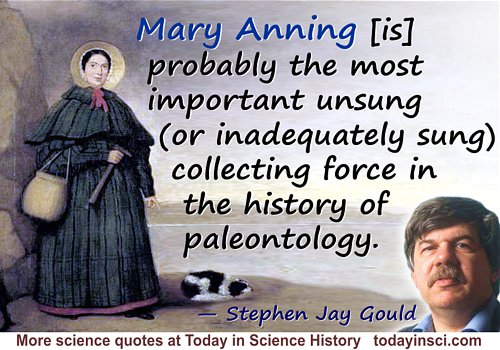
Mary Anning [is] probably the most important unsung (or inadequately sung) collecting force in the history of paleontology.
— Stephen Jay Gould
In Stephen Jay Gould and Rosamond Wolffe Purcell, Finders, Keepers: Eight Collectors (1992), 100.
Memory is a fascinating trickster. Words and images have enormous power and can easily displace actual experience over the years.
— Stephen Jay Gould
…...
Most books, after all, are ephemeral; their specifics, several years later, inspire about as much interest as daily battle reports from the Hundred Years’ War.
— Stephen Jay Gould
…...
Most impediments to scientific understanding are conceptual locks, not factual lacks. Most difficult to dislodge are those biases that escape our scrutiny because they seem so obviously, even ineluctably, just. We know ourselves best and tend to view other creatures as mirrors of our own constitution and social arrangements. (Aristotle, and nearly two millennia of successors, designated the large bee that leads the swarm as a king.)
— Stephen Jay Gould
…...
My profession often gets bad press for a variety of sins, both actual and imagined: arrogance, venality, insensitivity to moral issues about the use of knowledge, pandering to sources of funding with insufficient worry about attendant degradation of values. As an advocate for science, I plead ‘mildly guilty now and then’ to all these charges. Scientists are human beings subject to all the foibles and temptations of ordinary life. Some of us are moral rocks; others are reeds. I like to think (though I have no proof) that we are better, on average, than members of many other callings on a variety of issues central to the practice of good science: willingness to alter received opinion in the face of uncomfortable data, dedication to discovering and publicizing our best and most honest account of nature’s factuality, judgment of colleagues on the might of their ideas rather than the power of their positions.
— Stephen Jay Gould
In Dinosaur in a Haystack: Reflections in Natural History (1997), 270.
My visceral perception of brotherhood harmonizes with our best modern biological knowledge ... Many people think (or fear) that equality of human races represents a hope of liberal sentimentality probably squashed by the hard realities of history. They are wrong. This essay can be summarized in a single phrase, a motto if you will: Human equality is a contingent fact of history. Equality is not true by definition; it is neither an ethical principle (though equal treatment may be) nor a statement about norms of social action. It just worked out that way. A hundred different and plausible scenarios for human history would have yielded other results (and moral dilemmas of enormous magnitude). They didn’t happen.
— Stephen Jay Gould
…...
Mythology is wondrous, a balm for the soul. But its problems cannot be ignored. At worst, it buys inspiration at the price of physical impossibility ... At best, it purveys the same myopic view of history that made this most fascinating subject so boring and misleading in grade school as a sequential take of monarchs and battles.
— Stephen Jay Gould
…...
Natural historians tend to avoid tendentious preaching in this philosophical mode (although I often fall victim to such temptations in these essays). Our favored style of doubting is empirical: if I wish to question your proposed generality, I will search for a counterexample in flesh and blood. Such counterexamples exist in abundance, for the form a staple in a standard genre of writing in natural history–the “wonderment of oddity” or “strange ways of the beaver” tradition.
— Stephen Jay Gould
In 'Reversing Established Orders', Leonardo’s Mountain of Clams and the Diet of Worms (2011), 394.
Natural selection is a theory of local adaptation to changing environments. It proposes no perfecting principles, no guarantee of general improvement,
— Stephen Jay Gould
Ever Since Darwin: Reflections in Natural History (1977), 45.
Nature is objective, and nature is knowable, but we can only view her through a glass darkly–and many clouds upon our vision are of our own making: social and cultural biases, psychological preferences, and mental limitations (in universal modes of thought, not just individualized stupidity).
— Stephen Jay Gould
In Chap. 1, 'Huxley’s Chessboard', Full House: The Spread of Excellence From Plato to Darwin (1996, 2011), 8.
Nearly anyone in this line of work would take a bullet for the last pregnant dodo. But should we not admire the person who, when faced with an overwhelmingly sad reality beyond and personal blame or control, strives valiantly to rescue what ever can be salvaged, rather than retreating to the nearest corner to weep or assign fault?
— Stephen Jay Gould
…...
No Geologist worth anything is permanently bound to a desk or laboratory, but the charming notion that true science can only be based on unbiased observation of nature in the raw is mythology. Creative work, in geology and anywhere else, is interaction and synthesis: half-baked ideas from a bar room, rocks in the field, chains of thought from lonely walks, numbers squeezed from rocks in a laboratory, numbers from a calculator riveted to a desk, fancy equipment usually malfunctioning on expensive ships, cheap equipment in the human cranium, arguments before a road cut.
— Stephen Jay Gould
An Urchin in the Storm (1988), 98.
No more harmful nonsense exists than the common supposition that deepest insight into great questions about the meaning of life or the structure of reality emerges most readily when a free, undisciplined, and uncluttered (read, rather, ignorant and uneducated) mind soars above mere earthly knowledge and concern.
— Stephen Jay Gould
…...
No one should feel at all offended or threatened by the obvious fact that we are not all born entirely blank, or entirely the same, in our mixture of the broad behavioral propensities defining what we call ‘temperament.’
— Stephen Jay Gould
…...
No serious student of human behavior denies the potent influence of evolved biology upon our cultural lives. Our struggle is to figure out how biology affects us, not whether it does.
— Stephen Jay Gould
In An Urchin in the Storm: Essays about Books and Ideas (1988, 2010), 152.
Not since the Lord himself showed his stuff to Ezekiel in the valley of dry bones had anyone shown such grace and skill in the reconstruction of animals from disarticulated skeletons. Charles R. Knight, the most celebrated of artists in the reanimation of fossils, painted all the canonical figures of dinosaurs that fire our fear and imagination to this day.
— Stephen Jay Gould
In Wonderful Life: the Burgess Shale and the Nature of History (1990), 23. First sentence of chapter one.
Organisms ... are directed and limited by their past. They must remain imperfect in their form and function, and to that extent unpredictable since they are not optimal machines. We cannot know their future with certainty, if only because a myriad of quirky functional shifts lie within the capacity of any feature, however well adapted to a present role.
— Stephen Jay Gould
…...
Organisms are not billiard balls, propelled by simple and measurable external forces to predictable new positions on life’s pool table. Sufficiently complex systems have greater richness. Organisms have a history that constrains their future in myriad, subtle ways.
— Stephen Jay Gould
In The Panda’s Thumb: More Reflections in Natural History (1987, 2010), 16.
Orthodoxy can be as stubborn in science as in religion. I do not know how to shake it except by vigorous imagination that inspires unconventional work and contains within itself an elevated potential for inspired error. As the great Italian economist Vilfredo Pareto wrote: ‘Give me a fruitful error any time, full of seeds, bursting with its own corrections. You can keep your sterile truth for yourself.’ Not to mention a man named Thomas Henry Huxley who, when not in the throes of grief or the wars of parson hunting, argued that ‘irrationally held truths may be more harmful than reasoned errors.’
— Stephen Jay Gould
…...
Our discombobulated lives need to sink some anchors in numerical stability. (I still have not recovered from the rise of a pound of hamburger at the supermarket to more than a buck.)
— Stephen Jay Gould
…...
Our failure to discern a universal good does not record any lack of insight or ingenuity, but merely demonstrates that nature contains no moral messages framed in human terms. Morality is a subject for philosophers, theologians, students of the humanities, indeed for all thinking people. The answers will not be read passively from nature; they do not, and cannot, arise from the data of science. The factual state of the world does not teach us how we, with our powers for good and evil, should alter or preserve it in the most ethical manner.
— Stephen Jay Gould
…...
Our indirect methods have taught us a mountain of things about horses, but if you wished to learn even more, would you rather be Whirlaway in the stretch, than interview Eddie Arcaro afterwards?
— Stephen Jay Gould
…...
Our world is not an optimal place, fine tuned by omnipotent forces of selection. It is a quirky mass of imperfections, working well enough (often admirably); a jury-rigged set of adaptations built of curious parts made available by past histories in different contexts ... A world optimally adapted to current environments is a world without history, and a world without history might have been created as we find it. History matters; it confounds perfection and proves that current life transformed its own past.
— Stephen Jay Gould
…...
People may believe correct things for the damnedest and weirdest of wrong reasons.
— Stephen Jay Gould
…...
Perhaps I am just a hopeless rationalist, but isn’t fascination as comforting as solace? Isn’t nature immeasurably more interesting for its complexities and its lack of conformity to our hopes? Isn’t curiosity as wondrously and fundamentally human as compassion?
— Stephen Jay Gould
…...
Perhaps randomness is not merely an adequate description for complex causes that we cannot specify. Perhaps the world really works this way, and many events are uncaused in any conventional sense of the word. Perhaps our gut feeling that it cannot be so reflects only our hopes and prejudices, our desperate striving to make sense of a complex and confusing world, and not the ways of nature.
— Stephen Jay Gould
…...
Phenomena unfold on their own appropriate scales of space and time and may be invisible in our myopic world of dimensions assessed by comparison with human height and times metered by human lifespans. So much of accumulating importance at earthly scales ... is invisible by the measuring rod of a human life. So much that matters to particles in the microscopic world of molecules ... either averages out to stability at our scale or simply stands below our limits of perception.
— Stephen Jay Gould
…...
Phony psychics like Uri Geller have had particular success in bamboozling scientists with ordinary stage magic, because only scientists are arrogant enough to think that they always observe with rigorous and objective scrutiny, and therefore could never be so fooled–while ordinary mortals know perfectly well that good performers can always find a way to trick people.
— Stephen Jay Gould
…...
Results rarely specify their causes unambiguously. If we have no direct evidence of fossils or human chronicles, if we are forced to infer a process only from its modern results, then we are usually stymied or reduced to speculation about probabilities. For many roads lead to almost any Rome.
— Stephen Jay Gould
…...
Run the tape again, and let the tiny twig of Homo sapiens expire in Africa. Other hominids may have stood on the threshold of what we know as human possibilities, but many sensible scenarios would never generate our level of mentality. Run the tape again, and this time Neanderthal perishes in Europe and Homo erectus in Asia (as they did in our world). The sole surviving human stock, Homo erectus in Africa, stumbles along for a while, even prospers, but does not speciate and therefore remains stable. A mutated virus then wipes Homo erectus out, or a change in climate reconverts Africa into inhospitable forest. One little twig on the mammalian branch, a lineage with interesting possibilities that were never realized, joins the vast majority of species in extinction. So what? Most possibilities are never realized, and who will ever know the difference? Arguments of this form lead me to the conclusion that biology's most profound insight into human nature, status, and potential lies in the simple phrase, the embodiment of contingency: Homo sapiens is an entity, not a tendency.
— Stephen Jay Gould
Wonderful Life (1989), 320.
Science is a method for testing claims about the natural world, not an immutable compendium of absolute truths. The fundamentalists, by ‘knowing’ the answers before they start, and then forcing nature into the straitjacket of their discredited preconceptions, lie outside the domain of science–or of any honest intellectual inquiry.
— Stephen Jay Gould
…...
Science is a procedure for testing and rejecting hypotheses, not a compendium of certain knowledge. … Theories that cannot be tested in principle are not a part in science.
— Stephen Jay Gould
In The Flamingo's Smile: Reflections in Natural History (1985), 111.
Science is a search for a repeated pattern. Laws and regularities underlie the display.
— Stephen Jay Gould
In An Urchin in the Storm: Essays about Books and Ideas (1987, 2010), 181.
Science is an integral part of culture. It’s not this foreign thing, done by an arcane priesthood. It’s one of the glories of the human intellectual tradition.
— Stephen Jay Gould
Independent (London, Jan. 24, 1990).
Science is often regarded as the most objective and truth-directed of human enterprises, and since direct observation is supposed to be the favored route to factuality, many people equate respectable science with visual scrutiny–just the facts ma’am, and palpably before my eyes. But science is a battery of observational and inferential methods, all directed to the testing of propositions that can, in principle, be definitely proven false ... At all scales, from smallest to largest, quickest to slowest, many well-documented conclusions of science lie beyond the strictly limited domain of direct observation. No one has ever seen an electron or a black hole, the events of a picosecond or a geological eon.
— Stephen Jay Gould
In Eight Little Piggies: Reflections in Natural History (1994), 200.
Science is, and must be, culturally embedded; what else could the product of human passion be?... Culture is not the enemy of objectivity but a matrix that can either aid or retard advancing knowledge.
— Stephen Jay Gould
…...
Science simply cannot adjudicate the issue of God’s possible superintendence of nature.
— Stephen Jay Gould
In ‘Impeaching a Self-Appointed Judge’, Scientific American (Jul 1992), 119. Cited in Gerald L. Schroeder The Science of God: The Convergence of Scientific and Biblical Wisdom (2009), 18 & 220.
Scientists are not robotic inducing machines that infer structures of explanation only from regularities observed in natural phenomena (assuming, as I doubt, that such a style of reasoning could ever achieve success in principle). Scientists are human beings, immersed in culture, and struggling with all the curious tools of inference that mind permits ... Culture can potentiate as well as constrain–as Darwin’s translation of Adam Smith’s laissez-faire economic models into biology as the theory of natural selection. In any case, objective minds do not exist outside culture, so we must make the best of our ineluctable embedding.
— Stephen Jay Gould
…...
Since we proposed punctuated equilibria to explain trends, it is infuriating to be quoted again and again by creationists–whether through design or stupidity, I do not know–as admitting that the fossil record includes no transitional forms. Transitional forms are generally lacking at the species level, but they are abundant between larger groups.
— Stephen Jay Gould
…...
Siphonophores do not convey the message–a favorite theme of unthinking romanticism–that nature is but one gigantic whole, all its parts intimately connected and interacting in some higher, ineffable harmony. Nature revels in boundaries and distinctions; we inhabit a universe of structure. But since our universe of structure has evolved historically, it must present us with fuzzy boundaries, where one kind of thing grades into another.
— Stephen Jay Gould
…...
So why fret and care that the actual version of the destined deed was done by an upper class English gentleman who had circumnavigated the globe as a vigorous youth, lost his dearest daughter and his waning faith at the same time, wrote the greatest treatise ever composed on the taxonomy of barnacles, and eventually grew a white beard, lived as a country squire just south of London, and never again traveled far enough even to cross the English Channel? We care for the same reason that we love okapis, delight in the fossil evidence of trilobites, and mourn the passage of the dodo. We care because the broad events that had to happen, happened to happen in a certain particular way. And something unspeakably holy –I don’t know how else to say this–underlies our discovery and confirmation of the actual details that made our world and also, in realms of contingency, assured the minutiae of its construction in the manner we know, and not in any one of a trillion other ways, nearly all of which would not have included the evolution of a scribe to record the beauty, the cruelty, the fascination, and the mystery.
— Stephen Jay Gould
…...
Sociobiology is not just any statement that biology, genetics, and evolutionary theory have something to do with human behavior. Sociobiology is a specific theory about the nature of genetic and evolutionary input into human behavior. It rests upon the view that natural selection is a virtually omnipotent architect, constructing organisms part by part as best solutions to problems of life in local environments. It fragments organisms into “traits,” explains their existence as a set of best solutions, and argues that each trait is a product of natural selection operating “for” the form or behavior in question. Applied to humans, it must view specific behaviors (not just general potentials) as adaptations built by natural selection and rooted in genetic determinants, for natural selection is a theory of genetic change. Thus, we are presented with unproved and unprovable speculations about the adaptive and genetic basis of specific human behaviors: why some (or all) people are aggressive, xenophobic, religious, acquisitive, or homosexual.
— Stephen Jay Gould
In Hen's Teeth and Horses Toes (1983, 2010), 242-243.
Some beliefs may be subject to such instant, brutal and unambiguous rejection. For example: no left-coiling periwinkle has ever been found among millions of snails examined. If I happen to find one during my walk on Nobska beach tomorrow morning, a century of well nurtured negative evidence will collapse in an instant.
— Stephen Jay Gould
'A Foot Soldier for Evolution', In Eight Little Piggies (1994), 452.
Somehow I am not distressed that the human order must veil all our interactions with the universe, for the veil is translucent, however strong its texture.
— Stephen Jay Gould
…...
Surely the mitochondrion that first entered another cell was not thinking about the future benefits of cooperation and integration; it was merely trying to make its own living in a tough Darwinian world
— Stephen Jay Gould
Wonderful Life: the Burgess Shale and the Nature of History (1990), 310.
Taxonomy (the science of classification) is often undervalued as a glorified form of filing—with each species in its folder, like a stamp in its prescribed place in an album; but taxonomy is a fundamental and dynamic science, dedicated to exploring the causes of relationships and similarities among organisms. Classifications are theories about the basis of natural order, not dull catalogues compiled only to avoid chaos.
— Stephen Jay Gould
Wonderful Life (1989), 98.
Taxonomy is often regarded as the dullest of subjects, fit only for mindless ordering and sometimes denigrated within science as mere “stamp collecting” (a designation that this former philatelist deeply resents). If systems of classification were neutral hat racks for hanging the facts of the world, this disdain might be justified. But classifications both reflect and direct our thinking. The way we order represents the way we think. Historical changes in classification are the fossilized indicators of conceptual revolutions.
— Stephen Jay Gould
In Hen’s Teeth and Horse’s Toes: Further Reflections in Natural History (1983, 2010), 72
The animals of the Burgess Shale are holy objects–in the unconventional sense that this word conveys in some cultures. We do not place them on pedestals and worship from afar. We climb mountains and dynamite hillsides to find them. We quarry them, split them, carve them, draw them, and dissect them, struggling to wrest their secrets. We vilify and curse them for their damnable intransigence. They are grubby little creatures of a sea floor 530 million years old, but we greet them with awe because they are the Old Ones, and they are trying to tell us something.
— Stephen Jay Gould
…...
The argument of the ‘long view’ may be correct in some meaninglessly abstract sense, but it represents a fundamental mistake in categories and time scales. Our only legitimate long view extends to our children and our children’s children’s children–hundreds or a few thousands of years down the road. If we let the slaughter continue, they will share a bleak world with rats, dogs, cockroaches, pigeons, and mosquitoes. A potential recovery millions of years later has no meaning at our appropriate scale.
— Stephen Jay Gould
…...
The contingency of history (both for life in general and for the cultures of Homo sapiens) and human free will (in the factual rather than theological sense) are conjoined concepts, and no better evidence can be produced than the ‘experimental’ production of markedly different solutions in identical environments.
— Stephen Jay Gould
…...
The divine tape recorder holds a million scenarios, each perfectly sensible. Little quirks at the outset, occurring for no particular reason, unleash cascades of consequences that make a particular feature seem inevitable in retrospect. But the slightest early nudge contacts a different groove, and history veers into another plausible channel, diverging continually from its original pathway. The end results are so different, the initial perturbation so apparently trivial.
— Stephen Jay Gould
…...
The effects of general change in literature are most tellingly recorded not in alteration of the best products, but in the transformation of the most ordinary workaday books; for when potboilers adopt the new style, then the revolution is complete.
— Stephen Jay Gould
…...
The enemy is not fundamentalism; it is intolerance. In this case, the intolerance is perverse since it masquerades under the ‘liberal’ rhetoric of ‘equal time.’ But mistake it not.
— Stephen Jay Gould
…...
The equation of evolution with progress represents our strongest cultural impediment to a proper understanding of this greatest biological revolution in the history of human thought.
— Stephen Jay Gould
Leonardo's Mountain of Clams and the Diet of Worms: Essays on Natural History (1998), 173.
The facts of nature are what they are, but we can only view them through the spectacles of our mind. Our mind works largely by metaphor and comparison, not always (or often) by relentless logic. When we are caught in conceptual traps, the best exit is often a change in metaphor–not because the new guideline will be truer to nature (for neither the old nor the new metaphor lies ‘out there’ in the woods), but because we need a shift to more fruitful perspectives, and metaphor is often the best agent of conceptual transition.
— Stephen Jay Gould
…...
The history of a species, or any natural phenomenon that requires unbroken continuity in a world of trouble, works like a batting streak. All are games of a gambler playing with a limited stake against a house with infinite resources. The gambler must eventually go bust. His aim can only be to stick around as long as possible, to have some fun while he’s at it, and, if he happens to be a moral agent as well, to worry about staying the course with honor.
— Stephen Jay Gould
In Bully for Brontosaurus: Reflections in Natural History (1991), 471-472.
The history of life is more adequately represented by a picture of 'punctuated equilibria' than by the notion of phyletic gradualism. The history of evolution is not one of stately unfolding, but a story of homeostatic equilibria, disturbed only 'rarely' (i.e. rather often in the fullness of time) by rapid and episodic events of speciation.
— Stephen Jay Gould
'Punctuated Equilibria: An Alternative to Phyletic Gradualism', in Thomas J. M. Schopf (ed.), Models in Paleobiology (1972), 84.
The history of most fossil species includes two features particularly inconsistent with gradualism: 1. Stasis. Most species exhibit no directional change during their tenure on earth. They appear in the fossil record looking much the same as when they disappear; morphological change is usually limited and directionless. 2. Sudden appearance. In any local area, a species does not arise gradually by the steady transformation of its ancestors; it appears all at once and ‘fully formed.’
— Stephen Jay Gould
…...
The human brain became large by natural selection (who knows why, but presumably for good cause). Yet surely most ‘things’ now done by our brains, and essential both to our cultures and to our very survival, are epiphenomena of the computing power of this machine, not genetically grounded Darwinian entities created specifically by natural selection for their current function.
— Stephen Jay Gould
…...
The human mind delights in finding pattern–so much so that we often mistake coincidence or forced analogy for profound meaning. No other habit of thought lies so deeply within the soul of a small creature trying to make sense of a complex world not constructed for it.
— Stephen Jay Gould
…...
The legends of fieldwork locate all important sites deep in inaccessible jungles inhabited by fierce beasts and restless natives, and surrounded by miasmas of putrefaction and swarms of tsetse flies. (Alternative models include the hundredth dune after the death of all camels, or the thousandth crevasse following the demise of all sled dogs.)
— Stephen Jay Gould
In Wonderful Life: The Burgess Shale and the Nature of History (1990), 65.
The median isn’t the message.
— Stephen Jay Gould
'The Median Isn't the Message', Discover, Jun 1985, 40.
The most erroneous stories are those we think we know best—and therefore never scrutinize or question.
— Stephen Jay Gould
Full House: The Spread of Excellence from Plato to Darwin (1997), 57.
The only universal attribute of scientific statements resides in their potential fallibility. If a claim cannot be disproven, it does not belong to the enterprise of science.
— Stephen Jay Gould
Leonardo's Mountain of Clams and the Diet of Worms: Essays on Natural History (1998), 155.
The oppressive weight of disaster and tragedy in our lives does not arise from a high percentage of evil among the summed total of all acts, but from the extraordinary power of exceedingly rare incidents of depravity to inflict catastrophic damage, especially in our technological age when airplanes can become powerful bombs. (An even more evil man, armed only with a longbow, could not have wreaked such havoc at the Battle of Agincourt in 1415.)
— Stephen Jay Gould
…...
The progress of science requires more than new data; it needs novel frameworks and contexts. And where do these fundamentally new views of the world arise? They are not simply discovered by pure observation; they require new modes of thought. And where can we find them, if old modes do not even include the right metaphors? The nature of true genius must lie in the elusive capacity to construct these new modes from apparent darkness. The basic chanciness and unpredictability of science must also reside in the inherent difficulty of such a task.
— Stephen Jay Gould
…...
The real tragedy of human existence is not that we are nasty by nature, but that a cruel structural asymmetry grants to rare events of meanness such power to shape our history.
— Stephen Jay Gould
…...
The skein of human continuity must often become this tenuous across the centuries (hanging by a thread, in the old cliché), but the circle remains unbroken if I can touch the ink of Lavoisier’s own name, written by his own hand. A candle of light, nurtured by the oxygen of his greatest discovery, never burns out if we cherish the intellectual heritage of such unfractured filiation across the ages. We may also wish to contemplate the genuine physical thread of nucleic acid that ties each of us to the common bacterial ancestor of all living creatures, born on Lavoisier’s ancienne terre more than 3.5 billion years ago—and never since disrupted, not for one moment, not for one generation. Such a legacy must be worth preserving from all the guillotines of our folly.
— Stephen Jay Gould
From The Lying Stones of Marrakech (2000, 2011), 114, previously published in an article in Natural History Magazine. Gould was writing about tangibly having Lavoisier’s signature on proof plates bought at an auction. (The plates were made to accompany Lavoisier’s sole geological article of 1789.)
The solution, as all thoughtful people recognize, must lie in properly melding the themes of inborn predisposition and shaping through life’s experiences. This fruitful joining cannot take the false form of percentages adding to 100–as in ‘intelligence is 80 percent nature and 20 percent nurture,’ or ‘homosexuality is 50 percent inborn and 50 percent learned,’ and a hundred other harmful statements in this foolish format. When two ends of such a spectrum are commingled, the result is not a separable amalgam (like shuffling two decks of cards with different backs), but an entirely new and higher entity that cannot be decomposed (just as adults cannot be separated into maternal and paternal contributions to their totality).
— Stephen Jay Gould
…...
The spandrels of San Marco and the Panglossian Paradigm.
Co-authored with American biologist, R. C. Lewontin (1929- )
Co-authored with American biologist, R. C. Lewontin (1929- )
— Stephen Jay Gould
In 'The Spandrels of San Marco and the Panglossian Paradigm: A Critique of the Adaptionist Programme', Proceedings of the Royal Society, 1979, 205, 581-98.
The story of a theory’s failure often strikes readers as sad and unsatisfying. Since science thrives on self-correction, we who practice this most challenging of human arts do not share such a feeling. We may be unhappy if a favored hypothesis loses or chagrined if theories that we proposed prove inadequate. But refutation almost always contains positive lessons that overwhelm disappointment, even when no new and comprehensive theory has yet filled the void.
— Stephen Jay Gould
…...
The theory of punctuated equilibrium, proposed by Niles Eldredge and myself, is not, as so often misunderstood, a radical claim for truly sudden change, but a recognition that ordinary processes of speciation, properly conceived as glacially slow by the standard of our own life-span, do not resolve into geological time as long sequences of insensibly graded intermediates (the traditional, or gradualistic, view), but as geologically ‘sudden’ origins at single bedding planes.
— Stephen Jay Gould
…...
The true beauty of nature is her amplitude; she exists neither for nor because of us, and possesses a staying power that all our nuclear arsenals cannot threaten (much as we can easily destroy our puny selves).
— Stephen Jay Gould
…...
The truly awesome intellectuals in our history have not merely made discoveries; they have woven variegated, but firm, tapestries of comprehensive coverage. The tapestries have various fates: Most burn or unravel in the foot steps of time and the fires of later discovery. But their glory lies in their integrity as unified structures of great complexity and broad implication.
— Stephen Jay Gould
…...
The vigorous branching of life’s tree, and not the accumulating valor of mythical marches to progress, lies behind the persistence and expansion of organic diversity in our tough and constantly stressful world. And if we do not grasp the fundamental nature of branching as the key to life’s passage across the geological stage, we will never understand evolution aright.
— Stephen Jay Gould
…...
The world is full of signals that we don’t perceive. Tiny creatures live in a different world of unfamiliar forces. Many animals of our scale greatly exceed our range of perception for sensations familiar to us ... What an imperceptive lot we are. Surrounded by so much, so fascinating and so real, that we do not see (hear, smell, touch, taste) in nature, yet so gullible and so seduced by claims for novel power that we mistake the tricks of mediocre magicians for glimpses of a psychic world beyond our ken. The paranormal may be a fantasy; it is certainly a haven for charlatans. But ‘parahuman’ powers of perception lie all about us in birds, bees, and bacteria.
— Stephen Jay Gould
…...
The world, unfortunately, rarely matches our hopes and consistently refuses to behave in a reasonable manner.
— Stephen Jay Gould
…...
Theories rarely arise as patient inferences forced by accumulated facts. Theories are mental constructs potentiated by complex external prods (including, in idealized cases, a commanding push from empirical reality) . But the prods often in clude dreams, quirks, and errors–just as we may obtain crucial bursts of energy from foodstuffs or pharmaceuticals of no objective or enduring value. Great truth can emerge from small error. Evolution is thrilling, liberating, and correct. And Macrauchenia is a litoptern.
— Stephen Jay Gould
…...
Theory and fact are equally strong and utterly interdependent; one has no meaning without the other. We need theory to organize and interpret facts, even to know what we can or might observe. And we need facts to validate theories and give them substance.
— Stephen Jay Gould
Leonardo's Mountain of Clams and the Diet of Worms: Essays on Natural History (1998), 155.
There are no shortcuts to moral insight. Nature is not intrinsically anything that can offer comfort or solace in human terms–if only because our species is such an insignificant latecomer in a world not constructed for us. So much the better. The answers to moral dilemmas are not lying out there, waiting to be discovered. They reside, like the kingdom of God, within us–the most difficult and inaccessible spot for any discovery or consensus.
— Stephen Jay Gould
…...
There is no gene ‘for’ such unambiguous bits of morphology as your left kneecap or your fingernail ... Hundreds of genes contribute to the building of most body parts and their action is channeled through a kaleidoscopic series of environmental influences: embryonic and postnatal, internal and external. Parts are not translated genes, and selection doesn’t even work directly on parts.
— Stephen Jay Gould
…...
This theme of mutually invisible life at widely differing scales bears an important implication for the ‘culture wars’ that supposedly now envelop our universities and our intellectual discourse in general ... One side of this false dichotomy features the postmodern relativists who argue that all culturally bound modes of perception must be equally valid, and that no factual truth therefore exists. The other side includes the benighted, old-fashioned realists who insist that flies truly have two wings, and that Shakespeare really did mean what he thought he was saying. The principle of scaling provides a resolution for the false parts of this silly dichotomy. Facts are facts and cannot be denied by any rational being. (Often, facts are also not at all easy to determine or specify–but this question raises different issues for another time.) Facts, however, may also be highly scale dependent–and the perceptions of one world may have no validity or expression in the domain of another. The one-page map of Maine cannot recognize the separate boulders of Acadia, but both provide equally valid representations of a factual coastline.
— Stephen Jay Gould
The World as I See It (1999)
Throughout his last half-dozen books, for example, Arthur Koestler has been conducting a campaign against his own misunderstanding of Darwinism. He hopes to find some ordering force, constraining evolution to certain directions and overriding the influence of natural selection ... Darwinism is not the theory of capricious change that Koestler imagines. Random variation may be the raw material of change, but natural selection builds good design by rejecting most variants while accepting and accumulating the few that improve adaptation to local environments.
— Stephen Jay Gould
In The Panda’s Thumb: More Reflections in Natural History (1990, 2010), 38.
Thus, we have three principles for increasing adequacy of data: if you must work with a single object, look for imperfections that record historical descent; if several objects are available, try to render them as stages of a single historical process; if processes can be directly observed, sum up their effects through time. One may discuss these principles directly or recognize the ‘little problems’ that Darwin used to exemplify them: orchids, coral reefs, and worms–the middle book, the first, and the last.
— Stephen Jay Gould
…...
Time’s arrow of ‘just history’ marks each moment of time with a distinctive brand. But we cannot, in our quest to understand history, be satisfied only with a mark to recognize each moment and a guide to order events in temporal sequence. Uniqueness is the essence of history, but we also crave some underlying generality, some principles of order transcending the distinction of moments–lest we be driven mad by Borges’s vision of a new picture every two thousand pages in a book without end. We also need, in short, the immanence of time’s cycle.
— Stephen Jay Gould
…...
True majorities, in a TV-dominated and anti-intellectual age, may need sound bites and flashing lights–and I am not against supplying such lures if they draw children into even a transient concern with science. But every classroom has one [Oliver] Sacks, one [Eric] Korn, or one [Jonathan] Miller, usually a lonely child with a passionate curiosity about nature, and a zeal that overcomes pressures for conformity. Do not the one in fifty deserve their institutions as well–magic places, like cabinet museums, that can spark the rare flames of genius?
— Stephen Jay Gould
…...
Truly grand and powerful theories … do not and cannot rest upon single observations. Evolution is an inference from thousands of independent sources, the only conceptual structure that can make unified sense of all this disparate information. The failure of a particular claim usually records a local error, not the bankruptcy of a central theory … If I mistakenly identify your father’s brother as your own dad, you don’t become genealogically rootless and created de novo. You still have a father; we just haven’t located him properly.
— Stephen Jay Gould
Leonardo’s Mountain of Clams and the Diet of Worms: Essays on Natural History (1998), 155.
Very few people, including authors willing to commit to paper, ever really read primary sources–certainly not in necessary depth and contemplation, and often not at all ... When writers close themselves off to the documents of scholarship, and then rely only on seeing or asking, they become conduits and sieves rather than thinkers. When, on the other hand, you study the great works of predecessors engaged in the same struggle, you enter a dialogue with human history and the rich variety of our own intellectual traditions. You insert yourself, and your own organizing powers, into this history–and you become an active agent, not merely a ‘reporter.’
— Stephen Jay Gould
…...
Very little comes easily to our poor, benighted species (the first creature, after all, to experiment with the novel evolutionary inventions of self-conscious philosophy and art). Even the most ‘obvious,’ ‘accurate,’ and ‘natural’ style of thinking or drawing must be regulated by history and won by struggle. Solutions must therefore arise within a social context and record the complex interactions of mind and environment that define the possibility of human improvement.
— Stephen Jay Gould
…...
Wallace’s error on human intellect arose from the in adequacy of his rigid selectionism, not from a failure to apply it. And his argument repays our study today, since its flaw persists as the weak link in many of the most ‘modern’ evolutionary speculations of our current literature. For Wallace’s rigid selectionism is much closer than Darwin’s pluralism to the attitude embodied in our favored theory today, which, ironically in this context, goes by the name of ‘Neo-Darwinism.’
— Stephen Jay Gould
…...
We are the accidental result of an unplanned process … the fragile result of an enormous concatenation of improbabilities, not the predictable product of any definite process.
— Stephen Jay Gould
'Extemporaneous Comments of Evolutionary Hopes and Realities'. In Charles L. Hamrum (Ed.), Darwin's Legacy, Nobel Conference XVIII (1983), 101-102. Quoted in Holmes Rolston, Genes, Genesis, and God (1999), 17-18.
We build our personalities laboriously and through many years, and we cannot order fundamental changes just because we might value their utility; no button reading ‘positive attitude’ protrudes from our hearts, and no finger can coerce positivity into immediate action by a single and painless pressing.
— Stephen Jay Gould
…...
We debase the richness of both nature and our own minds if we view the great pageant of our intellectual history as a compendium of new in formation leading from primal superstition to final exactitude. We know that the sun is hub of our little corner of the universe, and that ties of genealogy connect all living things on our planet, because these theories assemble and explain so much otherwise disparate and unrelated information–not because Galileo trained his telescope on the moons of Jupiter or because Darwin took a ride on a Galápagos tortoise.
— Stephen Jay Gould
…...
We do live in a conceptual trough that encourages such yearning for unknown and romanticized greener pastures of other times. The future doesn’t seem promising, if only because we can extrapolate some disquieting present trends in to further deterioration: pollution, nationalism, environmental destruction, and aluminum bats. Therefore, we tend to take refuge in a rose-colored past ... I do not doubt the salutary, even the essential, properties of this curiously adaptive human trait, but we must also record the down side. Legends of past golden ages become impediments when we try to negotiate our current dilemma.
— Stephen Jay Gould
…...
We do not inhabit a perfected world where natural selection ruthlessly scrutinizes all organic structures and then molds them for optimal utility. Organisms inherit a body form and a style of embryonic development; these impose constraint s upon future change and adaptation. In many cases, evolutionary pathways reflect inherited patterns more than current environmental demands. These inheritances constrain, but they also provide opportunity. A potentially minor genetic change ... entails a host of complex, nonadaptive consequences ... What ‘play’ would evolution have if each structure were built for a restricted purpose and could be used for nothing else? How could humans learn to write if our brain had not evolved for hunting, social cohesion, or whatever, and could not transcend the adaptive boundaries of its original purpose?
— Stephen Jay Gould
…...
We inhabit a complex world. Some boundaries are sharp and permit clean and definite distinctions. But nature also includes continua that cannot be neatly parceled into two piles of unambiguous yeses and noes. Biologists have rejected, as fatally flawed in principle, all attempts by antiabortionists to define an unambiguous ‘beginning of life,’ because we know so well that the sequence from ovulation or spermatogenesis to birth is an unbreakable continuum–and surely no one will define masturbation as murder.
— Stephen Jay Gould
…...
We live in a capitalist economy, and I have no particular objection to honorable self-interest. We cannot hope to make the needed, drastic improvement in primary and secondary education without a dramatic restructuring of salaries. In my opinion, you cannot pay a good teacher enough money to recompense the value of talent applied to the education of young children. I teach an hour or two a day to tolerably well-behaved near-adults–and I come home exhausted. By what possible argument are my services worth more in salary than those of a secondary-school teacher with six classes a day, little prestige, less support, massive problems of discipline, and a fundamental role in shaping minds. (In comparison, I only tinker with intellects already largely formed.)
— Stephen Jay Gould
…...
We live in an essential and unresolvable tension between our unity with nature and our dangerous uniqueness. Systems that attempt to place and make sense of us by focusing exclusively either on the uniqueness or the unity are doomed to failure. But we must not stop asking and questing because the answers are complex and ambiguous.
— Stephen Jay Gould
In 'Our Natural Place', Hen's Teeth and Horse’s Toes: Further Reflections in Natural History (1994, 2010), 250.
We may need simple and heroic legends for that peculiar genre of literature known as the textbook. But historians must also labor to rescue human beings from their legends in science–if only so that we may understand the process of scientific thought aright.
— Stephen Jay Gould
…...
We must [it has been arued] go beyond reductionism to a holistic recognition that biology and culture interpenetrate in an inextricable manner.
— Stephen Jay Gould
An Urchin in the Storm (1988), 153.
We often think, naïvely, that missing data are the primary impediments to intellectual progress–just find the right facts and all problems will dissipate. But barriers are often deeper and more abstract in thought. We must have access to the right metaphor, not only to the requisite information. Revolutionary thinkers are not, primarily, gatherers of fact s, but weavers of new intellectual structures.
— Stephen Jay Gould
…...
We should therefore, with grace and optimism, embrace NOMA’s tough-minded demand: Acknowledge the personal character of these human struggles about morals and meanings, and stop looking for definite answers in nature’s construction. But many people cannot bear to surrender nature as a ‘transitional object’–a baby’s warm blanket for our adult comfort. But when we do (for we must) , nature can finally emerge in her true form: not as a distorted mirror of our needs, but as our most fascinating companion. Only then can we unite the patches built by our separate magisteria into a beautiful and coherent quilt called wisdom.
— Stephen Jay Gould
From essay, 'Non-overlapping Magisteria', Natural History magazine (Mar 1997), 106, 16–22 and 60–62. Collected in Rocks of Ages: Science and Religion in the Fullness of Life (1999), 178. [NOMA or Non-overlapping magisteria, is viewpoint advocated by Gould, that science and religion each represent different areas of inquiry, fact vs. values, and thus he aims to resolve the supposed conflict between science and religion. He draws the term “magisterium” from an encyclical of Pope Pius XII.
about science and religion. —Webmaster]
Well, evolution is a theory. It is also a fact. And facts and theories are different things, not rungs in a hierarchy of increasing certainty. Facts are the world’s data. Theories are structures of ideas that explain and interpret facts. Facts do not go away while scientists debate rival theories for explaining them. Einstein’s theory of gravitation replaced Newton’s, but apples did not suspend themselves in mid-air pending the outcome. And human beings evolved from apelike ancestors whether they did so by Darwin’s proposed mechanism or by some other, yet to be discovered … Evolutionists make no claim for perpetual truth, though creationists often do (and then attack us for a style of argument that they themselves favor).
— Stephen Jay Gould
'Evolution as Fact and Theory', in Hen’s Teeth and Horse’s Toes: Further Reflections in Natural History (1983), 254-255.
Western field-work conjures up images of struggle on horseback ... –toughing it out on one canteen a day as you labor up and down mountains. The value of a site is supposedly correlated with the difficulty of getting there. This, of course, is romantic drivel. Ease of access is no measure of importance. The famous La Brea tar pits are right in downtown Los Angeles. To reach the Clarkia lake beds, you turn off the main road at Buzzard’s Roost Trophy Company and drive the remaining fifty yards right up to the site.
— Stephen Jay Gould
…...
What intellectual phenomenon can be older, or more oft repeated, than the story of a large research program that impaled itself upon a false central assumption accepted by all practitioners? Do we regard all people who worked within such traditions as dishonorable fools? What of the scientists who assumed that the continents were stable, that the hereditary material was protein, or that all other galaxies lay within the Milky Way? These false and abandoned efforts were pursued with passion by brilliant and honorable scientists. How many current efforts, now commanding millions of research dollars and the full attention of many of our best scientists, will later be exposed as full failures based on false premises?
— Stephen Jay Gould
…...
When an inquiry becomes so convoluted, we must suspect that we are proceeding in the wrong way. We must return to go, change gears, and reformulate the problem, not pursue every new iota of information or nuance of argument jn the old style, hoping all the time that our elusive solution simply awaits a crucial item, yet undiscovered.
— Stephen Jay Gould
In The Flamingo’s Smile (1985).
When Bonner writes that ‘natural selection for optimal feeding is then presumed to be the cause of non-motility in all forms,’ I can’t help suspecting that some plants might do even better if they could walk from shade to sun–but the inherited constraints of design never permitted a trial of this intriguing option.
— Stephen Jay Gould
…...
When puzzled, it never hurts to read the primary documents–a rather simple and self-evident principle that has, nonetheless, completely disappeared from large sectors of the American experience.
— Stephen Jay Gould
…...
When we seek a textbook case for the proper operation of science, the correction of certain error offers far more promise than the establishment of probable truth. Confirmed hunches, of course, are more upbeat than discredited hypotheses. Since the worst traditions of ‘popular’ writing falsely equate instruction with sweetness and light, our promotional literature abounds with insipid tales in the heroic mode, although tough stories of disappointment and loss give deeper insight into a methodology that the celebrated philosopher Karl Popper once labeled as ‘conjecture and refutation.’
— Stephen Jay Gould
…...
Will we ever again be able to view a public object with civic dignity, unencumbered by commercial messages? Must city buses be fully painted as movable ads, lampposts smothered, taxis festooned, even seats in concert halls sold one by one to donors and embellished in perpetuity with their names on silver plaques?
— Stephen Jay Gould
…...
Without a commitment to science and rationality in its proper domain, there can be no solution to the problems that engulf us. Still, the Yahoos never rest.
— Stephen Jay Gould
Ever Since Darwin (1980),146.
Words change their meanings, just as organism s evolve. We would impose an enormous burden on our economy if we insisted on payment in cattle every time we identified a bonus as a pecuniary advantage (from the Latin pecus, or cattle, a verbal fossil from a former commercial reality).
— Stephen Jay Gould
…...
World views are social constructions and they channel the search for facts. But facts are found and knowledge progresses, however fitfully.
— Stephen Jay Gould
…...
Yes, Shakespeare foremost and forever (Darwin too). But also teach about the excellence of pygmy bushcraft and Fuegian survival in the world’s harshest climate. Dignity and inspiration come in many guises. Would anyone choose the tinhorn patriotism of George Armstrong Custer over the eloquence of Chief Joseph in defeat?
— Stephen Jay Gould
…...
Yet I also appreciate that we cannot win this battle to save species and environments without forging an emotional bond between ourselves and nature as well–for we will not fight to save what we do not love (but only appreciate in some abstract sense). So let them all continue–the films, the books, the television programs, the zoos, the little half acre of ecological preserve in any community, the primary school lessons, the museum demonstrations, even ... the 6:00 A.M. bird walks. Let them continue and expand because we must have visceral contact in order to love. We really must make room for nature in our hearts.
— Stephen Jay Gould
…...
Zoocentrism is the primary fallacy of human sociobiology, for this view of human behavior rests on the argument that if the actions of ‘lower’ animals with simple nervous systems arise as genetic products of natural selection, then human behavior should have a similar basis.
— Stephen Jay Gould
…...

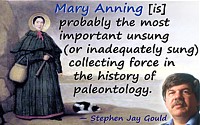
See also:
- 10 Sep - short biography, births, deaths and events on date of Gould's birth.
- Stephen Jay Gould - context of quote Mary Anning - Medium image (500 x 350 px)
- Stephen Jay Gould - context of quote Mary Anning - Large image (800 x 600 px)
- Stephen Jay Gould - context of quote Honorable errors…not…failures in science - Medium image (500 x 350 px)
- Stephen Jay Gould - context of quote Honorable errors…not…failures in science - Large image (800 x 600 px)
- Stephen Jay Gould - context of quote The status of Galileo - Medium image (500 x 350 px)
- Stephen Jay Gould - context of quote The status of Galileo - Large image (800 x 600 px)
- Stephen Jay Gould: Reflections on His View of Life, by Patricia Kelley, Robert Ross and Warren D. Allmon (ed.). - book suggestion.
- Booklist for Stephen Jay Gould.
 In science it often happens that scientists say, 'You know that's a really good argument; my position is mistaken,' and then they would actually change their minds and you never hear that old view from them again. They really do it. It doesn't happen as often as it should, because scientists are human and change is sometimes painful. But it happens every day. I cannot recall the last time something like that happened in politics or religion.
(1987) --
In science it often happens that scientists say, 'You know that's a really good argument; my position is mistaken,' and then they would actually change their minds and you never hear that old view from them again. They really do it. It doesn't happen as often as it should, because scientists are human and change is sometimes painful. But it happens every day. I cannot recall the last time something like that happened in politics or religion.
(1987) --