 (source)
|
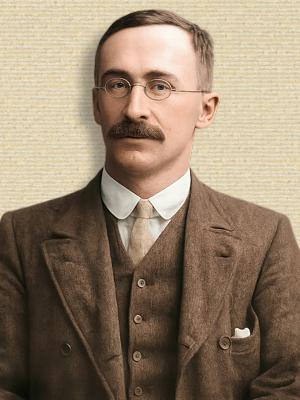
William Sealy Gosset
(13 Jun 1876 - 16 Oct 1937)
English statistician (pen name “Student”) who developed the Student’s t-test and t-distribution, foundational tools for analyzing small sample sizes and assessing statistical significance.
|
Science Quotes by William Sealy Gosset (3 quotes)
Any experiment may be regarded as forming an individual of a “population” of experiments which might be performed under the same conditions. A series of experiments is a sample drawn from this population.
Now any series of experiments is only of value in so far as it enables us to form a judgment as to the statistical constants of the population to which the experiments belong. In a great number of cases the question finally turns on the value of a mean, either directly, or as the mean difference between the two qualities.
If the number of experiments be very large, we may have precise information as to the value of the mean, but if our sample be small, we have two sources of uncertainty:— (1) owing to the “error of random sampling” the mean of our series of experiments deviates more or less widely from the mean of the population, and (2) the sample is not sufficiently large to determine what is the law of distribution of individuals.
Now any series of experiments is only of value in so far as it enables us to form a judgment as to the statistical constants of the population to which the experiments belong. In a great number of cases the question finally turns on the value of a mean, either directly, or as the mean difference between the two qualities.
If the number of experiments be very large, we may have precise information as to the value of the mean, but if our sample be small, we have two sources of uncertainty:— (1) owing to the “error of random sampling” the mean of our series of experiments deviates more or less widely from the mean of the population, and (2) the sample is not sufficiently large to determine what is the law of distribution of individuals.
— William Sealy Gosset
From 'The Probable Error of a Mean', Biometrika, 1908, 6, 1. Collected in William Sealy Gosset, E.S. Pearson (ed.) and John Wishart (ed.) “Student’s Collected Papers (1942), 11.
Conclusions
I. A curve has been found representing the frequency distribution of standard deviations of samples drawn from a normal population.
II. A curve has been found representing the frequency distribution of values of the means of such samples, when these values are measured from the mean of the population in terms of the standard deviation of the sample…
IV. Tables are given by which it can be judged whether a series of experiments, however short, have given a result which conforms to any required standard of accuracy or whether it is necessary to continue the investigation.
I. A curve has been found representing the frequency distribution of standard deviations of samples drawn from a normal population.
II. A curve has been found representing the frequency distribution of values of the means of such samples, when these values are measured from the mean of the population in terms of the standard deviation of the sample…
IV. Tables are given by which it can be judged whether a series of experiments, however short, have given a result which conforms to any required standard of accuracy or whether it is necessary to continue the investigation.
— William Sealy Gosset
From 'The Probable Error of a Mean', Biometrika, 1908, 6, 25. Collected in William Sealy Gosset, E.S. Pearson (ed.) and John Wishart (ed.) “Student’s Collected Papers (1942), 34.
I fancy you give me credit for being a more systematic sort of cove than I really am in the matter of limits of significance. What would actually happen would be that I should make out Pt (normal) and say to myself that would be about 50:1; pretty good but as it may not be normal we’d best not be too certain, or 100:1; even allowing that it may not be normal it seems good enough and whether one would be content with that or would require further work would depend on the importance of the conclusion and the difficulty of obtaining suitable experience.
— William Sealy Gosset
Letter to E. S. Pearson (18 May 1929) appended to E.S. Pearson, '“Student” as Statistician', Biometrika, 1939, 30, 244.
See also:
- 13 Jun - short biography, births, deaths and events on date of Gosset's birth.
 In science it often happens that scientists say, 'You know that's a really good argument; my position is mistaken,' and then they would actually change their minds and you never hear that old view from them again. They really do it. It doesn't happen as often as it should, because scientists are human and change is sometimes painful. But it happens every day. I cannot recall the last time something like that happened in politics or religion.
(1987) --
In science it often happens that scientists say, 'You know that's a really good argument; my position is mistaken,' and then they would actually change their minds and you never hear that old view from them again. They really do it. It doesn't happen as often as it should, because scientists are human and change is sometimes painful. But it happens every day. I cannot recall the last time something like that happened in politics or religion.
(1987) -- 





