 (source)
|
Johann Wolfgang von Goethe
(28 Aug 1749 - 22 Mar 1832)
German poet, zoologist, botanist and geologist who an intellectual with an interest writing on science, but was primarily famous for poetry and literature.
|
Science Quotes by Johann Wolfgang von Goethe (137 quotes)
>> Click for Johann Wolfgang von Goethe Quotes on | Evolution | Nature | Science And Art |
>> Click for Johann Wolfgang von Goethe Quotes on | Evolution | Nature | Science And Art |
[Nature] is complete, but never finished.
— Johann Wolfgang von Goethe
As quoted by T.H. Huxley, in Norman Lockyer (ed.), 'Nature: Aphorisms by Goethe', Nature (1870), 1, 10.
Alles Gescheite ist schon gedacht worden; man muss nur versuchen, es noch einmal zu denken.
Everything that is worth thinking has already been thought; one must only try to think it again.
Everything that is worth thinking has already been thought; one must only try to think it again.
— Johann Wolfgang von Goethe
As translated in William Francis Henry King (ed.), Classical and Foreign Quotations: A Polyglot Manual of Historical (1904), 234.

Blut ist ein ganz besondrer Saft.
Blood is a very special juice.
Blood is a very special juice.
— Johann Wolfgang von Goethe
In Faust, Part I (1808), scene in Faust’s study, line 1740. As translated by Stuart Atkins in Faust I & II, (1984, 1994), 45. Said by Mephistopheles, as Faust pledges his soul with his blood on the devil’s pact. Also translated by Bayard Taylor as “Blood is a juice of rarest quality,” in Faust: A Tragedy (1872), Part 1, 62. Also seen as “Blood is a very unusual fluid.”
Dauer in Wechsel.
Duration in change.
Duration in change.
— Johann Wolfgang von Goethe
Favourite expression.
Die Geschichte der Wissenschaften ist eine grosse Fuge, in der die Stimmen der Völker nach und nach zum Vorschein kommen.
The history of the sciences is a great fugue, in which the voices of the nations come one by one into notice.
The history of the sciences is a great fugue, in which the voices of the nations come one by one into notice.
— Johann Wolfgang von Goethe
In James Wood, Dictionary of Quotations from Ancient and Modern, English and Foreign Sources (1893), 64:23.
Die Mathematiker sind eine Art Franzosen. Spricht man zu ihnen, so übersetzen sie alles in ihre eigene Sprache, und so wird es alsobald etwas ganz anderes.
Mathematicians are a kind of Frenchmen. Whenever you say anything or talk to them, they translate it into their own language, and right away it is something completely different.
Mathematicians are a kind of Frenchmen. Whenever you say anything or talk to them, they translate it into their own language, and right away it is something completely different.
— Johann Wolfgang von Goethe
Quoted by Christiane Senn-Fennell, 'Oral and Written Communication', in Ian Westbury et al. (eds.), Teaching as a Reflective Practice (2000), 225.
Die Wahlverwandtschaften.
Elective affinities.
Elective affinities.
— Johann Wolfgang von Goethe
Title of a novel, 1809.
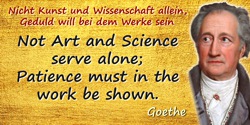
Nicht Kunst und Wissenschaft allein,
Geduld will bei dem Werke sein.
Not Art and Science serve alone; Patience must in the work be shown.
Geduld will bei dem Werke sein.
Not Art and Science serve alone; Patience must in the work be shown.
— Johann Wolfgang von Goethe
Lines for character Mephistopheles in Faust I. As translated by Bayard Taylor in Lilian Dalbiac, Dictionary of Quotations (German) (1909, 256. Also translated as “Not art and science only, but patience will be required for the work”, in James Wood, Dictionary of Quotations from Ancient and Modern, English and Foreign Sources (1893), 298, No. 11.
Wer fremde Sprachen nicht kennt, weiss nichts von seiner eigenen
He who is ignorant of foreign languages knows not his own.
He who is ignorant of foreign languages knows not his own.
— Johann Wolfgang von Goethe
Original German in Über Kunst und Alterthum (1821), 30. Quoted, in translation, in Samuel Arthur Bent, Short Sayings of Great Men: With Historical and Explanatory Notes (1882). Also seen as, “He who knows but one language knows none.”
Wer kann was Dummes, wer was Kluges denken, Das nicht die Vorwelt schon gedacht?
What is there, wise or foolish, one can think, That former ages have not thought before?
What is there, wise or foolish, one can think, That former ages have not thought before?
— Johann Wolfgang von Goethe
Words of Mephistopheles written in Faust, Pt. 2, Act 2. As quoted and translated by the editor in in William Francis Henry King (ed.), Classical and Foreign Quotations: A Polyglot Manual of Historical (1904), 234.
Wer Wissenschaft und Kunst besitzt,
Hat auch Religion;
Wer jene beiden nicht besitzt,
Der habe Religion
He who possesses science and art,
Possesses religion as well;
He who possesses neither of these,
Had better have religion.
Hat auch Religion;
Wer jene beiden nicht besitzt,
Der habe Religion
He who possesses science and art,
Possesses religion as well;
He who possesses neither of these,
Had better have religion.
— Johann Wolfgang von Goethe
'Gedichte' in Goethes Werke (1948, 1952), Vol. 1, 367. Cited in Max Jammer, Einstein and Religion (2002), 79.
Wilst du ins Unendliche schreiten, Geh nur im Endlichen nach allen Seiten.
If you want to reach the infinite, explore every aspect of the finite.
If you want to reach the infinite, explore every aspect of the finite.
— Johann Wolfgang von Goethe
Jeremy Naydler (ed.), Goethe On Science: An Anthology of Goethe’s Scientific Writings (1996), 37.

Zweck sein selbst ist jegliches Tier.
Each animal is an end in itself.
Each animal is an end in itself.
— Johann Wolfgang von Goethe
'Metamorphose der Tiere' (1806), in David Luke (ed.), Goethe (1964), 152.
A man avails himself of the truth so long as it is serviceable; but he seizes on what is false with a passionate eloquence as soon as he can make a momentary use of it; whether it be to dazzle others with it as a kind of half-truth, or to employ it as a stopgap for effecting all apparent union between things that have been disjointed.
— Johann Wolfgang von Goethe
In The Maxims and Reflections of Goethe (1906), 193.
A man cannot well stand by himself, and so he is glad to join a party; because if he does not find rest there, he at any rate finds quiet and safety.
— Johann Wolfgang von Goethe
In The Maxims and Reflections of Goethe (1906), 183.
A man must cling to the belief that the incomprehensible is comprehensible; otherwise he would not try to fathom it.
— Johann Wolfgang von Goethe
In The Maxims and Reflections of Goethe (1906), 194.
A man’s errors are what make him amiable.
— Johann Wolfgang von Goethe
As quoted in Adam Wooléver (ed.), A Treasury of Wisdom, Wit and Humor, Odd Comparisons and Proverbs (1876), 128. The quote is identified as from last number of his Journal of Art in his 77th year, in François duc de La Rochefoucauld, Moral Reflections, Sentences and Maxims (1851), 70, footnote.
A thorough advocate in a just cause, a penetrating mathematician facing the starry heavens, both alike bear the semblance of divinity
— Johann Wolfgang von Goethe
In Wilhelm Meister, Wanderjahre, Zweites Buch, in 'Sprüche in Prosa' Natur, VI, 947.
All is born of water; all is sustained by water.
— Johann Wolfgang von Goethe
…...
An important fact, an ingenious aperçu, occupies a very great number of men, at first only to make acquaintance with it; then to understand it; and afterwards to work it out and carry it further.
— Johann Wolfgang von Goethe
In The Maxims and Reflections of Goethe (1906), 189.
An old foundation is worthy of all respect, but it must not take from us the right to build afresh wherever we will.
— Johann Wolfgang von Goethe
In The Maxims and Reflections of Goethe (1906), 188.
And in acting thus he remains equally at ease whether the majority agree with him or he finds himself in a minority. For he has done what he could: he has expressed his convictions; and he is not master of the minds or hearts of others.
— Johann Wolfgang von Goethe
In The Maxims and Reflections of Goethe (1906), 190.
As for what I have done as a poet, I take no pride in whatever. Excellent poets have lived at the same time with me, poets more excellent lived before me, and others will come after me. But that in my country I am the only person who knows the truth in the difficult science of colors—of that, I say, I am not a little proud, and here have a consciousness of superiority to many.
— Johann Wolfgang von Goethe
Wed 18 Feb 1829. Johann Peter Eckermann, Conversations with Goethe, ed. J. K. Moorhead and trans. J. Oxenford, (1971), 302.
As soon as any one belongs to a narrow creed in science, every unprejudiced and true perception is gone.
— Johann Wolfgang von Goethe
Conversation (18 May 1824), with Johann Peter Eckermanns, in Conversations with Goethe (1850), 170.
Authority—the fact, namely, that something has already happened or been said or decided, is of great value; but it is only a pedant who demands authority for everything.
— Johann Wolfgang von Goethe
In The Maxims and Reflections of Goethe (1906), 188.
Authority. Man cannot exist without it, and yet it brings in its train just as much of error as of truth. It perpetuates one by one things which should pass away one by one; it rejects that which should be preserved and allows it to pass away; and it is chiefly to blame for mankind’s want of progress.
— Johann Wolfgang von Goethe
In The Maxims and Reflections of Goethe (1906), 188.
Every instant she commences an immense journey, and every instant she has reached her goal.
— Johann Wolfgang von Goethe
As quoted by T.H. Huxley, in Norman Lockyer (ed.), 'Nature: Aphorisms by Goethe', Nature (1870), 1, 10.
Every investigator must before all things look upon himself as one who is summoned to serve on a jury. He has only to consider how far the statement of the case is complete and clearly set forth by the evidence. Then he draws his conclusion and gives his vote, whether it be that his opinion coincides with that of the foreman or not.
— Johann Wolfgang von Goethe
In The Maxims and Reflections of Goethe (1906), 190.
Every situation, every moment—is of infinite worth; for it is the representative of a whole eternity.
— Johann Wolfgang von Goethe
Quoted in Kim Lim (ed.), 1,001 Pearls of Spiritual Wisdom: Words to Enrich, Inspire, and Guide Your Life (2014), 166
Everything that comes into being seeks room for itself and desires duration: hence it drives something else from its place and shortens its duration.
— Johann Wolfgang von Goethe
In The Maxims and Reflections of Goethe (1906), 199.
Everything that we call Invention or Discovery in the higher sense of the word is the serious exercise and activity of an original feeling for truth, which, after a long course of silent cultivation, suddenly flashes out into fruitful knowledge.
— Johann Wolfgang von Goethe
In The Maxims and Reflections of Goethe (1906), 193.
Figures govern the world.
— Johann Wolfgang von Goethe
…...
First let a man teach himself, and then he will be taught by others.
— Johann Wolfgang von Goethe
In The Maxims and Reflections of Goethe (1906), 184.
For they are, in truth, textbooks of life: they gather outer and inner experiences into a general and connected whole.
— Johann Wolfgang von Goethe
In The Maxims and Reflections of Goethe (1906), 189.
He who posseses science and art, has religion; he who possesses neither science nor art, let him get religion.
— Johann Wolfgang von Goethe
Quoted in Miguel De Unamuno, Tragic Sense of Life (1913), translated by John Ernest Crawford Flitch (1954), 210.
Here I am at the limit which God and nature has assigned to my individuality. I am compelled to depend upon word, language and image in the most precise sense, and am wholly unable to operate in any manner whatever with symbols and numbers which are easily intelligible to the most highly gifted minds.
— Johann Wolfgang von Goethe
In Letter to Naumann (1826), in Vogel, Goethe's Selbstzeugnisse (1903), 56.
Hypotheses are cradle-songs by which the teacher lulls his scholars to sleep. The thoughtful and honest observer is always learning more and more of his limitations; he sees that the further knowledge spreads, the more numerous are the problems that make their appearance.
— Johann Wolfgang von Goethe
In The Maxims and Reflections of Goethe (1906), 195.
Hypotheses are the scaffolds which are erected in front of a building and removed when the building is completed. They are indispensable to the worker; but the worker must not mistake the scaffolding for the building.
— Johann Wolfgang von Goethe
In Maxims and Reflections (1893), as quoted in Philipp Frank, Modern Science and its Philosophy (1949), 62.
I could never have known so well how paltry men are, and how little they care for really high aims, if I had not tested them by my scientific researches. Thus I saw that most men only care for science so far as they get a living by it, and that they worship even error when it affords them a subsistence.
— Johann Wolfgang von Goethe
Wed 12 Oct 1825. Johann Peter Eckermann, Conversations with Goethe, ed. J. K. Moorhead and trans. J. Oxenford (1971), 119-20.
I had rather be Mercury, the smallest among seven [planets], revolving round the sun, than the first among five [moons] revolving round Saturn.
— Johann Wolfgang von Goethe
In James Wood, Dictionary of Quotations from Ancient and Modern, English and Foreign Sources (1893), 166:23.
If a man devotes himself to the promotion of science, he is firstly opposed, and then he is informed that his ground is already occupied. At first men will allow no value to what we tell them, and then they behave as if they knew it all themselves.
— Johann Wolfgang von Goethe
In The Maxims and Reflections of Goethe (1906), 199.
If many a man did not feel obliged to repeat what is untrue, because he has said it once, the world would have been quite different.
— Johann Wolfgang von Goethe
In The Maxims and Reflections of Goethe (1906), 196.
If two masters of the same art differ in their statement of it, in all likelihood the insoluble problem lies midway between them.
— Johann Wolfgang von Goethe
In The Maxims and Reflections of Goethe (1906), 186.
If we look at the problems raised by Aristotle, we are astonished at his gift of observation. What wonderful eyes the Greeks had for many things! Only they committed the mistake of being overhasty, of passing straightway from the phenomenon to the explanation of it, and thereby produced certain theories that are quite inadequate. But this is the mistake of all times, and still made in our own day.
— Johann Wolfgang von Goethe
In The Maxims and Reflections of Goethe (1906), 195.
Ignorant people raise questions which were answered by the wise thousands of years ago.
— Johann Wolfgang von Goethe
In The Maxims and Reflections of Goethe (1906), 187.
In all our academies we attempt far too much. ... In earlier times lectures were delivered upon chemistry and botany as branches of medicine, and the medical student learned enough of them. Now, however, chemistry and botany are become sciences of themselves, incapable of comprehension by a hasty survey, and each demanding the study of a whole life, yet we expect the medical student to understand them. He who is prudent, accordingly declines all distracting claims upon his time, and limits himself to a single branch and becomes expert in one thing.
— Johann Wolfgang von Goethe
Quoted in Johann Hermann Baas, Henry Ebenezer Handerson (trans.), Outlines of the History of Medicine and the Medical Profession (1889), 842-843.
In all times it is only individuals that have advanced science, not the age.
— Johann Wolfgang von Goethe
In James Wood, Dictionary of Quotations from Ancient and Modern, English and Foreign Sources (1893), 184:42.
In Nature we never see anything isolated, but everything in connection with something else which is before it, beside it, under it, and over it.
— Johann Wolfgang von Goethe
In James Wood, Dictionary of Quotations from Ancient and Modern, English and Foreign Sources (1893), 183:24.
In science it is a service of the highest merit to seek out those fragmentary truths attained by the ancients, and to develop them further.
— Johann Wolfgang von Goethe
In The Maxims and Reflections of Goethe (1906), 198.
In the history of science and throughout the whole course of its progress we see certain epochs following one another more or less rapidly. Some important view is expressed, it may be original or only revived; sooner or later it receives recognition; fellow-Workers spring up; the outcome of it finds its way into the schools; it is taught and handed down; and we observe, unhappily, that it does not in the least matter whether the view be true or false. In either case its course is the same; in either case it comes in the end to he a mere phrase, a lifeless word stamped on the memory.
— Johann Wolfgang von Goethe
In The Maxims and Reflections of Goethe (1906), 184.
In the sphere of natural science let us remember that we have always to deal with an insoluble problem. Let us prove keen and honest in attending to anything which is in any way brought to our notice, most of all when it does not fit in with our previous ideas. For it is only thereby that we perceive the problem, which does indeed lie in nature, but still more in man.
— Johann Wolfgang von Goethe
In The Maxims and Reflections of Goethe (1906), 183.
In the world of science, however, these sentiments have never been of much account. There everything depends on making opinion prevail and dominate; few men are really independent; the majority draws the individual after it.
— Johann Wolfgang von Goethe
In The Maxims and Reflections of Goethe (1906), 191.
Incompetency is a greater obstacle to perfection than one would think.
— Johann Wolfgang von Goethe
In The Maxims and Reflections of Goethe (1906), 201.
It has been said that numbers rule the world; but I know that the numbers teach us, whether it is governed well or badly.
— Johann Wolfgang von Goethe
English using Google translate from the original German, “Man hat behauptet, die Welt werde durch Zahlen regiert; das aber weiss ich, dass die Zahlen uns belehren, ob sie gut oder schlecht regiert werde,” in J.P. Eckermann, entry for Sonntag den 31 Januar 1830', Gespräche mit Goethe (1836), 180. However, notice that in the original context, the sense of Zahen is “pay.” In the translation by S.M. Fuller, the full context is thus: “Goethe read in the French periodical, the ‘Times,’ an article on the enormous salaries of the English clergy, who receive more than all other ecclesiastics in Christendom put together. ‘It has been maintained,’ said Goethe, ‘that the world is governed by pay; this I know, by examining the distribution of pay, we can find out whether it is well or ill governed.’” In J.P. Eckermann and S.M. Fuller (trans.), 'Sunday, 31st January', Conversations with Goethe in the Last Years of His Life (1839), 336. Yet commonly seen on the web as “It has been said that figures rule the world. Maybe. But I am sure that figures show us whether it is being ruled well or badly.”
It is a misfortune to pass at once from observation to conclusion, and to regard both as of equal value; but it befalls many a student.
— Johann Wolfgang von Goethe
In The Maxims and Reflections of Goethe (1906), 183.
It is always, our eyes alone, our way of looking at things. Nature alone knows what she means now, and what she had meant in the past.
— Johann Wolfgang von Goethe
In The Maxims and Reflections of Goethe (1906), 203.
It is difficult to know how to treat the errors of the age. If a man oppose them, he stands alone; if he surrender to them, they bring him neither joy nor credit.
— Johann Wolfgang von Goethe
In The Maxims and Reflections of Goethe (1906), 185.
It is easier to perceive error than to find truth, for the former lies on the surface and is easily seen, while the latter lies in the depth, where few are willing to search for it.
— Johann Wolfgang von Goethe
…...
It seems to me that every phenomenon, every fact, itself is the really interesting object. Whoever explains it, or connects it with other events, usually only amuses himself or makes sport of us, as, for instance, the naturalist or historian. But a single action or event is interesting, not because it is explainable, but because it is true.
— Johann Wolfgang von Goethe
Quoted in translated from Unterhaltungen deutscher Ausgewanderten in Franz Boas, 'The Study of Geography', Science Supplement (11 Feb 1881), 9, No. 210, 139.
It will be! the mass is working clearer!
Conviction gathers, truer, nearer!
The mystery which for Man in Nature lies
We dare to test, by knowledge led;
And that which she was wont to organize
We crystallize, instead.
Conviction gathers, truer, nearer!
The mystery which for Man in Nature lies
We dare to test, by knowledge led;
And that which she was wont to organize
We crystallize, instead.
— Johann Wolfgang von Goethe
As spoken by character Wagner, in Johann Goethe and Bayard Taylr (trans.), Faust: A tragedy by Johann Wolfgang von Goethe, translated, in the original metres: The Second Part (1871), Act 2, Scene 2, Laboratory, 119.
Just as it will never be successfully challenged that the French language, progressively developing and growing more perfect day by day, has the better claim to serve as a developed court and world language, so no one will venture to estimate lightly the debt which the world owes to mathematicians, in that they treat in their own language matters of the utmost importance, and govern, determine and decide whatever is subject, using the word in the highest sense, to number and measurement.
— Johann Wolfgang von Goethe
In 'Sprüche in Prosa', Natur, III, 868.
Let us seek to fathom those things that are fathomable and reserve those things which are unfathomable for reverence in quietude.
— Johann Wolfgang von Goethe
…...
Man is born, not to solve the problems of the universe, but to find out where the problem applies, and then to restrain himself within the limits of the comprehensible.
— Johann Wolfgang von Goethe
Wed. 12 Oct 1825. Johann Peter Eckermann, Conversations with Goethe, ed. J. K. Moorhead and trans. J. Oxenford (1971), 120.
Man is not born to solve the problem of the universe, but to find out where the problem begins and then restrain himself within the limits of the comprehensible.
— Johann Wolfgang von Goethe
The Homiletic Review, Vol. 83-84 (1922), Vol. 84, 290.
Mathematicians are like a certain type of Frenchman: when you talk to them they translate it into their own language, and then it soon turns into something completely different.
— Johann Wolfgang von Goethe
Maxims and Reflections (1998), trans. E. Stopp, 162.
Mathematicians are like Frenchmen: whatever you say to them they translate into their own language and forthwith it is something entirely different.
— Johann Wolfgang von Goethe
From Maximen und Reflexionen (1907), Vol. 21, 266, Maxim 1279. Translation as quoted in George Edward Martin, The Foundations of Geometry and the Non-Euclidean Plane (1982), 94. From the original German, “Mathematiker sind eine Art Franzosen: redet man zu ihnen, so übersetzen sie es in ihre Sprache, und dann ist es alsobald ganz etwas anderes.”
Mathematics can remove no prejudices and soften no obduracy. It has no influence in sweetening the bitter strife of parties, and in the moral world generally its action is perfectly null.
— Johann Wolfgang von Goethe
In James Wood, Dictionary of Quotations from Ancient and Modern, English and Foreign Sources (1893), 271:3.
Mathematics has the completely false reputation of yielding infallible conclusions. Its infallibility is nothing but identity. Two times two is not four, but it is just two times two, and that is what we call four for short. But four is nothing new at all. And thus it goes on and on in its conclusions, except that in the higher formulas the identity fades out of sight.
— Johann Wolfgang von Goethe
As quoted in Richard von Mises, 'Mathematical Postulates and Human Understanding', collected in J.R. Newman (ed.) The World of Mathematics (1956), Vol. 3, 1754.
Mathematics, like dialectics, is an organ of the inner higher sense; in its execution it is an art like eloquence. Both alike care nothing for the content, to both nothing is of value but the form. It is immaterial to mathematics whether it computes pennies or guineas, to rhetoric whether it defends truth or error.
— Johann Wolfgang von Goethe
From Wilhelm Meislers Wanderjahre (1829), Zweites Buch. Collected in Goethe’s Werke (1830), Vol. 22, 252. As translated in Robert Édouard Moritz, Memorabilia Mathematica; Or, The Philomath’s Quotation-Book (1914), 36-37. The same book has another translation on p.202: “Mathematics, like dialectics, is an organ of the higher sense, in its execution it is an art like eloquence. To both nothing but the form is of value; neither cares anything for content. Whether mathematics considers pennies or guineas, whether rhetoric defends truth or error, is perfectly immaterial to either.” From the original German, “Die Mathematik ist, wie die Dialektik, ein Organ des inneren höheren Sinnes, in der Ausübung ist sie eine Kunst wie die Beredsamkeit. Für beide hat nichts Wert als die Form; der Gehalt ist ihnen gleichgültig. Ob die Mathematik Pfennige oder oder Guineen berechne, die Rhetorik Wahres oder Falsches verteidige, ist beiden vollkommen gleich.”
Nature does not suffer her veil to be taken from her, and what she does not choose to reveal to the spirit, thou wilt not wrest from her by levers and screws.
— Johann Wolfgang von Goethe
In James Wood, Dictionary of Quotations from Ancient and Modern, English and Foreign Sources (1893), 119:29.
Nature goes her own way, and all that to us seems an exception is really according to order.
— Johann Wolfgang von Goethe
Thurs 9 Dec 1824. Johann Peter Eckermann, Conversations with Goethe, ed. J. K. Moorhead and trans. J. Oxenford (1971), 75.
Nature is beneficent. I praise her and all her works. She is silent and wise. … She is cunning, but for good ends. … She has brought me here and will also lead me away. I trust her. She may scold me, but she will not hate her work.
— Johann Wolfgang von Goethe
As quoted by T.H. Huxley, in Norman Lockyer (ed.), 'Nature: Aphorisms by Goethe', Nature (1870), 1, 10.
Nature! … Each of her works has an essence of its own; each of her phenomena a special characterisation: and yet their diversity is in unity.
— Johann Wolfgang von Goethe
As quoted by T.H. Huxley, in Norman Lockyer (ed.), 'Nature: Aphorisms by Goethe', Nature (1870), 1, 10.
Nature! … Incessant life, development, and movement are in her, but she advances not. She changes for ever and ever, and rests not a moment. Quietude is inconceivable to her, and she has laid her curse upon rest. She is firm. Her steps are measured, her exceptions rare, her laws unchangeable.
— Johann Wolfgang von Goethe
As quoted by T.H. Huxley, in Norman Lockyer (ed.), 'Nature: Aphorisms by Goethe', Nature (1870), 1, 9.
Nature! … She creates needs because she loves action. Wondrous! that she produces all this action so easily. Every need is a benefit, swiftly satisfied, swiftly renewed.—Every fresh want is a new source of pleasure, but she soon reaches an equilibrium.
— Johann Wolfgang von Goethe
As quoted by T.H. Huxley, in Norman Lockyer (ed.), 'Nature: Aphorisms by Goethe', Nature (1870), 1, 10.
Nature! … She is always building up and destroying; but her workshop is inaccessible.
— Johann Wolfgang von Goethe
As quoted by T.H. Huxley, in Norman Lockyer (ed.), 'Nature: Aphorisms by Goethe', Nature (1870), 1, 10.
Nature! … She is ever shaping new forms: what is, has never yet been; what has been, comes not again. Everything is new, and yet nought but the old.
— Johann Wolfgang von Goethe
As quoted by T.H. Huxley, in Norman Lockyer (ed.), 'Nature: Aphorisms by Goethe', Nature (1870), 1, 9.
Nature! … She is the only artist; working-up the most uniform material into utter opposites; arriving, without a trace of effort, at perfection, at the most exact precision, though always veiled under a certain softness.
— Johann Wolfgang von Goethe
As quoted by T.H. Huxley, in Norman Lockyer (ed.), 'Nature: Aphorisms by Goethe', Nature (1870), 1, 10.
Nature! … She performs a play; we know not whether she sees it herself, and yet she acts for us, the lookers-on.
— Johann Wolfgang von Goethe
Jeremy Naydler (ed.), Goethe On Science: An Anthology of Goethe's Scientific Writings (1996), 60
Nature! … She tosses her creatures out of nothingness, and tells them not whence they came, nor whither they go. It is their business to run, she knows the road.
— Johann Wolfgang von Goethe
As quoted by T.H. Huxley, in Norman Lockyer (ed.), 'Nature: Aphorisms by Goethe', Nature (1870), 1, 9.
Nature! … The one thing she seems to aim at is Individuality; yet she cares nothing for individuals.
— Johann Wolfgang von Goethe
As quoted by T.H. Huxley, in Norman Lockyer (ed.), 'Nature: Aphorisms by Goethe', Nature (1870), 1, 9.
Nature! … The spectacle of Nature is always new, for she is always renewing the spectators. Life is her most exquisite invention; and death is her expert contrivance to get plenty of life.
— Johann Wolfgang von Goethe
As quoted by T.H. Huxley, in Norman Lockyer (ed.), 'Nature: Aphorisms by Goethe', Nature (1870), 1, 9.
Nature! … We live in her midst and know her not. She is incessantly speaking to us, but betrays not her secret. We constantly act upon her, and yet have no power over her.
— Johann Wolfgang von Goethe
As quoted by T.H. Huxley, in Norman Lockyer (ed.), 'Nature: Aphorisms by Goethe', Nature (1870), 1, 9.
Nature! … We obey her laws even when we rebel against them; we work with her even when we desire to work against her.
— Johann Wolfgang von Goethe
As quoted by T.H. Huxley, in Norman Lockyer (ed.), 'Nature: Aphorisms by Goethe', Nature (1870), 1, 10.
No catastrophe has ever yielded so much pleasure to the rest of humanity as that which buried Pompeii and Herculaneum.
— Johann Wolfgang von Goethe
From the original German, about his visit to Pompeii (notes written in Naples, 13 Mar 1787), “Es ist viel Unheil in der Welt geschehen, aber wenig das den Nachkommen so viel Freude gemacht hätte.” in Italienische Reise Vol. 1 (1816), 220. [Goethe continued, “Ich weiß nicht leicht etwas Interessanteres,” meaning, “I don’t easily know anything more interesting.” This subject quote above may seem callous, but he no doubt refers to the elation of modern archaeologists in having such a rare chance to explore and learn from these mummified cities. There are variations in translation, such as: “Many disasters have befallen the world, but few have brought posterity so much joy,” in Ian Jenkins and Kim Sloan, 'William Hamilton and the ‘Art of Going Through Life’', Vases & Volcanoes: Sir William Hamilton and His Collection (1996), 11. Or, translated freely with more sensitivity: “Of all the catastrophes which have been visited upon the world, few have bequeathed such enormous benefit to future generations,” cited in Erich Lessing, Pompeii (1996), 28.” —Webmaster]
No one can take from us the joy of the first becoming aware of something, the so-called discovery. But if we also demand the honor, it can be utterly spoiled for us, for we are usually not the first. What does discovery mean, and who can say that he has discovered this or that? After all it’s pure idiocy to brag about priority; for it’s simply unconscious conceit, not to admit frankly that one is a plagiarist.
— Johann Wolfgang von Goethe
Epigraph to Lancelot Law Whyte, The Unconscious before Freud (1960).
Nothing is more consonant with Nature than that she puts into operation in the smallest detail that which she intends as a whole.
— Johann Wolfgang von Goethe
Jeremy Naydler (ed.), Goethe On Science: An Anthology of Goethe’s Scientific Writings (1996), 59.
Nowhere would anyone grant that science and poetry can be united. They forgot that science arose from poetry, and did not see that when times change the two can meet again on a higher level as
friends.
— Johann Wolfgang von Goethe
On Morphology (Zur Morphologie) (1817). Quoted in Goethe’s Botanical Writings (1952), 171-172.
On the appearance of anything new the mass of people ask: What is the use of it? And they are not wrong. For it is only through the use of anything that they can perceive its value.
— Johann Wolfgang von Goethe
In The Maxims and Reflections of Goethe (1906), 189.
Only he who finds empiricism irksome is driven to method.
— Johann Wolfgang von Goethe
Maxims and Reflections (1998), trans. E. Stopp, 154.
Our advice is that every man should remain in the path he has struck out for himself, and refuse to be overawed by authority, hampered by prevalent opinion, or carried away by fashion.
— Johann Wolfgang von Goethe
In The Maxims and Reflections of Goethe (1906), 188-189.
Our mistake is that we doubt what is certain and want to establish what is uncertain. My maxim in the study of Nature is this: hold fast what is certain and keep a watch on what is uncertain.
— Johann Wolfgang von Goethe
In The Maxims and Reflections of Goethe (1906), 196.
Progress has not followed a straight ascending line, but a spiral with rhythms of progress and retrogression, of evolution and dissolution.
— Johann Wolfgang von Goethe
As given, without citation, in Kate Louise Roberts (ed.), Hoyt’s New Cyclopedia of Practical Quotations (1922), 635.
Science and art belong to the whole world, and the barriers of nationality vanish before them.
Wissenschaft und Kunst gehoren der Welt an, und vor ihhen verschwinden die Schranken der Nationalitat.
Wissenschaft und Kunst gehoren der Welt an, und vor ihhen verschwinden die Schranken der Nationalitat.
— Johann Wolfgang von Goethe
From 'In a Conversation With a German Historian' (1813), in Kate Louise Roberts (ed.), Hoyt’s New Cyclopedia of Practical Quotations (1922), 691.
Science has been seriously retarded by the study of what is not worth knowing and of what is not knowable.
— Johann Wolfgang von Goethe
Attributed. In James Wood, Dictionary of Quotations from Ancient and Modern, English and Foreign Sources (1893), 382:30.
Science helps us before all things in this, that it somewhat lightens the feeling of wonder with which Nature fills us; then, however, as life becomes more and more complex, it creates new facilities for the avoidance of what would do us harm and the promotion of what will do us good.
— Johann Wolfgang von Goethe
In The Maxims and Reflections of Goethe (1906), 203.
Since men are really interested in nothing but their own opinions, every one who puts forward an opinion looks about him right and left for means of strengthening himself and others in it.
— Johann Wolfgang von Goethe
In The Maxims and Reflections of Goethe (1906), 193.
Someday someone will write a pathology of experimental physics and bring to light all those swindles which subvert our reason, beguile our judgement and, what is worse, stand in the way of any practical progress. The phenomena must be freed once and for all from their grim torture chamber of empiricism, mechanism, and dogmatism; they must be brought before the jury of man's common sense.
— Johann Wolfgang von Goethe
Jeremy Naydler (ed.), Goethe On Science: An Anthology of Goethe's Scientific Writings (1996), 31.
The beautiful is a manifestation of secret laws of nature, which but for this phenomenon would have remained hidden from us for ever.
— Johann Wolfgang von Goethe
Quoted in The Life of Goethe (1905), 101, citing Sprüche in Prosa, No. 197.
The credit of advancing science has always been due to individuals, never to the age.
— Johann Wolfgang von Goethe
In James Wood, Dictionary of Quotations from Ancient and Modern, English and Foreign Sources (1893), 422:12.
The discerning man who acknowledges his limitations is not far off perfection.
— Johann Wolfgang von Goethe
In The Maxims and Reflections of Goethe (1906), 200.
The first and last thing demanded of Genius is love of truth.
— Johann Wolfgang von Goethe
In George Henry Lewes, Life of J.W. von Goethe (1902), 75.
The mathematician is perfect only in so far as he is a perfect being, in so far as he perceives the beauty of truth; only then will his work be thorough, transparent, comprehensive, pure, clear, attractive and even elegant. All this is necessary to resemble Lagrange.
— Johann Wolfgang von Goethe
In Wilhelm Meister, Wanderjahre, Zweites Buch, in 'Sprüche in Prosa' Natur, VI, 950.
The orbits of certainties touch one another; but in the interstices there is room enough for error to go forth and prevail.
— Johann Wolfgang von Goethe
In The Maxims and Reflections of Goethe (1906), 187.
The Primal Plant is going be the strangest creature in the world, which Nature herself must envy me. With this model and the key to it, it will be possible to go on for ever inventing plants and know that their existence is logical; that is to say, if they do not actually exist, they could, for they are not the shadowy phantoms of a vain imagination, but possess an inner necessity and truth. The same law will be applicable to all other living organisms.
— Johann Wolfgang von Goethe
To Herder, 17 May 1787. Italian Journey (1816-17), trans. W. H. Auden and Elizabeth Mayer (1970), 310-11.
The supreme achievement would be to see that stating a fact is starting a theory.
— Johann Wolfgang von Goethe
In The Maxims and Reflections of Goethe (1906), 194.
The thinker makes a great mistake when he asks after cause and effect. They both together make up the invisible phenomenon.
— Johann Wolfgang von Goethe
…...
The truly wise ask what the thing is in itself and in relation to other things, and do not trouble themselves about the use of it,—in other words, about the way in which it may be applied to the necessities of existence and what is already known. This will soon be discovered by minds of a very different order—minds that feel the joy of living, and are keen, adroit, and practical.
— Johann Wolfgang von Goethe
In The Maxims and Reflections of Goethe (1906), 190.
The various branches of knowledge always tend as a whole to stray away from life, and return thither only by a roundabout way.
— Johann Wolfgang von Goethe
In The Maxims and Reflections of Goethe (1906), 189.
The works of Lavoisier and his associates operated upon many of us at that time like the Sun's rising after a night of moonshine: but Chemistry is now betrothed to the Mathematics, and is in consequence grown somewhat shy of her former admirers.
— Johann Wolfgang von Goethe
In Luke Howard, Johann Wolfgang von Goethe and D.F.S. Scott (ed.), Luke Howard (1772-1864): His Correspondence with Goethe and his Continental Journey of 1816(1976), 2.
There are two things of which a man cannot be careful enough: of obstinacy if he confines himself to his own line of thought; of incompetency, if he goes beyond it.
— Johann Wolfgang von Goethe
In The Maxims and Reflections of Goethe (1906), 200.
There is much that is true which does not admit of being calculated; just as there are a great many things that cannot be brought to the test of a decisive experiment.
— Johann Wolfgang von Goethe
In The Maxims and Reflections of Goethe (1906), 191.
There is no patriotic art and no patriotic science.
— Johann Wolfgang von Goethe
In James Wood, Dictionary of Quotations from Ancient and Modern, English and Foreign Sources (1893), 473:44.
There is no permanence in doubt; it incites the mind to closer inquiry and experiment, from which, if rightly managed, certainty proceeds, and in this alone can man find thorough satisfaction.
— Johann Wolfgang von Goethe
In James Wood, Dictionary of Quotations from Ancient and Modern, English and Foreign Sources (1893), 474:2.
There is nothing more frightful than ignorance in action.
— Johann Wolfgang von Goethe
In 'Maximen und Reflexionen' (1826), Goethes Sprüche in Prosa: Maximen und Reflexionen (1908), 45. Translated using Google Translate from the original German, “Es ist nichts schrecklicher als eine tätige Unwissenheit.”
There is nothing more odious than the majority; it consists of a few powerful men to lead the way; of accommodating rascals and submissive weaklings; and of a mass of men who trot after them, without in the least knowing their own mind.
— Johann Wolfgang von Goethe
In The Maxims and Reflections of Goethe (1906), 197.
This also explains how it is that truths which have been recognised are at first tacitly admitted, and then gradually spread, so that the very thing which was obstinately denied appears at last as something quite natural.
— Johann Wolfgang von Goethe
In The Maxims and Reflections of Goethe (1906), 187.
To a new truth there is nothing more hurtful than an old error.
— Johann Wolfgang von Goethe
In The Maxims and Reflections of Goethe (1906), 192.
To err is to be as though truth did not exist. To lay bare the error to oneself and others is retrospective discovery.
— Johann Wolfgang von Goethe
In The Maxims and Reflections of Goethe (1906), 186.
Treat people as if they were what they ought to be, and you help them to become what they are capable of being.
— Johann Wolfgang von Goethe
…...
Unless the eye had sun-like parts
It could not see the sun and sight us.
It could not see the sun and sight us.
— Johann Wolfgang von Goethe
In 'Unless the Eye Had Sunlike Parts' (1810), Selected Poems (1998), 107.
We more readily confess to errors, mistakes, and shortcomings in our conduct than in our thought.
— Johann Wolfgang von Goethe
In The Maxims and Reflections of Goethe (1906), 187.
We praise the eighteenth century for concerning itself chiefly with analysis. The task remaining to the nineteenth is to discover the false syntheses which prevail, and to analyse their contents anew.
— Johann Wolfgang von Goethe
In The Maxims and Reflections of Goethe (1906), 198.
What a master a man would be in his own subject if he taught nothing useless!
— Johann Wolfgang von Goethe
In The Maxims and Reflections of Goethe (1906), 196.
What a true saying it is that he who wants to deceive mankind must before all things make absurdity plausible.
— Johann Wolfgang von Goethe
In The Maxims and Reflections of Goethe (1906), 200.
What friends do with us and for us is a real part of our life; for it strengthens and advances our personality. The assault of our enemies is not part of our life ; it is only part of our experience ; we throw it off and guard ourselves against it as against frost, storm, rain, hail, or any other of the external evils which may be expected to happen.
— Johann Wolfgang von Goethe
In The Maxims and Reflections of Goethe (1906), 201.
What is exact about mathematics but exactness? And is not this a consequence of the inner sense of truth?
— Johann Wolfgang von Goethe
In 'Sprüche in Prosa', Natur, 6, 948.
What is the universal?
The single case.
What is the particular?
Millions of cases.
The single case.
What is the particular?
Millions of cases.
— Johann Wolfgang von Goethe
Jeremy Naydler (ed.), Goethe On Science: An Anthology of Goethe's Scientific Writings (1996), 92.
Whatever Nature undertakes, she can only accomplish it in a sequence. She never makes a leap. For example she could not produce a horse if it were not preceded by all the other animals on which she ascends to the horse’s structure as if on the rungs of a ladder. Thus every one thing exists for the sake of all things and all for the sake of one; for the one is of course the all as well. Nature, despite her seeming diversity, is always a unity, a whole; and thus, when she manifests herself in any part of that whole, the rest must serve as a basis for that particular manifestation, and the latter must have a relationship to the rest of the system.
— Johann Wolfgang von Goethe
Jeremy Naydler (ed.), Goethe On Science: An Anthology of Goethe's Scientific Writings (1996), 60
Whatever you can do or dream you can, begin it. Boldness has genius, power, and magic in it.
— Johann Wolfgang von Goethe
…...
When a man sees a phenomenon before him, his thoughts often range beyond it; when he hears it only talked about, he has no thoughts at all.
— Johann Wolfgang von Goethe
In The Maxims and Reflections of Goethe (1906), 188.
When I observe the luminous progress and expansion of natural science in modern times, I seem to myself like a traveller going eastwards at dawn, and gazing at the growing light with joy, but also with impatience; looking forward with longing to the advent of the full and final light, but, nevertheless, having to turn away his eyes when the sun appeared, unable to bear the splendour he had awaited with so much desire.
— Johann Wolfgang von Goethe
In The Maxims and Reflections of Goethe (1906), 197-198.
When the boy begins to understand that the visible point is preceded by an invisible point, that the shortest distance between two points is conceived as a straight line before it is ever drawn with the pencil on paper, he experiences a feeling of pride, of satisfaction. And justly so, for the fountain of all thought has been opened to him, the difference between the ideal and the real, potentia et actu, has become clear to him; henceforth the philosopher can reveal him nothing new, as a geometrician he has discovered the basis of all thought.
— Johann Wolfgang von Goethe
In Sprüche in Reimen. Sprüche in Prosa. Ethisches (1850), Vol. 3, 214. As translated in Robert Édouard Moritz, Memorabilia Mathematica; Or, The Philomath’s Quotation-Book (1914), 67. From the original German, “Wenn der knabe zu begreifen anfängt, daß einem sichtbaren Punkte ein unsichtbarer vorhergehen müsse, daß der nächste Weg zwischen zwei Punkten schon als Linie gedacht werde, ehe sie mit dem Bleistift aufs Papier gezogen wird, so fühlt er einen gewissen Stolz, ein Behagen. Und nicht mit Unrecht; denn ihm ist die Quelle alles Denkens aufgeschlossen, Idee und Verwirklichtes, potentia et actu, ist ihm klargeworden; der Philosoph entdeckt ihm nichts Neues; dem Geometer war von seiner Seite der Grund alles Denkens aufgegangen.” The Latin phrase, “potentia et actu” means “potentiality and actuality”.
When we find facts within our knowledge exhibited by some new method, or even, it may be, described in a foreign language, they receive a peculiar charm of novelty and wear a fresh air.
— Johann Wolfgang von Goethe
In The Maxims and Reflections of Goethe (1906), 186.
Whether one show one's self a man of genius in science or compose a song, the only point is, whether the thought, the discovery, the deed, is living and can live on.
— Johann Wolfgang von Goethe
In James Wood, Dictionary of Quotations from Ancient and Modern, English and Foreign Sources (1893), 549:41.
With the growth of knowledge our ideas must from time to time be organised afresh. The change takes place usually in accordance with new maxims as they arise, but it always remains provisional.
— Johann Wolfgang von Goethe
In The Maxims and Reflections of Goethe (1906), 186.
Without my attempts in natural science, I should never have learned to know mankind such as it is. In nothing else can we so closely approach pure contemplation and thought, so closely observe the errors of the senses and of the understanding, the weak and strong points of character.
— Johann Wolfgang von Goethe
Fri 13 Feb 1829. Johann Peter Eckermann, Conversations with Goethe, ed. J. K. Moorhead and trans. J. Oxenford (1971), 293.
Quotes by others about Johann Wolfgang von Goethe (13)
Goethe's devil is a cultivated personage and acquainted with the modern sciences; sneers at witchcraft and the black art even while employing them, and doubts most things, nay, half disbelieves even his own existence.
In James Wood, Dictionary of Quotations from Ancient and Modern, English and Foreign Sources (1893), 128:24.
[Thomas Henry] Huxley, I believe, was the greatest Englishman of the Nineteenth Century—perhaps the greatest Englishman of all time. When one thinks of him, one thinks inevitably of such men as Goethe and Aristotle. For in him there was that rich, incomparable blend of intelligence and character, of colossal knowledge and high adventurousness, of instinctive honesty and indomitable courage which appears in mankind only once in a blue moon. There have been far greater scientists, even in England, but there has never been a scientist who was a greater man.
'Thomas Henry Huxley.' In the Baltimore Evening Sun (4 May 1925). Reprinted in A Second Mencken Chrestomathy: A New Selection from the Writings of America's Legendary Editor, Critic, and Wit (2006), 157.
Pathology, probably more than any other branch of science, suffers from heroes and hero-worship. Rudolf Virchow has been its archangel and William Welch its John the Baptist, while Paracelsus and Cohnheim have been relegated to the roles of Lucifer and Beelzebub. … Actually, there are no heroes in Pathology—all of the great thoughts permitting advance have been borrowed from other fields, and the renaissance of pathology stems not from pathology itself but from the philosophers Kant and Goethe.
Quoted from an address to a second year class, in Levin L. Waters, obituary for Harry S. N. Greene, M.D., in Yale Journal of Biology and Medicine (Feb-Apr 1971), 43:4-5, 207.
[L]et us not overlook the further great fact, that not only does science underlie sculpture, painting, music, poetry, but that science is itself poetic. The current opinion that science and poetry are opposed is a delusion. … On the contrary science opens up realms of poetry where to the unscientific all is a blank. Those engaged in scientific researches constantly show us that they realize not less vividly, but more vividly, than others, the poetry of their subjects. Whoever will dip into Hugh Miller’s works on geology, or read Mr. Lewes's “Seaside Studies,” will perceive that science excites poetry rather than extinguishes it. And whoever will contemplate the life of Goethe will see that the poet and the man of science can co-exist in equal activity. Is it not, indeed, an absurd and almost a sacrilegious belief that the more a man studies Nature the less he reveres it? Think you that a drop of water, which to the vulgar eye is but a drop of water, loses anything in the eye of the physicist who knows that its elements are held together by a force which, if suddenly liberated, would produce a flash of lightning? Think you that what is carelessly looked upon by the uninitiated as a mere snow-flake, does not suggest higher associations to one who has seen through a microscope the wondrously varied and elegant forms of snow-crystals? Think you that the rounded rock marked with parallel scratches calls up as much poetry in an ignorant mind as in the mind of a geologist, who knows that over this rock a glacier slid a million years ago? The truth is, that those who have never entered upon scientific pursuits know not a tithe of the poetry by which they are surrounded. Whoever has not in youth collected plants and insects, knows not half the halo of interest which lanes and hedge-rows can assume. Whoever has not sought for fossils, has little idea of the poetical associations that surround the places where imbedded treasures were found. Whoever at the seaside has not had a microscope and aquarium, has yet to learn what the highest pleasures of the seaside are. Sad, indeed, is it to see how men occupy themselves with trivialities, and are indifferent to the grandest phenomena—care not to understand the architecture of the Heavens, but are deeply interested in some contemptible controversy about the intrigues of Mary Queen of Scots!—are learnedly critical over a Greek ode, and pass by without a glance that grand epic written by the finger of God upon the strata of the Earth!
In Education: Intellectual, Moral, and Physical (1889), 82-83.
Being also in accord with Goethe that discoveries are made by the age and not by the individual, I should consider the instances to be exceedingly rare of men who can be said to be living before their age, and to be the repository of knowledge quite foreign to the thought of the time. The rule is that a number of persons are employed at a particular piece of work, but one being a few steps in advance of the others is able to crown the edifice with his name, or, having the ability to generalise already known facts, may become in time to be regarded as their originator. Therefore it is that one name is remembered whilst those of coequals have long been buried in obscurity.
In Historical Notes on Bright's Disease, Addison's Disease, and Hodgkin's Disease', Guy's Hospital Reports (1877), 22, 259-260.
Looking back … over the long and labyrinthine path which finally led to the discovery [of the quantum theory], I am vividly reminded of Goethe’s saying that men will always be making mistakes as long as they are striving after something.
From Nobel Prize acceptance speech (2 Jun 1920), as quoted and translated by James Murphy in 'Introduction: Max Planck: a Biographical Sketch', in Max Planck and James Murphy (trans.), Where is Science Going (1932), 23. This passage of Planck’s speech is translated very differently for the Nobel Committee. See elsewhere on this web page, beginning, “When I look back…”.
Read no newspapers, try to find a few friends who think as you do, read the wonderful writers of earlier times, Kant, Goethe, Lessing, and the classics of other lands, and enjoy the natural beauties of Munich’s surroundings. Make believe all the time that you are living, so to speak, on Mars among alien creatures and blot out any deeper interest in the actions of those creatures. Make friends with a few animals. Then you will become a cheerful man once more and nothing will be able to trouble you.
Letter (5 Apr 1933). As quoted in Jamie Sayen, Einstein in America: The Scientist’s Conscience in the Age of Hitler and Hiroshima (1985), 12. This is part of Einstein’s reply to a letter from a troubled, unemployed musician, presumably living in Munich.
To illustrate the apparent contrast between statistics and truth … may I quote a remark I once overheard: “There are three kinds of lies: white lies, which are justifiable; common lies—these have no justification; and statistics.” Our meaning is similar when we say: “Anything can be proved by figures”; or, modifying a well-known quotation from Goethe, with numbers “all men may contend their charming systems to defend.”
In Probability, Statistics, and Truth (1939), 1.
After Goethe had expressed to me his greatest satisfaction regarding the account of the man [whom I’d] rescued [from serving in Napoleon’s army] by apparent “black star” [i.e., amaurosis, blindness] as well as the other, he handed me a carton of coffee beans, which a Greek had sent him as a delicacy. “You can also use these in your investigations,” said Goethe. He was right; for soon thereafter I discovered therein caffeine, which became so famous on account of its high nitrogen content.
Translated from the original German, “Nachdem Goethe mir seine größte Zufriedenheit sowol über die Erzählung des durch scheinbaren schwarzen Staar Geretteten, wie auch über das andere ausgesprochen, übergab er mir noch eine Schachtel mit Kaffeebohnen, die ein Grieche ihm als etwas Vorzügliches gesandt. "Auch diese können sie zu Ihren Untersuchungen brauchen," sagte Goethe. Er hatte recht; denn bald darauf entdeckte ich darin das, wegen seines großen Stickstoffgehaltes so berühmt gewordene Coffein.” in Hauswirtschaftlichen Briefen (Domestic Letters, 1866). Reprinted in Johann Wolfgang von Goethe with F.W. von Biedermann (ed.), Goethes Gespräche, Vol. 10: Nachträge, 1755–1832 (1896), 95.
Goethe said that he who cannot draw on 3,000 years of learning is living hand to mouth. It could just as well be said that individuals who do tap deeply into this rich cultural legacy are wealthy indeed. Yet the paradox is that much of this wisdom is buried in a sea of lesser books or like lost treasure beneath an ocean of online ignorance and trivia. That doesn’t mean that with a little bit of diligence you can’t tap into it. Yet many people, perhaps most, never take advantage of all this human experience. They aren’t obtaining knowledge beyond what they need to know for work or to get by. As a result, their view of our amazing world is diminished and their lives greatly circumscribed.
In An Embarrassment of Riches: Tapping Into the World's Greatest Legacy of Wealth (2013), 65.
As he [Clifford] spoke he appeared not to be working out a question, but simply telling what he saw. Without any diagram or symbolic aid he described the geometrical conditions on which the solution depended, and they seemed to stand out visibly in space. There were no longer consequences to be deduced, but real and evident facts which only required to be seen. … So whole and complete was his vision that for the time the only strange thing was that anybody should fail to see it in the same way. When one endeavored to call it up again, and not till then, it became clear that the magic of genius had been at work, and that the common sight had been raised to that higher perception by the power that makes and transforms ideas, the conquering and masterful quality of the human mind which Goethe called in one word das Dämonische.
In Leslie Stephen and Frederick Pollock (eds.), Lectures and Essays by William Kingdon Clifford(1879), Vol. 1, Introduction, 4-5.
It was a felicitous expression of Goethe’s to call a noble cathedral “frozen music,” but it might even better be called “petrified mathematics.”
In The Teaching of Mathematics in the Elementary and the Secondary School (1906), 44.
When, to the flame that the natural heat of youth kindles, the oil of riches is added, little more than the ashes of the phoenix remains; and only a Goethe has had the forbearance not to singe his phoenix wings at the sun of Fortune.
From 'Autobiography' translated from the original German by Eliza Buckminster Lee, collected in Life of Jean Paul Frederic Richter (1842), Vol. 1, 20-21.


See also:
- 28 Aug - short biography, births, deaths and events on date of Goethe's birth.
- Goethe's Way of Science, by David Seamon. - book suggestion.
 In science it often happens that scientists say, 'You know that's a really good argument; my position is mistaken,' and then they would actually change their minds and you never hear that old view from them again. They really do it. It doesn't happen as often as it should, because scientists are human and change is sometimes painful. But it happens every day. I cannot recall the last time something like that happened in politics or religion.
(1987) --
In science it often happens that scientists say, 'You know that's a really good argument; my position is mistaken,' and then they would actually change their minds and you never hear that old view from them again. They really do it. It doesn't happen as often as it should, because scientists are human and change is sometimes painful. But it happens every day. I cannot recall the last time something like that happened in politics or religion.
(1987) -- 





.jpg)