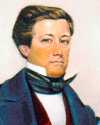
 (source)
|
James Melville Gilliss
(6 Sep 1811 - 9 Feb 1865)
American naval officer and astronomer who founded the Naval Observatory in Washington, D.C., the first U.S. observatory devoted entirely to research.
|
[p.135]
BIOGRAPHICAL MEMOIR OF
JAMES MELVILLE GILLISS.
1811-1865.
BY
BENJAMIN APTHORP GOULD.
MR PRESIDENT AND GENTLEMEN OF THE ACADEMY:—
THE year which has just elapsed has been more sparing of our number than its predecessors; yet death has taken one from the ranks of the Academy who could ill be spared, and on the 9th of February last the tidings went forth from this capital to all parts of the land, that a great bereavement had come upon the science of America. A month before we had met Gilliss here in the vigor of his manhood, the fulness of his energy, and the manly dignity so characteristic of his bearing.
To mark whose lamp was dim,
From out these ranks of active men
Would you have singled him?”
His life has been in some respects its own sufficient record, for its impress has been given and will long remain; yet in other respects the time is not yet come for the full portrayal of his many services to science and to his country, – for these are still too recent for complete recital, and their enumeration and description might tend to impair their best influence. Loyalty to his country, his government, his science, his friends; – stern integrity, unflinching resolve, and earnest piety were the predominant traits of his moral nature. A keen sense of duty, which never permitted to himself those indulgences which his charity readily conceded to others, was blended with exquisite sympathy and kindliness, In his remarkable character the two extremes met of austerity and geniality; but the sternness was for himself, the tenderness was for his fellowmen.
JAMES MELVILLE GILLISS was born in Georgetown, D.C., on the 6th of September, 1811, the oldest son of George and Mary (Melville) Gilliss. His father was in the service of the United States government, and had been so since its transferrence to this [p.138] city. The family was originally of Scottish origin, but had been in this country for several generations.1 At the age of fifteen years Gilliss entered the navy as midshipman, and made his first cruise in the “Delaware,” under Captain Downes. Returning after an absence of three years, during which he served also in the “Concord” and the “Java,” he passed his examinations with honor, and received in 1831 the grade of passed midshipman.
Even at this early age the aspirations which guided his whole career began to manifest their influence. In a letter written long years afterwards to his friend Dr. Gerling of Marburg, he says:-
“Very shortly after I came to Washington for duty as a Passed [p.139] Midshipman, members of Congress were told in my presence. There is not an officer of the navy capable to conduct a scientific enterprise. The charge was intended prejudicially to the service to which I belonged, and was the more humiliating because the speakers were unknown, and defence was not possible. But from that hour no effort has been spared by which the standard of intelligence in the service might be increased and its reputation enhanced.”
How much the scientific reputation of the navy may have been directly or indirectly advanced by the exertions of our lost colleague, I will not undertake to estimate; but thirty years have wrought a wondrous change, and the response which the logic of history would furnish to any disparaging remark to-day needs no added encomium of mine.
So keenly was the young officer touched by the assertion, whether true or not, that on the instant he resolved to disprove it in his own person. Such is his account, and from that moment he was wont to date his scientific impulses; yet those who knew him best can hardly believe that to so slight an incident we owe the rousing of his strong powers, and the commencement of that useful scientific career by which he accomplished so much for our country, and which terminated only with his life.
Desiring to perfect his own culture, he applied for leave of absence to prosecute his studies, and in 1833 entered the University of Virginia, resolved, so far as lay in his own power, to bring to his country's service the highest scientific culture attainable. His residence at the University, however, was of less than a year's duration. Excessive study impaired his health, and 80 severe inflammation of the eyes confined him for many weeks to so dark room. Upon his partial recovery he made 80 fourth cruise, ending in October, 1835, after which he resumed his studies in Paris, and pursued them there for about six months, before returning to his professional duties.
In the following year, Mr. Gilliss was ordered from Philadelphia, where he had been on duty, to Washington, as assistant to Lieut. (now Commodore) Hitchcock, who was then in charge of the Depot of Charts and Instruments. This institution had been established by the Navy Department six years previous, through the influence of Lieut. (now Admiral) Goldsborough, for the care and distribution of the charts and instruments required by national [p.140] vessels. Among the duties of the officers was the rating of chronometers. The determination of time was at first made by sextant and circle observations; in 1831 a small transit-instrument was mounted for this purpose; and when in 1833, Lieut. (now Commodore) Wilkes was assigned to its charge, he removed the office to the vicinity of his own residence, about 1200 feet north of the Capitol, erected a small wooden observatory fourteen feet by thirteen, in which be mounted a 4-inch transit-instrument of larger dimensions, lent the office by the Coast Survey. This instrument was made by Troughton, and had a clear aperture of 3ft with a focal length of 63 inches.
In a very short time after the arrival of Gilliss in Washington, he was placed in full charge of this establishment, and here he made his first astronomical observations, these being at first solely for determining time, like all those of his predecessors. A year later, during the winter of 1837-38, he observed an extensive series of transits of the moon and moon-culminating stars for the determination of longitudes in connection with a survey of Savannah River; but these observations appear never to have been reduced.
At this time he was married to Miss Rebecca Roberts, the daughter of John Roberts, Esq., of Alexandria. D. C., with whom he passed a life of uninterrupted domestic happiness.
For more than twenty-seven years, his interests and cures and aims were hers, and he owed much to her encouragement and sympathy in his intellectual as well as his domestic life.
In 1838 the U. S. Exploring Expedition sailed under the command of Capt. Wilkes. For the purpose of determining differences of longitude by means of moon-culminations, occultations, and eclipses, special instructions were drawn up by him for the observation of these phenomena, and application was specially made by him to the department that Lieut. Gilliss should not be permitted to leave the depot during the absence of the expedition. The late Mr. W. C. Bond, who had a transit instrument mounted at his house in Dorchester, was also engaged for the same purpose, the instructions to him and to Gilliss being duplicate. These instructions also contemplated extended magnetic and meteorological observations, and he availed himself of this opportunity to procure a portable 3¼ inch achromatic, equatorially mounted, a variation-transit for use in measuring the magnetic [p.141] declinations, a balance magnetometer, a dip circle, two clocks, and a chronometer for sidereal time. The instructions from the Secretary of the Navy (Mr. J. K. Paulding) were dated 1838, August 13, and Gilliss's observations began in the very next month. Here commences his astronomical career. Young as he was, he must be considered the first representative of practical astronomy in America. Astronomical observations had been made for a century, it is true. Men, his seniors, now living, and others still not long deceased, had made them before him, and were able to aid him with counsel and even experience. Among these I may mention Hassler, the founder of the Coast Survey, Bache, our own beloved and revered President, whose absence we are mourning, Prof. Bartlett, our honored colleague, Messrs. W. C. Bond, R. T. Paine, Patterson, Olmsted, and Loomis. But it was Gilliss who first in all the land conducted a working observatory, he who first gave his whole time to practical astronomical work, he who first published a volume of observations, first prepared a catalogue of stars, and planned and carried into effect the construction of a working observatory as contrasted with one intended chiefly for purposes of instruction.
“From that time” (September, 1838), says Gilliss,2 “till the return of the expedition in June, 1842, I observed every culmination of the moon, and every occultation visible at Washington, which occurred between two hours before sunset and two hours after sunrise. The transit was extremely deficient in optical power, and would not define stars smaller than the second magnitude when the sun was two hours above the horizon. The number of transits recorded exceeds 10,000, embracing the moon, planets, and about 1100 stars. The average annual number of culminations of the moon observed was 110, and of lunar occultations about 20.”
The difficulties under which he labored, and the zeal with which he pursued his aim, may be inferred from the modest Preface to the volume containing his observations at this little observatory, which were not reduced and published until four years after their completion. It will be borne in mind that these observations of moon-culminating stars constituted but a part of his duties during all this period, – that the instruments and charts [p.142] of the office were to be cared for, the magnetical and meteorological observations assiduously prosecuted, and many official details to be attended to. Moreover the amount of his astronomical work was understated by him in his report as above cited, inasmuch as his printed volume of observations gives the places of 1248 fixed stars. Of these stars 6823 transits are published, as also 365 transits of the moon, 31 of planets and 84 occultations.
As this volume3 is now rare, it may not be amiss for me to quote the greater portion of the Preface.
“With but little experience in the manipulation of fixed instruments; without a book relating to the subject in any manner, except ‘Pearson's Introduction' and 'Vince's Astronomy,' or an acquaintance in the astronomical world from whom suitable advice could be obtained, literal compliance with the directions of the Department was the only course to be pursued at the commencement of the observations. Indeed, as I had never seen a volume of the annals of European observatories, there could be no reason to suppose they did not embody every requisite to be complied with in recording observations; and it was not until the latter part of 1840 I became aware that the exact state of astronomical science demanded more than a simple record of the transits, after the errors of the instrument had been rectified. For information and counsel on this, as well as other important points, I most respectfully tender my thanks to Rev. Richard Sheepshanks, and to S. C. Walker, Esq., gentlemen whose devotion to and labors in the cause of astronomy have established for them most enviable fame.
“Limited to the Nautical Almanac and the catalogues contained in the volumes mentioned, for observable objects, my attention was early arrested by discrepancies between the clock errors resulting from standard stars and some of those comprised in the list of moon-culminations; discrepancies amounting in several cases to more than two seconds in time, which, being confirmed by the observations of consecutive nights, were consequently altogether beyond the limits of probable errors. Receiving [p.143] about this time, through the kindness of Mr. William Simms, a copy of that vade mecum of astronomers, ‘The Catalogue of the Royal Astronomical Society,' it occurred to me, that, whilst carrying out the objects of the exploring expedition, the mites which I could add to the data for more correctly locating the landmarks of the universe' would not be entirely unworthy of collection; and, with this object in view, I determined hence-forward to increase the number of stars to be nightly observed, so as to embrace one in each three and a half to four minutes between the times of transit of the first and last moon-culminating star, – the interval fixed on being the time ordinarily occupied by the transit of one star over all the wires, and setting the finder for its successor. This was all I could hope to accomplish with the means in my power, unless careful estimations of the apparent magnitudes of each star observed should enable me to detect, at the termination of the series, variations in their brightness, or to confirm the degree of lustre already assigned to them.
“All the observations of the volume, excluding a part of those on three dates (as stated in the foot-notes), were made by myself. Absence on two or three days was caused by illness; and it is proper to state, that, with the above exceptions, there was not a visible culmination of the moon which occurred when the sun was less than an hour above the horizon, during the entire period embraced by the observations, or an occultation after the, 15th June, 1839, except one, which I did not personally observe, although my residence, till the middle of May, 1839, was two miles distant from the observatory. Earlier in the afternoon or later in the morning than just specified, the transit-instrument would not show stars of the 2-3 magnitude.
“Occupation during the day in attention to the duties originally allotted to the office, and the want of sufficient assistance, prevented any attempt at reduction of the constantly accumulating materials prior to the summer of 1843.
“It remains but for me to express my gratitude that the prosecution of these observations should have resulted in the foundation of a permanent naval observatory, and have obtained for me, though for a. brief period, the privilege of association with many of the most distinguished astronomers of the present century.” [p.144] In describing the results attained, the mention of a serious obstacle ought not to be omitted, – the very inadequate construction of the little building in which the observations were made. The observing slits of the roof of the ten-foot structure which served as his observatory extended only to within three feet of the ridge-pole on each side, thus precluding all observations between 26° and 68° north declination, a region which actually, includes a portion of the moon's path. This was partially remedied by extending the aperture for about 5½° on the southern side, which was found to be the utmost that the strength of the edifice permitted, and it was found necessary to compensate even this gain by introducing transverse bars of iron, and nearly one-seventh part, 12 out of 88, of the standard stars of the Nautical Almanac still remained hidden from view.
The magnetic and meteorological observations carried on at the same time by Capt. Gilliss were probably as laborious, and were certainly as conscientiously prosecuted as the astronomical ones. They were subsequently reduced and published, the last volume appearing in the same year with that containing the astronomical results.
I have said that Gilliss's volume of observations was the first one published on our side of the Atlantic, and have shown how, in spite of many and serious obstacles, his conscientious assiduity and unwavering zeal accomplished not only all that his instructions required, but much more than this. It remains to speak in this connection of the character of the observations and their results.
I need not remind you, gentlemen, how many an accomplished practical astronomer Jacks that delicacy of the senses, and those other physical powers, by which alone the most refined observations may be attained. Even the best observers have not always the highest qualification in these respects; for a quick ear, a sharp vision, and a delicate touch are by no means all that constitute the highest skill in an observer. The refined methods of observing, the adroit precautions against incidental errors not dependent upon the senses, the ingenious devices for detecting, measuring, and allowing for errors unavoidably incurred, as distinguished from the simple endeavor to avoid them – an endeavor of which the success must necessarily be more restricted by the limits of our senses, however acute, than the attempt at measuring [p.145] and eliminating these errors is found to be—these are unquestionably the highest characteristics of the practical astronomer; and experience has shown that these will more than compensate for the dimmed eye, the unsteady hand, and the impaired susceptibilities of advancing years. The whole spirit of modern practical astronomy tends in this direction. Never otherwise could that great dictum of the immortal Struve have passed into an astronomical theorem: “Whatever may be seen may be measured.” It is by this principle that the modern forms and appliances of the choicest astronomical instruments are regulated, and the modern methods of observation prescribed. No longer are azimuthal errors supposed to be eliminated by adjustment upon a meridian mark, or collimation-errors removed by analogous processes, or clock-rates assumed as constant through protracted intervals of time, nor the graduations of any instruments implicitly relied on for delicate determinations, nor positions based upon the most massive structures assumed to remain constant. The chief effort of the skillful observer of to-day is directed rather to the elimination and measurement than to the avoidance of error; for human sense is but fallible, while human intellect and art are at least a reflex, if not a spark, from the divine altar.
Yet despite all this, it would be folly to attempt to portray the indescribable advantage to an observer which is afforded by delicacy of the senses. Training will do much, but the culture of delicate perceptions must accomplish more than the training of average ones. And it was Gilliss's peculiar privilege to be endowed with a wondrous acuteness of the perceptive powers of eye and ear, as manifested in his astronomical observations. No one at all conversant with observations can examine the printed record, however casually, without a vivid perception of this marked peculiarity. Before it was my privilege to know him and to appreciate his manly truthfulness and scrupulous honor, I once heard another astronomer impugn his observations in this respect. I asked whether the recently published volume of observations were good and creditable to astronomy in America.. “Yes,” was the reply, “they are very good, too good for Gilliss's reputation. No man could have made such good ones.” In fact it is rarely that the record of a transit over the middle thread of his reticule does not accord, to the nearest tenth, with the mean of observations over the five threads.
[p.146] It is true that few men could have made such observations; but happily there are tests, unsuspected then, so searching that cavil is impossible. Not only do the original records exist, in such a form as to preclude any idea that they could have been tampered with – not only have subsequent observations confirmed those of Gilliss and made manifest their high precision – not only was our colleague spared to enrich the annals of astronomy with yet more results of just such quality, in the other hemisphere, but a touchstone exists, potent as Ithuriel's spear. I refer to the so-called personal scale, by which the counting and assortment of the last figures, in a very large number of observations, enables the inquirer to determine the degree of precision of these last figures by the law of probabilities. This searching test was applied to this volume of observations by Prof. Pierce, and with results signally confirming the faith of Gilliss's warmest admirers. In the long list of observers, living and dead, whose results were thus critically and searchingly tested, Gilliss held the second place (and scarcely second indeed) for the close precision with which his tenths of seconds have been noted – a degree of accuracy only attainable by extreme concentration of energy, and assiduous training superposed upon physical perceptions much more delicate than those of most men. Indeed a moderate amount of scrutiny will detect the growth and development of his powers in this respect from year to year.
Walker tested the frame work in a different and more laborious way. He reduced more than a thousand observations over the lateral threads in order to compare their results with those given by the central one, and with similar results. At a meeting of the American Association for the Advancement of Science, he publicly stated, that, after an extensive series of analogous examinations, made for the purpose of deciding the relative weight to be assigned to the results of different observers, he had found transit observations of only one astronomer, Argelander, which manifested equal precision with those of Gilliss.
Such were the observations made by Gilliss in the years 1838-42, beginning at the age of twenty-seven, without previous training other than he had given himself, without astronomical acquaintances, and, what was more than all, without scientific sympathy until the observations had been prosecuted for more than two years.
[p.147] The printed volume contains nearly 700 octavo pages, comprising the detailed observations of each year, with the details of their reduction, the work of each year being specially referred to the mean equinox of its commencement; and at the close, a General Catalogue of the mean right-ascensions of 1248 stars, formed from these annual tables—together with their precessions, proper motions, and polar distances, derived from the British Association Catalogue, and added for convenience in making one of his own results.
We come now to one of the noblest achievements of Gilliss's life – the construction and equipment of the Naval Observatory. To understand the exact bearing and amount of his services in this connection, it will be well to revert to previous efforts in the same direction, and I will take the liberty of making use, without apology, of a summary of this history, which I prepared a few years since for another purpose.
The claims which science – and especially those departments of scientific inquiry which cannot be prosecuted without the aid of implements inaccessible to most private men – may legitimately make upon a civilized community, if not, indeed, upon its government, are too patent to most thoughtful men, for the want of any proper observatory in the United States thirty years ago not to have been a source of regret, and an occasion for effort to those interested in the intellectual development of our nation. When we consider that not only had England and France led the way, and, for centuries, practically acknowledged the title of the eldest of sciences to national encouragement and support, but that scarcely a principality or petty duchy exited on all the continent of Europe so insignificant, or so poor, that it did not support an astronomical observatory, we cannot but feel astonishment at the unwillingness manifested by the then dominant school of legislators to promote astronomical research by providing some means at the national expense. It was, to be sure, not as a system of wise economy and large policy like that to which this Academy probably owes its origin, and on which its claims to national support might be entitled to acknowledgment – nor even to that still larger and more comprehensive statesmanship, which recognizes in the promotion of scientific research a sure and efficient mode of developing the national resources, both intellectual and, material – that the foundation and support of an observatory at [p.148] government expense was urged. But it was insisted on by its advocates on the ground that the importance of astronomical observations to the world at large, especially their manifest bearing upon commerce, rendered it the bounden duty of the United States, as a mercantile nation, to contribute their part toward those observations and computations for which all other civilized countries strove to do their share, and that a decent national pride should render us unwilling to rely exclusively upon Europe for data indispensable to navigators, even did it not lead us to desire that our republic should emulate her monarchies in the advancement of the highest civilization, Curiously enough, the so-called constitutional arguments brought forward in opposition to such plans did not possess sufficient force to prevent the equipment of that expedition for general geographical exploration to which, through a singular change of circumstances, the establishment of a government observatory was ultimately due. The essential importance of a central observatory for the exploration and survey of our own territory, for the determination of the geographical position of our own ports and in land towns, was also made prominent; yet it seems almost incredible that only thirty years ago, not merely did such arguments as these fail of all effect, but even those men who entertained larger and more elevated views seem not to have thought it worth their while to develop them. But such was the case, and the few instances in which any exertions were made in this direction afford us admirable examples of seed sown upon stony ground – not to allude to another scriptural comparison perhaps yet more appropriate.
The first of these efforts will probably be found in the first message sent to Congress by John Q. Adams, after his inauguration as President of the United States, in March, 1825. In this message he earnestly recommended the establishment of a National Observatory, and also, of a Uniform Standard of Weights and Measures, of a Naval Academy, a Nautical Almanac, and a National University. But all these recommendations were treated with neglect by Congress; although time has written a sufficient commentary on their wisdom and foresight. An excellent report on the subject, advocating the views of the President, was made by Mr. C. F. Mercer, chairman of the Committee of the House, to whom, in the ordinary routine, the subject was referred, but the recommendations of the President, and of the Committee, [p.149] were suffered to lie unnoticed on the tables of both Houses; and it was reserved for the Emperor Nicholas of Russia to follow those counsels which party rancor precluded the Congress of the United States from adopting on the recommendation of their President, and by the establishment of the noblest Observatory of the world to render the capital of his empire a capital of astronomical science.”
The first structure in the United States which might claim the name of a fixed Astronomical Observatory was the ill-constructed little edifice of which I have already spoken, 14 feet long, 13 feet broad, and 10 feet high, in which Gilliss industriously labored for nearly four years, making the excellent observations of right-ascension already described, and furnishing the first volume of astronomical observations published in this hemisphere, and probably a more precise record of transits than has ever been made in America by any other person.
In 1838, the year in which Lieutenant Gilliss commenced his observations, a small astronomical structure had been built at the Western Reserve College, in Hudson, Ohio, through the exertions of Professor Elias Loomis, and equipped with a 4-inch equatorial telescope and a 5-inch transit-circle, both of English manufacture. With these Professor Loomis made a number of astronomical observations; but the duties of his office, as teacher, left him little opportunity for continued research.
It was in this same year, 1838, that the money bequeathed by Smithson to found that noble institution, which will render his name immortal, was received by our minister in London. Mr. Adams, then a member of the House of Representatives, again exerted his most strenuous efforts to secure the establishment of an astronomical observatory as a part of the institution. He immediately waited on President Van Buren, and, in a long interview, urged his views of the subject. A few months later, at the call of the Secretary of State, he reduced his views to writing, advocating the application of part of the fund to the establishment of a great observatory, and of a Nautical Almanac. Mr. Van Buren expressed his concurrence with the views, but never acted in the premises.
Indeed, so bitter was the rancor of political partisanship at this time, and so intense the hatred entertained by the then dominant section of the country against Mr. Adams, that, to use the [p.150] language of his biographer, opposition to the design became identified with party spirit, and to defeat it no language of contempt or of ridicule was omitted by the partisans of General Jackson. In every appropriation which it was apprehended might be converted to its accomplishment, the restriction “and to no other” was carefully inserted. In the second section of an act passed on the l0th July, 1832, providing for the survey of the coast of the United States, the following limitation was inserted by the Naval Committee: “Provided, that nothing in this act, or in the act hereby revived, shall be construed to authorize the construction or maintenance of a permanent Astronomical Observatory.” Yet, at the time of passing this act, it was well understood that a part of the appropriation it contained must necessarily be applied to astronomical observations. And, indeed, I may anticipate the order of this narrative by adding here that when, at last, Congress did appropriate the money for an Astronomical Observatory, and subsequently for its support, it was under a fictitious name, the authors of the laws intending an Astronomical Observatory, and being wen aware that the funds would be so applied, but causing the insertion of the proviso in the one case, and of the feigned name in the other, for the purpose of preventing the institution from being attributed to the influence of Mr. Adams.4
In 1840, precisely fifteen years after that first message to Congress, in which he had advocated the establishment of a National Observatory by government, Mr. Adams, being Chairman of the Committee on the Smithsonian Fund, made a second report, in which, after recounting all the principal facts connected with the bequest and its acceptance, he again advocated the views which he had so often urged. But while the question was pending, a resolution was passed by the Senate appointing a Joint Committee on the subject of the Smithsonian bequest. . The House, in courtesy, concurred, and appointed on its own part the members of the Select Committee, of which Mr. Adams was Chairman, to be members of the Joint Committee. It may . readily be imagined that the two portions of the Committee were . unable to agree; and it was finally decided that each of the two component parts should present. its own report; and, while Mr. [p.151] Adams reported5a series of resolutions prescribing the investment and management of the fund, and directing that the first appropriation of interest-money should be “applied for the erection of an Astronomical Observatory, and for the various objects incident to such an establishment,” Mr. Preston, of South Carolina, the Chairman of the Senate Committee, presented counter-resolutions, containing the provision that no part of the funds should be applied to the erection of an Astronomical Observatory. This report of Mr. Adams is well worthy the perusal of every lover of the exalted science of astronomy, both for the richness of its information and the beauty of its eloquence. In 1840 and 1841, two observatories were established – the first at Philadelphia, by the High School of that city, and the second at West Point, by the United States Military Academy. The former was placed under the direction of the late Sears C. Walker, the other pioneer of practical astronomy in the United States, and of Professor E. O. Kendall; the latter under that of Professor Bartlett. To these astronomers we owe the first introduction into the country of those German instruments which the combined genius of Bessel, Struve, and Argelander, that wondrous triad, together with Fraunhofer, and his gifted co-laborers in the highest fields of optical and mechanical art, had devised and perfected. To these observatories at West Point and Philadelphia, or rather to the ability and assiduity of their directors, working in the hours of relaxation from professional duties, we owe the first important series of astronomical observations made in the United States. It is to the stimulus given by their observations – especially the admirable ones of Mr. Walker, rendered peculiarly valuable by his computations, for which they supplied the material; and to their publications, particularly the able report on European Observatories, presented by Professor Bartlett to the Engineer Department on returning from a journey to Europe for the purpose of ordering instruments – that we are doubtless indebted for much of that public sentiment which, combined with other influences, at last brought about the establishment of the Naval Observatory.
In 1841, after three years of zealous observations, Gilliss obtained authority to import a meridian-circle. This could not [p152] be erected in the little hut where he was then observing, and he availed himself of the opportunity to urge both upon the Navy Department and upon members of Congress the establishment of a permanent Observatory for the Navy, to be attached to the Depot of Charts and Instruments. Let me quote his own words from his official report after the successful accomplishment of this design.
“As the observations progressed, the unsuitableness of the building, the defects of the transit-instrument, the want of space to erect a permanent circle, and the absolute necessity of rebuilding the observatory in use, became each day more urgent, and, at my earnest solicitation, the Commissioners of the Navy recommended an appropriation for a permanent establishment in December, 1841. Even this, however, was not accomplished without difficulty. But the efforts of the honorable Secretary to advance science, and more especially those branches of it in which the Navy is interested, are well known to the country; and immediately appreciating its importance, he brought this subject before Congress in his report to the President of December, 1841. “Much delay occurred with the Naval Committees in Congress. The Hon. Francis Mallory, to whom it was referred by the House Committee, espoused the cause warmly, but the majority kept aloof from the depot (although so near) until the entire winter passed away. Finally, on the 15th March, 1842, I succeeded in persuading the only member of the committee who was skeptical to visit the observatory, and on that very day a unanimous report and bill were presented to the House of Representatives. Believing the chances of success would be greater if a bill could be passed by the Senate, by the advice of Mr. Mallory, I waited on the Naval Committee of the Senate, but my entreaties for a personal inspection of our wants were put off from time to time. The question was probably decided by an astronomical event.
“At a meeting of the National Institute, at which the Hon. William C. Preston was present, I gave notice of having found Encke's comet with the 31 feet achromatic, the comet being then near its perihelion. A few days subsequently, I made what was intended to be a last visit to the chairman of the Senate Committee, and found Mr. Preston with him. As soon as I began the conversation about the little observatory, Mr. Preston inquired whether I had not given the notice of the comet at the Institute, [p.153] and immediately volunteered, ‘I will do all I can to, help you.’ Within a week, a bill was passed by the Senate.
“It is hardly necessary to trace its progress in the House. A majority was known to be favorable, but its number on the calendar, and the opposition of one or two members, were likely to prevent action upon it; and that it did receive the sanction of the House of Representatives at the last hour of the session of 1841-42, the Navy is indebted to the untiring exertions of Dr. Mallory.”
Meanwhile Mr. Adams, on the 15th April, 1842, had presented yet a third report from the committee on the Smithsonian fund in the form of a bill, providing for its administration on the same principles which he had advocated in former years, and directed that the income already accrued should be invested as a capital, and its interest applied to the construction and maintenance of an Astronomical Observatory. The bill failed; for, as Mr. Adams's biographer remarks, “there was no purpose on which the predominating party were more fixed than to prevent the gratification of Mr. Adams in this well-known cherished wish of his heart.” Yet an Observatory, under a feigned name, and restricted to' the Navy Department instead of being made a national institution, was established by act of that very Congress at that very session, without a division, or indeed any opposition in either House; and four years later the Smithsonian Institution was organized essentially on the' basis so often urged by him, although omitting the Observatory element, which was then no longer desirable, inasmuch as the end, had been obtained by other means.6
The bill introduced by the Naval Committee of the House of Representatives was read twice and disposed of by reference to the Committee of the Whole on the State of the Union. But on the 23d of June, a bill identical in its language with the one thus laid to rest was introduced in the Senate, as related by Lieutenant Gilliss in the extract which I have presented from his report. This passed through the several stages of legislation in due order, without hindrance or objection; went to the House on the 30th July; was referred to the same committee as before; but as a [p.154] Senate bill was treated with courtesy. It was reported back without discussion, passed by the House without debate, and on the 31st .August, 1842, became a law.
Thus was established the present Naval Observatory, owing, like all progressive steps in our country, at least, to the combination of many influences, and the gradual education of the community by a few leading intellects – yet how large a share in the work was due to Gilliss, this history will show. His useful observations, together with his excellent administration of the affairs of the Depot of Charts and Instruments, had won the confidence of his official superiors, and impressed all whom he could induce to see what he was doing. To his immediate influence must be attributed the official recommendations of the Naval Commission in December, 1841; that of the Secretary of the Navy in the same month; the unanimous presentation of bill in its favor by the Naval Committee of the House, after much reluctance, and in spite of strong political prejudice against this very measure under another name; the winning to his views of the identical Senator who had presented resolutions concerning the Smithsonian fund, “providing that no part of the funds should be applied to the erection of an .Astronomical Observatory,” and that persistent advocacy which culminated in the final passage of the bill on the last day of August, 1842, without discussion and without a division.
Nine days later the Secretary of the Navy, “taking the Report of the Naval Committee, which accompanied the [House] bill, as the exponent of the will of Congress,” assigned to Lieutenant Gilliss the duty of preparing the plans for a building and arranging for the instruments. How well he did his work I need not tell you.
After consulting those Americans most conversant with astronomical subjects, he visited Europe to obtain the counsel of foreign astronomers, and to make himself acquainted by personal inspection with the latest improvements in the construction of astronomical and magnetic implements. In March, 1843, he returned home, having ordered the instruments under authority from the Secretary of the Navy, and began the erection of the Observatory. The building was completed, the instruments mounted and essentially adjusted, and a library procured within eighteen months. [p.155] On the 7th February, 1845, Gilliss presented a detailed final report of his labors, which is published as Senate Document No. 114, 28th Congress, 2d Session. It contains full descriptions, with minute drawings, of the instruments, and suggestions as to the ends to which they might be most usefully devoted, and it is a curious fact that these instruments are essentially the same that, after the lapse of 21 years, are still in active and successful employment. The only important change is the disuse and removal (by himself) of the Ertel Circle – obtained by him while still at the little box on Capitol Hill, and subsequently mounted at the new Observatory – in order to make room for the magnificent meridian-circle also ordered by him, but which it was never his privilege to look upon. This noble instrument, purchased by the Navy Department under authority of the present Superintendent, then Chief of the appropriate Bureau, is now in working condition, and offers rich promise of contributions alike useful and honorable to science.
The great work was thus accomplished. The first working American Observatory had been built—stimulating to quick emulation in the Observatory at Cambridge, and so on in the numerous other similar institutions which now ornament our land. Who should direct its activity? Lieutenant Gilliss had brought about its existence, had planned it, selected and ordered the instruments, superintended the construction of the building, mounted and adjusted the instruments, and at the close of September, 1844, reported the work done and the Observatory ready for occupation. No breath of scandal had ever sullied his fame. He was the sole working astronomer in the nation. His work had met the commendation of astronomers everywhere, so far as they had bad opportunity to become acquainted with it.
It was not Gilliss who was assigned to its superintendence. But, on the 1st October, orders to assume the charge of this noble institution were issued by Hon. John Y. Mason, then Secretary of the Navy, to Lieutenant Matthew F. Maury, a young officer without scientific education or experience, and with small scientific pretensions. A corps of three lieutenants, six midshipmen, and a machinist was assigned him, and within the year four more lieutenants and three naval professors were added to this corps, in addition to the all-important., but. unhappily very temporary services of the gifted and enthusiastic Walker. Surely with such [p.156] an organization we might have looked for more than we received; especially when we remember that Walker, Hubbard, Coffin, Ferguson, Keith, Yarnall were among its members. Honor to their names for what they did accomplish.
The influences which prompted this appointment and the intensely mortifying treatment of Gilliss seem to have been no very recondite ones, and can be readily imagined by any of you – for it needs but a five years' memory to recall those ancient days; yet never in the course of fifteen years of friendship, an unrestricted intercourse, and a close intimacy, did I hear one word of even pardonable bitterness, either concerning this severe disappointment, or the neglect of astronomy by the officers to whom the Observatory had been assigned. “It was hard,” he would say, “but an officer must obey orders and not find fault with them ” On the other subject he ever preserved a dignified reticence, and it is my firm belief that in his freest utterances he never spoke one word expressive of the sentiments which we may naturally suppose him to have entertained.
From February, 1845, to July, 1846, Gilliss was occupied with the preparation of his observations for the press, as has been already mentioned, and at the close of this work he was assigned to duty upon the Coast Survey under Professor Bache. While on this service he reduced for the use of the Survey the entire series of moon-culminations previously observed and published by him. Fifteen manuscript folio volumes in the archives of the Survey contain this valuable work, the subsequent discussion of which by Walker, and still later by Peirce, led to the investigations by these geometers, into the relative accuracy of Gilliss's observations, concerning which I have already spoken.
In May, 1847, Dr. Gerling, the eminent mathematician of Marburg, published a memoir, calling the attention of astronomers to the fact that the universally adopted value of the solar parallax depended solely upon observations of the transits of Venus in 1761 and 1769; and that, although the materials afforded by the observations then made had doubtless been exhausted by the labor and skill with which Encke had deduced the value since adopted by astronomers, yet a constant so important as this, which affords directly or indirectly the sole unit for the determination of all celestial distances, should not be subject to the possible uncertainties of anyone method. Especially was it [p.157] unfortunate that the only method employed depended upon a phenomenon which recurred, doubly to be sure, yet only at intervals of mare than a century; and which would not again take place until after the lapse of more than a quarter of that period. The combination of observations of Mars at apposition, made from terrestrial stations widely differing in latitude, had been frequently suggested; but Dr. Gerling advocated especially the similar employment of observations of Venus at inferior conjunction, and especially when at, or near, the stationary points, and of oppositions of Mars. His conviction in favor of this method rested principally an the consideration that, whereas, in transits of Venus, the quantity to be determined is the difference between the parallax of the planet and that of the sun—the other methods yield the planet's parallax at once – the element directly deducible bearing to the solar parallax the following ratios:
| At transits of Venus | 2.57 |
| At oppositions of Mars | 1.92 on the average. |
| ” ” ” ” | 2.74 in extremely favorable cases. |
| Inf. conjunctions of Venus | 3.57 |
| Stationary positions of Venus | 2.94 |
Thus the observations of Venus promised to yield a better determination of the solar parallax than any oppositions of Mars; and these at the stationary or turning paints of her apparent path, a result surpassing in accuracy that from the average of these oppositions by about of its whole amount. The natural objection that the conjunctions of Venus must be observed by day, thus dispensing with the advantage of micrometer comparisons, and requiring meridian observations at midday, was recognized by Dr. Gerling, but the excellence and power of the newer meridian instruments were cited as compensating for this serious disadvantage. The observations during the stationary period were, however, chiefly urged.
Before the publication of this memoir, in which the subject was discussed at very considerable length, Dr. Gerling had, in April of the same year (1847), written to Gilliss, in acknowledgment of his volume of observations, and, in his letter of thanks, gave some account of his proposition.
“I am of opinion,” said he, “that astronomers act unwisely in considering the solar parallax deducted from the transits of Venus [p.158] in 1761 and 1769 sufficiently correct, and do not avail themselves of more modern methods of observation, for the purpose of gradually acquiring more accurate knowledge of it. It is true, indeed, that the oppositions of Mars were long ago proposed for this purpose; but I am not aware that any effective use has been made of them since 1751, although the Nautical Almanac has regularly furnished an ephemeris. There is, however, a third method, which presented itself to me some time ago, and I cannot comprehend why it should have been so entirely neglected. I mean, by observations of Venus during the period of its retrograde motion, and, more especially, when the planet is stationary.
“The delicate and faint crescent form of Venus, at the conjunctions, offers excellent opportunities for observation; and from what I have been able to accomplish with my small instrument, I have every reason to believe that most excellent results are obtainable with meridian instruments, at observatories in opposite hemispheres, but lying nearly under the same meridian. Furthermore, at that time, Venus is almost twice as near to the earth as is Mars when in opposition, and observations upon it have the very important advantage that it is not absolutely essential they should be simultaneous, or nearly simultaneous. Again, when the planet is stationary, the observations of one meridian may be readily referred to another by interpolation, without risk of error, and, at this time, it is much nearer to the earth than Mars can be in the most favorable case. Finally – the distance of the planet from the sun being about 29° – micrometrical may be combined with meridional observations. In my opinion, then. it should be our object to multiply meridian observations of Venus about the periods when it is stationary, and endeavor to obtain micrometrical measurements from all parts of the earth; more especially from voyagers.”
After a summary of his view, Dr. Gurling continued: “The preceding synopsis of my paper will, I hope, reach you in print after a while. Meantime, I beg you will examine the subject, and should you coincide in my views, I trust you will interest American astronomers as far as you can for I flatter myself that observations win be instituted this year at European observatories; and, indeed. I am sure that a greater number of accurate meridian observations are likely to be made during the months of September, October, and November than is common. For the results [p.159] and success of 1847, it is much to be desired that the few delicate meridian instruments in the southern hemisphere should be brought to co-operate with us; and this, perhaps, it is in your power to facilitate. Of equal consequence will be micrometer observations from the same section of the globe; but as the latter require no permanent observatory, and only a chronometer, a telescope fitted with a micrometer, and a knowledge of the neighboring stars, such observations may well be made by travellers. Whether there will remain time prior to the eastern period for the necessary instruction of voyagers to the southern hemisphere, I am not able to determine.”
“This letter,” says Gilliss, in the history of his expeditions, “bears date 17th of April, but was not received until the early part of July, and the next eastern stationary term was to occur in September. On conference with the late able astronomer, Professor S. O. Walker, he suggested the immediate publication of the letter, as the mode most expeditious of making it generally known, and, in accordance with his advice, printed copies of a translation were forwarded to all the astronomers and observatories of the United States, with as little delay as possible. There was too little time in which to perfect arrangements for more extended co-operation at that conjunction, and Dr. Gerling was shortly notified that the distribution of his letter was probably all that I should be able to do in the work for 1847. But, to prove my interest in the prosecution of the problem to its solution, I then proposed an expedition to Chile, to observe the planet near its stationary terms and opposition, in 1849, should my views receive encouragement from astronomers to justify such an undertaking. Nearly on the same meridian as Washington is the island of Chilóe – a place of considerable trade with the nearer ports, and occasionally visited by American whale-ships. At all events, it was accessible without much difficulty, and I hoped to be able to induce the government to send me there, proposing to leave the United States in time to reach the island by the middle of March of that year, at latest. To avoid expense, which it was supposed would prove the first and main obstacle, I contemplated only one assistant, who, like myself, would be an officer of the Navy, and in the receipt of pay, whether abroad or at home, and. would take instruments already belonging to, or under control of, the government. I proposed Chilóe, because it was the point [p.160] farthest south on this continent at which a lengthened winter residence could be endured, in exposure, without incurring an outlay that might prove a. serious impediment, and because I thought that a passage to it could be obtained in a whale-ship from one of our northern ports. It being inhabited by a civilized and most hospitable people, would tend to render a residence of five or six months, in the latter part of the autumn and winter, not altogether uncomfortable. Its distance is about 5000 miles, due south from Washington; and a comparison of the observations I proposed to make there, with those to be obtained at the Washington Observatory, would give us a determination of the parallax from data wholly American. This last reason I hoped would benefit me, should it be necessary to seek the interposition of Congress.”
Then commenced a series of efforts, prosecuted with the well-known energy of our lamented colleague, to prepare judicious plans – and to interest both astronomers and lawgivers in the proposed enterprise. “Remembering,” said he, in a. letter to Gerling, in November following, “the vast outlays Europe has encountered in efforts for the faithful solution of this very problem, as well as in other hundreds of scientific enterprises, and the fact that America, which participates so largely in the benefits derived from the labors of astronomers, has hitherto contributed so trifling an amount to the common stock, I am the more keenly sensible of the noble opportunity now within our grasp to present the world, from our own continent as a base, the dimensions of our common system … There is but one perceptible obstacle – pecuniary outlay – yet when its very inconsiderable amount is contrasted with the grandeur and importance of the object to be attained, I cannot bring myself to believe that this objection will be suffered to weigh, and I therefore repeat the remark made in my former letter – give the proposition the encouragement of scientific men, and I stand pledged for its successful equipment. At all1 events, regardless it as a possible attainment only, two questions present themselves for consideration, and it is time they were discussed: first, Is the locality proposed (Chilóe) the best which can be selected for the contemplated object? And second, Will the instruments which have been specified to you permit the accomplishment of that object in the most satisfactory or desirable manner?”
[p.161] To the careful examination of these all-important questions Gilliss addressed himself with zeal, entering into correspondence on the subject with American and foreign astronomers, and gathering information and counsel from every possible quarter. He soon found that the climate of Chilóe was ill-adapted to his purposes, and that the better climate of Valparaiso would in all probability more than compensate for the diminished length of base which it would entail. Some disadvantage arose from the eastwardly trend of the coast farther north, which would carry the observer to the eastward of Washington; but this he over-ruled as a minor objection, “more especially as we have other observatories at Philadelphia, West Point, and Cambridge, whose equipments justify the expectation that they will take part in. the observations; and there is but one to the westward of us at all likely to co-operate, viz., at Hudson, Ohio.”
Encouragements soon began to arrive from the other side of the Atlantic. Gauss and Encke contributed the influence of their great names, and Bache, Peirce, and Walker added their endorsements to the plan. Resolutions of approval and recommendation were passed by the American Philosophical Society, of Philadelphia, and the American Academy of Arts and Sciences, of Boston; and each of these bodies, then the leading scientific tribunals of the land, appointed a committee to co-operate in furtherance of the undertaking. The Secretary of the Navy referred the matter to the action of Congress; and within a fortnight a report was made by the Hon. F. P. Stanton, of Tennessee, chairman of the Naval Committee, cordially approving of the plan. Gilliss had pledged himself that if the Navy Department would furnish the apparatus already within its control, and assistance from the officers under its direction, the total expenses of every kind for the expedition, exclusive of instruments, should not exceed $5000. The Naval Committee reported an amendment to their bill, appropriating this sum, and giving the requisite authority to the Secretary of the Navy. The clause was sanctioned by both Houses of Congress, and the bill containing it was approved by the President on the 3d of August, 1848. Preparatory orders were at once issued by the Secretary, containing all needful authority for making the preliminary arrangements.
Before a year had elapsed, the programme had been matured, the formal concurrence of the committees of the two learned [p.162] societies obtained, an equatorial telescope and a meridian-circle ordered and constructed, and Gilliss had reported to the Navy Department that the instruments and other portions of the equipment essential to the proposed observations were on their way to Chile, in charge of the officers assigned by the Department as assistants. Not a fortnight more than the year had passed when Gilliss himself was on his way to Valparaiso, where he arrived by the way of Panama, in advance of the ship containing the instruments and his assistants.
The detailed account of the organization of the expedition is very interesting, and may be found presented at length by Gilliss himself, in the third volume of the Results of the Expedition. The limits of this notice preclude any more minute description; but the whole constitutes a most interesting chapter in the history of science in America, and one no less important in its indirect influence than in its direct results. It was one of the earliest instances, if not the first, of deference, by the legislative and executive authorities of the nation, to the views of the organized representatives of science within its borders. Rarely before had they been consulted when the weightiest scientific interests were at stake, and almost as rarely had any formal expression of their convictions, however unanimous, availed to guide the scientific policy of the nation. It was moreover the occasion of the first order to an American artist for a telescope of any considerable dimensions, and to the truly patriotic spirit shown by Gilliss on that occasion, at the instance of our colleague, Mr. Rutherfurd, whose efforts in that direction are so familiar to us all, may unquestionably be attributed much of that subsequent development of instrumental art of which we are now so proud, and which has already given such distinction to the names of Fitz, Spencer, Würdemann, Clark, Tolles, and others, all happily yet remaining to us except the first-named – the pioneer of all. Although well aware of the danger of too much detail, I cannot refrain from giving the history of this first large American Equatorial. The five-foot telescope purchased for the exploring expedition, and upon which Gilliss has depended for his observations, was found, to his dismay and embarrassment, to have been stored in a position exposed to the extremes of temperature and moisture, which had seriously, if not fatally injured the object glass. Already the Fox's deflector had been found to be hopelessly [p.163] injured, and the declinometer to have been given to a mixed commission for surveys in California. But in these difficulties the Smithsonian Institution, although scarcely more than organized, came to his relief. Professor Henry offered a seismometer and a complete meteorological outfit, and subsequently authorized the purchase, at the expense of the Institution, of a complete set of portable instruments for magnetic determinations. But where in this unforeseen emergency to look for the telescope, the indispensable implement for the proposed observations, became a question of the most serious moment. Nearly one-half of the appropriation was already pledged for the meridian-circle ordered from Berlin, and $1000 at the least would be needed for the piers, buildings, etc.
To the honor of the Smithsonian Institution, this admirable organization came again to Gilliss's succor. Although all its available funds were in demand for current expenses, and for the erection of the expensive building, then slowly going on, so that any immediate appropriation of the requisite amount was out of the question, the Regents, at the instance of Professor Henry, manifested a deep interest in the undertaking, and at last offered the credit of the Institution by authorizing the purchase of an equatorial telescope of 6½- inches aperture, provided it could be obtained at a stated price, with interest, on a credit of three years.
Let me continue in Gilliss's own words – “No importer to whom application was made was willing to order one from Germany on such terms. Messrs. Merz, the successors to Fraunhofer, at first declined selling without the cash; indeed their ordinary custom is to demand one-half the price in advance; and the only maker in the United States likely to execute properly the mechanical portions of so large an instrument refused to accept the offer. Just as I had made arrangements to borrow on my own account the sum charged by Messrs. Merz, and import an equatorial from them, Professor Henry authorized me to increase the offer to Mr. Young, of Philadelphia, and eventually a contract was concluded with him, on behalf of the Smithsonian Institution, the right being reserved to me to procure the object-glass and micrometer from such artists as might be preferred.
“About this time notice was published by Mr. Rutherfurd, in Silliman's Journal, of the performance of an object-glass made [p.164] from imported materials by Mr. Henry Fitz, an optician at New York. Learning that several other lenses had been perfected by the same artist, I determined to examine them all, and then confer with Messrs. Bache, Peirce, and Walker. To be brief, the examination and conference resulted in an order to Fitz to grind a lens from Guinand's glass, to be of the same diameter (six French inches) as that of the telescope at the High School Observatory in Philadelphia, and to forward it to Professor Kendall. If he and other competent judges should pronounce it as good, in every respect, as the High School lens, it would be purchased at the Munich price, $500. If inferior, we should have the right to retain and use it, free of cost, until another could be imported from Bavaria.
“Between the date of the order, November 27th, and the time that the tube was ready, April 15, 1849, Mr. Fitz prepared three lenses of that size. Veins developed themselves in one, only after it had been polished; and a second proved scarcely less objectionable in its crystallization. Of the third submitted for trial, Professor Kendall wrote to me, May 1: ‘I had the pleasure of making trial of the Fitz object-glass last evening, and was highly gratified with the result I compared it with ours upon the moon, Jupiter, several double stars, and the bright star Vega, with its companion, using a variety of powers, and it is my opinion that Mr. Fitz has fully accomplished all that he undertook to perform. From this trial I am unable to pronounce which is the better glass. The Fraunhofer did nothing which was not as well done by the Fitz glass. . . . . Indeed, we are all delighted with his success, and I am fully persuaded that between this and one you might order from Merz the chances would be decidedly in favor of the former.’
“Gratification is a feeble word to express my pleasure at the success of the American optician, for I could not but think this first Yankee telescope of considerable size marked an era in the progress of mechanical science in our country, for which I hoped future astronomers would render due credit to the expedition. That Mr. Fitz was thoroughly competent to figure and polish, I was fully convinced, on examining the object-glasses previously made, and my only regret was that he could not forthwith undertake the whole task, and begin by manufacturing his own glass. [p.165] But he had genius, and nothing would be more likely to stimulate him to undertake it than the success just met with.
“Thus, through the assistance of others, the expedition would be most efficiently equipped; and the support of the Smithsonian Institution, at a very trying period, will always be remembered with the sincerest gratitude.”
Two passed-midshipmen, Messrs. Archibald MacRae and Henry C. Hunter, were detailed as assistants, and a young civilian appointed as “Captain's clerk,” and thus the expedition was equipped. Before their departure they were stationed for a short time at the Observatory, for instruction by the officers in charge of the instruments, and employed in selecting stars to be designated in advance as objects of comparison. Lithographed charts exhibiting the apparent paths of both Venus and Mars during the period of the proposed observations in the years 1849-52, were sent to all the northern observatories, since the observations for parallax would be available only when combined with corresponding observations in the Northern Hemisphere. And inasmuch as the co-operation of all other institutions would be matters of favor or of scientific zeal, special instructions were issued by the Secretary of the Navy to Lieutenant Maury to cause the requisite observations to be made at the Naval Observatory.
A circular was also prepared by Lieutenant Maury, and distributed to the various observatories of the world, describing the expedition, asking for their co-operation, and requesting that the results be sent annually to him at the Washington Observatory.
The precise place of observation was left to be decided upon Gilliss's arrival in Chile, the only limits determined in advance being the parallel of Valparaiso and Concepcion. It was not till after his arrival in Chile that the city of Santiago was fixed upon, as combining the greatest number of advantages; and there, upon Santa Lucia, a small porphyritic knoll in the eastern quarter of the city, the observatory was erected, which had previously been constructed in Washington.
The Chilian government received the expedition with a cordial hospitality, placing at his disposal any unoccupied public ground, admitting free of duty all the effects of the officers as well as the equipments of the expedition, and from first to last facilitating the enterprise by every means in their power. On the 6th December, 1849, the equatorial was in position, on the 10th the [p.166] series of observations of Mars was commenced and it was continued for the fifty-two remaining nights which had been designated in the programme, with the loss of only four, on which the weather was unfavorable. Early in February the circle was ready for us, and a series of zone observations was commenced with it at 150 from the pole – working toward the zenith on successive nights in belts 24’ wide, until compelled to return below again in order to connect in right ascension. “We were always occupied,” says Gilliss, from five to six, and sometimes more, hours. Lieutenant MacRae and myself devoted alternate nights to these observations, very rarely having relief by clouds until after April 21. Indeed, between Feb. 4th and that date, seventy-six nights, there were only four of them obscure. The rains of latter autumn and winter came none too soon for us.”
Meantime, at the application of the Minister of Public Instruction, three young Chilians were instructed in astronomy and the use of instruments; and magnetic and meteorological observations were systematically carried on. Mr. Hunter, having been injured early in January by being thrown from a horse, was obliged to return to the United States, and his place was supplied by Passed-midshipman S. L. Phelps, the same who has since, as Lieutenant-Commander rendered such essential service to the country in naval operations upon the Mississippi, and other western rivers.
An accident to one of the micrometer-screws of the circle rendering the simultaneous labor of both assistants necessary at the zones, their duties were fixed for each alternate night, while Gilliss himself employed the intermediate ones in examining such of LaCaille's stars between the zenith and the pole as had never been twice observed. The pages of the astronomical periodicals of that time bear witness to the effectiveness of his scrutiny, by the record of many hundred errors detected in the Catalogue of LaCaille. On the reception in June of new micrometer-screws from the makers in Berlin, the original system of observations was resumed. During the series of observations of Venus, Gillis records several occasions when the cusps of Venus could be distinguished by the unassisted eye.
I will not dwell further upon the details of the observations, for they are fully described in the magnificent volumes containing the results of the expedition. Let me simply sum up the work accomplished. Between the 6th December, 1849, and the [p.167] 13th September, 1852, series of micrometric comparisons of Mars were made on forty-six days during the first, and ninety-three days during the second opposition, and micrometric comparisons of Venus on fifty-one days during the first, and twenty-seven days during the second inferior conjunctions; the observations on each day being continued through several hours, whenever the sky permitted, and the work being executed with the same delicacy and care which had characterized those earlier transit-observations on Capitol Hill in this city. In addition to this, very much else had been done; but these grand series of observations, executed in precise conformity to the programme laid down, warranted the confidence that his devotion had not been in vain, and that the problem of the parallax would be solved. His two hundred and seventeen series of observations extended' over nearly three years; – if northern observations had accomplished half as much in correspondent observations, the question must be decided, and the celestial unit of measure determined with new precision. What shall I say, Gentlemen of the Academy, of Gilliss's emotions, when, after returning from his long absence to combine and discuss the result of his five years' labor, he found the following correspondent observations awaiting him?
From the Washington Observatory – eleven of Mars, of which six were recorded as wholly, and three others as partially unsatisfactory, and eight of Venus, two of which were noted as bad. From the Cambridge Observatory – five of Mars, of which four were of one limb only. From the Greenwich Observatory – four of Mars, three of them being designated as not good. From all northern observatories, none. His expedition was fruitless, so far as his primary object was concerned, but the consciousness was his, that he had done his duty.
He caused his results to be elaborated, thoroughly discussed, and all possible observations in the Northern and Southern Hemispheres to be collected and combined. No toil was spared in this work; and the recollection of the painful struggle to attain, through punctiliousness of computation, what had been hoped for from abundance and thoroughness of observations, is yet among the most vivid within the range of my memory. But it was in vain. The processes of reduction, the reference to approximate ephemerides, the determination of the comparison-stars, are all on record, and it will be for the future historian, when the true [p.168] values are established beyond question, to decide whether a better determination can be elicited from the materials provided. The final results attained were – that from the second opposition of Mars, as also from either conjunction of Venus, no tolerably probable result could be deduced, by reason of the almost total lack of observations; and that whatever result was deduced must be from the first Mars-opposition alone. The materials here too were entirely inadequate, though in comparison with those for the three other series they seemed large; but on closer scrutiny a great portion of them proved not to have been made with the needful cure. The only result to be deduced was altogether at variance with that which subsequent investigations have rendered probable.
Fortunately for science, and happily for Gilliss's own consciousness, his observations were not limited to those which it was his special duty to make. Even those on Mars and Venus, which failed of yielding their deserved fruit in affording those data which they were instituted to obtain, are yet of priceless value in the means which they afford, and which will doubtless soon be made useful, for improving our knowledge of the orbits of our two neighboring planets.
Among other astronomical fruits of the expedition to Chile I may mention the following: 7000 meridian observations of 2000 stars, chiefly the standard stars used for determining the errors of instrumental adjustment, and the LaCaille stars already mentioned. These, with their instrumental and tabular reductions, and a resultant catalogue of their mean places for the equinox of 1850.0 form a part of Vol. IV. of the series of the results of the expedition. The remainder consists of observations of Mars and Venus not included in the Parallax volume, and observations of the moon and moon-culminating stars. This volume was left ready for the press at Gilliss's death; and his distinguished successor, Admiral Davis, gives me the gratifying information that he proposes now to strike off and bind up the catalogue by itself, on account of its special utility to astronomers.
Equal, if indeed not superior, in value to these are the Zones, comprising more than 33,000 observations of about 23,000 stars within 241/5º of the South Polo. These comprise stars to the tenth magnitude inclusive, more than five-sixths of which, or about 20,000, had not before been observed. These will constitute [p.169] the fifth volume, which will contain about 1200 quarto pages. The reduction of the declinations has already been essentially completed, and Admiral Davis, under whose charge the work is now placed, estimates that two years' more labor with the present force will prepare it for the press. I need not say with what satisfaction the publication will be welcomed by astronomers throughout the world.
An unforeseen and peculiar obstacle was encountered in the large azimuthal motion of the hill of Santa Lucia, which seemed to undergo a certain amount of rotation, alternating in direction as the scorching rays of the sun by day, or the frigid emanations of the near Andes by night, alternately exerted their maximum effect. This phenomenon seems to have been not only greater in degree, but entirely different in some respects from that other analogous phenomenon of diurnal azimuthal fluctuation, which there is now reason to believe very general, and of which I have spoken on other occasions. Add to this the earthquakes, of which he recorded one hundred and twenty-four observations during the three years of his sojourn in Santiago, and which inevitably destroyed or changed the adjustments of the instruments, the permanent or temporary loss of assistance on several occasions, and the exhausting nature of the observations, continued with such unfailing assiduity through seasons at once so cloudless and so enervating, and you may form some estimate of the effort and energy implied. Such are the astronomical results of this most honorable and useful expedition; yet these constitute by no means all the information it collected.
The observations on earthquakes are most valuable and extensive, comprising not merely those made under Gilliss's immediate direction, but others also, instigated or collected by him, of the same phenomena at other places than Santiago, during his stay in Chile. Among these is an admirable series, not less complete than his own, observed by Señor Troncoso at La Serena, the capital of the province of Coquimbo, about 250 miles to the north of Santiago. These, and a collection of the accounts of the chief Chilian earthquakes on record, are included in his first volume, and warranted in Gilliss's opinion sundry important deductions, the chief of which, apart from those of a purely local nature, are: That there are no permanent centres of disturbance, the apparent direction of the vibrations varying at each occurrence. That a [p.170] large proportion of the tremors are neither undulations nor vibrations, but rather vertical displacements of the crust of the earth, almost, if not absolutely simultaneous over the disturbed district. And finally, the very curious one, that the season of the year seems to exert some influence – the average monthly shocks at Santiago during thirty-five consecutive months being 132/3 for April, while it reached in no other month so large a number as 14½, and similarly at La Serena, the average number during twenty-eight months being fifteen for November, eight for December, and for the mean of the other months less than four.
The barometer and thermometer were recorded seven times in twenty-four hours for the whole thirty-five months, and hourly one day in each month. On three days in each month, one of these being the regular “term-day,” extended systematic observations of direction and intensity of terrestrial magnetism were carried on; and on the first of each month, during preappointed hours, the the fluctuations of the magnetic declination were watched, simultaneously with corresponding observations by the Coast Survey on the Atlantic and Pacific coasts of the United States, to discover whether these fluctuations showed indications of synchronism in the two hemispheres. The last of the six quarto volumes which record the results of the expedition is already published, and devoted to the meteorological and magnetic observations, and their tabular discussions.
The first volume of this series contains an elaborate treatise upon the physical and social characteristics of Chile, its commerce and its resources. The second volume begins with the narration of Lieutenant MacRae of a journey homeward and back across the Andes and Pampas. After the completion of the magnetic observations in Chile, they were placed in charge of Lieutenant MacRae, who was instructed to carry them across the Andes and the Argentine Territory, returning home by way of Buenos Ayres, making regular observations on his way for determining elevations, geographical positions, magnetic and meteorological data, for each 3000 feet of ascent and descent, and for each hundred miles of longitude; and collecting at the same time such other geographical and statistical data as he could. These instructions were well carried out by Lieutenant MacRae, but his mountain-barometer having been broken on the way, and his chronometers so much injured as to impair his reliance on them [p.171] for longitudes, he offered on his return to retrace the journey at his own expense, and repeat the observations, provided a new set of instruments could be supplied. This was at once acceded to by the Secretary of the Navy, and the outlays for the transportation authorized. The description of the two journeys across the continent, with the accompanying tables of physical constants for a large number of stations, and meteorological records during each transit, form a valuable contribution to the results of the expedition. And together with these are published reports by the most competent authorities whose aid Gilliss could enlist on his return, giving descriptions and classifications of the various objects of natural history collected during the three years. There is also an interesting chapter by Mr. Ewbank, upon the curious antiquities brought home from Chile and Peru.
The third volume contains the observations for deducing the parallax, together with their discussion as heretofore described. The fourth and fifth, as yet unpublished, are, as I have stated, to contain respectively the absolute determinations with the meridian-circle, and the invaluable circumpolar zones.
If I have devoted much time and space to the description of this interesting and valuable expedition, it is because few others on record have accomplished so much, in proportion to the means provided, and because the results have been especially honorable to all those who took part in it – from the legislators, who introduced the measure in Congress, to the Chilian government, who purchased the instruments and equipments, when the contemplated work was done, and have established the first really National Observatory of the Western Continent. And moreover, in so far as the admirable Naval Observatory in this city may be regarded as a National Observatory, Gilliss's name is no less inseparably connected with the one than with the other.
Professor Moesta, a graduate of Marburg in Hesse, and a Chilian by residence, was appointed Director of the National Observatory of Chile, and has conducted it with honor to himself, and to the government which placed it in his charge.
On the 1st October, 1852, Gilliss left Santiago on his return homeward, and in the following month arrived in the United States, after an absence of three years and a quarter.
During the four years next ensuing, he was engaged under orders from the Navy Department in reducing the observations, [p.172] and the preparation of his narrative, and of the work on Chile. In September, 1855, however, a great blow fell on him. The Naval Retiring Board, under orders to report to the Secretary of the Navy the names of all officers who were in their judgement incapable of performing their duties both ashore and afloat, in order that they be placed on the “reserved list” with furlough pay, reported the names of 201 out of the 712 officers in the several grades prescribed by law. Of these 201 names, 49 were stricken from the rolls, and the remainder placed on the reserve list. Strange as it may seem, Gilliss’s name was among the number, the reason assigned – indeed the only assignable – being, that twenty years had elapsed since his last sea service.
Gilliss felt this imputation keenly. His first volume only had appeared, and the Secretary promptly notified him that he would be retained on the same duty of preparing the remaining five for publication, and without diminution of his salary. Still a stigma was affixed, as he thought, and he fancied that disgrace, or at least humiliation, attached to his new position. He had fulfilled the first duty of an officer for all these years by implicitly obeying orders. No one of these orders had ever been solicited by him, excepting that for the charge of the expedition to Chile. Some of them had indeed been adverse to his known wishes, and in a published letter sent to those learned societies which had enrolled him among their members, he earnestly, yet with remarkable gentleness and courtesy of language, set forth the injustice with which he considered he had been treated. He urged that a man of trained mind could no more forget the profession acquired in the vigor of his youth, than he could forget the art of swimming, mastered at the same period of life, and that the only ground on which his “retirement” could be advocated or defended, namely. A presumed inability by reason of disuse to perform the duties of an officer at sea, were utterly fallacious. Yet, waiving that point, how could an officer be justly set aside for alleged incompetency in his profession, when his life had been spent in active, energetic fulfilment of orders of his superiors, over which he had no control – even had these orders not been given without solicitation on his own part.
I pass this subject by, for it can do no good to dwell on it. It is not for me, nor indeed any of us, to pass judgement upon acts purely professional and technical; and there can be no one [p.173] more painfully aware how frequently great individual injustice seems inseparable from the execution of plans judicious in themselves, and conducive to the public welfare. It is not an infrequent observation that wise laws do not always seem to go hand in hand with equity.
It may be well to state here that when, after the flight of Maury, in 1861, Gilliss had been assigned to the post which the scientific world had expected for him sixteen years before, he soon received a commission as Commander, and a little more than a year later he received a commission as Captain, in the regular order of his seniority.
Early in the summer of 1858, while he was still engaged in the reduction of his observations, Gilliss, seeing the announcement that European observers were preparing to visit Brazil for the purpose of observing the total eclipse of the sun in September following, and perceiving that no arrangements were in progress for sending observers to the rainless region on the western coast of South America, volunteered his services. On the 8th of June he addressed a letter to Professor Henry, as Secretary of the Smithsonian Institution, offering to undertake the journey; and, the proposition meeting a ready response, arrangements were speedily made and carried into execution. The Coast Survey furnished instruments for determining geographical position and time, as also a tent; the Naval Observatory contributed two pocket-chronometers, and Mr. Fitz hurried to its completion, and lent for the enterprise, a 4½-inch equatorial, mounted on a stand adjustable for different latitudes. Accompanied by a young friend from New York, Gilliss left that city on the 5th of August, for Payta, in Peru, where they arrived on the 21st of the same month.
It is intensely gratifying to the lover of science, in reviewing the history of this expedition, to note the international courtesies, the liberality, and the appreciation of scientific research, which it elicited on every side. Doubtless the personal reputation of Gilliss, especially high in that direction where so much of his scientific efforts had been expended, contributed largely to these amenities; and to his dignified yet modest bearing, together with his unfailing courtesy, unquestionably much was due. Still, such aid and ready assistance as the expedition received on every side clearly manifested an earnest desire to aid the scientific enterprise [p.174] in every possible way. The United States Mail Steamship Company, the Panama Railway Company, gave the use of their ships and cars, offering, moreover, every other assistance in their power. The British Steam-Navigation Company granted free transport with great cordiality, and instructed their agents to and the objects of the expedition in every possible way. “And so faithfully were these instructions carried out,” says Gillis, “that I cannot too earnestly express my appreciation of the considerate kindness shown me by the manager and agents of the line at Callao, Valparaiso, and Panama, or of the captains while making the voyages on boards their ships.” “During two weeks’ detention on the isthmus,” when returning, “we were guests of the Pacific Mail steamship Company.” On the day of his arrival at Payta, was received, through the captain of a war steamer lying in that port, a message from the Admiral commanding the French Fleet in the Pacific, offering to carry him to any point on the coast, or to facilitate the observations by any means at his disposal. The Peruvian Minister at Washington had given official letters commending the expedition to the interest of the local authorities. The cases containing instruments and personal effects were passed unopened through the custom-house; the captain of the port, the prefect of the province, the governors of the towns, and the inhabitant of the regions traversed, afforded all the official aid and all the personal hospitality in their power.
Finding that the atmosphere near the coast was very unfavorable about the hour of sunrise, at which time the eclipse would occur, it was decided to travel inland to some point near the Andes, and close upon the central line of totality. Leaving the zenith-telescope of the Coast Survey, and a chronometer, with the captain of the French steamer, who proceeded with the steamer to a point sixty miles south of Payta, where the central line of the shadow would first touch the continent, Gilliss himself, with Mr. Raymond, his companion, carrying the smaller instruments, and after despatching the Fitz telescope, the tent and provisions, half a day in advance of them, took their way inland on mule-back. “The country between the two places in a desert of sand, which is so drifted by the strong winds, that the mule paths are obliterated almost as soon as made, and the traveller finds his way by the tall stakes that have been planted, and the skeletons [p.175] of animals that have died on the road from heat and thirst.” Passing through the town of Piura, where they rested for a day and obtained important local information, they followed the dry beds of the so-called rivers, pitching their tent nightly. Water for the party, none of the best, was carried by the muleteers in calabashes. On the second day the guide lost his way, and it was not until noon of the fourth day from Piura, the fifth of their travel, that they reached the little town of Olmos, in just 6° south latitude, which had been chosen for the place of observation. But the journey had been too exhausting, and long before his arrival Gilliss was suffering from an intense fever. Here his energy and determination made themselves strikingly manifest. The fever assuming an intermittent type, he availed himself of its intervals to select a site for his tent, about one mile from the town, to obtain time for his chronometers and observations for latitude, and, while lying prostrate on the ground, he instructed his companion as to each part of the telescope, until it was properly mounted, for on the next morning the eclipse was to take place. Happily the fever had abated when morning came, and the eclipse was satisfactorily observed, with all the magnificent phenomena of a total obscuration, which lasted for more than a minute. Descending to the town early next day, they reached Payta on the sixth day thereafter. The results of the observations of Messrs. Gilliss, Raymond, and the French officers, are published in the Smithsonian Contributions to Knowledge.
The tedious, exhausting, and even hazardous journey across the Peruvian desert had been undertaken in spite of the fact that a point on the sea-coast called Lambayeque was but twenty-two Peruvian leagues from Olmos, the road passing along a valley which offers resources throughout the whole distance. But Gilliss had been informed by the commander of the steamer that the surf at Lambayeque was heavy, and that the risk of landing there with instruments might produce detention. He was not the man to hesitate under such circumstances, and chose the desert, with its privations and hardships, but its increased chances of success. The event confirmed the propriety of the choice; for when Dr. Moesta, who came up from Chile for the same purpose, endeavored to land at Lambayeque, the surf precluded all possibility of landing until the fifth. In spite of his best efforts, he could only reach a village five leagues south of Olmos [p176] before the 7th, the morning of the eclipse, and the morning was cloudy there. In December, Gilliss again reached New York, having availed himself of an opportunity of accompanying Dr. Moesta on his return to Chile, and thus revisiting for a few days the friends whom he had left in Santiago six years before.
Meanwhile, as the various reductions and publications of the Parallax Expedition went on, Gilliss was not idle in other directions. As the time for the total eclipse of 1860 approached. He suggested the noted expedition for its observation which was despatched to Labrador under our colleagues, Messrs. Alexander and Barnard, by Mr. Bache for the Coast Survey, and that sent by Mr. Winlock of the Nautical Almanac to the Hudson’s Bay territory, under Professors Ferrel and Newcomb. He himself took charge of a third, to Washington Territory, and under the auspices of the Coast Survey. He observed the eclipse with great success, assisted by his son, now a captain in the army, but then in the Coast Survey Service, and Mr. A. T. Mosman, also of the Coast Survey. The point originally selected had been upon the Cascade Mountain near Puget’s Sound, since the eclipse also would occur nearly at sunrise, and it was feared that the mountain ranges might intercept the view. But on arriving at Fort Steilacoom the officers of the garrison relieved his apprehensions on this score by showing the inaccuracy of the topographical information previously obtained. A point was found only ten miles from the fort, upon a small open prairie, which commanded an excellent view of the sun at its rising, and, profiting by the experience gained at Olmos, and the greater force at his disposal, the observations made here were even more successful. A very singular phenomenon was here observed, which is most graphically described in Gilliss’s report. All the prismatic colors flashed with wondrous brilliance in circular bands and rapid revolution over the black disk of the moon, changing their relative places like the figures of a kaleidoscope. The suspicion naturally arises that this phenomenon was physiological, but the contemporaneous view of the same spectacle by an observer at Fort Steilacoom, ten miles distant, using an opera-glass, seems to throw some doubt upon this explanation.
On the memorable 15th of April, 1861, Commander Maury fled from his post at the Naval Observatory, leaving in his haste unquestionable proofs of treasonable correspondence with the [p.177] public enemy. A day or two later, orders were issued to Gilliss to assume the charge of the institution, and poetic justice, though long deferred, was at last fulfilled. The sudden transformation which took place was like the touch of an enchanter's wand. Order sprang from chaos, system from confusion, and the hearts of the faithful few who had struggled on for years, hoping against hope, were filled with sudden joy. Short time elapsed before their number was augmented by the advent of new astronomers, and in the first week of January following, the reduced observations of the year were ready for the printer – an unwonted sight, for the last volume printed contained the observations of 1849 and 1850, while only one-seventh part of the southern zones, planned by Coffin and Hubbard, and observed between the years 1846 and 1849, had been reduced, and but one-thirteenth part published.
You need no reminder, gentlemen, of the suddenness with which the American Navy sprang into existence, almost like Minerva in full panoply from the brain of Jove at the stroke of Vulcan. Apart from scientific duty, it fell to Gilliss's share to provide for the equipment of all national vessels with charts and instruments; and this he did, until the passage of the next supply – bill, from the unexpended balance of Maury's annual appropriation made in times of peace. But this was the least of his deserts: he did it from home resources; he gave a new impulse to the industry and skill of mechanic artists and opticians in the United States, and for the first time laid down and carried out the principle that no instrument should be imported for the American navy which could be manufactured as well at home. The workshops of the scientific artisans of whom we are so justly proud sprang into new activity, and the devices and admirable workmanship then and thus evoked reflect upon Gilliss's memory an honor second only to that due to the men whose ingenuity and enterprise responded to his summons – men who need no mention here, for we delight to honor them. Spy-glasses, sextants, compasses, chronometers, barometers, and all the many minor instrumental equipments of the navy, were so ordered that the navy, the artisans, and the public purse were alike gainers.The American Nautical Almanac, which had so long earned scientific reputation for us abroad, was brought into use on board our own [p.178] national vessels, and for the first time officers held glasses of American make, to note the running of American log-lines.
The energies of the Observatory were not merely stimulated, but became directed by a definite policy in the prosecution of distinct aims. The reduction of the accumulated mass of the whole ten, and the greater part of fourteen years’ crude observations, was provided for, and plans for their publication were matured. The various astronomical institutions of the land were invited to systematic co-operation for the prosecution of organized schemes of joint activity. The long-deferred hope of obtaining the parallax by simultaneous observations in Chile and in the United States was revived, and by a strange coincidence of circumstances, the last morning of his life witnessed the publication of the result deduced, according to the original plan, by the joint activity of the two observatories founded through his own exertions five thousand miles apart. The results deduced by Messrs. Ferguson and Hall from meridian and from micrometric observations closely accord with each other, and with those deduced within the last few years by other methods – and a further discussion of materials from two other observatories shows a close corroboration of these values by one of them.
While the first public announcement of these interesting deductions was issuing from the press, Gilliss breathed his last. The message for his departure could not have come more suddenly, yet it found him prepared, and with his lamp trimmed and burning. A month before, we had parted from him here in the full culmination of his meridian power, and most of us had felt the cordial pressure of his friendly grasp. It was but a day before that he had welcomed home his eldest son, freed from the horrors of a rebel dungeon. It was but a few minutes since he had welcomed the new day. We hoped from him yet much more for the welfare and honor of our country. Yet we will not call his death untimely. He had lived to see the would-be destroyers of the republic melting away, amid struggles which his enemies had fondly deemed her death-throes, putting forth new tokens of life, and inaugurating a new era for her science as well as for her liberties. After years of discouragement and disappointment, he had seen his own service recognized. While the institution in the other hemisphere whose successful foundation [p.179] was due to his own ability and endeavor had become permanent and active, he had enjoyed the yet greater satisfaction of seeing the cloud disperse which had so long overshadowed that other institution which had been one of the dearest objects of his life, and whose reputation his earliest and latest labors have alike identified with his own. When charlatanism and disloyalty were no longer dominant there, we may imagine the just pride with which he had entered its doors and assumed command. When he departed, the new day-star which has risen upon our nation was high enough in heaven to show him the auguries of the morning, yet it had not sufficed to throw those dark shadows which we must yet encounter, or to display the unwelcome forms which yet remain for our eyes. No lingering disease wasted his manly powers, nor was his active mind fettered in the dungeon of an exhausted body. His brain was full of large ideas, his heart teeming with kindly affections, when “God’s finger touched him, and he slept.”
1. For most of my information regarding Captain Gilliss's ancestry, I am indebted to the Rev. Isaac W. K. Handy, D.D., of Orange Co., Va., who has kindly supplied it to me from the MS. of “The Annals and Memorials of the Handys and their Kindred,“ soon to be published. The line of descent was as follows:—
B. Capt. Thomas Gilliss, born at Monokin (now Princess Anne), 1668, July 12, married as his third wife Anna, widow of Capt. John Handy, and daughter of Thomas Dashiell.
8. Sarah (m. Major Thomas Irving).
9. Nelly (m. Capt. George Handy).
10. Anne (m. John Irving).
2. Betty Irving.
2. Esther (m. Dr. W. Cheney).
________
3. Joseph.
4. George.
5. Anna.
6. Sarah (m. —— Polk).
7. Nelly.
8. Eliza.
3. Astronomical Observations made at the Naval Observatory, Washington, under the orders of the Hon. Secretary of the Navy, dated August 13, 1838, by Lt. J. M. Gilliss, U. S. N. Printed by Order of the Senate of the U. S., Washington, 1846.
4. Quincy. Memoir of the Life of J. Q. Adams.
5. Twenty-sixth Congress, 1st Session, Rep. No. 277.
6. Gilliss's Report, p. 65.
- 6 Sep - short biography, births, deaths and events on date of Gilliss's birth.





