 (source)
|
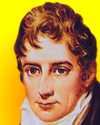
Robert Fulton
(14 Nov 1765 - 24 Feb 1815)
American inventor, engineer and artist who brought steamboating from the experimental stage to commercial success.
|
The First Steamboat
from: Cradle Days of New York (1909)
(1798)
The First Steamboat - Monopoly of Hudson Traffic Granted to Robert R. Livingston - his Craft a Failure - Fulton and the Clermont’s First Trip to Albany - First Steam Ferryboats.
[p.162] The second movement inaugurated in 1798 for the benefit of the people was the application of steam as a propulsive power on water. At the first session of the legislature held that year Chancellor Robert R. Livingstone, who had sailed around the Collect the previous year in Fitch's boat, appeared before the body with a plan for “applying the steam engine in such a way as to propel a boat.” As the experiment would he expensive, he wanted the assurance of the legislature that in the event of its proving successful he would be protected in whatever advantages were derived from the operation of his scheme. While the members of the House listened with apparent interest to the Chancellor's views on steam propelled boats, when the bill to protect him in his rights was introduced by his friend, Dr. Samuel L. Mitchell, they received its reading with laughter, and some of them with ridicule. The bill's sponsor was as much interested in the ultimate success of Chancellor Livingston's experiment as the Chancellor was, and persisted in pushing the bill until it was either accepted or rejected. The House played with it for a while, and made sport of Dr. Mitchell, but eventually, believing in his sincerity, passed an act which gave to Judge Livingston “the exclusive right and privilege or navigating all kinds of boats which might be propelled by the force of fire or steam, on all the waters within the territory or jurisdiction of the State of New York for a term of twenty years from the passing of the act—upon condition that he should within a twelvemonth build such a boat, the mean of whose progress should not be less than four miles an hour.”
The Chancellor prior to the passage of the act had made an agreement with Nicholas Roosevelt, of the old New York family, and Colonel John Stevens to build a boat on joint account, the engines for which were to be constructed by Roosevelt at his shop on the Passiac, the propelling agency to be planned by Livingston, with the co-operation of Stevens. It was because of the promising signs of success that the protection of the legislature was sought. However, on October 21, 1798, the craft was completed and ready for the trial trip, it proved a failure. Later Stevens persuaded the Chancellor to put a set of paddles in the stern, with the result that the craft on which Livingston had built his hopes was shaken to pieces and was abandoned. The Chancellor was not easily beaten, however. A few years later he was the accredited minister plenipotentiary of the United States [p.163] to France, and became acquainted with Robert Fulton. Fulton in 1785 was known only as a miniature portrait painter in New York, and had gone over to Europe to study art with Benjamin West. in his trips among the rural mansions of the nobility to study, at West's suggestion, the masterpieces possessed by many of them, he made the acquaintance of the Earl of Bridgewater, then interested in England's canal system. During his intercourse with the earl Fulton found that his tastes lay more toward civil engineering than toward art, and adopted the former profession. His successful experiments began to be mooted throughout the Continent, and one of them, with submarine torpedoes and torpedo boats, created so much anxiety in the minds of the officials of the English government that they hastened to acquaint themselves with all his doings.
When Fulton called upon Chancellor Livingston he found him receptive regarding his scheme to construct a steamboat, whose trial trip was to take place on the Seine. Work was begun on the craft, and it was completed in 1803. The first trial resulted in the boat going to the bottom of the river because its hull was not able to sustain the weight of the machinery. It was taken up and reconstructed, and another trial proved successful. The Chancellor saw at once that Fulton's idea or model was better than Fitch's or his own, and agreed to enter into partnership, Joel Barlow, a man of means, guaranteeing Fulton's share of the finances. In the mean time Livingston wrote home and procured an extension of the legislative act granted in 1798 by the State of New York, and thus secured the monopoly of the Hudson for a few years longer. He was convinced that a boat could be successfully moved by steam over the waters of New York, and from his large wealth was willing to give enough money to accomplish the result. Through his aid an engine was ordered built in England from plans which Fulton furnished, and in 1806 Fulton returned to New York to build the boat to contain it. The Chancellor could not stay in France while the work was under way, and resigned his mission in 1805, traveling for a. few months on the Continent and reaching New York about the time the engine arrived at the shipyard of Brown Brothers, at the foot of East Houston street.
The building of the craft created great discussion, the possibility of its success was denied, and those who watched its construction were filled with incredulity. And it was a strangely constructed affair, 130 feet long, 18 feet beam and 7 feet in depth, of 160 tons burden, with two masts, rigged for the purpose of carrying sails; a deckhouse pierced by windows and fitted up with twelve berths, the space at both ends of it open to the sky. When the machinery arrived it was put up piece by piece within the boat, the last of the fittings being a great iron pipe, which rose from the centre of the boat to the height of the masts, and two great wheels hung on either side like those in use in mills.
The day for the trial trip arrived, and it was with evident reluctance that the persons invited by Fulton to participate were present. Very few believed the boat would ever reach its destination, and dire disaster was predicted by others. “Silent and uneasy, they stood around in groups when the signal was given to start. When the great, uncouth wheels, without any wheelboxes, stirred the water into a while foam and the boat moved [p.164] forward, many closed their eyes and waited for the moment when they would be either sent skyward or go down to the bottom of the river. The boat stopped suddenly, and the crowd lining the river bank shouted derisively to those on board. Fulton was evidently perplexed, and asked the indulgence of the passengers for half an hour, promising that if he could not remedy the trouble he would abandon the undertaking. He hurried below, found the cause to be the improper adjustment of some of the machinery, and quickly remedied it. After going a short distance the craft was headed homeward, and the trial trip was successful.”
On Friday, August 4, 1807, an advertisement appeared in the New York newspapers which astonished everyone who read it. Fulton's craft, christened the Clermont, after Livingston's country seat on the Hudson, was announced to sail from the foot of Cortland street at half past 6 o'clock on Monday morning, August 7, and would take passengers to Albany at $7 each. On the day of sailing all the berths had been taken, and thousands of people lined the shore in the vicinity of the dock to see the boat depart-some with hope, some with despair. When she moved out of the dock and reached mid-stream a burst of applause rent the air. On her way north she presented a strange spectacle, with immense columns of black smoke issuing from her tall smokestack, mingled with sparks and a cloud of ashes, and every now and then flames rising far in the air from the pine wood fuel she was being fed with. At dark this spectacle appalled the crews or other vessels, and many bowed the knee in prayer for protection. It surely presented to the uncouth mind or the farmer “the devil on his way to Albany in a sawmill.”
Fulton enjoyed his triumph as the speed increased and the new power which he had chained to his bidding bore him, in defiance of wind and tide, far from the city. At the country seat of Chancellor Livingston he stopped to take on wood, and continued his trip to Albany, which he reached in thirty-two hours, and thus secured the monopoly of steam navigation over the waters of New York.
On Friday, August 11, the citizens were amazed to see the Clermont coming back again. They didn't believe she had made the trip to Albany, but Fulton published an official and sworn statement in the newspapers that he had reached Clermont in exactly twenty-four hours, had rested there over night, and proceeded to Albany, which he reached in eight hours on Wednesday; that he, started from Albany on Thursday at 9 A.M., stopped one hour at Clermont and proceeded to New York, accomplishing the trip of a hundred and fifty miles coming down in just thirty hours, fulfilling the terms at the act of the legislature. Within four years the Clermont was improved and enlarged, and its name changed to the North River. Two other boats were also added to what now was designated the Albany Line, the Car of Neptune and the Paragon, each larger than its predecessor and abounding in improvements.
But Fulton's success was too marked, and his prosperity was watched by envious eyes. Legal difficulties touching his right exclusively to navigate the Hudson beset him. New Jersey claimed that it was too wide a privilege to be given by the legislature of a single State, and other inventors denied his having originated the idea of steam as a propulsive force on water. [p.165] Every kind of argument was used to invalidate Fulton's pretensions as an inventor of the steamboat. But he earned his fame justly, and all authorities agree that, at the time the trial trip of the Clermont took place, in no other part of the globe was another steamboat in successful operation.
In the mean time one at the two associates of Chancellor Livingston, Colonel John Stevens, of Hoboken, was not idle. While Fulton was in Europe in 1804, Stevens built an open steamboat sixty-eight feet long, with a screw propeller, and the next year another one, with twin screws. So successful were the trial trips of these boats that he set about eclipsing the Fulton boat. He built the Phoenix, and launched her a few weeks after Fulton was hailed pioneer of steam propulsion on water. She made regular trips between New Brunswick and New York, but was prevented from showing her work in New York waters on account at the legislative act passed to protect Chancellor Livingston. To prove her capability, however, Robert Livingston Stevens, the colonel's son, made the passage with her from New York to Philadelphia by sea in the early summer of 1808, and ran her on the Delaware for a short time.
With protests being constantly made to the courts against the monopoly held by Livingston and Fulton, it was not wondered at when the work of the legislature was nullified, and the field of steam navigation opened to all who had inventive talent. The Stevenses were not slow to lake advantage of the new order of things, and a few years after some of their finest productions plied on the Hudson.
A new method of communication between the islands adjacent to New York began to engross the attention of Fulton and Stevens in 1809. At this time the ferryboats, with two exceptions, were barges propelled by oars. The exceptions were boats which bad been recently constructed, with wheels in the centre, turned by a horizontal treadmill worked by horses, and called horseboats. In October, 1811, Stevens put into operation the first steam ferryboat, which plied between New York and Hoboken, and was the first used in any part of the world. In 1812 Fulton built a small steam ferryboat for the Paulus Hook ferry, and before the following year had ended two other ferryboats were built to connect New York with Brooklyn. Here is an interesting question for historians: Was the name of Fulton's first boat the Clermont or Katherine of Clermont, so-called, it is said, in honor of Fulton's wife, who was a niece of Chancellor Livingston?

![Robert Fulton quote: As the component parts of all new machines may be said to be old[,] it is a nice discriminating judgment,](https://todayinsci.com/F/Fulton_Robert/FultonRobert-MechanicThm.jpg)
- Science Quotes by Robert Fulton.
- 14 Nov - short biography, births, deaths and events on date of Fulton's birth.
- The Fulton Patents - excerpt from Robert Fulton and the “Clermont” (1909).
- Inventor - Businessman - transcript of a 1940s radio talk by Charles F. Kettering.
- 11 Feb - event description for steamboat patent issued to Robert Fulton in 1810.
- The Fire of His Genius: Robert Fulton and the American Dream, by Kirkpatrick Sale. - book suggestion.
- Booklist for Robert Fulton Steamboats.






