 (source)
|
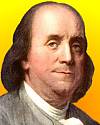
Benjamin Franklin
(17 Jan 1706 - 17 Apr 1790)
American statesman, scientist, inventor, diplomat, author, printer and publisher known for his electrical experiment, the Franklin stove, bifocal eyeglasses and the lightning rod. Less well know are his efforts establishing public amenities, including a fire company, library, and hospital.
|
Science Quotes by Benjamin Franklin (78 quotes)
>> Click for Benjamin Franklin Quotes on | Diet | Doctor | Electricity | Experiment | Health | Knowledge | Life | Physician |
>> Click for Benjamin Franklin Quotes on | Diet | Doctor | Electricity | Experiment | Health | Knowledge | Life | Physician |
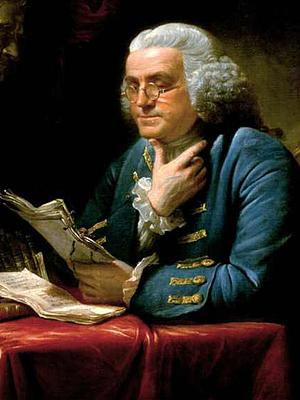
[Franklin always found it a] pleasure ... to see good workmen handle their tools.
— Benjamin Franklin
Autobiography.
~~[Attributed, authorship undocumented]~~ Mathematical demonstrations are a logic of as much or more use, than that commonly learned at schools, serving to a just formation of the mind, enlarging its capacity, and strengthening it so as to render the same capable of exact reasoning, and discerning truth from falsehood in all occurrences, even in subjects not mathematical. For which reason it is said, the Egyptians, Persians, and Lacedaemonians seldom elected any new kings, but such as had some knowledge in the mathematics, imagining those, who had not, men of imperfect judgments, and unfit to rule and govern.
— Benjamin Franklin
From an article which appeared as 'The Usefulness of Mathematics', Pennsylvania Gazette (30 Oct 1735), No. 360. Collected, despite being without clear evidence of Franklin’s authorship, in The Works of Benjamin Franklin (1809), Vol. 4, 377. Evidence of actual authorship by Ben Franklin for the newspaper article has not been ascertained, and scholars doubt it. See Franklin documents at the website founders.archives.gov. The quote is included here to attach this caution.
A fat kitchin, a lean Will.
— Benjamin Franklin
In Poor Richard's Almanack (1733).
A learned blockhead is a greater blockhead than an ignorant one.
— Benjamin Franklin
In Poor Richard's Almanack (1734).
A Man of Knowledge like a rich Soil, feeds
If not a world of Corn, a world of Weeds.
If not a world of Corn, a world of Weeds.
— Benjamin Franklin
In Poor Richard's Almanack (1739).
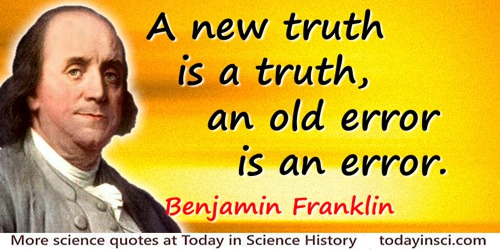
A new truth is a truth, an old error is an error.
— Benjamin Franklin
In Poor Richard's Almanack (1734).
Against Diseases here, the strongest Fence,
Is the defensive Virtue, Abstinence.
Is the defensive Virtue, Abstinence.
— Benjamin Franklin
In Poor Richard's Almanack (1742).
An infallible Remedy for the Tooth-ach, viz Wash the Root of an aching Tooth, in Elder Vinegar, and let it dry half an hour in the Sun; after which it will never ach more; Probatum est.
— Benjamin Franklin
In Poor Richard's Almanack (1739).
An iron rod being placed on the outside of a building from the highest part continued down into the moist earth, in any direction strait or crooked, following the form of the roof or other parts of the building, will receive the lightning at its upper end, attracting it so as to prevent it's striking any other part; and, affording it a good conveyance into the earth, will prevent its damaging any part of the building.
— Benjamin Franklin
Of Lightning, and the Method (now used in America) of securing Buildings and Persons from its mischievous Effects', Paris 1767. In I. Bernard Cohen (ed.), Benjamin Franklin's Experiments (1941), 390.
An ounce of prevention is worth a pound of cure.
— Benjamin Franklin
Perhaps an older adage, but an example of its use appears in Pennsylvania Gazette (4 Feb 1734-5), about fire prevention, including taking care, moving live coals from a fireplace between rooms, for safety in a closed warming-pan. A midnight fire from a spilled ember might set your stairs on fire: “You may be forced, as I once was, to leap out of your windows, and hazard your necks to avoid being over-roasted.” As cited in Benjamin Franklin and J. Sparks (ed.), The Works of Benjamin Franklin (1840), Vol. 1, 134, footnote.
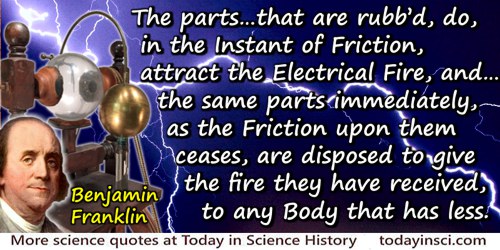
And we daily in our experiments electrise bodies plus or minus, as we think proper. [These terms we may use till your Philosophers give us better.] To electrise plus or minus, no more needs to be known than this, that the parts of the Tube or Sphere, that are rubb’d, do, in the Instant of Friction, attract the Electrical Fire, and therefore take it from the Thin rubbing; the same parts immediately, as the Friction upon them ceases, are disposed to give the fire they have received, to any Body that has less.
— Benjamin Franklin
Letter 25 May 1747. Quoted in I. Bernard Cohen, Franklin and Newton: An Enquiry into Speculative Newtonian Experimental Science and Franklin’s Work in Electricity as an Example Thereof (1956), 439.
At length being at Clapham where there is, on the common, a large pond which, I observed to be one day very rough with the wind, I fetched out a cruet of oil and dropt a little of it on the water. I saw it spread itself with surprising swiftness upon the surface; but the effect of smoothing the waves was not produced; for I had applied it first on the leeward side of the pond, where the waves were largest, and the wind drove my oil back upon the shore. I then went to the windward side, where they began to form; and there the oil, though not more than a tea-spoonful, produced an instant calm over a space several yards square, which spread amazingly, and extended itself gradually till it reached the leeside, making all that quarter of the pond, perhaps half an acre, as smooth as a looking-glass.
[Experiment to test an observation made at sea in 1757, when he had seen the wake of a ship smoothed, explained by the captain as presumably due to cooks emptying greasy water in to the sea through the scuppers.]
[Experiment to test an observation made at sea in 1757, when he had seen the wake of a ship smoothed, explained by the captain as presumably due to cooks emptying greasy water in to the sea through the scuppers.]
— Benjamin Franklin
Letter, extract in 'Of the still of Waves by Means of Oil The Gentleman's Magazine (1775), Vol. 45, 82.
Be not sick too late, nor well too soon.
— Benjamin Franklin
In Poor Richard's Almanack (1734).
Be temperate in wine, in eating, girls, & sloth;
Or the Gout will seize you and plague you both.
Or the Gout will seize you and plague you both.
— Benjamin Franklin
In Poor Richard's Almanack (1734).
Beware of the young Doctor, & the old Barber.
— Benjamin Franklin
In Poor Richard's Almanack (1733).
Certainlie these things agree,
The Priest, the Lawyer, & Death all three:
Death takes both the weak and the strong.
The lawyer takes from both right and wrong,
And the priest from living and dead has his Fee.
The Priest, the Lawyer, & Death all three:
Death takes both the weak and the strong.
The lawyer takes from both right and wrong,
And the priest from living and dead has his Fee.
— Benjamin Franklin
In Poor Richard's Almanack (1737).
Chagrined a little that we have been hitherto able to produce nothing in this way of use to mankind; and the hot weather coming on, when electrical experiments are not so agreeable, it is proposed to put an end to them for this season, somewhat humorously, in a party of pleasure, on the banks of Skuylkil. Spirits, at the same time, are to be fired by a spark sent from side to side through the river, without any other conductor that the water; an experiment which we some time since performed, to the amazement of many. A turkey is to be killed for our dinner by the electrified bottle: when the healths of all the famous electricians in England, Holland, France, and Germany are to be drank in electrified bumpers, under the discharge of guns from the electrical battery.
— Benjamin Franklin
Letter to Peter Collinson, 29 Apr 1749. In I. Bernard Cohen (ed.), Benjamin Franklin's Experiments (1941), 199-200.
Cheese and salt meat, should be sparingly eat.
— Benjamin Franklin
In Poor Richard's Almanack (1733).
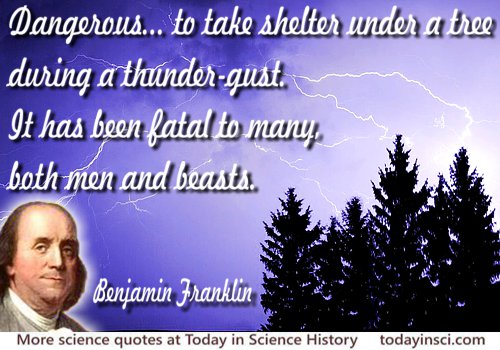
Dangerous, therefore, is it to take shelter under a tree, during a thunder-gust. It has been fatal to many, both men and beasts.
— Benjamin Franklin
'Letter IV. Containing Observations and Suppositions towards forming a new Hypothesis, for explaining the several Phænomena of Thunder-Gusts', in Experiments and Observations on Electricity, Made at Philadelphia in America by Mr. Benjamin Franklin, and Commnicated in Several Letters to Mr. P. Collinson, of London, F.R.S. (1751), 47. In the book, the letter is undated, but it is printed after a footnote dated 29 Apr 1749, and is followed by one dated 29 Jul 1750. Therefore, it is assumed by later authors to have been written in summer 1749. When I. Bernard Cohen editted Benjamin Franklin's Experiments (1941), 209, he wrote that the letter was wrtten during summer or autumn of 1749 and “was dispatched, not to Collinson, but to Dr John Mitchel F.R.S." In his later books, Cohen dates it as 29 Apr 1749.
Do not squander time for that is the stuff life is made of.
— Benjamin Franklin
…...
Don't go to the doctor with every distemper, nor to the lawyer with every quarrel, nor to the pot for every thirst.
— Benjamin Franklin
In Poor Richard's Almanack (1737).
Don't misinform your Doctor nor your Lawyer.
— Benjamin Franklin
In Poor Richard's Almanack (1737).
Early to bed and early to rise, makes a man healthy wealthy and wise.
— Benjamin Franklin
In Poor Richard's Almanack (1735).
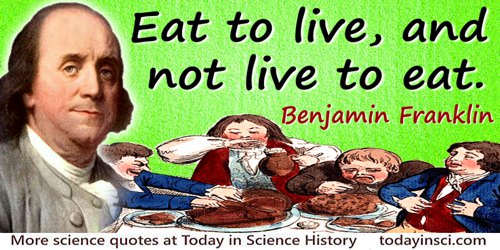
Eat to live, and not live to eat.
— Benjamin Franklin
In Poor Richard’s Almanack (1733).
Furnished as all Europe now is with Academies of Science, with nice instruments and the spirit of experiment, the progress of human knowledge will be rapid and discoveries made of which we have at present no conception. I begin to be almost sorry I was born so soon, since I cannot have the happiness of knowing what will be known a hundred years hence.
— Benjamin Franklin
…...
God heals, and the Doctor takes the Fees.
— Benjamin Franklin
In Poor Richard's Almanack (1744). Note: q.v. John Ray, “God healeth and the physician hath the thanks.”
He that drinks his Cyder alone, let him catch his Horse alone.
— Benjamin Franklin
In Poor Richard's Almanack (1744).
He that waits upon fortune is never sure of a dinner.
— Benjamin Franklin
…...
He’s a Fool that makes his Doctor his Heir.
— Benjamin Franklin
In Poor Richard's Almanack (1733). See the Francis Bacon page for: Male secum agit æger, medicum qui hæredem ficit. That sick man does ill for himself, who makes his physician his heir. (1625)
He's the best physician that knows the worthlessness of the most medicines.
— Benjamin Franklin
In Poor Richard's Almanack (1733).
Hide not your talents, they for use were made. What’s a sundial in the shade?
— Benjamin Franklin
…...
Hot things, sharp things, sweet things, cold things
All rot the teeth, and make them look like old things.
All rot the teeth, and make them look like old things.
— Benjamin Franklin
In Poor Richard's Almanack (1734).
I always rejoice to hear of your being still employed in experimental researches into nature, and of the success you meet with. The rapid progress true science now makes, occasions my regretting sometimes that I was born so soon: it is impossible to imagine the height to which may be carried, in a thousand years, the power of man over matter; we may perhaps learn to deprive large masses of their gravity, and give them absolute levity for the sake of easy transport. Agriculture may diminish its labour and double its produce; all diseases may by sure means be prevented or cured (not excepting even that of old age), and our lives lengthened at pleasure even beyond the antediluvian standard. Oh! that moral science were in as fair a way of improvement; that men would cease to be wolves to one another; and that human beings would at length learn what they now improperly call humanity!
— Benjamin Franklin
Letter to Dr Priestley, 8 Feb 1780. In Memoirs of Benjamin Franklin (1845), Vol. 2, 152.
I have never seen the Philosopher's Stone that turns lead into Gold, but I have known the pursuit of it turn a Man's Gold into Lead.
— Benjamin Franklin
In Poor Richard's Almanack (1738).
I must own I am much in the dark about light. I am not satisfied with the doctrine that supposes particles of matter, called light … May not all the phenomena of light be more conveniently solved, by supposing universal space filled with a subtle elastic fluid, which, when at rest, is not visible, but whose vibrations affect that fine sense in the eye, as … the ear … in the case of sound … May not different degrees of the vibration of the above-mentioned universal medium occasion the appearances of different colors? I think the electric fluid is always the same; yet I find that weaker and stronger sparks differ in apparent color; some white, blue, purple, red; the strongest, white; weak ones, red.
— Benjamin Franklin
In Letter (23 Apr 1752) to Calwallader Colden, collected in William Duane (ed.), Memoirs of Benjamin Franklin (1834), Vol. 2, 270.
I say it is impossible that so sensible a people [citizens of Paris], under such circumstances, should have lived so long by the smoky, unwholesome, and enormously expensive light of candles, if they had really known that they might have had as much pure light of the sun for nothing.
[Describing the energy-saving benefit of adopting daylight saving time. (1784)]
[Describing the energy-saving benefit of adopting daylight saving time. (1784)]
— Benjamin Franklin
'An Economical Project', The Life and Miscellaneous Writings of Benjamin Franklin (1839), 58. A translation of this letter appeared in one of the Paris daily papers about 1784. He estimated, during six months, a saving of over 64 million pound weight of candles, worth over 96 million livres tournois.
I… formerly had two pair of spectacles, which I shifted occasionally, as in travelling I sometimes read, and often wanted to regard the prospects. Finding this change troublesome, and not always sufficiently ready, I had the glasses cut, and half of each kind associated in the same circle. … By this means, as I wear my spectacles constantly, I have only to move my eyes up or down, as I want to see distinctly far or near, the proper glasses being always ready.
— Benjamin Franklin
Letter (23 May 1785) to George Wheatley). Collected in William Temple Franklin (ed.), The Works of Dr. Benjamin Franklin (1809), Vol. 6, 168.
If a man empties his purse into his head, no man can take it away from him. An investment in knowledge always pays the best interest.
— Benjamin Franklin
…...
If we are industrious, we shall never starve; for, ‘at the workingman’s house hunger looks in, but dares not enter.’ Nor will the bailiff or the constable enter, for ‘industry pays debts, while despair increaseth them.’
— Benjamin Franklin
Published in Poor Richard's Almanac. Collected in Memoirs of Benjamin Franklin (1834), 477.
If you would not be forgotten
As soon as you are dead and rotten
Either write things worth reading,
Or do things worth the writing.
As soon as you are dead and rotten
Either write things worth reading,
Or do things worth the writing.
— Benjamin Franklin
Collected in Poor Richard's Almanack (1914), 32, No. 285.
In general, mankind, since the improvement of cookery, eat about twice as much as nature requires.
— Benjamin Franklin
Louis Klopsch, Many Thoughts of Many Minds (1896), 67.
In going on with these Experiments, how many pretty systems do we build, which we soon find ourselves oblig’d to destroy! If there is no other Use discover’d of Electricity, this, however, is something considerable, that it may help to make a vain Man humble.
— Benjamin Franklin
Letter to Peter Collinson, 14 Aug 1747. In I. Bernard Cohen (ed.), Benjamin Franklin’s Experiments (1941), 63.
In New England they once thought blackbirds useless, and mischievous to the corn. They made efforts to destroy them. The consequence was, the blackbirds were diminished; but a kind of worm, which devoured their grass, and which the blackbirds used to feed on, increased prodigiously; then, finding their loss in grass much greater than their saving in corn, they wished again for their blackbirds.
— Benjamin Franklin
Letter to Richard Jackson, 5 May 1753. In Albert Henry Smyth, The Writings of Benjamin Franklin (1905), Vol. 3, 135.
It seems to me, that if statesmen had a little more arithmetic, or were accustomed to calculation, wars would be much less frequent.
— Benjamin Franklin
Letter to his sister, Mrs. Jane Mecom (1787) just after the close of the Constitutional Convention. In Jared Sparks (ed.) The Works of Benjamin Franklin (1840), Vol. 10, 445.
Let the experiment be made.
— Benjamin Franklin
Letter to Dr L—, 18 March 1755. In I. Bernard Cohen (ed.), Benjamin Franklin's Experiments (1941), 334.
Lost time is never found again.
— Benjamin Franklin
No. 332, Poor Richard’s Almanack (Jan 1748). Collected in Poor Richard's Almanack (1914), 35.
Love, Cough, & a Smoke, can't well be hid.
— Benjamin Franklin
In Poor Richard's Almanack (1737).
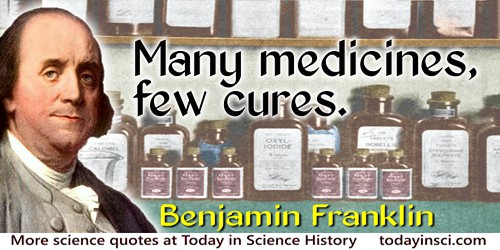
Many dishes many diseases,
Many medicines few cures.
Many medicines few cures.
— Benjamin Franklin
In Poor Richard’s Almanack (1734).
Money never made a man happy yet, nor will it. There is nothing in its nature to produce happiness. The more a man has, the more he wants. Instead of filling a vacuum, it makes one.
— Benjamin Franklin
…...
One should eat to live not live to eat.
— Benjamin Franklin
As quoted, without citation, in John Walker, A Fork in the Road: Answers to Daily Dilemmas from the Teachings of Jesus Christ (2005), 83.
One today is worth two tomorrows.
— Benjamin Franklin
…...
Our new Constitution is now established, and has an appearance that promises permanency; but in this world nothing can be said to be certain, except death and taxes.
— Benjamin Franklin
Letter to Jean Baptiste Le Roy, 13 Nov 1789. Quoted in Albert Henry Smyth (ed.) The Writings of Benjamin Franklin (1907), vol. 10, 69.
Some guns were fired to give notice that the departure of the balloon was near. ... Means were used, I am told, to prevent the great balloon's rising so high as might endanger its bursting. Several bags of sand were taken on board before the cord that held it down was cut, and the whole weight being then too much to be lifted, such a quantity was discharged as would permit its rising slowly. Thus it would sooner arrive at that region where it would be in equilibrio with the surrounding air, and by discharging more sand afterwards, it might go higher if desired. Between one and two o’clock, all eyes were gratified with seeing it rise majestically from above the trees, and ascend gradually above the buildings, a most beautiful spectacle. When it was about two hundred feet high, the brave adventurers held out and waved a little white pennant, on both sides of their car, to salute the spectators, who returned loud claps of applause. The wind was very little, so that the object though moving to the northward, continued long in view; and it was a great while before the admiring people began to disperse. The persons embarked were Mr. Charles, professor of experimental philosophy, and a zealous promoter of that science; and one of the Messrs Robert, the very ingenious constructors of the machine.
While U.S. ambassador to France, writing about witnessing, from his carriage outside the garden of Tuileries, Paris, the first manned balloon ascent using hydrogen gas on the afternoon of 1 Dec 1783. A few days earlier, he had watched the first manned ascent in Montgolfier's hot-air balloon, on 21 Nov 1783.
While U.S. ambassador to France, writing about witnessing, from his carriage outside the garden of Tuileries, Paris, the first manned balloon ascent using hydrogen gas on the afternoon of 1 Dec 1783. A few days earlier, he had watched the first manned ascent in Montgolfier's hot-air balloon, on 21 Nov 1783.
— Benjamin Franklin
Letter to Sir Charles Banks (1 Dec 1783). In The Writings of Benjamin Franklin: 1783-1788 (1906), Vol. 9, 119-120.
Some men grow mad by studying much to know,
But who grows mad by studying good to grow.
But who grows mad by studying good to grow.
— Benjamin Franklin
In Poor Richard's Almanack (1734).
The bell ringing for church, we went thither immediately, and with hearts full of gratitude, returned sincere thanks to God for the mercies we had received: were I a Roman Catholic, perhaps I should on this occasion vow to build a chapel to some saint, but as I am not, if I were to vow at all, it should be to build a light-house. [Upon narrowly missing a shipwreck on the Scilly rocks.]
[Frequently seen summarized as, though not Franklin's own wording: Lighthouses are more helpful than churches.
[Frequently seen summarized as, though not Franklin's own wording: Lighthouses are more helpful than churches.
— Benjamin Franklin
Letter written at Falmouth, England (17 Jul 1757) to Deborah Read Franklin (common-law wife). Quoted in Benjamin Franklin and William Temple Franklin, The Works of Dr. Benjamin Franklin (1818), 175 footnote added by W.T. Franklin.
The best of all medicines are rest and fasting.
— Benjamin Franklin
In Tryon Edwards (ed.), A Dictionary of Thoughts (1908), 339.
The body of Benjamin Franklin, Printer (like the cover of an old book, its contents torn out and stripped of its lettering and gilding), lies here, food for worms; but the work shall not be lost, for it will (as he believed) appear once more in a new and more elegant edition, revised and corrected by the Author.
— Benjamin Franklin
Epitaph on his tombstone
The electrical matter consists of particles extremely subtile, since it can permeate common matter, even the densest metals, with such ease and freedom as not to receive any perceptible resistance.
If anyone should doubt whether the electrical matter passes through the substance of bodies, or only over along their surfaces, a shock from an electrified large glass jar, taken through his own body, will probably convince him.
Electrical matter differs from common matter in this, that the parts of the latter mutually attract, those of the former mutually repel each other.
If anyone should doubt whether the electrical matter passes through the substance of bodies, or only over along their surfaces, a shock from an electrified large glass jar, taken through his own body, will probably convince him.
Electrical matter differs from common matter in this, that the parts of the latter mutually attract, those of the former mutually repel each other.
— Benjamin Franklin
'Opinions and Conjectures, Concerning the Properties and Effects of the Electrical Matter, arising from Experiments and Observations, made at Philadelphia, 1749.' In I. Bernard Cohen (ed.), Benjamin Franklin's Experiments (1941), 213.
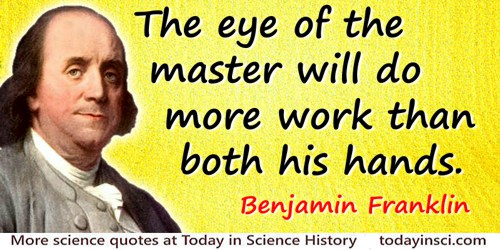
The eye of the master will do more work than both his hands.
— Benjamin Franklin
In James Wood, Dictionary of Quotations from Ancient and Modern, English and Foreign Sources (1893), 426:34.
The game of Chess is not merely an idle amusement. Several very valuable qualities of the mind, useful in the course of human life, are to be acquired or strengthened by it so as to become habits ready on all occasions.
— Benjamin Franklin
In The Morals of Chess. As quoted in The Gentleman's Magazine, and Historical Chronicle (1787), 590.
The greatest inventions are those inquiries which tend to increase the power of man over matter.
— Benjamin Franklin
Unverified. If you know a primary source for this quote, please contact Webmaster who searched and, as yet, found none.
There has not been any science so much esteemed and honored as this of mathematics, nor with so much industry and vigilance become the care of great men, and labored in by the potentates of the world, viz. emperors, kings, princes, etc.
— Benjamin Franklin
In 'On the Usefulness of Mathematics', in Works (1840), Vol. 2, 28.
There seem to be but three ways for a nation to acquire wealth: the first is by war, as the Romans did, in plundering their conquered neighbors—this is robbery; the second by commerce, which is generally cheating; the third by agriculture, the only honest way, wherein man receives a real increase of the seed thrown into the ground, in a kind of continual miracle, wrought by the hand of God in his favor, as a reward for his innocent life and his virtuous industry.
— Benjamin Franklin
In 'Positions to be Examined', The Works of Benjamin Franklin Consisting of Essays, Humorous, Moral and Literary (1824), 241.
There’s more old Drunkards than old Doctors.
— Benjamin Franklin
In Poor Richard’s Almanack (1736). Compare Thomas Fuller, published earlier, “There are more old Drunkards than old Physicians. Proverb collected as No. 4858 in Gnomologia: Adagies and Proverbs, Wise Sentences and Witty Sayings (1732), 210. The quote appears centuries earlier by François Rabelais (1596), as translated to English: “A hundred devils leap into my body, if there be not more old drunkards than old physicians.” See the François Rabelais quotes page on this website.
Thomas Godfrey [was] a self-taught mathematician, great in his way…. But he knew little out of his way and was not a pleasing companion, as, like most great mathematicians I have met with, he expected universal precision in everything said, and was forever denying and distinguishing upon trifles, to the disturbance of all conversation.
— Benjamin Franklin
In The Autobiography of Benjamin Franklin (1850), 57-58.
Time is a herb that cures all Diseases.
— Benjamin Franklin
In Poor Richard's Almanack (1738). http://www. vlib.us/amdocs/texts/prichard38.html
To inquisitive minds like yours and mine the reflection that the quantity of human knowledge bears no proportion to the quantity of human ignorance must be in one view rather pleasing, viz., that though we are to live forever we may be continually amused and delighted with learning something new.
— Benjamin Franklin
In letter to Dr. Ingenhouz. Quoted in Theodore Diller, Franklin's Contribution to Medicine (1912), 65. The source gives no specific cite for the letter, and Webmaster has found the quote in no other book checked, so authenticity is in question.
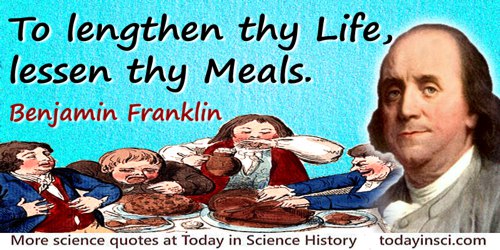
To lengthen thy Life, lessen thy Meals.
— Benjamin Franklin
In Poor Richard's Almanack (1733).
Use now and then a little Exercise a quarter of an Hour before Meals, as to swing a Weight, or swing your Arms about with a small Weight in each Hand; to leap, or the like, for that stirs the Muscles of the Breast.
— Benjamin Franklin
In Poor Richard's Almanack (1742).
We hold these truths to be self-evident.
Franklin's edit to the assertion of religion in Thomas Jefferson's original wording, “We hold these truths to be sacred and undeniable” in a draft of the Declaration of Independence changes it instead into an assertion of rationality. The scientific mind of Franklin drew on the scientific determinism of Isaac Newton and the analytic empiricism of David Hume and Gottfried Leibniz. In what became known as “Hume's Fork” the latters' theory distinguished between synthetic truths that describe matters of fact, and analytic truths that are self-evident by virtue of reason and definition.
Franklin's edit to the assertion of religion in Thomas Jefferson's original wording, “We hold these truths to be sacred and undeniable” in a draft of the Declaration of Independence changes it instead into an assertion of rationality. The scientific mind of Franklin drew on the scientific determinism of Isaac Newton and the analytic empiricism of David Hume and Gottfried Leibniz. In what became known as “Hume's Fork” the latters' theory distinguished between synthetic truths that describe matters of fact, and analytic truths that are self-evident by virtue of reason and definition.
— Benjamin Franklin
As explained by Walter Isaacson in Benjamin Franklin: An American Life (2004), 312.
What is a butterfly? At best
He's but a caterpiller drest.
The gaudy Fop's his picture just.
He's but a caterpiller drest.
The gaudy Fop's his picture just.
— Benjamin Franklin
In Poor Richard's Almanack (1740).
What is the use of a new-born child?
When asked of the use of a new invention.
When asked of the use of a new invention.
— Benjamin Franklin
In I. Bernard Cohen, Benjamin Franklin's Science (1990), 38.
What science can there be more noble, more excellent, more useful for men, more admirably high and demonstrative, than this of the mathematics?
— Benjamin Franklin
In 'On the Usefulness of Mathematics', Works (1840), Vol. 2, 69.
What signifies Philosophy that does not apply to some Use? May we not learn from hence, that black Clothes are not so fit to wear in a hot Sunny Climate or Season, as white ones; because in such Cloaths the Body is more heated by the Sun when we walk abroad, and are at the same time heated by the Exercise, which double Heat is apt to bring on putrid dangerous Fevers? The Soldiers and Seamen, who must march and labour in the Sun, should in the East or West Indies have an Uniform of white?
— Benjamin Franklin
Letter to Miss Mary Stevenson, 20 Sep 1761. In Albert Henry Smyth (ed.), The Writings of Benjamin Franklin (1906), Vol. 4, 115.
Whatever may have been imputed to some other studies under the notion of insignificancy and loss of time, yet these [mathematics], I believe, never caused repentance in any, except it was for their remissness in the prosecution of them.
— Benjamin Franklin
In 'On the Usefulness of Mathematics', Works (1840), Vol. 2, 69.
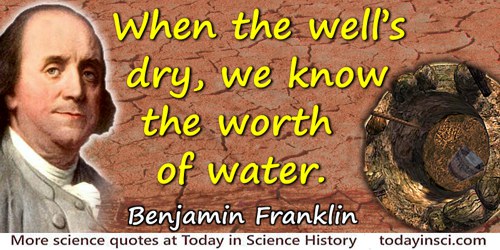
When the well’s dry, we know the worth of water.
— Benjamin Franklin
In Poor Richard’s Almanac (1757, 1900), 23. Published earlier (1732) by Thomas Fuller as: “We never know the worth of water ’til the well is dry.” Proverb collected by Thomas Fuller in Gnomologia: Adagies and Proverbs: Wise Sentences and Witty Sayings, Ancient and Modern, Foreign and British (1732), 237.
Wouldst thou enjoy a long Life, a healthy Body, and a vigorous Mind, and be acquainted also with the wonderful Works of God? labour in the first place to bring thy Appetite into Subjection to Reason.
— Benjamin Franklin
In Poor Richard's Almanack (1742).
Write with the learned, pronounce with the vulgar.
— Benjamin Franklin
In Poor Richard's Almanack (1914), 62.
https://books.google.com/books?id=o6lJAAAAIAAJ
Benjamin Franklin - 1914
Quotes by others about Benjamin Franklin (17)
Whilst I am writing to a Philosopher and a Friend, I can scarcely forget that I am also writing to the greatest Statesman of the present, or perhaps of any century, who spread the happy contagion of Liberty among his countrymen.
Letter to Benjamin Franklin, 29 May 1787. Quoted In Desmond King-Hele (ed.), The Letters of Erasmus Darwin (1981), 166.
Eripuit coelo fulmen sceptrumque tyrannis.
He snatched the lightning from the sky and the sceptre from tyrants.
Admiring Benjamin Franklin in a letter to Samuel P. du Pont, c. 1779.
He snatched the lightning from the sky and the sceptre from tyrants.
Admiring Benjamin Franklin in a letter to Samuel P. du Pont, c. 1779.
In I. Bernard Cohen, Benjamin Franklin's Experiments (1941), xxvii.
People will accept your idea much more readily if you tell them Benjamin Franklin said it first
In Dr. N Sreedharan, Quotations of Wit and Wisdom (2007), 35.
The faith of scientists in the power and truth of mathematics is so implicit that their work has gradually become less and less observation, and more and more calculation. The promiscuous collection and tabulation of data have given way to a process of assigning possible meanings, merely supposed real entities, to mathematical terms, working out the logical results, and then staging certain crucial experiments to check the hypothesis against the actual empirical results. But the facts which are accepted by virtue of these tests are not actually observed at all. With the advance of mathematical technique in physics, the tangible results of experiment have become less and less spectacular; on the other hand, their significance has grown in inverse proportion. The men in the laboratory have departed so far from the old forms of experimentation—typified by Galileo's weights and Franklin's kite—that they cannot be said to observe the actual objects of their curiosity at all; instead, they are watching index needles, revolving drums, and sensitive plates. No psychology of 'association' of sense-experiences can relate these data to the objects they signify, for in most cases the objects have never been experienced. Observation has become almost entirely indirect; and readings take the place of genuine witness.
Philosophy in a New Key; A Study in Inverse the Symbolism of Reason, Rite, and Art (1942), 19-20.
It is impossible not to feel stirred at the thought of the emotions of man at certain historic moments of adventure and discovery—Columbus when he first saw the Western shore, Pizarro when he stared at the Pacific Ocean, Franklin when the electric spark came from the string of his kite, Galileo when he first turned his telescope to the heavens. Such moments are also granted to students in the abstract regions of thought, and high among them must be placed the morning when Descartes lay in bed and invented the method of co-ordinate geometry.
Quoted in James Roy Newman, The World of Mathematics (2000), Vol. 1, 239.
ELECTRICITY, n. The power that causes all natural phenomena not known to be caused by something else. It is the same thing as lightning, and its famous attempt to strike Dr. Franklin is one of the most picturesque incidents in that great and good man's career. The memory of Dr. Franklin is justly held in great reverence, particularly in France, where a waxen effigy of him was recently on exhibition, bearing the following touching account of his life and services to science:
Monsieur Franqulin, inventor of electricity. This illustrious savant, after having made several voyages around the world, died on the Sandwich Islands and was devoured by savages, of whom not a single fragment was ever recovered.
Electricity seems destined to play a most important part in the arts and industries. The question of its economical application to some purposes is still unsettled, but experiment has already proved that it will propel a street car better than a gas jet and give more light than a horse.
Monsieur Franqulin, inventor of electricity. This illustrious savant, after having made several voyages around the world, died on the Sandwich Islands and was devoured by savages, of whom not a single fragment was ever recovered.
Electricity seems destined to play a most important part in the arts and industries. The question of its economical application to some purposes is still unsettled, but experiment has already proved that it will propel a street car better than a gas jet and give more light than a horse.
The Cynic's Word Book (1906), 87. Also published later as The Devil's Dictionary.
When Benjamin Franklin invented the lightning-rod, the clergy, both in England and America, with the enthusiastic support of George III, condemned it as an impious attempt to defeat the will of God. For, as all right-thinking people were aware, lightning is sent by God to punish impiety or some other grave sin—the virtuous are never struck by lightning. Therefore if God wants to strike any one, Benjamin Franklin [and his lightning-rod] ought not to defeat His design; indeed, to do so is helping criminals to escape. But God was equal to the occasion, if we are to believe the eminent Dr. Price, one of the leading divines of Boston. Lightning having been rendered ineffectual by the “iron points invented by the sagacious Dr. Franklin,” Massachusetts was shaken by earthquakes, which Dr. Price perceived to be due to God’s wrath at the “iron points.” In a sermon on the subject he said,“In Boston are more erected than elsewhere in New England, and Boston seems to be more dreadfully shaken. Oh! there is no getting out of the mighty hand of God.” Apparently, however, Providence gave up all hope of curing Boston of its wickedness, for, though lightning-rods became more and more common, earthquakes in Massachusetts have remained rare.
In An Outline of Intellectual Rubbish (1943), 6-7.
My ideal man is Benjamin Franklin—the figure in American history most worthy of emulation ... Franklin is my ideal of a whole man. ... Where are the life-size—or even pint-size—Benjamin Franklins of today?
Describing his personal hero, in a lecture (1964). In Gerald James Holton, Victory and Vexation in Science: Einstein, Bohr, Heisenberg, and Others (2005), 92. In John S. Rigden,Science: The Center of Culture (1970), 111-112. In Rabi, Scientist and Citizen (2000), xxv, the author states that a portrait of Benjamin Franklin hung in Rabi's office.
As every circumstance relating to so capital a discovery as this (the greatest, perhaps, that has been made in the whole compass of philosophy, since the time of Sir Isaac Newton) cannot but give pleasure to all my readers, I shall endeavour to gratify them with the communication of a few particulars which I have from the best authority. The Doctor [Benjamin Franklin], after having published his method of verifying his hypothesis concerning the sameness of electricity with the matter lightning, was waiting for the erection of a spire in Philadelphia to carry his views into execution; not imagining that a pointed rod, of a moderate height, could answer the purpose; when it occurred to him, that, by means of a common kite, he could have a readier and better access to the regions of thunder than by any spire whatever. Preparing, therefore, a large silk handkerchief, and two cross sticks, of a proper length, on which to extend it, he took the opportunity of the first approaching thunder storm to take a walk into a field, in which there was a shed convenient for his purpose. But dreading the ridicule which too commonly attends unsuccessful attempts in science, he communicated his intended experiment to no body but his son, who assisted him in raising the kite.
The kite being raised, a considerable time elapsed before there was any appearance of its being electrified. One very promising cloud passed over it without any effect; when, at length, just as he was beginning to despair of his contrivance, he observed some loose threads of the hempen string to stand erect, and to avoid one another, just as if they had been suspended on a common conductor. Struck with this promising appearance, he inmmediately presented his knuckle to the key, and (let the reader judge of the exquisite pleasure he must have felt at that moment) the discovery was complete. He perceived a very evident electric spark. Others succeeded, even before the string was wet, so as to put the matter past all dispute, and when the rain had wetted the string, he collected electric fire very copiously. This happened in June 1752, a month after the electricians in France had verified the same theory, but before he had heard of any thing that they had done.
The kite being raised, a considerable time elapsed before there was any appearance of its being electrified. One very promising cloud passed over it without any effect; when, at length, just as he was beginning to despair of his contrivance, he observed some loose threads of the hempen string to stand erect, and to avoid one another, just as if they had been suspended on a common conductor. Struck with this promising appearance, he inmmediately presented his knuckle to the key, and (let the reader judge of the exquisite pleasure he must have felt at that moment) the discovery was complete. He perceived a very evident electric spark. Others succeeded, even before the string was wet, so as to put the matter past all dispute, and when the rain had wetted the string, he collected electric fire very copiously. This happened in June 1752, a month after the electricians in France had verified the same theory, but before he had heard of any thing that they had done.
The History and Present State of Electricity, with Original Experiments (1767, 3rd ed. 1775), Vol. 1, 216-7.
When Franklin drew the lightning from the clouds, he little dreamed that in the evolution of science his discovery would illuminate the torch of Liberty for France and America. The rays from this beacon, lighting this gateway to the continent, will welcome the poor and the persecuted with the hope and promise of homes and citizenship.
Speech at unveiling of the Statue of Liberty, New York. In E.S. Werner (ed.), Werner's Readings and Recitations (1908), 108.
As an answer to those who are in the habit of saying to every new fact, “What is its use?” Dr. Franklin says to such, “What is the use of an infant?” The answer of the experimentalist would be, “Endeavour to make it useful.”
From 5th Lecture in 1816, in Bence Jones, The Life and Letters of Faraday (1870), Vol. 1, 218.
Some of my youthful readers are developing wonderful imaginations. This pleases me. Imagination has brought mankind through the Dark Ages to its present state of civilization. Imagination led Columbus to discover America. Imagination led Franklin to discover electricity. Imagination has given us the steam engine, the telephone, the talking-machine and the automobile, for these things had to be dreamed of before they became realities. So I believe that dreams—day dreams, you know, with your eyes wide open and your brain-machinery whizzing—are likely to lead to the betterment of the world. The imaginative child will become the imaginative man or woman most apt to create, to invent, and therefore to foster civilization. A prominent educator tells me that fairy tales are of untold value in developing imagination in the young. I believe it.
Opening paragraph of preface, 'To My Readers', The Lost Princess of Oz (1917), 13.
We have never had another man like him [Charles Kettering] in America. He is the most willing man to do things I have ever seen. Benjamin Franklin was a little like him. Both had horse sense and love of fun. If a fellow goes to school long enough he gets frozen in his thinking. He is not free any more. But Ket has always been free.
In book review, T.A. Boyd, 'Charles F. Kettering: Prophet of Progress', Science (30 Jan 1959), 256.
Jefferson refused to pin his hopes on the occasional success of honest and unambitious men; on the contrary, the great danger was that philosophers would be lulled into complacence by the accidental rise of a Franklin or a Washington. Any government which made the welfare of men depend on the character of their governors was an illusion.
In The Lost World of Thomas Jefferson (1948, 1993), 178.
The terror of the thunderstorm led primitive man to the conception of a Supreme Being whose attribute was the thunderbolt. But when Franklin brought the lightning from the clouds and showed it to he a mere electric spark, when we learned to make the lightning harmless by the lightning-rod, and when finally we harnessed electricity to do our work, naturally our reverence for the thrower of the thunderbolt decayed. So the gods of experience vanished.
In 'Religion and Modern Science', The Christian Register (16 Nov 1922), 101, 1089. The article is introduced as “the substance of an address to the Laymen’s League in All Soul’s Church (5 Nov 1922).
“On doit etre etonné ([Abbé Raynal]says) que l'Amerique n’ait pas encore produit un bon poëte, un habile mathematicien, un homme de génie dans un seul art, ou une seule science.” …“America has not yet produced one good poet.” When we shall have existed as a people as long as the Greeks did before they produced a Homer, the Romans a Virgil, the French a Racine and Voltaire, the English a Shakespeare and Milton, should this reproach be still true, we will enquire from what unfriendly causes it has proceeded, that the other countries of Europe and quarters of the earth shall not have inscribed any name in the roll of poets. But neither has America produced “one able mathematician, one man of genius in a single art or a single science.” … In physics we have produced a [Benjamin] Franklin, than whom no one of the present age has made more important discoveries, nor has enriched philosophy with more, or more ingenious solutions of the phaenomena, of nature. … [The quadrant invented by Godfrey, an American also, and with the aid of which the European nations traverse the globe, is called Hadley’s quadrant.] … We have supposed Mr. [David] Rittenhouse second to no astronomer living: that in genius he must be the first, because he is self-taught. As an artist he has exhibited as great a proof of mechanical genius as the world has ever produced. … We therefore suppose, that this reproach is as unjust as it is unkind; and that, of the geniuses which adorn the present age, America contributes its full share. [Compared to the much larger populations of European countries.]
The reference given by Jefferson for the original reproach by Abbé Raynal, an ellipsis above, is “7. Hist. Philos. p. 92. ed. Maestricht. 1774”. The original remark written in French, translates as: “One must be amazed that America has not yet produced a good poet, an able mathematician, one man of genius in a single art, or a single science.” Jefferson uses parts of it in English, to introduce his rebuttal. From Thomas Jefferson, Notes on the State of Virginia (1787), 107-110. A footnote adds that: “In a later edition of the Abbé Raynal’s work, he has withdrawn his censure…”
Franklin brought down the lightning, Morse made it a bearer of dispatches, and in answer to the increasing human demands of progressive human nature, Daguerre has taught the god of day to deck the world with pictures far beyond the art of ancient masters.
In Henry Louis Gates, Jr. (ed.), The Portable Frederick Douglass (2016), 350.

See also:
- 17 Jan - short biography, births, deaths and events on date of Franklin's birth.
- Benjamin Franklin - context of quote “Dangerous... to take shelter under a tree, during a thunder-gust” - Medium image (500 x 350 px)
- Benjamin Franklin - context of quote “Dangerous... to take shelter under a tree, during a thunder-gust” - Large image (800 x 600 px)
- Benjamin Franklin: An American Life, by Walter Isaacson. - book suggestion.
- Booklist for Benjamin Franklin.
 In science it often happens that scientists say, 'You know that's a really good argument; my position is mistaken,' and then they would actually change their minds and you never hear that old view from them again. They really do it. It doesn't happen as often as it should, because scientists are human and change is sometimes painful. But it happens every day. I cannot recall the last time something like that happened in politics or religion.
(1987) --
In science it often happens that scientists say, 'You know that's a really good argument; my position is mistaken,' and then they would actually change their minds and you never hear that old view from them again. They really do it. It doesn't happen as often as it should, because scientists are human and change is sometimes painful. But it happens every day. I cannot recall the last time something like that happened in politics or religion.
(1987) -- 





