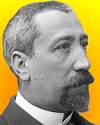
 (source)
|
Anatole France
(16 Apr 1844 - 12 Oct 1924)
French novelist and poet , was the pen-name of Jacques Anatole François Thibault who was awarded the 1921 Nobel Prize in Literature 'in recognition of his brilliant literary achievements, characterized as they are by a nobility of style, a profound human sympathy, grace, and a true Gallic temperament.' His work is remembered for his literary style and his use of wit, irony and skepticism.
|
Science Quotes by Anatole France (11 quotes)
Ce qui est admirable, ce n'est pas que le champ des étoiles soit si vaste, c'est que l'homme l'ait mesuré.
The wonder is, not that the field of the stars is so vast, but that man has measured it.
The wonder is, not that the field of the stars is so vast, but that man has measured it.
— Anatole France
The Garden of Epicurus (1894) translated by Alfred Allinson, in The Works of Anatole France in an English Translation (1920), 16.
Doutons même du doute.
Even doubt the doubt.
Even doubt the doubt.
— Anatole France
'Discours d’A. France à la Société des Etudes Rabelaisiennes 21 mars 1912' as cited in Edith Tendron, Anatole France Inconnu (1995), 26 & footnote 222.
Je suis médecin. Je tiens boutique de mensonges. Je soulage, je console. Peut-on consoler et soulager sans mentir? … Les femmes et les médecins savent seuls combien le mensonge est nécessaire et bienfaisant aux hommes.
I am a physician. I keep a drug-shop of lies. I give relief, consolation. Can one console and relieve without lying? … Only women and doctors know how necessary and how helpful lies are to men.
I am a physician. I keep a drug-shop of lies. I give relief, consolation. Can one console and relieve without lying? … Only women and doctors know how necessary and how helpful lies are to men.
— Anatole France
From the fictional Dr. Trublet in Histoire Comique (1900), 171-172. As translated in Lewis P. Shanks, Anatole France (1919), 165.
L’art d’enseigner n’est que l’art d’éveiller la curiosité des jeunes âmes pour la satisfaire ensuite.
The whole art of teaching is only the art of awakening the natural curiosity of young minds for the purpose of satisfying it afterwards.
The whole art of teaching is only the art of awakening the natural curiosity of young minds for the purpose of satisfying it afterwards.
— Anatole France
The Crime of Sylvestre Bonnard (1894) translated by Lafcadio Hearn, in The Works of Anatole France in an English Translation (1920), 198.
Les hommes ne sont pas faits pour savoir; les hommes ne sont pas faits pour comprendre … et nos illusions croissent avec nos connaissances.
Men are not created to know, men are not created to understand … and our illusions increase with our knowledge.
Men are not created to know, men are not created to understand … and our illusions increase with our knowledge.
— Anatole France
From the fictional Dr. Trublet in Histoire Comique (1900), 212. As translated in Lewis P. Shanks, Anatole France (1919), 165. Shanks comments that Anatole France was writing, not as “an idealist of science, but as a skeptic content to accept truths merely pragmatic. … Trublet has lost faith in absolute truth.”
Pour accomplir de grandes choses il ne suffit pas d'agir il faut rêver; il ne suffit pas de calculer, il faut croire.
To accomplish great things, we must not only act but also dream, not only plan but also believe.
[Referring to the Suez Canal, initiated by Ferdinand de Lesseps.]
To accomplish great things, we must not only act but also dream, not only plan but also believe.
[Referring to the Suez Canal, initiated by Ferdinand de Lesseps.]
— Anatole France
Speech (24 Dec 1896) upon election to the French Academy, in the vacant place of the late Ferdinand de Lesseps, Discours de Réception de M. Anatole France: Séance de l'Académie Française du 24 Décembre 1896 (1897), 21.
Chance may be the pseudonym God uses when He doesn't want to sign His name.
— Anatole France
As quoted, without citation, by Marcus Bach, 'Serendiptiy in the Business World', in The Rotarian (Oct 1981), 139, No. 4, 40. If you know the primary source, please contact Webmaster.
Distrust even Mathematics; albeit so sublime and highly perfected, we have here a machine of such delicacy it can only work in vacuo, and one grain of sand in the wheels is enough to put everything out of gear. One shudders to think to what disaster such a grain of sand may bring a Mathematical brain. Remember Pascal.
— Anatole France
The Garden of Epicurus (1894) translated by Alfred Allinson, in The Works of Anatole France in an English Translation (1920), 187.
The man of science multiples the points of contact between man and nature.
— Anatole France
The Garden of Epicurus (1894) translated by Alfred Allinson, in The Works of Anatole France in an English Translation (1920), 49.
The sciences are beneficent. They prevent men from thinking.
— Anatole France
Quoted in The Ironic Temper: Anatole France and His Time (1932), 31.
We find it hard to picture to ourselves the state of mind of a man of older days who firmly believed that the Earth was the centre of the Universe, and that all the heavenly bodies revolved around it. He could feel beneath his feet the writhings of the damned amid the flames; very likely he had seen with his own eyes and smelt with his own nostrils the sulphurous fumes of Hell escaping from some fissure in the rocks. Looking upwards, he beheld ... the incorruptible firmament, wherein the stars hung like so many lamps.
— Anatole France
The Garden of Epicurus (1894) translated by Alfred Allinson, in The Works of Anatole France in an English Translation (1920), 11.
Quotes by others about Anatole France (1)
Neither the absolute nor the relative size of the brain can be used to measure the degree of mental ability in animal or in man. So far as man is concerned, the weights of the brains or the volumes of the cranial cavities of a hundred celebrities of all branches of knowledge all over the world have been listed. … At the bottom of those lists are Gall, the famous phrenologist, Anatole France, the French novelist, and Gambetta, the French statesman, each with about 1,100 cc brain mass. The lists are topped by Dean Jonathan Swift, the English writer, Lord Byron, the English poet, and Turgenev, the Russian novelist, all with about 2,000 cc … Now our mental test! Had Turgenev really twice the mental ability of Anatole France?
In 'The Human Brain in the Light of Its Phylogenetic Development', Scientific Monthly (Aug 1948), 67, No. 2, 104-105. Collected in Sherwood Larned Washburn and Davida Wolffson (eds.), The Shorter Anthropological Papers of Franz Weidenreich Published in the Period 1939-1948: A Memorial Volume (1949), 18.
 In science it often happens that scientists say, 'You know that's a really good argument; my position is mistaken,' and then they would actually change their minds and you never hear that old view from them again. They really do it. It doesn't happen as often as it should, because scientists are human and change is sometimes painful. But it happens every day. I cannot recall the last time something like that happened in politics or religion.
(1987) --
In science it often happens that scientists say, 'You know that's a really good argument; my position is mistaken,' and then they would actually change their minds and you never hear that old view from them again. They really do it. It doesn't happen as often as it should, because scientists are human and change is sometimes painful. But it happens every day. I cannot recall the last time something like that happened in politics or religion.
(1987) -- 




