 (source)
|
Sir Ronald Aylmer Fisher
(17 Feb 1890 - 29 Jul 1962)
British statistician, geneticist and evolutionary biologist who contributed to mathematical statistics, but also initiated biometric genetics and investigated dominance, backed up with practical breeding experiments. He published his fundamental theorem of natural selection in 1918.
|
Science Quotes by Sir Ronald Aylmer Fisher (18 quotes)
Experimental observations are only experience carefully planned in advance, and designed to form a secure basis of new knowledge.
— Sir Ronald Aylmer Fisher
In The Design of Experiments (1935, 1970), 7.
If one in twenty does not seem high enough odds, we may, if we prefer it, draw the line at one in fifty (the 2 per cent. point), or one in a hundred (the 1 per cent. point). Personally, the writer prefers to set a low standard of significance at the 5 per cent. point, and ignore entirely all results which fail to reach this level. A scientific fact should be regarded as experimentally established only if a properly designed experiment rarely fails to give this level of significance.
— Sir Ronald Aylmer Fisher
'The Arrangement of Field Experiments', The Journal of the Ministry of Agriculture, 1926, 33, 504.
![Ronald Aylmer Fisher quote Inductive inference … [for] new knowledge.](https://todayinsci.com/F/Fisher_Ronald/FisherRonald-Inference500x250px.jpg "Click here for larger picture")
Inductive inference is the only process known to us by which essentially new knowledge comes into the world.
— Sir Ronald Aylmer Fisher
In The Design of Experiments (1935, 1971), 7.
It is easy without any very profound logical analysis to perceive the difference between a succession of favorable deviations from the laws of chance, and on the other hand, the continuous and cumulative action of these laws. It is on the latter that the principle of Natural Selection relies.
— Sir Ronald Aylmer Fisher
In The Genetical Theory of Natural Selection (1930), 37. Reprinted as A Complete Variorum Edition (2003), 37.
It was Darwin’s chief contribution, not only to Biology but to the whole of natural science, to have brought to light a process by which contingencies a priori improbable are given, in the process of time, an increasing probability, until it is their non-occurrence, rather than their occurrence, which becomes highly improbable.
— Sir Ronald Aylmer Fisher
From essay 'Retrospect of the Criticisms of the Theory of Natural Selection', reproduced in Julian Huxley, A.C. Hardy, and E.B. Ford (eds.), Evolution as a Process (1954), 91, as cited in Elizabeth Knowles, What They Didn't Say: A Book of Misquotations (2006), 79-80. “Natural selection is a mechanism for generating an exceedingly high degree of improbability,” which is seen more often, is a summary form of Fisher’s idea (not a verbatim quote) written by Julian Huxley, ibid, 5.
It will be noticed that the fundamental theorem proved above bears some remarkable resemblances to the second law of thermodynamics. Both are properties of populations, or aggregates, true irrespective of the nature of the units which compose them; both are statistical laws; each requires the constant increase of a measurable quantity, in the one case the entropy of a physical system and in the other the fitness, measured by m, of a biological population. As in the physical world we can conceive the theoretical systems in which dissipative forces are wholly absent, and in which the entropy consequently remains constant, so we can conceive, though we need not expect to find, biological populations in which the genetic variance is absolutely zero, and in which fitness does not increase. Professor Eddington has recently remarked that “The law that entropy always increases—the second law of thermodynamics—holds, I think, the supreme position among the laws of nature.” It is not a little instructive that so similar a law should hold the supreme position among the biological sciences. While it is possible that both may ultimately be absorbed by some more general principle, for the present we should note that the laws as they stand present profound differences—-(1) The systems considered in thermodynamics are permanent; species on the contrary are liable to extinction, although biological improvement must be expected to occur up to the end of their existence. (2) Fitness, although measured by a uniform method, is qualitatively different for every different organism, whereas entropy, like temperature, is taken to have the same meaning for all physical systems. (3) Fitness may be increased or decreased by changes in the environment, without reacting quantitatively upon that environment. (4) Entropy changes are exceptional in the physical world in being irreversible, while irreversible evolutionary changes form no exception among biological phenomena. Finally, (5) entropy changes lead to a progressive disorganization of the physical world, at least from the human standpoint of the utilization of energy, while evolutionary changes are generally recognized as producing progressively higher organization in the organic world.
— Sir Ronald Aylmer Fisher
The Genetical Theory of Natural Selection (1930), 36.

Natural selection is a mechanism for generating an exceedingly high degree of improbability.
— Sir Ronald Aylmer Fisher
This is not a verbatim quote, but it is a summary of Fisher’s idea, as appearing without quotation marks in the words of the editor, Julian Huxley, in J.S. Huxley, A.C. Hardy and E.B. Ford (eds.), Evolution as a Process (1954), 5. The lengthier quote is from Fisher’s full essay 'Retrospect of the Criticisms of the Theory of Natural Selection' which appears in the same book on p.91. See it elsewhere in this site’s collection, as the Fisher quote that begins: “It was Darwin’s chief contribution…”.
No aphorism is more frequently repeated in connection with field trials, than that we must ask Nature few questions, or, ideally, one question, at a time. The writer is convinced that this view is wholly mistaken. Nature, he suggests, will best respond to a logical and carefully thought out questionnaire; indeed, if we ask her a single question, she will often refuse to answer until some other topic has been discussed.
— Sir Ronald Aylmer Fisher
'The Arrangement of Field Experiments', The Journal of the Ministry of Agriculture, 1926, 33, 511.
No isolated experiment, however significant in itself, can suffice for the experimental demonstration of any natural phenomenon; for the “one chance in a million” will undoubtedly occur, with no less and no more than its appropriate frequency, however surprised we may be that it should occur to us.
— Sir Ronald Aylmer Fisher
The Design of Experiments (1935, 1971), 13-14.
The analysis of variance is not a mathematical theorem, but rather a convenient method of arranging the arithmetic.
— Sir Ronald Aylmer Fisher
Remarking on the paper, ‘Statistics in Agricultural Research’ by J. Wishart, Journal of the Royal Statistical Society, Supplement (1934), 1, 52. As cited in Michael Cowle, Statistics in Psychology: An Historical Perspective (2005), 210.
The best causes tend to attract to their support the worst arguments, which seems to be equally true in the intellectual and in the moral sense.
— Sir Ronald Aylmer Fisher
Statistical Methods and Scientific Inference (1956), 31.
The function of mutation is to maintain the stock of genetic variance at a high level.
— Sir Ronald Aylmer Fisher
(1930).
The neutral zone of selective advantage in the neighbourhood of zero is thus so narrow that changes in the environment, and in the genetic constitution of species, must cause this zone to be crossed and perhaps recrossed relatively rapidly in the course of evolutionary change, so that many possible gene substitutions may have a fluctuating history of advance and regression before the final balance of selective advantage is determined.
— Sir Ronald Aylmer Fisher
'The Distribution of Gene Ratios for Rare Mutations', Proceedings of the Royal Society of Edinburgh, 1930, 50, 219.
The statistician cannot excuse himself from the duty of getting his head clear on the principles of scientific inference, but equally no other thinking man can avoid a like obligation.
— Sir Ronald Aylmer Fisher
The Design of Experiments (1935), 2.
To call in the statistician after the experiment is done may be no more than asking him to perform a postmortem examination: he may be able to say what the experiment died of.
— Sir Ronald Aylmer Fisher
Presidential address to the first Indian Statistical Congress, Sankhya, (ca. 1938), 14-.
We have usually no knowledge that any one factor will exert its effects independently of all others that can be varied, or that its effects are particularly simply related to variations in these other factors.
— Sir Ronald Aylmer Fisher
The Design of Experiments (6th Ed., 1951), 92.
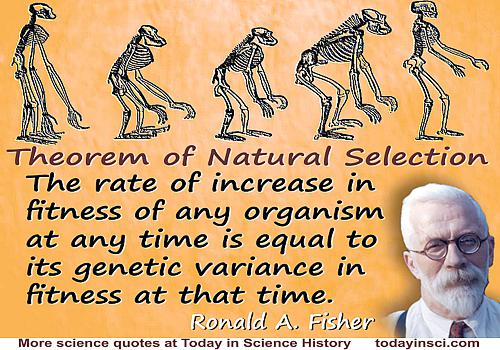
We may consequently state the fundamental theorem of Natural Selection in the form: The rate of increase in fitness of any organism at any time is equal to its genetic variance in fitness at that time.
— Sir Ronald Aylmer Fisher
The Genetical Theory of Natural Selection (1930), 35.
When there are two independent causes of variability capable of producing in an otherwise uniform population distributions with standard deviations s1 and s2, it is found that the distribution, when both causes act together, has a standard deviation vs12 + s22. It is therefore desirable in analysing the causes of variability to deal with the square of the standard deviation as the measure of variability. We shall term this quantity the Variance of the normal population to which it refers, and we may now ascribe to the constituent causes fractions or percentages of the total variance which they together produce.
— Sir Ronald Aylmer Fisher
'The Correlation between Relatives on the Supposition of Mendelian Inheritance,' Transactions of the Royal Society of Edinburgh, 1918, 52, 399.
![Ronald Aylmer Fisher quote Inductive inference … [for] new knowledge.](https://todayinsci.com/F/Fisher_Ronald/FisherRonald-InferenceThm.jpg)
See also:
- 17 Feb - short biography, births, deaths and events on date of Fisher's birth.
- Ronald Aylmer Fisher - context of quote “Natural selection is a mechanism for…improbability.” - Medium image (500 x 250 px)
- Ronald Aylmer Fisher - context of quote “Natural selection is a mechanism for…improbability.” - Large image (800 x 400 px)
- Ronald Aylmer Fisher - context of quote “Inductive inference … [for] new knowledge.” - Medium image (500 x 250 px)
- Ronald Aylmer Fisher - context of quote “Inductive inference … [for] new knowledge.” - Large image (800 x 400 px)
- Ronald Aylmer Fisher - context of quote “No isolated experiment can suffice” - Medium image (500 x 250 px)
- Ronald Aylmer Fisher - context of quote “No isolated experiment can suffice” - Large image (800 x 400 px)
- Ronald Aylmer Fisher - context of quote “Fundamental Theorem of Natural Selection” - Medium image (500 x 350 px)
- Ronald Aylmer Fisher - context of quote “Fundamental Theorem of Natural Selection” - Large image (800 x 600 px)
- Statistical Methods, Experimental Design, and Scientific Inference, by Ronald A. Fisher. - book suggestion.
 In science it often happens that scientists say, 'You know that's a really good argument; my position is mistaken,' and then they would actually change their minds and you never hear that old view from them again. They really do it. It doesn't happen as often as it should, because scientists are human and change is sometimes painful. But it happens every day. I cannot recall the last time something like that happened in politics or religion.
(1987) --
In science it often happens that scientists say, 'You know that's a really good argument; my position is mistaken,' and then they would actually change their minds and you never hear that old view from them again. They really do it. It doesn't happen as often as it should, because scientists are human and change is sometimes painful. But it happens every day. I cannot recall the last time something like that happened in politics or religion.
(1987) -- 





