 (source)
|
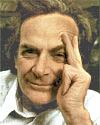
Richard P. Feynman
(11 May 1918 - 15 Feb 1988)
American theoretical physicist who was probably the most brilliant, influential, and iconoclastic figure in his field. His lifelong interest was in subatomic physics. In 1965, he shared the Nobel Prize in Physics for his work in quantum electrodynamics.
|
Science Quotes by Richard P. Feynman (116 quotes)
>> Click for Richard P. Feynman Quotes on | Atom | Discovery | Imagination | Knowledge | Law | Mystery | Nature | Physics | Problem | Science | Theory | Thinking | Universe |
>> Click for Richard P. Feynman Quotes on | Atom | Discovery | Imagination | Knowledge | Law | Mystery | Nature | Physics | Problem | Science | Theory | Thinking | Universe |
“Conservation” (the conservation law) means this … that there is a number, which you can calculate, at one moment—and as nature undergoes its multitude of changes, this number doesn't change. That is, if you calculate again, this quantity, it'll be the same as it was before. An example is the conservation of energy: there's a quantity that you can calculate according to a certain rule, and it comes out the same answer after, no matter what happens, happens.
— Richard P. Feynman
'The Great Conservation Principles', The Messenger Series of Lectures, No. 3, Cornell University, 1964. From transcript of BBC programme (11 Dec 1964).
[As a youth, fiddling in my home laboratory] I discovered a formula for the frequency of a resonant circuit which was 2π x sqrt(LC) where L is the inductance and C the capacitance of the circuit. And there was π, and where was the circle? … I still don’t quite know where that circle is, where that π comes from.
— Richard P. Feynman
From address to the National Science Teachers’ Association convention (Apr 1966), 'What Is Science?', collected in Richard Phillips Feynman and Jeffrey Robbins (ed.), The Pleasure of Finding Things Out: The Best Short Works of Richard P. Feynman (1999, 2005), 177.
[In my early youth, walking with my father,] “See that bird?” he says. “It’s a Spencer’s warbler.” (I knew he didn’t know the real name.) “Well, in Italian, it’s a Chutto Lapittida. In Portuguese, it’s a Bom da Peida. In Chinese, it’s a Chung-long-tah, and in Japanese, it’s a Katano Tekeda. You can know the name of that bird in all the languages of the world, but when you’re finished, you’ll know absolutely nothing whatever about the bird. You’ll only know about humans in different places, and what they call the bird. So let’s look at the bird and see what it’s doing—that’s what counts.” (I learned very early the difference between knowing the name of something and knowing something.)
— Richard P. Feynman
In 'The Making of a Scientist', What Do You Care What Other People Think?": Further Adventures of a Curious Character (2001), 13-14.
[Quantum mechanics is] a phenomenon which is impossible, absolutely impossible, to explain in any classical way.
— Richard P. Feynman
…...
[To a man expecting a scientific proof of the impossibility of flying saucers] I might have said to him: “Listen, I mean that from my knowledge of the world that I see around me, I think that it is much more likely that the reports of flying saucers are the results of the known irrational characteristics of terrestrial intelligence than of the unknown rational efforts of extra-terrestrial intelligence.” It is just more likely, that is all. It is a good guess. And we always try to guess the most likely explanation, keeping in the back of the mind the fact that if it does not work we must discuss the other possibilities.
— Richard P. Feynman
In The Character of Physical Law (1965, 2001), 166.
~~[Need source]~~ All theoretical chemistry is really physics; and all theoretical chemists know it.
— Richard P. Feynman
Webmaster, so far, has been unable to find a primary source that adds the ending clause. (Can you help?) But Feynman certainly several times stated the idea in the opening clause. See, for example, the quote, “The theory of quantum mechanics … supplied the theory behind chemistry. So, fundamental theoretical chemistry is really physics.” on the Richard Feynman Quotes page on this website.
A good theoretical physicist today might find it useful to have a wide range of physical viewpoints and mathematical expressions of the same theory (for example, of quantum electrodynamics) available to him. This may be asking too much of one man. Then new students should as a class have this. If every individual student follows the same current fashion in expressing and thinking about electrodynamics or field theory, then the variety of hypotheses being generated to understand strong interactions, say, is limited. Perhaps rightly so, for possibly the chance is high that the truth lies in the fashionable direction. But, on the off-chance that it is in another direction—a direction obvious from an unfashionable view of field theory—who will find it?
— Richard P. Feynman
In his Nobel Prize Lecture (11 Dec 1965), 'The Development of the Space-Time View of Quantum Electrodynamics'. Collected in Stig Lundqvist, Nobel Lectures: Physics, 1963-1970 (1998), 177.
A philosopher once said, “It is necessary for the very existence of science that the same conditions always produce the same results”. Well, they do not.
— Richard P. Feynman
In Character of Physical Law (1965), 147.
All things are made of atoms—little particles that move around in perpetual motion, attracting each other when they are a little distance apart, but repelling upon being squeezed into one another. In that one sentence ... there is an enormous amount of information about the world.
His suggestion that the most valuable information on scientific knowledge in a single sentence using the fewest words is to state the atomic hypothesis.
His suggestion that the most valuable information on scientific knowledge in a single sentence using the fewest words is to state the atomic hypothesis.
— Richard P. Feynman
Six Easy Pieces (1995), 4.
As usual, nature’s imagination far surpasses our own, as we have seen from the other theories which are subtle and deep.
— Richard P. Feynman
In The Character of Physical Law (1965, 2001), 162.
Astronomy is older than physics. In fact, it got physics started by showing the beautiful simplicity of the motion of the stars and planets, the understanding of which was the beginning of physics. But the most remarkable discovery in all of astronomy is that the stars are made of atoms of the same kind as those on the earth.
— Richard P. Feynman
In 'Astronomy', The Feynman Lectures on Physics (1961), Vol. 1, 3-6.
Before I was born, my father told my mother, “If it’s a boy, he’s going to be a scientist.”
— Richard P. Feynman
In 'The Making of a Scientist', What Do You Care What Other People Think?": Further Adventures of a Curious Character (2001), 12. The editor of the the book, Ralph Leighton, footnoted that Feynman’s younger sister, Joan, has a Ph.D. in physics, in spite of this preconception that only boys are destined to be scientists.
But I don’t have to know an answer. I don’t feel frightened by not knowing things, by being lost in a mysterious universe without any purpose, which is the way it really is, so far as I can tell. It doesn’t frighten me.
— Richard P. Feynman
In Richard Feynman and Jeffrey Robbins (ed.), The Pleasure of Finding Things Out: The Best Short Works of Richard Feynman (1999), 25, last sentence of Chap. 1. The chapter, with the same title as the book, is an edited transcript of an interview with Feynman made for the BBC television program Horizon (1981).
But the real glory of science is that we can find a way of thinking such that the law is evident.
— Richard P. Feynman
The Feynman Lectures on Physics (1965), Vol. 1, 26-3. In Carver A. Mead, Collective Electrodynamics: Quantum Foundations of Electromagnetism (2002), 1.
Einstein was a giant. His head was in the clouds, but his feet were on the ground. Those of us who are not so tall have to choose!
— Richard P. Feynman
Spoken at a seminar, as quoted by Carver A. Mead, Collective Electrodynamics: Quantum Foundations of Electromagnetism (2002), xix.
Every theoretical physicist who is any good knows six or seven different theoretical representations for exactly the same physics. He knows that they are all equivalent, and that nobody is ever going to be able to decide which one is right at that level, but he keeps them in his head, hoping that they will give him different ideas for guessing.
— Richard P. Feynman
In The Character of Physical Law (1965, 2001), 168.
Everything is made of atoms ... Everything that animals do, atoms do. ... There is nothing that living things do that cannot be understood from the point of view that they are made of atoms acting according to the laws of physics.
— Richard P. Feynman
In The Feynman Lectures (1963), 8.
First you guess. Don’t laugh, this is the most important step. Then you compute the consequences. Compare the consequences to experience. If it disagrees with experience, the guess is wrong. In that simple statement is the key to science. It doesn’t matter how beautiful your guess is or how smart you are or what your name is. If it disagrees with experience, it’s wrong.
— Richard P. Feynman
As condensed in Florentin Smarandache, V. Christianto, Multi-Valued Logic, Neutrosophy, and Schrodinger Equation? (2006), 73 & 160 (footnote), paraphrasing from Lecture No. 7, 'Seeking New Laws', Messenger Lectures, Cornell (1964). The original verbatim quote, taken from the transcript is elsewhere on the Richard Feynman Quotations webpage, beginning: “In general, we look for a new law…”.
First, [Newton’s Law of Universal Gravitation] is mathematical in its expression…. Second, it is not exact; Einstein had to modify it…. There is always an edge of mystery, always a place where we have some fiddling around to do yet…. But the most impressive fact is that gravity is simple…. It is simple, and therefore it is beautiful…. Finally, comes the universality of the gravitational law and the fact that it extends over such enormous distances…
— Richard P. Feynman
In The Character of Physical Law (1965, 2001), 33.
For a successful technology, reality must take precedence over public relations, for nature cannot be fooled.
— Richard P. Feynman
Upon identifying the reason for the explosion of the space shuttle Challenger with his demonstration showing that O-rings grow brittle when cold by immersing a sample in iced water. Concluding remark in Feynman's Appendix to the Rogers Commission Report on the Space Shuttle Challenger Accident. In (Jan 1987). In James B. Simpson, Simpson’s Contemporary Quotations (1988).
For those who want some proof that physicists are human, the proof is in the idiocy of all the different units which they use for measuring energy.
— Richard P. Feynman
In The Character of Physical Law (1967, 2001), 75.
From a long view of the history of mankind—seen from, say, ten thousand years from now—there can be little doubt that the most significant event of the 19th century will be judged as Maxwell’s discovery of the laws of electrodynamics. The American Civil War will pale into provincial insignificance in comparison with this important scientific event of the same decade.
— Richard P. Feynman
In The Feynman Lectures on Physics (1964), Vol. 2, page 1-11.
God was always invented to explain mystery. God is always invented to explain those things that you do not understand. Now, when you finally discover how something works … you don't need him anymore. But … you leave him to create the universe because we haven't figured that out yet.
— Richard P. Feynman
Interview, collected in Paul C. W. Davies and Julian R. Brown (eds.) Superstrings: A Theory of Everything? (1988), 208-209.
Happy Birthday Mrs Chown! Tell your son to stop trying to fill your head with science—for to fill your heart with love is enough. Richard P. Feynman (the man you watched on BBC Horizon).
— Richard P. Feynman
Note to the mother of Marcus Chown. Reproduced in Christopher Simon Sykes, No Ordinary Genius: The Illustrated Richard Feynman (1996), 161. Chown's mother, though usually disinterested in science, had given close attention to a 1981 BBC Horizon science documentary that profiled Feynman. This was Feynman’s own choice of a birthday message, although Chown (then a physics graduate student at Caltech) had anticipated that the scientist would have helped him interest his mother in scientific things. Marcus Chown was a radio astronomer at Caltech and is now a writer and broadcaster.
Hell, if I could explain it to the average person, it wouldn't have been worth the Nobel prize.
— Richard P. Feynman
After being awarded a Nobel Prize, he was frequently asked to explain what he had done, and would would give this answer. As stated in Lee Dye, 'Nobel Physicist R.P. Feynman of Caltech Dies', Los Angeles Times (16 Feb 1988). About this answer, the articles also states that, “Feynman once said, claiming he was told that by a New York cab driver.”
I believe that a scientist looking at nonscientific problems is just as dumb as the next guy—and when he talks about a nonscientific matter, he will sound as naive as anyone untrained in the matter.
— Richard P. Feynman
In 'The Value of Science' (Dec 1955), collected in The Pleasure of Finding Things Out: The Best Short Works of Richard P. Feynman (1999, 2005), 142.
I can live with doubt and uncertainty. I think it’s much more interesting to live not knowing than to have answers which might be wrong.
— Richard P. Feynman
From transcript of a BBC television program, 'The Pleasure of Finding Things Out' (1981). In Richard Phillips Feynman and Jeffrey Robbins (ed.), The Pleasure of Finding Things Out: the Best Short Works of Richard P. Feynman (2000), 24.
I have approximate answers and possible beliefs in different degrees of certainty about different things, but I am not absolutely sure of anything, and of many things I don’t know anything about but I don’t have to know an answer.
— Richard P. Feynman
Interview, in BBC TV program, 'The Pleasure of Finding Things Out', Horizon (23 Nov 1981). As quoted in Caroline Baillie, Alice Pawley, Donna M. Riley, Engineering and Social Justice: In the University and Beyond (2012), 108.
I learned a lot of different things from different schools. MIT is a very good place…. It has developed for itself a spirit, so that every member of the whole place thinks that it’s the most wonderful place in the world—it’s the center, somehow, of scientific and technological development in the United States, if not the world … and while you don’t get a good sense of proportion there, you do get an excellent sense of being with it and in it, and having motivation and desire to keep on…
— Richard P. Feynman
From Surely You’re Joking, Mr. Feynman!: Adventures of a Curious Character (1985), 51.
I often use the analogy of a chess game: one can learn all the rules of chess, but one doesn’t know how to play well…. The present situation in physics is as if we know chess, but we don’t know one or two rules. But in this part of the board where things are in operation, those one or two rules are not operating much and we can get along pretty well without understanding those rules. That’s the way it is, I would say, regarding the phenomena of life, consciousness and so forth.
— Richard P. Feynman
In Superstrings: A Theory of Everything? by P. C. W. Davies and Julian Brown (1988).
I think all this superstring stuff is crazy and is in the wrong direction. I don’t like that they’re not calculating anything. I don’t like that they don’t check their ideas. I don’t like that for anything that disagrees with an experiment, they cook up an explanation… It doesn’t look right.
— Richard P. Feynman
Interview published in Paul C.W. Davies and Julian R. Brown (eds.),Superstrings: A Theory of Everything? (1988, 1992), 194.
I think equation guessing might be the best method to proceed to obtain the laws for the part of physics which is presently unknown.
— Richard P. Feynman
In his Nobel Prize Lecture (11 Dec 1965), 'The Development of the Space-Time View of Quantum Electrodynamics'. Collected in Stig Lundqvist, Nobel Lectures: Physics, 1963-1970 (1998), 177.
I think I can safely say that nobody understands quantum mechanics.
— Richard P. Feynman
'Probability and Uncertainty—the Quantum Mechanical View of Nature', the sixth of his Messenger Lectures (1964), Cornell University. Collected in The Character of Physical Law (1967), 129. Often misquoted in various ways, for example, “If people say they understand quantum mechanics they’re lying,” in Ari Ben-Menahem, Historical Encyclopedia of Natural and Mathematical Sciences (2009), 5699.
I was born not knowing and have only had a little time to change that here and there.
— Richard P. Feynman
…...
I was inspired by the remarks in those books; not by the parts in which everything was proved and demonstrated [but by] the remarks about the fact that this doesn’t make any sense. … So I had this as a challenge and an inspiration.
— Richard P. Feynman
In his Nobel Prize Lecture (11 Dec 1965), 'The Development of the Space-Time View of Quantum Electrodynamics'. Collected in Stig Lundqvist, Nobel Lectures: Physics, 1963-1970 (1998), 156.
I would like to be rather more special, and I would like to be understood in an honest way rather than in a vague way.
— Richard P. Feynman
In The Character of Physical Law (1965, 2001), 13.
If I say [electrons] behave like particles I give the wrong impression; also if I say they behave like waves. They behave in their own inimitable way, which technically could be called a quantum mechanical way. They behave in a way that is like nothing that you have seen before.
— Richard P. Feynman
'Probability abd Uncertainty—the Quantum Mechanical View of Nature', the sixth of his Messenger Lectures (1964), Cornell University. Collected in The Character of Physical Law (1967), 128.
If it [a hypothesis] disagrees with experiment, it’s wrong. In that simple statement, is the key to science: it doesn’t make any difference how beautiful your guess is; it doesn’t make any difference how smart you are, who made the guess, or what his name is—if it disagrees with experiment, it’s wrong; that’s all there is to it.
— Richard P. Feynman
Verbatim from Lecture No. 7, 'Seeking New Laws', Messenger Lectures, Cornell, (1964) in video and transcript online at caltech.edu website. Also in Christopher Sykes, No Ordinary Genius: The Illustrated Richard Feynman (1994), 143. This quote continues one elsewhere on the Richard Feynman Quotations webpage, which begins: “In general, we look for a new law by…”.
If science is to progress, what we need is the ability to experiment, honesty in reporting results—the results must be reported without somebody saying what they would like the results to have been—and finally—an important thing—the intelligence to interpret the results.
— Richard P. Feynman
In The Character of Physical Law (1965, 2001), 148.
If there is something very slightly wrong in our definition of the theories, then the full mathematical rigor may convert these errors into ridiculous conclusions.
— Richard P. Feynman
Feynman Lectures on Gravitation, edited by Brian Hatfield (2002), 21.
If we go back to our chequer game, the fundamental laws are rules by which the chequers move. Mathematics may be applied in the complex situation to figure out what in given circumstances is a good move to make. But very little mathematics is needed for the simple fundamental character of the basic laws. They can be simply stated in English for chequers.
— Richard P. Feynman
In The Character of Physical Law (1965), 36.
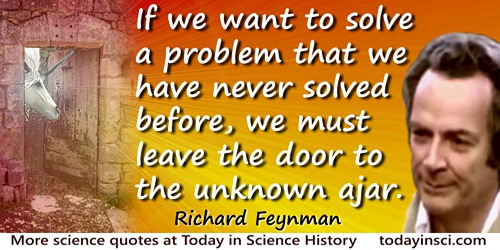
If we want to solve a problem that we have never solved before, we must leave the door to the unknown ajar.
— Richard P. Feynman
In 'The Value of Science,' What Do You Care What Other People Think? (1988, 2001), 247. Collected in The Pleasure of Finding Things Out (2000), 149.
If you thought that science was certain well, that is just an error on your part.
— Richard P. Feynman
…...
Imagine that … the world is something like a great chess game being played by the gods, and we are observers of the game. … If we watch long enough, we may eventually catch on to a few of the rules…. However, we might not be able to understand why a particular move is made in the game, merely because it is too complicated and our minds are limited…. We must limit ourselves to the more basic question of the rules of the game.
If we know the rules, we consider that we “understand” the world.
If we know the rules, we consider that we “understand” the world.
— Richard P. Feynman
In 'Basic Physics', The Feynman Lectures on Physics (1964, 2013), Vol. 1, 2-1.
In general, we look for a new law by the following process. First, we guess it. Then we—don’t laugh, that’s really true. Then we compute the consequences of the guess to see if this is right—if this law that we guessed is right—we see what it would imply. And then we compare those computation results to nature—or, we say compare to experiment or experience—compare it directly with observation to see if it works. If it disagrees with experiment, it’s wrong.
— Richard P. Feynman
Verbatim from Lecture No. 7, 'Seeking New Laws', Messenger Lectures, Cornell, (1964) in video and transcript online at caltech.edu website. Also, lightly paraphrased, in Christopher Sykes, No Ordinary Genius: The Illustrated Richard Feynman (1994), 143. There is another paraphrase elsewhere on the Richard Feynman Quotations webpage, beginning: “First you guess…”. Also see the continuation of this quote, verbatim, beginning: “If it disagrees with experiment…”.
In its efforts to learn as much as possible about nature, modern physics has found that certain things can never be “known” with certainty. Much of our knowledge must always remain uncertain. The most we can know is in terms of probabilities.
— Richard P. Feynman
In The Feynman Lectures on Physics (1963), Vol. 1.
In this age of specialization men who thoroughly know one field are often incompetent to discuss another. … The old problems, such as the relation of science and religion, are still with us, and I believe present as difficult dilemmas as ever, but they are not often publicly discussed because of the limitations of specialization.
— Richard P. Feynman
Opening statement, in transcript of talk to the Caltech Lunch Forum (2 May 1956), 'The Relation of Science and Religion', collected in Richard Phillips Feynman and Jeffrey Robbins (ed.), The Pleasure of Finding Things Out: The Best Short Works of Richard P. Feynman (1999, 2005), 245-246.
In this lecture I would like to conclude with … some characteristics [of] gravity … The most impressive fact is that gravity is simple. It is simple to state the principles completely and not have left any vagueness for anybody to change the ideas of the law. It is simple, and therefore it is beautiful. It is simple in its pattern. I do not mean it is simple in its action—the motions of the various planets and the perturbations of one on the other can be quite complicated to work out, and to follow how all those stars in a globular cluster move is quite beyond our ability. It is complicated in its actions, but the basic pattern or the system beneath the whole thing is simple. This is common to all our laws; they all turn out to be simple things, although complex in their actual actions.
— Richard P. Feynman
In 'The Law of Gravitation, as Example of Physical Law', the first of his Messenger Lectures (1964), Cornell University. Collected in The Character of Physical Law (1967), 33-34.
Is no one inspired by our present picture of the universe? This value of science remains unsung by singers: you are reduced to hearing not a song or poem, but an evening lecture about it. This is not yet a scientific age.
Perhaps one of the reasons for this silence is that you have to know how to read music. For instance, the scientific article may say, “The radioactive phosphorus content of the cerebrum of the rat decreases to one-half in a period of two weeks.” Now what does that mean?
It means that phosphorus that is in the brain of a rat—and also in mine, and yours—is not the same phosphorus as it was two weeks ago. It means the atoms that are in the brain are being replaced: the ones that were there before have gone away.
So what is this mind of ours: what are these atoms with consciousness? Last week’s potatoes! They now can remember what was going on in my mind a year ago—a mind which has long ago been replaced. To note that the thing I call my individuality is only a pattern or dance, that is what it means when one discovers how long it takes for the atoms of the brain to be replaced by other atoms. The atoms come into my brain, dance a dance, and then go out—there are always new atoms, but always doing the same dance, remembering what the dance was yesterday.
Perhaps one of the reasons for this silence is that you have to know how to read music. For instance, the scientific article may say, “The radioactive phosphorus content of the cerebrum of the rat decreases to one-half in a period of two weeks.” Now what does that mean?
It means that phosphorus that is in the brain of a rat—and also in mine, and yours—is not the same phosphorus as it was two weeks ago. It means the atoms that are in the brain are being replaced: the ones that were there before have gone away.
So what is this mind of ours: what are these atoms with consciousness? Last week’s potatoes! They now can remember what was going on in my mind a year ago—a mind which has long ago been replaced. To note that the thing I call my individuality is only a pattern or dance, that is what it means when one discovers how long it takes for the atoms of the brain to be replaced by other atoms. The atoms come into my brain, dance a dance, and then go out—there are always new atoms, but always doing the same dance, remembering what the dance was yesterday.
— Richard P. Feynman
'What do You Care What Other People Think?' Further Adventures of a Curious Character (1988), 244.
It always bothers me that according to the laws as we understand them today, it takes a computing machine an infinite number of logical operations to figure out what goes on in no matter how tiny a region of space and no matter how tiny a region of time … I have often made the hypothesis that ultimately physics will not require a mathematical statement, that in the end the machinery will be revealed and the laws will turn out to be simple, like the chequer board with all its apparent complexities. But this speculation is of the same nature as those other people make—“I like it”,“I don't like it”—and it is not good to be too prejudiced about these things.
— Richard P. Feynman
In The Character of Physical Law (1965, 2001), 57.
It doesn't seem to me that this fantastically marvelous universe, this tremendous range of time and space and different kinds of animals, and all the different planets, and all these atoms with all their motions, and so on, all this complicated thing can merely be a stage so that God can watch human beings struggle for good and evil—which is the view that religion has. The stage is too big for the drama.
— Richard P. Feynman
'Viewpoint' Interview (with Bill Stout) for Los Angeles KNXT television station (1 May 1959), printed in Michelle Feynman (ed.) Perfectly Reasonable Deviations (from the Beaten Track) (2006), Appendix I, 426. Also quoted in James Gleick, Genius: The Life and Science of Richard Feynman (1992), 372. Gleick adds that KNXT “felt obliged to suppress” the interview. It was not broadcast until after Feynman, asked to redo the interview, wrote back with a letter objecting to “a direct censorship of the expression of my views.”
It doesn’t matter how beautiful your theory is, it doesn’t matter how smart you are. If it doesn’t agree with experiment, it’s wrong.
— Richard P. Feynman
…...
It is exciting to think that it costs nothing to create a new particle,…
— Richard P. Feynman
In Lectures on Gravitation: 1962-62, quoted by John Preskill and Kip S. Thorne, 'Foreword to Feynman Lectures on Gravitation' (15 May 1995). The authors of the Foreword explain: “Because the total energy of the universe could really be zero, … matter creation is possible because the rest energy of the matter is actually canceled by its gravitational potential energy.”
It is going to be necessary that everything that happens in a finite volume of space and time would have to be analyzable with a finite number of logical operations. The present theory of physics is not that way, apparently. It allows space to go down into infinitesimal distances, wavelengths to get infinitely great, terms to be summed in infinite order, and so forth; and therefore, if this proposition [that physics is computer-simulatable] is right, physical law is wrong.
— Richard P. Feynman
International Journal of Theoretical Physics (1982), 21 Nos. 6-7, 468. Quoted in Brian Rotman, Mathematics as Sign (2000), 82.
It is possible in quantum mechanics to sneak quickly across a region which is illegal energetically.
— Richard P. Feynman
In Feynman Lectures on Physics, Vol. 3, 8-12.
It is the facts that matter, not the proofs. Physics can progress without the proofs, but we can’t go on without the facts … if the facts are right, then the proofs are a matter of playing around with the algebra correctly.
— Richard P. Feynman
Feynman Lectures on Gravitation, edited by Brian Hatfield (2002), 137.
Mathematicians are only dealing with the structure of reasoning, and they do not really care what they are talking about. They do not even need to know what they are talking about … But the physicist has meaning to all his phrases. … In physics, you have to have an understanding of the connection of words with the real world.
— Richard P. Feynman
In The Character of Physical Law (1965), 55.
Nature uses only the longest threads to weave her patterns, so that each small piece of her fabric reveals the organization of the entire tapestry.
— Richard P. Feynman
In The Character of Physical Law (1965, 2001), 34.
On the contrary, God was always invented to explain mystery. God is always invented to explain those things that you do not understand. Now when you finally discover how something works, you get some laws which you're taking away from God; you don't need him anymore. But you need him for the other mysteries. So therefore you leave him to create the universe because we haven't figured that out yet; you need him for understanding those things which you don't believe the laws will explain, such as consciousness, or why you only live to a certain length of time—life and death—stuff like that. God is always associated with those things that you do not understand. Therefore, I don't think that the laws can be considered to be like God because they have been figured out.
— Richard P. Feynman
Quoted in P. C. W. Davies and Julian Brown (eds.), Superstrings: A Theory of Everything? (1988), 208-9.
One of the biggest and most important tools of theoretical physics is the wastebasket.
— Richard P. Feynman
In interview for the American Association for the Advancement of Science (AAAS), 'Richard Feynman Builds a Universe', collected in Jeffrey Robbins (ed.), The Pleasure of Finding Things Out (1999), Chap. 12, 234.
One of the greatest experimental scientists of the time who was really doing something, William Harvey, said that what Bacon said science was, was the science that a lord-chancellor would do. He [Bacon] spoke of making observations, but omitted the vital factor of judgment about what to observe and what to pay attention to.
— Richard P. Feynman
From address (1966) at the 14th Annual Convention of the National Science Teachers Association, New York City, printed in 'What is science?', The Physics Teacher (1969), 7, No. 6, 321.
One of the most impressive discoveries was the origin of the energy of the stars, that makes them continue to burn. One of the men who discovered this was out with his girl friend the night after he realized that nuclear reactions must be going on in the stars in order to make them shine.
She said “Look at how pretty the stars shine!”
He said, “Yes, and right now I am the only man in the world who knows why they shine.”
She merely laughed at him. She was not impressed with being out with the only man who, at that moment, knew why stars shine. Well, it is sad to be alone, but that is the way it is in this world.
She said “Look at how pretty the stars shine!”
He said, “Yes, and right now I am the only man in the world who knows why they shine.”
She merely laughed at him. She was not impressed with being out with the only man who, at that moment, knew why stars shine. Well, it is sad to be alone, but that is the way it is in this world.
— Richard P. Feynman
…...
One of the ways of stopping science would be only to do experiments in the region where you know the law. … In other words we are trying to prove ourselves wrong as quickly as possible, because only in that way can we find progress.
— Richard P. Feynman
In The Character of Physical Law (1965, 2001), 158.
Our imagination is stretched to the utmost, not as in fiction, to imagine things which are not really there, but just to comprehend those things which are there.
— Richard P. Feynman
In The Character of Physical Law (1965, reprint 2001), 127-128.
People say to me, “Are you looking for the ultimate laws of physics?” No, I’m not; I’m just looking to find out more about the world and if it turns out there is a simple ultimate law which explains everything, so be it; that would be very nice to discover. If it turns out it’s like an onion with millions of layers, and we’re just sick and tired of looking at the layers, then that’s the way it is …
— Richard P. Feynman
From Interview in BBC TV program Horizon (1981). As quoted in The Pleasure of Finding Things Out: The Best Short Works of Richard P. Feynman 1983, (1999), 23.
Philosophers have said that if the same circumstances don't always produce the same results, predictions are impossible and science will collapse. Here is a circumstance—identical photons are always coming down in the same direction to the piece of glass—that produces different results. We cannot predict whether a given photon will arrive at A or B. All we can predict is that out of 100 photons that come down, an average of 4 will be reflected by the front surface. Does this mean that physics, a science of great exactitude, has been reduced to calculating only the probability of an event, and not predicting exactly what will happen? Yes. That's a retreat, but that's the way it is: Nature permits us to calculate only probabilities. Yet science has not collapsed.
— Richard P. Feynman
QED: The Strange Theory of Light and Matter (1985), 19.
Philosophers say a great deal about what is absolutely necessary for science, and it is always, so far as one can see, rather naive, and probably wrong.
— Richard P. Feynman
…...
Philosophy of Science is about as much use to scientists as ornithology is to birds.
— Richard P. Feynman
Attributed. Frequently quoted, but primary source is lacking. For example, Steven Weinberg quoted it in a talk at the Tercentenary Celebration of Newton's Principia, 'Newtonianism, Reductionism and the Art of Congressional Testimony' (See Nature (3 Dec 1987), 330, No. 6147, 433). Weinberg states “I’ve heard the remark (although I forget the source).” Any attribution to Stephen Weinberg is thus incorrect, although it appears thus in, for example, the Oxford Dictionary of Scientific Quotations. Other sources most often attribute the subject quote to Richard Feynman, though still without a documented source. So Webmaster moved the quote from the Weinberg page to this Feynman page 1 Jul 2015. If you know a primary source, please contact Webmaster.
Physicists can only think the same damn thing over and over.
— Richard P. Feynman
In 'Loose Ends', QED: The Strange Theory of Light and Matter (1985), Chap. 4, 149.
Physicists like to think that all you have to do is say, these are the conditions, now what happens next?
— Richard P. Feynman
In Messenger Lecture (1964), at Cornell University, 'The Distinction of Past and Future', collected in The Character of Physical Law (1967, 2017), 114.
Physics is to mathematics what sex is to masturbation.
— Richard P. Feynman
In Fear of Physics by Lawrence M. Krauss (1993).
Poets say science takes away from the beauty of the stars—mere globs of gas atoms. Nothing is “mere.” I too can see the stars on a desert night, and feel them. But do I see less or more? The vastness of the heavens stretches my imagination—stuck on this carousel my little eye can catch one-million-year-old light. A vast pattern—of which I am a part. … What is the pattern, or the meaning, or the “why?” It does not do harm to the mystery to know a little about it. For far more marvelous is the truth than any artists of the past imagined it. Why do the poets of the present not speak of it? What men are poets who can speak of Jupiter if he were a man, but if he is an immense spinning sphere of methane and ammonia must be silent?
— Richard P. Feynman
In 'Astronomy', The Feynman Lectures on Physics (1961), Vol. 1, 3-6, footnote.
Principles. You can't say A is made of B or vice versa. All mass is interaction.
— Richard P. Feynman
Noted in his pocket address book. As quoted in James Gleick, Genius: The Life and Science of Richard Feynman (1992), 283.
Professor Bethe … is a man who has this characteristic: If there’s a good experimental number you’ve got to figure it out from theory. So, he forced the quantum electrodynamics of the day to give him an answer [for the experimentally measured Lamb-shift of hydrogen], … and thus, made
the most important discovery in the history of the theory of quantum electrodynamics. He worked this out on the train from Ithaca, New York to Schenectady.
— Richard P. Feynman
Bethe calculated, what Lamb had experimentally just measured, for the separation of the 2S½ and 2P½ of hydrogen. Both theory and measurement yielded about one thousand megacycles for the Lamb-shift. Feynman was at the time associated with Bethe at Cornell. In Feynman’s Nobel Prize Lecture (11 Dec 1965), 'The Development of the Space-Time View of Quantum Electrodynamics'. Collected in Stig Lundqvist, Nobel Lectures: Physics, 1963-1970 (1998), 170.
Religion is a culture of faith; science is a culture of doubt.
— Richard P. Feynman
…...
Science is the belief in the ignorance of experts.
— Richard P. Feynman
From address to the National Science Teachers’ Association convention (Apr 1966), 'What Is Science?', collected in Richard Phillips Feynman and Jeffrey Robbins (ed.), The Pleasure of Finding Things Out: The Best Short Works of Richard P. Feynman (1999, 2005), 187.
Shortly after electrons were discovered it was thought that atoms were like little solar systems, made up of a … nucleus and electrons, which went around in “orbits,” much like the planets … around the sun. If you think that’s the way atoms are, then you’re back in 1910.
— Richard P. Feynman
In QED: The Strange Theory of Light and Matter (1985, 2006), 84.
Some people think Wheeler’s gotten crazy in his later years, but he’s always been crazy.
— Richard P. Feynman
Quoted in Dennis Overbye, 'John A. Wheeler, Physicist Who Coined the Term Black Hole, Is Dead at 96', New York Times (14 Apr 2008).
Suppose we divide the space into little volume elements. If we have black and white molecules, how many ways could we distribute them among the volume elements so that white is on one side and black is on the other? On the other hand, how many ways could we distribute them with no restriction on which goes where? Clearly, there are many more ways to arrange them in the latter case. We measure “disorder” by the number of ways that the insides can be arranged, so that from the outside it looks the same. The logarithm of that number of ways is the entropy. The number of ways in the separated case is less, so the entropy is less, or the “disorder” is less.
— Richard P. Feynman
In 'Order And Entropy', The Feynman Lectures on Physics (1964), 46-7.
That was the beginning, and the idea seemed so obvious to me and so elegant that I fell deeply in love with it. And, like falling in love with a woman, it is only possible if you do not know much about her, so you cannot see her faults. The faults will become apparent later, but after the love is strong enough to hold you to her. So, I was held to this theory, in spite of all difficulties, by my youthful enthusiasm.
— Richard P. Feynman
Expressing how his work on quantum electrodynamics began with an original idea. In his Nobel Prize Lecture (11 Dec 1965), 'The Development of the Space-Time View of Quantum Electrodynamics'. Collected in Stig Lundqvist, Nobel Lectures: Physics, 1963-1970 (1998), 157.
The ‘paradox’ is only a conflict between reality and your feeling of what reality ‘ought to be’.
— Richard P. Feynman
…...
The deepest part of theoretical chemistry must end up in quantum mechanics.
— Richard P. Feynman
In 'Chemistry', The Feynman Lectures on Physics (1965), Vol. 1, page 3-1.
The difficulty really is psychological and exists in the perpetual torment that results from your saying to yourself, “But how can it be like that?” which is a reflection of uncontrolled but utterly vain desire to see it in terms of something familiar. … If you will simply admit that maybe [Nature] does behave like this, you will find her a delightful, entrancing thing. Do not keep saying to yourself, if you can possible avoid it, "But how can it be like that?" because you will get 'down the drain', into a blind alley from which nobody has escaped. Nobody knows how it can be like that.
[About wave-particle duality.]
[About wave-particle duality.]
— Richard P. Feynman
'Probability abd Uncertainty—the Quantum Mechanical View of Nature', the sixth of his Messenger Lectures (1964), Cornell University. Collected in The Character of Physical Law (1967), 129.
The first principle is that you must not fool yourself—and you are the easiest person to fool. So you have to be very careful about that. After you’ve not fooled yourself, it’s easy not to fool other scientists. You just have to be honest in a conventional way after that.
— Richard P. Feynman
From Commencement Address, Caltech (1974), 'Cargo Cult Science'. On Caltech library website. This quote may be the origin of a paraphrase (which by itself seems to have no verbatim source): “Science is a way of trying not to fool yourself.” Also seen as, “Science is a way to not fool ourselves,” or “Science is a long history of learning how not to fool ourselves.”
The idea that time may vary from place to place is a difficult one, but it is the idea Einstein used, and it is correct—believe it or not.
— Richard P. Feynman
…...
The inside of a computer is as dumb as hell but it goes like mad!
— Richard P. Feynman
Feynman Lectures on Computation (1996), 7.
The problem is not to find the best or most efficient method to proceed to a discovery, but to find any method at all.
— Richard P. Feynman
In his Nobel Prize Lecture (11 Dec 1965), 'The Development of the Space-Time View of Quantum Electrodynamics'. Collected in Stig Lundqvist, Nobel Lectures: Physics, 1963-1970 (1998), 177.
The real problem in speech is not precise language. The problem is clear language. The desire is to have the idea clearly communicated to the other person. [But] precise language is not precise in any sense if you deal with the real objects of the world, and is overly pedantic and quite confusing to use it unless there are some special subtleties which have to be carefully distinguished.
— Richard P. Feynman
Criticizing “overly pedantic” language in proposed textbooks for a modified arithmetic course for grades 1-8 in California schools. In article, 'New Textbooks for the ‘New’ Mathematics', Engineering and Science (Mar 1965), 28, No. 6. Collected in Perfectly Reasonable Deviations from the Beaten Track: The Letters of Richard Feynman (2008), 454. He was writing as a member of the California State Curriculum Committee
The sun atom shakes; my eye electron shakes eight minutes later, because of a direct interaction across.
— Richard P. Feynman
In his Nobel Prize Lecture (11 Dec 1965), 'The Development of the Space-Time View of Quantum Electrodynamics'. Collected in Stig Lundqvist, Nobel Lectures: Physics, 1963-1970 (1998), 156.
The theoretical broadening which comes from having many humanities subjects on the campus is offset by the general dopiness of the people who study these things and by the Department of Home Economics.
— Richard P. Feynman
Letter to Robert Bacher (6 Apr 1950), as quoted in James Gleick, Genius: The Life and Science of Richard Feynman (1992), 278.
The theory of quantum mechanics also explained all kinds of details, such as why an oxygen atom combines with two hydrogen atoms to make water, and so on. Quantum mechanics thus supplied the theory behind chemistry. So, fundamental theoretical chemistry is really physics.
— Richard P. Feynman
In 'Introduction', QED: The Strange Theory of Light and Matter (1985), 5.
The way we have to describe Nature is generally incomprehensible to us.
— Richard P. Feynman
In 'Electrons and Their Interactions', QED: The Strange Theory of Light and Matter (1985), Chap. 3, 77.
The whole question of imagination in science is often misunderstood by people in other disciplines. ... They overlook the fact that whatever we are allowed to imagine in science must be consistent with everything else we know.
— Richard P. Feynman
In The Feynman Lectures in Physics (1964), Vol. 2, Lecture 20, p.20-10. As quoted by James Gleick in Genius: The Life and Science of Richard Feynman (1992), 324.
The whole question of imagination in science is often misunderstood by people in other disciplines. They try to test our imagination in the following way. They say, “Here is a picture of some people in a situation. What do you imagine will happen next?” When we say, “I can’t imagine,” they may think we have a weak imagination. They overlook the fact that whatever we are allowed to imagine in science must be consistent with everything else we know; that the electric fields and the waves we talk about are not just some happy thoughts which we are free to make as we wish, but ideas which must be consistent with all the laws of physics we know. We can’t allow ourselves to seriously imagine things which are obviously in contradiction to the laws of nature. And so our kind of imagination is quite a difficult game. One has to have the imagination to think of something that has never been seen before, never been heard of before. At the same time the thoughts are restricted in a strait jacket, so to speak, limited by the conditions that come from our knowledge of the way nature really is. The problem of creating something which is new, but which is consistent with everything which has been seen before, is one of extreme difficulty
— Richard P. Feynman
In The Feynman Lectures in Physics (1964), Vol. 2, Lecture 20, p.20-10 to p.20-11.
The work I have done has, already, been adequately rewarded and recognized. Imagination reaches out repeatedly trying to achieve some higher level of understanding, until suddenly I find myself momentarily alone before one new corner of nature’s pattern of beauty and true majesty revealed. That was my reward.
— Richard P. Feynman
Nobel Banquet Speech (10 Dec 1965).
The world looks so different after learning science. For example, trees are made of air, primarily. When they are burned, they go back to air, and in the flaming heat is released the flaming heat of the sun which was bound in to convert the air into tree, and in the ash is the small remnant of the part which did not come from air, that came from the solid earth, instead. These are beautiful things, and the content of science is wonderfully full of them. They are very inspiring, and they can be used to inspire others.
— Richard P. Feynman
From address (1966) at the 14th Annual Convention of the National Science Teachers Association, New York City, printed in 'What is science?', The Physics Teacher (1969), 7, No. 6, 320.
There are all kinds of interesting questions that come from a knowledge of science, which only adds to the excitement and mystery and awe of a flower.
— Richard P. Feynman
From interview by BBC TV in episode 'The Pleasure of Finding Things Out', Horizon (1981). Collected in Richard P. Feynman, 'The Making of a Scientist', What Do You Care What Other People Think?": Further Adventures of a Curious Character (2001), 11.
There is one simplification at least. Electrons behave ... in exactly the same way as photons; they are both screwy, but in exactly in the same way...
— Richard P. Feynman
'Probability abd Uncertainty—the Quantum Mechanical View of Nature', the sixth of his Messenger Lectures (1964), Cornell University. Collected in The Character of Physical Law (1967), 128.
There’s Nature and she’s going to come out the way She is. So therefore when we go to investigate we shouldn’t predecide what it is we’re looking for only to find out more about it. Now you ask: “Why do you try to find out more about it?” If you began your investigation to get an answer to some deep philosophical question, you may be wrong. It may be that you can’t get an answer to that particular question just by finding out more about the character of Nature. But that’s not my interest in science; my interest in science is to simply find out about the world and the more I find out the better it is, I like to find out...
— Richard P. Feynman
…...
This law [of gravitation] has been called “the greatest generalization achieved by the human mind”. … I am interested not so much in the human mind as in the marvel of a nature which can obey such an elegant and simple law as this law of gravitation. Therefore our main concentration will not be on how clever we are to have found it all out, but on how clever nature is to pay attention to it.
— Richard P. Feynman
In The Character of Physical Law (1965), 14.
Turbulence is the most important unsolved problem of classical physics.
— Richard P. Feynman
In The Feynman Lectures on Physics (1964).
Von Neumann gave me an interesting idea: that you don’t have to be responsible for the world that you’re in. So I have developed a very powerful sense of social irresponsibility as a result of Von Neumann’s advice. It’s made me a very happy man ever since.
— Richard P. Feynman
In 'Los Alamos From Below', “Surely You're Joking, Mr. Feynman!”: Adventures of a Curious Character (1997, 2010), 132, a collection of stories told to Ralph Leighton and edited by Edward Hutchings.
We are at the very beginning of time for the human race. It is not unreasonable that we grapple with problems. But there are tens of thousands of years in the future. Our responsibility is to do what we can, learn what we can, improve the solutions, and pass them on.
— Richard P. Feynman
…...
We are not talking about what to teach; we are talking about what science is. It is not science to know how to change Centigrade to Fahrenheit. It’s necessary, but it is not exactly science.
— Richard P. Feynman
From address to the National Science Teachers’ Association convention (Apr 1966), 'What Is Science?', collected in Richard Phillips Feynman and Jeffrey Robbins (ed.), The Pleasure of Finding Things Out: The Best Short Works of Richard P. Feynman (1999, 2005), 179.
We are very lucky to be living in an age in which we are still making discoveries. It is like the discovery of America—you only discover it once. The age in which we live is the age in which we are discovering the fundamental laws of nature, and that day will never come again. It is very exciting, it is marvelous, but this excitement will have to go.
— Richard P. Feynman
From transcript of the seventh Messenger Lecture, Cornell University (1964), 'Seeking New Laws.' Published in The Character of Physical Law (1965, reprint 2001), 172.
We can’t define anything precisely. If we attempt to, we get into that paralysis of thought that comes to philosophers… one saying to the other: “You don’t know what you are talking about!” The second one says: “What do you mean by know? What do you mean by talking? What do you mean by you?”
— Richard P. Feynman
In 'Motion', The Feynman Lectures on Physics (1961), Vol. 1, 8-2.
We have a habit in writing articles published in scientific journals to make the work as finished as possible, to cover up all the tracks, to not worry about the blind alleys or describe how you had the wrong idea first, and so on. So there isn’t any place to publish, in a dignified manner, what you actually did in order to get to do the work.
— Richard P. Feynman
In his Nobel Prize Lecture (11 Dec 1965), 'The Development of the Space-Time View of Quantum Electrodynamics'. Collected in Stig Lundqvist, Nobel Lectures: Physics, 1963-1970 (1998), 155.
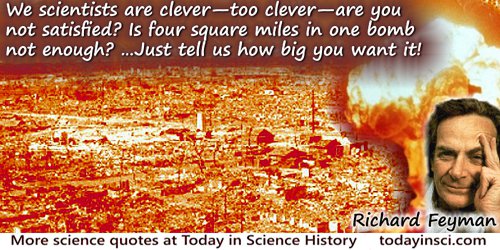
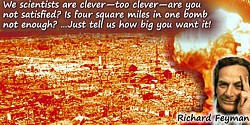
We scientists are clever—too clever—are you not satisfied? Is four square miles in one bomb not enough? Men are still thinking. Just tell us how big you want it!
— Richard P. Feynman
As quoted in James Gleick, Genius: The Life and Science of Richard Feynman (1992), 204.
What I am going to tell you about is what we teach our physics students in the third or fourth year of graduate school… It is my task to convince you not to turn away because you don’t understand it. You see my physics students don’t understand it… That is because I don’t understand it. Nobody does.
— Richard P. Feynman
From Lecture, the first in the first series of Alix G. Mauntner Lectures, trascribed and editted by Ralph Leighton, 'Introduction', QED, The Strange Theory of Light and Matter (1985, 1988), 9.
What makes planets go around the sun? At the time of Kepler, some people answered this problem by saying that there were angels behind them beating their wings and pushing the planets around an orbit. As you will see, the answer is not very far from the truth. The only difference is that the angels sit in a different direction and their wings push inward.
— Richard P. Feynman
In The Character of Physical Law (1965), 18.
What of the future of this adventure? What will happen ultimately? We are going along guessing the laws; how many laws are we going to have to guess? I do not know. Some of my colleagues say that this fundamental aspect of our science will go on; but I think there will certainly not be perpetual novelty, say for a thousand years. This thing cannot keep on going so that we are always going to discover more and more new laws … It is like the discovery of America—you only discover it once. The age in which we live is the age in which we are discovering the fundamental laws of nature, and that day will never come again. Of course in the future there will be other interests … but there will not be the same things that we are doing now … There will be a degeneration of ideas, just like the degeneration that great explorers feel is occurring when tourists begin moving in on a territory.
— Richard P. Feynman
In The Character of Physical Law (1965, 1994), 166.
What we need is imagination, but imagination is a terrible strait-jacket.
— Richard P. Feynman
In The Character of Physical Law (1965, 2001), 171.
When I was a small boy [my father] used to sit me on his lap and read to me from the [Encyclopaedia] Britannica … say, about … the Tyrannosaurus rex, and it would say something like, “This dinosaur is twenty-five feet high and its head is six feet across.” My father would stop reading and say, “Now, let’s see what that means. That would mean that if he stood in our front yard, he would be tall enough to put his head through our window up here.” (We were on the second floor.) “But his head would be too wide to fit in the window.” Everything he read to me he would translate as best he could into some reality. …
— Richard P. Feynman
In 'The Making of a Scientist', What Do You Care What Other People Think?": Further Adventures of a Curious Character (2001), 12-13. I learned from my father to translate: everything I read I try to figure out what it really means, what it’s really saying.
When someone says “science teaches such and such,” he is using the word incorrectly. Science doesn’t teach it; experience teaches it.
— Richard P. Feynman
From address to the National Science Teachers’ Association convention (Apr 1966), 'What Is Science?', collected in Richard Phillips Feynman and Jeffrey Robbins (ed.), The Pleasure of Finding Things Out: The Best Short Works of Richard P. Feynman (1999, 2005), 187.
When we look out anywhere and see light, we can always “see” some matter as the source of the light. We don't just see light.
— Richard P. Feynman
In his Nobel Prize Lecture (11 Dec 1965), 'The Development of the Space-Time View of Quantum Electrodynamics'. Collected in Stig Lundqvist, Nobel Lectures: Physics, 1963-1970 (1998), 157.
You can recognize truth by its beauty and simplicity. When you get it right, it is obvious that it is right—at least if you have any experience—because usually what happens is that more comes out than goes in. … The inexperienced, the crackpots, and people like that, make guesses that are simple, but you can immediately see that they are wrong, so that does not count. Others, the inexperienced students, make guesses that are very complicated, and it sort of looks as if it is all right, but I know it is not true because the truth always turns out to be simpler than you thought.
— Richard P. Feynman
In The Character of Physical Law (1965), 171.
Quotes by others about Richard P. Feynman (10)
[Richard P.] Feynman's cryptic remark, “no one is that much smarter ...,” to me, implies something Feynman kept emphasizing: that the key to his achievements was not anything “magical” but the right attitude, the focus on nature's reality, the focus on asking the right questions, the willingness to try (and to discard) unconventional answers, the sensitive ear for phoniness, self-deception, bombast, and conventional but unproven assumptions.
In book review of James Gleick's Genius, 'Complexities of Feynman', Science, 259 (22 Jan 1993), 22
The reason Dick's [Richard Feynman] physics was so hard for ordinary people to grasp was that he did not use equations. The usual theoretical physics was done since the time of Newton was to begin by writing down some equations and then to work hard calculating solutions of the equations. This was the way Hans [Bethe] and Oppy [Oppenheimer] and Julian Schwinger did physics. Dick just wrote down the solutions out of his head without ever writing down the equations. He had a physical picture of the way things happen, and the picture gave him the solutions directly with a minimum of calculation. It was no wonder that people who had spent their lives solving equations were baffled by him. Their minds were analytical; his was pictorial.
Quoted in Michio Kaku and Jennifer Trainer Thompson, Beyond Einstein: the Cosmic Quest for the Theory of the Universe (1987, 1999), 56-57, citing Freeman Dyson, Disturbing the Universe (1979, 1981), 55-56.
Richard Feynman was fond of giving the following advice on how to be a genius. You have to keep a dozen of your favorite problems constantly present in your mind, although by and large they will lay in a dormant state. Every time you hear or read a new trick or a new result, test it against each of your twelve problems to see whether it helps. Every once in a while there will be a hit, and people will say, “How did he do it? He must be a genius!”
In 'Ten Lessons I Wish I Had Been Taught', Indiscrete Thoughts (2008), 202.
“Half genius and half buffoon,” Freeman Dyson ... wrote. ... [Richard] Feynman struck him as uproariously American—unbuttoned and burning with physical energy. It took him a while to realize how obsessively his new friend was tunneling into the very bedrock of modern science.
In Genius: The Life and Science of Richard Feynman (1992), Prologue, 4.
For [Richard] Feynman, the essence of the scientific imagination was a powerful and almost painful rule. What scientists create must match reality. It must match what is already known. Scientific creativity is imagination in a straitjacket.
In Genius: The Life and Science of Richard Feynman (1992), 324.
Theorists write all the popular books on science: Heinz Pagels, Frank Wilczek, Stephen Hawking, Richard Feynman, et al. And why not? They have all that spare time.
In Leon Lederman and Dick Teresi, The God Particle: If the Universe is the Answer, What is the
Question (1993), 15.
[Richard Feynman] believed in the primacy of doubt, not as a blemish upon our ability to know but as the essence of knowing. The alternative to uncertainty is authority, against which science has fought for centuries.
In Genius: The Life and Science of Richard Feynman (1992), 371-372.
Newton was the greatest creative genius physics has ever seen. None of the other candidates for the superlative (Einstein, Maxwell, Boltzmann, Gibbs, and Feynman) has matched Newton’s combined achievements as theoretician, experimentalist, and mathematician. … If you were to become a time traveler and meet Newton on a trip back to the seventeenth century, you might find him something like the performer who first exasperates everyone in sight and then goes on stage and sings like an angel.
In Great Physicists (2001), 39.
Some of Feynman’s ideas about cosmology have a modern ring. A good example is his attitude toward the origin of matter. The idea of continuous matter creation in the steady state cosmology does not seriously offend him (and he notes … that the big bang cosmology has a problem just as bad, to explain where all the matter came from in the beginning). … He emphasizes that the total energy of the universe could really be zero, and that matter creation is possible because the rest energy of the matter is actually canceled by its gravitational potential energy. “It is exciting to think that it costs nothing to create a new particle, …”
In John Preskill and Kip S. Thorne, 'Foreword to Feynman Lectures on Gravitation' (15 May 1995). Feynman delivered his lectures in 1962–63.
People say Richard Feynman had one of these extraordinary minds that could grapple with ideas of which I have no concept. And you hear all the ancillary bits—like he was a good bongo player—that make him human. So I admire this man who could not only deal with string theory but also play the bongos. But he is beyond me. I have no idea what he was talking of.
From 'Interview: Of Mind and Matter: David Attenborough Meets Richard Dawkins', The Guardian (11 Sep 2010). When asked, “Which living scientist do you most admire, and why?”, Attenborough first replied, “I don’t know.” He continued with the quote above. [String theory pioneer John H. Schwarz of Caltech, in a 2018 interview said that Feynman, who died in 1988, was also at Caltech at the time of the 1984 to 1985 breakthroughs in understanding superstring theory; but Feynman held a “skepticism of superstring theory … based mostly on the concern that it could not be tested experimentally.”]
See also:
- 11 May - short biography, births, deaths and events on date of Feynman's birth.
- Richard Feynman on The French Curve: a reflection on thinking inside the box.
- Genius: The Life and Science of Richard Feynman, by James Gleick. - book suggestion.
- Booklist for Richard Feynman.
 In science it often happens that scientists say, 'You know that's a really good argument; my position is mistaken,' and then they would actually change their minds and you never hear that old view from them again. They really do it. It doesn't happen as often as it should, because scientists are human and change is sometimes painful. But it happens every day. I cannot recall the last time something like that happened in politics or religion.
(1987) --
In science it often happens that scientists say, 'You know that's a really good argument; my position is mistaken,' and then they would actually change their minds and you never hear that old view from them again. They really do it. It doesn't happen as often as it should, because scientists are human and change is sometimes painful. But it happens every day. I cannot recall the last time something like that happened in politics or religion.
(1987) -- 





