 (source)
|
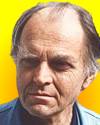
Paul K. Feyerabend
(13 Jan 1924 - 11 Feb 1994)
Austrian-American philosopher of science who became an American citizen in 1935, but spent parts of his his life in other countries, including England and New Zealand. He wrote about the philosophy of science in Against Method and Science in a Free Society.
|
Science Quotes by Paul K. Feyerabend (12 quotes)

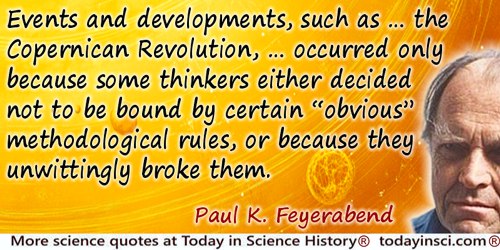
Events and developments, such as … the Copernican Revolution, … occurred only because some thinkers either decided not to be bound by certain “obvious” methodological rules, or because they unwittingly broke them.
— Paul K. Feyerabend
Against Method: Outline of an Anarchistic Theory of Knowledge (1975, 1993), 14.
Everywhere science is enriched by unscientific methods and unscientific results, ... the separation of science and non-science is not only artificial but also detrimental to the advancement of knowledge. If we want to understand nature, if we want to master our physical surroundings, then we must use all ideas, all methods, and not just a small selection of them.
— Paul K. Feyerabend
Against Method: Outline of an Anarchistic Theory of Knowledge (1975), 305-6.
Given any rule, however “fundamental” or “necessary” for science, there are always circumstances when it is advisable not only to ignore the rule, but to adopt its opposite. For example, there are circumstances when it is advisable to introduce, elaborate and defend ad hoc hypotheses, or hypotheses which contradict well-established and generally accepted experimental results, or hypotheses whose content is smaller than the content of the existing and empirically adequate alternative, or self-inconsistent hypotheses, and so on.
— Paul K. Feyerabend
Against Method: Outline of an Anarchistic Theory of Knowledge (1975, 1993), 14-15.
It is clear, then, that the idea of a fixed method, or of a fixed theory of rationality, rests on too naive a view of man and his social surroundings. To those who look at the rich material provided by history, and who are not intent on impoverishing it in order to please their lower instincts, their craving for intellectual security in the form of clarity, precision, “objectivity”, “truth”, it will become clear that there is only one principle that can be defended under all circumstances and in all stages of human development. It is the principle: anything goes.
— Paul K. Feyerabend
Against Method: Outline of an Anarchistic Theory of Knowledge (1975, 1993), 18-19.
Lakatos realized and admitted that the existing standards of rationality, standards of logic included, were too restrictive and would have hindered science had they been applied with determination. He therefore permitted the scientist to violate them (he admits that science is not “rational” in the sense of these standards). However, he demanded that research programmes show certain features in the long run—they must be progressive. … I have argued that this demand no longer restricts scientific practice. Any development agrees with it.
— Paul K. Feyerabend
In Science in a Free Society (1978), 15.
No theory ever agrees with all the facts in its domain, yet it is not always the theory that is to blame. Facts are constituted by older ideologies, and a clash between facts and theories may be proof of progress. It is also a first step in our attempt to find the principles implicit in familiar observational notions.
— Paul K. Feyerabend
Against Method: Outline of an Anarchistic Theory of Knowledge (1975, 1993), 39. This is his summary at the head of Chapter 5.
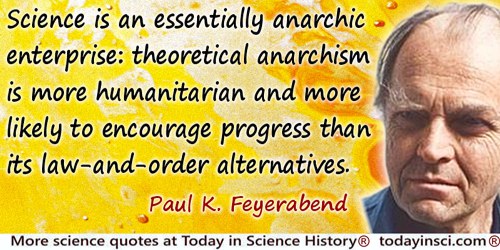
Science is an essentially anarchic enterprise: theoretical anarchism is more humanitarian and more likely to encourage progress than its law-and-order alternatives.
— Paul K. Feyerabend
From Against Method: Outline of an Anarchistic Theory of Knowledge (1975, 1993), 9.
Science is neither a single tradition, nor the best tradition there is, except for people who have become accustomed to its presence, its benefits and its disadvantages. In a democracy it should be separated from the state just as churches are now separated from the state.
— Paul K. Feyerabend
Against Method, p. 238 (1975).The author's warning against allowing scientists to become the new 'high priests' of society.
The idea of a method that contains firm, unchanging, and absolutely binding principles for conducting the business of science meets considerable difficulty when confronted with the results of historical research. We find, then, that there is not a single rule, however plausible, and however firmly grounded in epistemology, that is not violated at some time or another.
— Paul K. Feyerabend
Against Method: Outline of an Anarchistic Theory of Knowledge (1975, 1993), 14.
The only principle that does not inhibit progress is: anything goes.
— Paul K. Feyerabend
Against Method: Outline of an Anarchistic Theory of Knowledge (1975, 1993), 14. In the chapter summary for Chapter 1.
The separation of state and church must be complemented by the separation of state and science, that most recent, most aggressive, and most dogmatic religious institution.
— Paul K. Feyerabend
Against Method: Outline of an Anarchistic Theory of Knowledge (1975), 295.
Unanimity of opinion may be fitting for a church, for the frightened or greedy victims of some (ancient, or modern) myth, or for the weak and willing followers of some tyrant. Variety of opinion is necessary for objective knowledge. And a method that encourages variety is also the only method that is comparable with a humanitarian outlook.
— Paul K. Feyerabend
Against Method: Outline of an Anarchistic Theory of Knowledge (1975, 1993), 31-32.
See also:
- 13 Jan - short biography, births, deaths and events on date of Feyerabend's birth.
 In science it often happens that scientists say, 'You know that's a really good argument; my position is mistaken,' and then they would actually change their minds and you never hear that old view from them again. They really do it. It doesn't happen as often as it should, because scientists are human and change is sometimes painful. But it happens every day. I cannot recall the last time something like that happened in politics or religion.
(1987) --
In science it often happens that scientists say, 'You know that's a really good argument; my position is mistaken,' and then they would actually change their minds and you never hear that old view from them again. They really do it. It doesn't happen as often as it should, because scientists are human and change is sometimes painful. But it happens every day. I cannot recall the last time something like that happened in politics or religion.
(1987) -- 




