 (source)
|
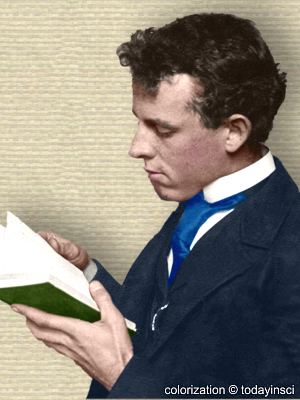
David Fairchild
(7 Apr 1869 - 6 Aug 1954)
American botanist and plant explorer who supervised the introduction of over 20,000 exotic plants and varieties of established crops into the U.S., including soya beans, mangos, alfalfa, nectarines, horseradish, and flowering cherries.
|
Science Quotes by David Fairchild (8 quotes)
...after my first feeling of revulsion had passed, I spent three of the most entertaining and instructive weeks of my life studying the fascinating molds which appeared one by one on the slowly disintegrating mass of horse-dung. Microscopic molds are both very beautiful and absorbingly interesting. The rapid growth of their spores, the way they live on each other, the manner in which the different forms come and go, is so amazing and varied that I believe a man could spend his life and not exhaust the forms or problems contained in one plate of manure.
— David Fairchild
The World Was My Garden (1938, 1941), 55.
...the need for a garden of rare palms and vines and ornamental trees and shrubs which would be near enough to a growing city to form a quiet place where children with their elders could peer, as it were, into those fascinating jungles and palm glades of the tropics which have for generations stimulated the imaginations of American youth.
— David Fairchild
For keenest enjoyment, I visit when the dew is on them, or in cloudy weather, or when the rain is falling: and I must be alone or with someone who cares for them as I do.
— David Fairchild
I have always liked horticulturists, people who make their living from orchards and gardens, whose hands are familiar with the feel of the bark, whose eyes are trained to distinguish the different varieties, who have a form memory. Their brains are not forever dealing with vague abstractions; they are satisfied with the romance which the seasons bring with them, and have the patience and fortitude to gamble their lives and fortunes in an industry which requires infinite patience, which raise hopes each spring and too often dashes them to pieces in fall. They are always conscious of sun and wind and rain; must always be alert lest they lose the chance of ploughing at the right moment, pruning at the right time, circumventing the attacks of insects and fungus diseases by quick decision and prompt action. They are manufacturers of a high order, whose business requires not only intelligence of a practical character, but necessitates an instinct for industry which is different from that required by the city dweller always within sight of other people and the sound of their voices. The successful horticulturist spends much time alone among his trees, away from the constant chatter of human beings.
— David Fairchild
Never to have seen anything but the temperate zone is to have lived on the fringe of the world. Between the Tropic of Capricorn and the Tropic of Cancer live the majority of all the plant species, the vast majority of the insects, most of the strange ... quadrupeds, all of the great and most of the poisonous snakes and large lizards, most of the brilliantly colored sea fishes, and the strangest and most gorgeously plumaged of the birds.
— David Fairchild
Exploring For Plants (1930), 329.
The avocado is a food without rival among the fruits, the veritable fruit of paradise.
— David Fairchild
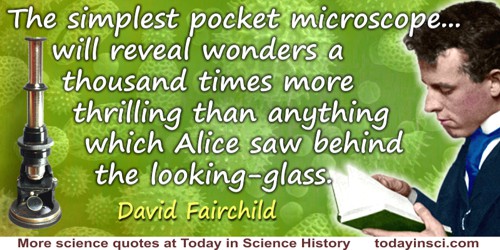
The human mind prefers something which it can recognize to something for which it has no name, and, whereas thousands of persons carry field glasses to bring horses, ships, or steeples close to them, only a few carry even the simplest pocket microscope. Yet a small microscope will reveal wonders a thousand times more thrilling than anything which Alice saw behind the looking-glass.
— David Fairchild
In The World Was My Garden (1938, 1941), 11.
The mangosteen, queen of the tropical fruit.
— David Fairchild
Our Plant Immigrants', The National Geographic Magazine (Apr 1906), Vol. 17, No. 4, 196.
See also:
- 7 Apr - short biography, births, deaths and events on date of Fairchild's birth.
- David Fairchild’s The World Was My Garden, by David Fairchild. - book suggestion.
 In science it often happens that scientists say, 'You know that's a really good argument; my position is mistaken,' and then they would actually change their minds and you never hear that old view from them again. They really do it. It doesn't happen as often as it should, because scientists are human and change is sometimes painful. But it happens every day. I cannot recall the last time something like that happened in politics or religion.
(1987) --
In science it often happens that scientists say, 'You know that's a really good argument; my position is mistaken,' and then they would actually change their minds and you never hear that old view from them again. They really do it. It doesn't happen as often as it should, because scientists are human and change is sometimes painful. But it happens every day. I cannot recall the last time something like that happened in politics or religion.
(1987) -- 




