America’s First Rubber Street
Exchange Street, Akron, Sep 1948
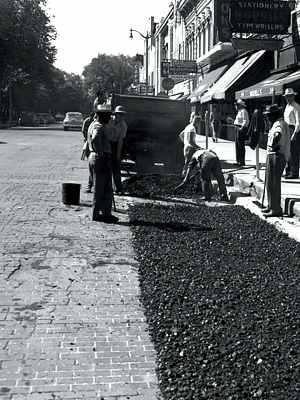
Akron, Ohio, added another dimension to its moniker as America’s “Rubber City” when it began a trial of what they claimed was America’s first “Rubber Road.” Construction workers began on 7 September 19481, to spent a few days resurfacing 6,217 feet of Exchange Street. The project began with the north lane of Exchange Street, between South Broadway and Five Points near Maple Street. The original brick surface disappeared under a hot, viscous, pungent black layer of asphalt mixed with rubber additive. The material was compressed with large rollers, and after several hours of cooling, traffic resumed on the new pavement. When both north and south lanes were completed, the city posted signs at each end to notify drivers of their unique feature.
In 1898, Frank Seiberling established the Goodyear Tire and Rubber Company in Akron, Ohio, and a thriving rubber industry developed in the city over following years. The idea for the rubber road in Akron began when Paul Weeks Litchfield, the current president of the Goodyear Company, visited Holland in 1947, where rubberized paving material had been used on roads there since the 1930s. Litchfield realized the business opportunity for his rubber company that could bring huge financial returns if they manufactured a product that became part of roads throughout America. So, he invited Dr. I. R. Houwink, director general of the Dutch Rubber Foundation to come to speak to Akron’s city leaders about the gains from using rubber additives for road paving.
Dr. Houwink conveyed his enthusiasm for the benefits of rubberized additives in road paving. The resulting smooth, non-skid finish reduced wear and tear on vehicles while providing a smoother ride. The surface, he said, was more durable and water-resistant. Thus, it protected the underlying structure of the road and lowered the costs of maintenance. The city leaders were impressed with this presentation. They knew that in Akron, the weather ranged from hot to freezing, and rain caused slippery conditions. To have roads that were less liable to deteriorate was appealing to those conscious of the city budget.
As a further incentive for the city, Litchfield proposed to donate all the rubber material needed to complete a test paving project in Akron. Hence, a cautious experiment was authorized. In 1947, to begin, small test areas were laid down on Rose Boulevard and South Main near Long Street, using asphalt mixed with Goodyear’s donated crumbled synthetic rubber.
After a year, the trial was deemed satisfactory, so a larger-scale test was authorized, and in the fall of 1948, the work began on Exchange Street. The Thorpe Construction Company heated asphalt to 175°F, and added rubber (again donated by Goodyear). As the prepared mixture was used to pave to a thickness of 2½ inches, it was finished with a top coating of finely ground rubber, resembling “coffee grounds.”
As a control to the experiment, test areas were covered with asphalt alone. Some areas used a mixture with 5% rubber and others had 7½% rubber. The highway engineer, Iver Schmidt inspected the road surface during the following year of normal traffic, and detected no wear. However, it would take several more years in service before results with significance could be expected. Meanwhile, the rubberized mixture was also used on North Main Street in Akron.
Elsewhere, rubberized asphalt paving was used on Broad Boulevard in Cuyahoga Falls. It was also laid down on stretches of Ohio State Routes 5, 18, 82 and 224.
Goodyear marketed the rubber compound with the tradename Rubarite. U.S. Rubber sold Latricrete and Firestone made Rub-R-Road. Rubarite Inc. was a company owned one-third by National Lead, one-third by Goodyear Rubber Co. and one-third by Bird & Sons. Rubarite was offered to rubberize asphalt for highway and airport construction. Thus more cities in other states joined in their own testing of the product, including Baltimore, Chicago, Detroit, Milwaukee, New York and Washington, D.C.
Ten years later, by 1959 in Akron, it came time to judge the experiment on Exchange Street. Highway engineer Iver Schmidt determined that the rubberized areas had held up as well as the ordinary asphalt control sections, but with, in fact, no noticeable difference in his observation.
On the other hand, the rubberized asphalt paving material had significant differences in much higher cost, and greater difficulty in application (together with a more offensive smell). There was no perceived positive value to outweigh these negatives.
The experiment ended with the decision for Akron to continue with only regular asphalt paving.
Rubarite Inc. was liquidated on 1 Jan 1957.
Yet, the rubber concept rebounded, as in following years, there are various other examples of paving with asphalt containing rubber reclaimed from old tires. The tests had in mind to not only have an innovative rubberized asphalt surface, but also to recycle worn-out tires to reduce the endless waste stream going to landfills. Rubber also presently remains useful on running tracks and walking path surfaces.





