 (source)
|
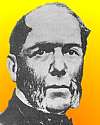
Abraham (Pineo) Gesner
(2 May 1797 - 29 Apr 1864)
Canadian chemist and geologist whp pioneered the extraction of kerosene (which he named) from asphalt rock. Because it was a cleaner-burning fuel, it replace whale oil for use in in oil lamps.
|
ABRAHAM GESNER, OF WILLIAMSBURG, N. Y., ASSIGNOR TO THE ASPHALT
MINING AND KEROSENE GAS COMPANY.
IMPROVEMENT IN KEROSENE BURNING-FLUIDS.
Specification of Letters Patent No. 11,203, dated June 27, 1854
To all whom it may concern:
Be it known that I, ABRAHAM GESNER, late of the city and county of New York, now of Williamsburg, in the county of Kings, and State of New York, have invented and discovered a new and useful manufacture or composition of matter, being a new liquid hydrocarbon which I denominate “kerosene” and which may be used for illuminating and other purposes, of which the following is a specification.
I obtain this product from petroleum, maltha, or soft mineral pitch, asphaltum, or bitumen, wherever found, by dry distillation and subsequent treatment with powerful reagents and redistillation.
This process, which will presently be described, yields kerosene of three different qualities or proofs, each of which, in my opinion, is a mixture in certain proportions of a spirituous, light, and highly volatile and inflammable liquid, with an oily, heavy, and less volatile and inflammable liquid. I have not succeeded in completely separating these liquids in the manufacture, and I see no practically-useful object to be gained by doing so. Neither have I ascertained the exact proportions in which the two liquids are mixed; but I suppose the lightest fluid, which I denominate “A” kerosene, to be composed of two parts, by measure or equivalent proportions, of the heavy and eight of the light fluid. Its specific gravity is .750, water being 1, and it boils at 150º Fahrenheit. It is not a solvent of such gums as I have tried to dissolve in it, among which I may mention india rubber. Sixty-five parts, by measure, of alcohol of specific gravity .844, at a temperature of 60º Fahrenheit, will dissolve thirty-five parts, by measure, of this liquid. By itself the “A” kerosene is highly volatile and inflammable, so much so that even in cold winter weather a good light is produced by forcing a current of atmospheric air through it, circulating the same in pipes and burning it in jets like gas.
The second or medium-proof fluid I call “B” kerosene, and suppose to be composed of four parts or equivalents of the heavy and six of the light fluid. Its specific gravity is .775 and its boiling-point 250º Fahrenheit. It is not a solvent of gums, but will soften them very slightly. Seventy-five parts of alcohol, of specific gravity .844 at a temperature of 60º Fahrenheit, will dissolve twenty-five parts of this liquid. By itself the “B” kerosene is moderately volatile and inflammable, but will not, like the “A,” yield a good light by having a current of air passed through it and burned.
The third or low-proof fluid I call “C” kerosene, and suppose it to be composed of six parts or equivalents of the heavy and four of the light liquid. Unlike the “A” and “B,” the heavy liquid preponderates in and gives character to the “C” kerosene. Its specific gravity is .800, and its boiling-point is 350º Fahrenheit. Unlike “A” and “B,” it is not soluble in alcohol, but it is a good solvent of gums, as india-rubber dissolves in it readily. It is not very volatile or inflammable; but in an Argand lamp, with a button over the wick, it burns with a brilliant white light without smoke or the naphthalous odor so offensive in many hydrocarbons having some resemblance to this but possessing very different properties. As burning-fluids for the purpose of artificial illumination, these are highly useful and economical, either separately, mixed together, or “A” and” B” mixed with alcohol. The “C” kerosene has also proved very good as a lubricant for machinery where it has been tried; but, being a new and almost untried thing, the kerosene doubtless has very numerous uses besides its adaptation to illumination and lubrication that will soon be discovered after it is manufactured on the large scale and put into the market as an article of trade. Moreover, as the rocks whence the kerosene is most abundantly obtained are widely disseminated, and the deposits of them are of almost unlimited extent, an immense mass of hitherto useless matter will by means of this invention be rendered available for the uses of mankind as a cheap and convenient substitute for illuminating purposes for the oils and fats which are yearly increasing in scarcity and price.
The process and apparatus I employ in producing the kerosene I will now proceed to describe, premising that I do not confine myself to any particular form or arrangement of apparatus, but intend to use whatever may prove most convenient in any given case.
The first part of the process consists in submitting the raw material to dry distillation at the lowest temperature at which the kerosene will volatilize, care being taken not to raise the temperature so long as tolerably-rapid evaporation continues, and the heat must not in any case be raised above 800º Fahrenheit, a the heat, if raised to the slightest perceptible red in daylight, would be so high as to defeat the whole object of the process, for a greatly increased production of gas would take place and the liquid product would be naphtha instead of kerosene. Whatever gas may be generated I employ for ilIuminating purposes in the ordinary manner and also as fuel for heating the still. For this dry distillation I have used large cast-iron retorts set in suitable furnaces for the evaporation, and “metal pipes or chambers surrounded by water for the condensation, of the vapor. The liquid products of this distillation are heavy tar and water or ammoniacal liquor, which lie at the bottom of the receiver and a lighter liquid, which floats above them. The heavy liquids and the light are separated by drawing off one or the other into another vessel by means of a cock, siphon, or otherwise. The heavy liquids may be utilized or disposed of advantageously, but they have no further connection with this process, and therefore I shall not here describe the mode in which I propose to utilize them. The light liquid is then submitted to redistillation at the lowest possible heat in a common still and condenser. The product of this redistillation is a light volatile liquid, which accumulates in the receiver, and a heavy tarry residuum left in the still, and which may be added to the heavy liquid impurities of the first distillate. The light liquid is transferred from the receiver to a suitable vessel or vat, and mixed thoroughly with from five to ten per cent of strong sulphuric, nitric, or muriatic acid, according to the quantity of tar present. Seven per cent is about the average quantity required; but any quantity is useful. I have enumerated three acids; but I gave the preference to sulphuric, although either of the others will answer very well. I also mix, with the liquid from one to three per cent of peroxide of manganese, according to the turbidness of the liquid, about two per cent being the average quantity required. It has the effect of facilitating greatly the precipitation of certain of the impurities which the liquid contains; but although useful I do not deem it essential. After these substances have been thoroughly mixed with the liquid by agitation it is allowed to stand from twelve to twenty-four hours without being disturbed, in order that the impurities may subside. The clear supernatant liquid is now separated from the impurities, both solid and liquid, that have settled to the bottom of the tank by drawing off either the one or the other into a separate vessel. I next mix the distillate with about two per cent by weight, of powdered and freshly-calcined lime. The latter by its powerful affinity for water will absorb it thoroughly from the liquid hydrocarbon, which always at this stage of the process contains it in a greater or less quantity. Lime by its alkaline properties will also neutralize any acid in the liquid. After the lime has been thoroughly mixed with the liquid by stirring the mixture is again distilled, care being taken to raise the heat gradually and slowly first to about 60° Fahrenheit, where it is kept by regulating the damper until all the vapor has passed over into the receiver that the liquid will yield at this temperature. This product or distillate is the “A” kerosene, and is drawn off from the receiver into an appropriate vessel. The heat is now raised by again drawing the damper to about 260º Fahrenheit, when vapors will again rise and he condensed in the receiver. As soon as the distillate ceases to flow at this temperature it is drawn off from the receiver into a separate vessel, and it constitutes the “B” kerosene. The heat of the still is now raised to about 360º Fahrenheit, when vapors will again rise and condense in the receiver. As soon as the distillate ceases to run at this temperature the process is complete. This last product is the “C” kerosene.
The quantity of lime I have mentioned is the quantity I have found sufficient in all cases; but any quantity less than ten per cent would be useful. The lime as an alkali appears to exert a specific influence or effect which is indispensable to the good quality of the product. Neither soda nor potash can produce this effect in any form in which I have tried them, and I have made special and numerous effects to replace the lime with these alkalies.
To deprive the liquid of water, by freshly calcined lime is important, because, as I have discovered, water is highly injurious to the process and product, even in very small quantities, as it causes carbolic acid to pass over with the distillates, giving to them a creosotic odor, which is extremely offensive. It is one of the great and peculiar advantages of my process that the fluids which it produces have no disagreeable odor.
The boiling-points of the “A,” “B,” and “C” kerosene, as before stated, indicate approximately the temperature at which the boiling takes place. 10º or 20º increase of temperature might take place without producing any sensible effect upon the quality or character of the product, as no evaporation takes place at a temperature below that at which the first distillation begins, or between the first and second or second and third distillations, and a thermometer is not used for the purpose of regulating the temperature, as the observation and judgment of a skillful workman are sufficient.
Having claimed under separate specifications the “B” and “C” kerosene, I claim -
As a new manufacture or composition of matter for illuminating and other purposes, the liquid hydrocarbon herein described, which I denominate “A” kerosene.
In testimony whereof I have hereunto subscribed my name.
P. H. Watson.
- 2 May - short biography, births, deaths and events on date of Gesner's birth.
- Abraham Gesner, by Joyce Barkhouse. - book suggestion.





