 (source)
|
Sir Benjamin Baker
(31 Mar 1840 - 19 May 1907)
English civil engineer who was the chief designer of the railway bridge over the Firth of Forth.
|
Human Cantilever
A Demonstration Devised by Benjamin Baker
Royal Institution Lecture (1887)
The Forth Railway Bridge designed by John Fowler and Benjamin Baker was a bold application of the cantilever principle at a time when it had been used for only two decades by modern engineers for major bridges.
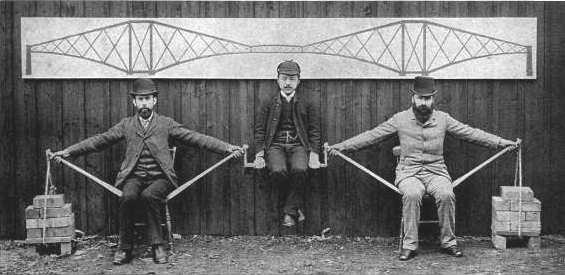
In order to explain the principle, Benjamin Baker presented a human cantilever as a demonstration for a Royal Institution lecture at the time of the bridge construction. His idea is shown in the photograph.
The background shows a diagram the Forth Bridge drawn to the same scale as the human cantilever. Two men sat with their chairs positioned in front of the main piers on the diagram they represented. They were flanked by piles of bricks that simulated the anchor piers. The outspread arms of the seated men were supported by wooden struts from each hand butted against their seat. The tops of the two outermost ends of the sticks were steadied by ropes down to the anchorages. A central span was suspended between the top ends of the sticks held by the two men's inner hands.
This arrangement easily supported the weight of a third person, seated on the central span. A consideration of the perfect balance of forces involved recognises that the arms and ropes carry tension forces, whereas the torso of each man and the wooden struts carried compression forces.
In recognition of the ancient origins of the cantilever design attributed to the Far East, Fowler chose a young Japanese to be supported on the central span for the focal point of the demonstration. Kaichi Watanabe studied at Glasgow University, served as chief foreman for the bridge construction, and later became president of several Japanese companies.
- 31 Mar - short biography, births, deaths and events on date of Baker's birth.
- Remark on Metal Fatigue by Sir Benjamin Baker (reported in 1910)
- The Forth Bridge - by Benjamin Baker in Chambers’s Journal (1888),
- Booklist for the Forth Bridge.
- 15 Jul - short biography, births, deaths and events on John Fowler's date of birth.
- 100 Years of the Forth Bridge, by the American Society of Civil Engineers. - book suggestion.






