 (source)
|
Euclid
(c. 325 B.C. - c. 270 B.C.)
Greek mathematician who is famous for his text-books on geometry. Though little is known of his private life, his work in geometry has been in use for almost two thousand years.
|
Science Quotes by Euclid (3 quotes)
In right-angled triangles the square on the side subtending the right angle is equal to the squares on the sides containing the right angle.
— Euclid
The Thirteen Books of Euclid's Elements Translated from the Text of Heiberg, introduction and commentary by Sir T. L. Heath (1926), Vol. 1, 349.
That, if a straight line falling on two straight lines make the interior angles on the same side less than two right angles, the two straight lines, if produced indefinitely, meet on that side on which are the angles less than the two right angles.
— Euclid
The Thirteen Books of Euclid's Elements Translated from the Text of Heiberg, introduction and commentary by Sir T. L. Heath (1926), Vol. 1, 155.
There is no royal road to geometry.
— Euclid
In James Wood, Dictionary of Quotations from Ancient and Modern, English and Foreign Sources (1893), 474:17. Said to be Euclid’s response to Ptolemy I, King of Egypt, who wished to study geometry without going over the thirteen parts of Euclid’s Elements.
Quotes by others about Euclid (60)
These estimates may well be enhanced by one from F. Klein (1849-1925), the leading German mathematician of the last quarter of the nineteenth century. “Mathematics in general is fundamentally the science of self-evident things.” ... If mathematics is indeed the science of self-evident things, mathematicians are a phenomenally stupid lot to waste the tons of good paper they do in proving the fact. Mathematics is abstract and it is hard, and any assertion that it is simple is true only in a severely technical sense—that of the modern postulational method which, as a matter of fact, was exploited by Euclid. The assumptions from which mathematics starts are simple; the rest is not.
Mathematics: Queen and Servant of Science (1952),19-20.
Reductio ad absurdum, which Euclid loved so much, is one of a mathematician's finest weapons. It is a far finer gambit than any chess play: a chess player may offer the sacrifice of a pawn or even a piece, but a mathematician offers the game.
In A Mathematician's Apology (1940, reprint with Foreward by C.P. Snow 1992), 94.
![Augustus De Morgan quote: As to writing another book on geometry [to replace Euclid] the middle ages would have as soon thought](https://todayinsci.com/D/DeMorgan_Augustus/DeMorganAugustus-Testament500x250px.jpg)
As to writing another book on geometry [to replace Euclid] the middle ages would have as soon thought of composing another New Testament.
In George Edward Martin, The Foundations of Geometry and the Non-Euclidean Plane (1982), 130.
He was 40 yeares old before he looked on Geometry; which happened accidentally. Being in a Gentleman's Library, Euclid's Elements lay open, and 'twas the 47 El. Libri 1 [Pythagoras' Theorem]. He read the proposition. By G-, sayd he (he would now and then sweare an emphaticall Oath by way of emphasis) this is impossible! So he reads the Demonstration of it, which referred him back to such a Proposition; which proposition he read. That referred him back to another, which he also read. Et sic deinceps [and so on] that at last he was demonstratively convinced of that trueth. This made him in love with Geometry .
Of Thomas Hobbes, in 1629.
Of Thomas Hobbes, in 1629.
Brief Lives (1680), edited by Oliver Lawson Dick (1949), 150.
Then one day Lagrange took out of his pocket a paper which he read at the Académe, and which contained a demonstration of the famous Postulatum of Euclid, relative to the theory of parallels. This demonstration rested on an obvious paralogism, which appeared as such to everybody; and probably Lagrange also recognised it such during his lecture. For, when he had finished, he put the paper back in his pocket, and spoke no more of it. A moment of universal silence followed, and one passed immediately to other concerns.
Quoting Lagrange at a meeting of the class of mathematical and physical sciences at the Institut de France (3 Feb 1806) in Journal des Savants (1837), 84, trans. Ivor Grattan-Guinness.
It would be foolish to give credit to Euclid for pangeometrical conceptions; the idea of geometry deifferent from the common-sense one never occurred to his mind. Yet, when he stated the fifth postulate, he stood at the parting of the ways. His subconscious prescience is astounding. There is nothing comperable to it in the whole history of science.
Ancient Science And Modern Civilization (1954, 1959), 28. In George Edward Martin, The Foundations of Geometry and the Non-Euclidean Plane (1982), 130.
As to the need of improvement there can be no question whilst the reign of Euclid continues. My own idea of a useful course is to begin with arithmetic, and then not Euclid but algebra. Next, not Euclid, but practical geometry, solid as well as plane; not demonstration, but to make acquaintance. Then not Euclid, but elementary vectors, conjoined with algebra, and applied to geometry. Addition first; then the scalar product. Elementary calculus should go on simultaneously, and come into vector algebraic geometry after a bit. Euclid might be an extra course for learned men, like Homer. But Euclid for children is barbarous.
Electro-Magnetic Theory (1893), Vol. 1, 148. In George Edward Martin, The Foundations of Geometry and the Non-Euclidean Plane (1982), 130.
Euclid avoids it [the treatment of the infinite]; in modern mathematics it is systematically introduced, for only then is generality obtained.
'Geometry', Encyclopedia Britannica, 9th edition. In George Edward Martin, The Foundations of Geometry and the Non-Euclidean Plane (1982), 130. This is part of a longer quote, which begins “In Euclid each proposition…”, on the Arthur Cayley Quotes page of this website.
The existence of these patterns [fractals] challenges us to study forms that Euclid leaves aside as being formless, to investigate the morphology of the amorphous. Mathematicians have disdained this challenge, however, and have increasingly chosen to flee from nature by devising theories unrelated to anything we can see or feel.
The Fractal Geometry of Nature (1977, 1983), Introduction, xiii.
Fractal is a word invented by Mandelbrot to bring together under one heading a large class of objects that have [played] … an historical role … in the development of pure mathematics. A great revolution of ideas separates the classical mathematics of the 19th century from the modern mathematics of the 20th. Classical mathematics had its roots in the regular geometric structures of Euclid and the continuously evolving dynamics of Newton. Modern mathematics began with Cantor’s set theory and Peano’s space-filling curve. Historically, the revolution was forced by the discovery of mathematical structures that did not fit the patterns of Euclid and Newton. These new structures were regarded … as “pathological,” .… as a “gallery of monsters,” akin to the cubist paintings and atonal music that were upsetting established standards of taste in the arts at about the same time. The mathematicians who created the monsters regarded them as important in showing that the world of pure mathematics contains a richness of possibilities going far beyond the simple structures that they saw in Nature. Twentieth-century mathematics flowered in the belief that it had transcended completely the limitations imposed by its natural origins.
Now, as Mandelbrot points out, … Nature has played a joke on the mathematicians. The 19th-century mathematicians may not have been lacking in imagination, but Nature was not. The same pathological structures that the mathematicians invented to break loose from 19th-century naturalism turn out to be inherent in familiar objects all around us.
Now, as Mandelbrot points out, … Nature has played a joke on the mathematicians. The 19th-century mathematicians may not have been lacking in imagination, but Nature was not. The same pathological structures that the mathematicians invented to break loose from 19th-century naturalism turn out to be inherent in familiar objects all around us.
From 'Characterizing Irregularity', Science (12 May 1978), 200, No. 4342, 677-678. Quoted in Benoit Mandelbrot, The Fractal Geometry of Nature (1977, 1983), 3-4.
The new painters do not propose, any more than did their predecessors, to be geometers. But it may be said that geometry is to the plastic arts what grammar is to the art of the writer. Today, scholars no longer limit themselves to the three dimensions of Euclid. The painters have been lead quite naturally, one might say by intuition, to preoccupy themselves with the new possibilities of spatial measurement which, in the language of the modern studios, are designated by the term fourth dimension.
The Cubist Painters: Aesthetic Meditations (1913) translated by Lionel Abel (1970), 13. Quoted in Michele Emmer, The Visual Mind II (2005), 352.
Think of the image of the world in a convex mirror. ... A well-made convex mirror of moderate aperture represents the objects in front of it as apparently solid and in fixed positions behind its surface. But the images of the distant horizon and of the sun in the sky lie behind the mirror at a limited distance, equal to its focal length. Between these and the surface of the mirror are found the images of all the other objects before it, but the images are diminished and flattened in proportion to the distance of their objects from the mirror. ... Yet every straight line or plane in the outer world is represented by a straight line or plane in the image. The image of a man measuring with a rule a straight line from the mirror, would contract more and more the farther he went, but with his shrunken rule the man in the image would count out exactly the same results as in the outer world, all lines of sight in the mirror would be represented by straight lines of sight in the mirror. In short, I do not see how men in the mirror are to discover that their bodies are not rigid solids and their experiences good examples of the correctness of Euclidean axioms. But if they could look out upon our world as we look into theirs without overstepping the boundary, they must declare it to be a picture in a spherical mirror, and would speak of us just as we speak of them; and if two inhabitants of the different worlds could communicate with one another, neither, as far as I can see, would be able to convince the other that he had the true, the other the distorted, relation. Indeed I cannot see that such a question would have any meaning at all, so long as mechanical considerations are not mixed up with it.
In 'On the Origin and Significance of Geometrical Axioms,' Popular Scientific Lectures< Second Series (1881), 57-59. In Robert Édouard Moritz, Memorabilia Mathematica (1914), 357-358.
For God’s sake, please give it up. Fear it no less than the sensual passion, because it, too, may take up all your time and deprive you of your health, peace of mind and happiness in life.
Having himself spent a lifetime unsuccessfully trying to prove Euclid's postulate that parallel lines do not meet, Farkas discouraged his son János from any further attempt.
Having himself spent a lifetime unsuccessfully trying to prove Euclid's postulate that parallel lines do not meet, Farkas discouraged his son János from any further attempt.
Letter (1820) to his son, János Bolyai. Translation as in Philip J. Davis and Reuben Hersh, The Mathematical Experience (1981), 220. In Bill Swainson, Encarta Book of Quotations (2000), 124.
Detest it as lewd intercourse, it can deprive you of all your leisure, your health, your rest, and the whole happiness of your life.
Having himself spent a lifetime unsuccessfully trying to prove Euclid’s postulate that parallel lines do not meet, Farkas discouraged his son János from any further attempt.
Having himself spent a lifetime unsuccessfully trying to prove Euclid’s postulate that parallel lines do not meet, Farkas discouraged his son János from any further attempt.
Letter (1820), to his son, János Bolyai. Translation as in Dirk Jan Struik, A concise history of mathematics (2nd Ed., 1948), 253.
Do not try the parallels in that way: I know that way all along. I have measured that bottomless night, and all the light and all the joy of my life went out there.
Having himself spent a lifetime unsuccessfully trying to prove Euclid's postulate that parallel lines do not meet, Farkas discouraged his son János from any further attempt.
Having himself spent a lifetime unsuccessfully trying to prove Euclid's postulate that parallel lines do not meet, Farkas discouraged his son János from any further attempt.
Letter (4 Apr 1820), to his son, János Bolyai. In J. J. O'Connor and E. F. Robertson, 'Farkas Wolfgang Bolyai' (Mar 2004), web article in MacTutor..
Let me tell you how at one time the famous mathematician Euclid became a physician. It was during a vacation, which I spent in Prague as I most always did, when I was attacked by an illness never before experienced, which manifested itself in chilliness and painful weariness of the whole body. In order to ease my condition I took up Euclid’s Elements and read for the first time his doctrine of ratio, which I found treated there in a manner entirely new to me. The ingenuity displayed in Euclid’s presentation filled me with such vivid pleasure, that forthwith I felt as well as ever.
Selbstbiographie (1875), 20. In Robert Édouard Moritz, Memorabilia Mathematica; Or, The Philomath's Quotation-book (1914), 146.
[T]he 47th proposition in Euclid might now be voted down with as much ease as any proposition in politics; and therefore if Lord Hawkesbury hates the abstract truths of science as much as he hates concrete truth in human affairs, now is his time for getting rid of the multiplication table, and passing a vote of censure upon the pretensions of the hypotenuse.
In 'Peter Plymley's Letters', Essays Social and Political (1877), 530.
Mathematics is not only one of the most valuable inventions—or discoveries—of the human mind, but can have an aesthetic appeal equal to that of anything in art. Perhaps even more so, according to the poetess who proclaimed, “Euclid alone hath looked at beauty bare.”
From 'The Joy of Maths'. Collected in Arthur C. Clarke, Greetings, Carbon-Based Bipeds!: Collected Essays, 1934-1998, 460.
Detection is, or ought to be, an exact science, and should be treated in the same cold unemotional manner. You have attempted to tinge it with romanticism, which produces the same effect as if you worked a love-story into the fifth proposition of Euclid.
By Sherlock Holmes to Dr. Watson, fictional characters in The Sign of Four (1890), 6.
[Euclid's Elements] has been for nearly twenty-two centuries the encouragement and guide of that scientific thought which is one thing with the progress of man from a worse to a better state. The encouragement; for it contained a body of knowledge that was really known and could be relied on, and that moreover was growing in extent and application. For even at the time this book was written—shortly after the foundation of the Alexandrian Museum—Mathematics was no longer the merely ideal science of the Platonic school, but had started on her career of conquest over the whole world of Phenomena. The guide; for the aim of every scientific student of every subject was to bring his knowledge of that subject into a form as perfect as that which geometry had attained. Far up on the great mountain of Truth, which all the sciences hope to scale, the foremost of that sacred sisterhood was seen, beckoning for the rest to follow her. And hence she was called, in the dialect of the Pythagoreans, ‘the purifier of the reasonable soul.’
From a lecture delivered at the Royal Institution (Mar 1873), collected postumously in W.K. Clifford, edited by Leslie Stephen and Frederick Pollock, Lectures and Essays, (1879), Vol. 1, 296.
We think of Euclid as of fine ice; we admire Newton as we admire the peak of Teneriffe. Even the intensest labors, the most remote triumphs of the abstract intellect, seem to carry us into a region different from our own—to be in a terra incognita of pure reasoning, to cast a chill on human glory.
In Estimates of Some Englishmen and Scotchmen (1856), 411-412
The primes are the raw material out of which we have to build arithmetic, and Euclid’s theorem assures us that we have plenty of material for the task.
In A Mathematician's Apology (1940, 2012), 99.
We reverence ancient Greece as the cradle of western science. Here for the first time the world witnessed the miracle of a logical system which proceeded from step to step with such precision that every single one of its propositions was absolutely indubitable—I refer to Euclid’s geometry. This admirable triumph of reasoning gave the human intellect the necessary confidence in itself for its subsequent achievements. If Euclid failed to kindle your youthful enthusiasm, then you were not born to be a scientific thinker.
From 'On the Method of Theoretical Physics', in Essays in Science (1934, 2004), 13.
I claim that many patterns of Nature are so irregular and fragmented, that, compared with Euclid—a term used in this work to denote all of standard geometry—Nature exhibits not simply a higher degree but an altogether different level of complexity … The existence of these patterns challenges us to study these forms that Euclid leaves aside as being “formless,” to investigate the morphology of the “amorphous.”
Cited as from Fractals: Form, Chance, and Dimension (1977), by J.W. Cannon, in review of The Fractal Geometry of Nature (1982) in The American Mathematical Monthly (Nov 1984), 91, No. 9, 594.
I should rejoice to see … Euclid honourably shelved or buried “deeper than did ever plummet sound” out of the schoolboys’ reach; morphology introduced into the elements of algebra; projection, correlation, and motion accepted as aids to geometry; the mind of the student quickened and elevated and his faith awakened by early initiation into the ruling ideas of polarity, continuity, infinity, and familiarization with the doctrines of the imaginary and inconceivable.
From Presidential Address (1869) to the British Association, Exeter, Section A, collected in Collected Mathematical Papers of Lames Joseph Sylvester (1908), Vol. 2, 657. Also in George Edward Martin, The Foundations of Geometry and the Non-Euclidean Plane (1982), 93. [Note: “plummet sound” refers to ocean depth measurement (sound) from a ship using a line dropped with a weight (plummet). —Webmaster]
No man who has not a decently skeptical mind can claim to be civilized. Euclid taught me that without assumptions there is no proof. Therefore, in any argument, examine the assumptions. Then, in the alleged proof, be alert for inexplicit assumptions. Euclid’s notorious oversights drove this lesson home. Thanks to him, I am (I hope!) immune to all propaganda, including that of mathematics itself.
In 'What Mathematics Has Meant to Me', Mathematics Magazine (Jan-Feb 1951), 24, 161.
The cowboys have a way of trussing up a steer or a pugnacious bronco which fixes the brute so that it can neither move nor think. This is the hog-tie, and it is what Euclid did to geometry.
In The Search For Truth (1934), 117.
… There can be no doubt about faith and not reason being the ultima ratio. Even Euclid, who has laid himself as little open to the charge of credulity as any writer who ever lived, cannot get beyond this. He has no demonstrable first premise. He requires postulates and axioms which transcend demonstration, and without which he can do nothing. His superstructure indeed is demonstration, but his ground his faith. Nor again can he get further than telling a man he is a fool if he persists in differing from him. He says “which is absurd,” and declines to discuss the matter further. Faith and authority, therefore, prove to be as necessary for him as for anyone else.
In The Way of All Flesh (1917), 319-320.
A book should have either intelligibility or correctness; to combine the two is impossible, but to lack both is to be unworthy of a place as Euclid has occupied in education.
In essay, 'Mathematics and the Metaphysicians' (1901), collected in Mysticism and Logic: And Other Essays (1917), 73. The essay was also published as 'Recent Work in the Philosophy of Mathematics', in the American magazine, International Monthly.
Four circles to the kissing come,
The smaller are the benter.
The bend is just the inverse of
The distance from the centre.
Though their intrigue left Euclid dumb
There’s now no need for rule of thumb.
Since zero bend’s a dead straight line
And concave bends have minus sign,
The sum of squares of all four bends
Is half the square of their sum.
The smaller are the benter.
The bend is just the inverse of
The distance from the centre.
Though their intrigue left Euclid dumb
There’s now no need for rule of thumb.
Since zero bend’s a dead straight line
And concave bends have minus sign,
The sum of squares of all four bends
Is half the square of their sum.
In poem, 'The Kiss Precise', Nature (20 Jun 1936), 137, 1021, as quoted, cited, explained and illustrated in Martin Gardner, The Colossal Book of Mathematics: Classic Puzzles, Paradoxes, and Problems (2001), 139-141.
There is no sect in geometry; we never say,—An Euclidian, an Archimedian.
In 'Sects' Philosophical Dictionary (2010), 269.
Euclid alone has looked on Beauty bare.
Let all who prate of Beauty hold their peace,
And lay them prone upon the earth and cease
To ponder on themselves, the while they stare
At nothing, intricately drawn nowhere
In shapes of shifting lineage; let geese
Gabble and hiss, but heroes seek release
From dusty bondage into luminous air.
O blinding hour, O holy, terrible day,
When first the shaft into his vision shone
Of light anatomized! Euclid alone
Has looked on Beauty bare. Fortunate they
Who, though once only and then but far away,
Have heard her massive sandal set on stone.
Let all who prate of Beauty hold their peace,
And lay them prone upon the earth and cease
To ponder on themselves, the while they stare
At nothing, intricately drawn nowhere
In shapes of shifting lineage; let geese
Gabble and hiss, but heroes seek release
From dusty bondage into luminous air.
O blinding hour, O holy, terrible day,
When first the shaft into his vision shone
Of light anatomized! Euclid alone
Has looked on Beauty bare. Fortunate they
Who, though once only and then but far away,
Have heard her massive sandal set on stone.
Poem, 'Euclid Alone Has Looked on Beauty Bare", collected in Wallace Warner Douglas and Hallett Darius Smith (eds.), The Critical Reader: Poems, Stories, Essays (1949), 110.
Euclid alone
Has looked on Beauty bare.
He turned away at once;
Far too polite to stare.
Has looked on Beauty bare.
He turned away at once;
Far too polite to stare.
Parody after Edna St. Vincent Millay. In The Mathematical Intelligencer (Fall 1994), 16, No. 4, 20.
J. J. Sylvester was an enthusiastic supporter of reform [in the teaching of geometry]. The difference in attitude on this question between the two foremost British mathematicians, J. J. Sylvester, the algebraist, and Arthur Cayley, the algebraist and geometer, was grotesque. Sylvester wished to bury Euclid “deeper than e’er plummet sounded” out of the schoolboy’s reach; Cayley, an ardent admirer of Euclid, desired the retention of Simson’s Euclid. When reminded that this treatise was a mixture of Euclid and Simson, Cayley suggested striking out Simson’s additions and keeping strictly to the original treatise.
In History of Elementary Mathematics (1910), 285.
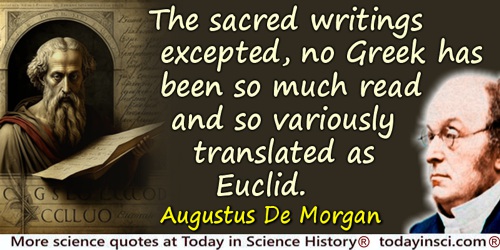
The sacred writings excepted, no Greek has been so much read and so variously translated as Euclid.
In Article 'Eucleides', in Smith, Dictionary of Greek and Roman Biology and Mythology (1902). A footnote adds: Riccardi, Bibliografia Euclidea (1887), lists nearly two thousand editions.
The thirteen books of Euclid must have been a tremendous advance, probably even greater than that contained in the Principia of Newton.
In Article 'Eucleides', in Smith, Dictionary of Greek and Roman Biology and Mythology (1902).
In other branches of science, where quick publication seems to be so much desired, there may possibly be some excuse for giving to the world slovenly or ill-digested work, but there is no such excuse in mathematics. The form ought to be as perfect as the substance, and the demonstrations as rigorous as those of Euclid. The mathematician has to deal with the most exact facts of Nature, and he should spare no effort to render his interpretation worthy of his subject, and to give to his work its highest degree of perfection. “Pauca sed matura” was Gauss’s motto.
In Presidential Address British Association for the Advancement of Science, Section A, (1890), Nature, 42, 467. [The Latin motto translates as “Few, but ripe”. —Webmaster]
The golden age of mathematics—that was not the age of Euclid, it is ours. Ours is the age when no less than six international congresses have been held in the course of nine years. It is in our day that more than a dozen mathematical societies contain a growing membership of more than two thousand men representing the centers of scientific light throughout the great culture nations of the world. It is in our time that over five hundred scientific journals are each devoted in part, while more than two score others are devoted exclusively, to the publication of mathematics. It is in our time that the Jahrbuch über die Fortschritte der Mathematik, though admitting only condensed abstracts with titles, and not reporting on all the journals, has, nevertheless, grown to nearly forty huge volumes in as many years. It is in our time that as many as two thousand books and memoirs drop from the mathematical press of the world in a single year, the estimated number mounting up to fifty thousand in the last generation. Finally, to adduce yet another evidence of a similar kind, it requires not less than seven ponderous tomes of the forthcoming Encyclopaedie der Mathematischen Wissenschaften to contain, not expositions, not demonstrations, but merely compact reports and bibliographic notices sketching developments that have taken place since the beginning of the nineteenth century.
In Lectures on Science, Philosophy and Art (1908), 8.
Euclid and Archimedes are allowed to be knowing, and to have demonstrated what they say: and yet whosoever shall read over their writings without perceiving the connection of their proofs, and seeing what they show, though he may understand all their words, yet he is not the more knowing. He may believe, indeed, but does not know what they say, and so is not advanced one jot in mathematical knowledge by all his reading of those approved mathematicians.
In Conduct of the Understanding, sect. 24.
The ancients devoted a lifetime to the study of arithmetic; it required days to extract a square root or to multiply two numbers together. Is there any harm in skipping all that, in letting the school boy learn multiplication sums, and in starting his more abstract reasoning at a more advanced point? Where would be the harm in letting the boy assume the truth of many propositions of the first four books of Euclid, letting him assume their truth partly by faith, partly by trial? Giving him the whole fifth book of Euclid by simple algebra? Letting him assume the sixth as axiomatic? Letting him, in fact, begin his severer studies where he is now in the habit of leaving off? We do much less orthodox things. Every here and there in one’s mathematical studies one makes exceedingly large assumptions, because the methodical study would be ridiculous even in the eyes of the most pedantic of teachers. I can imagine a whole year devoted to the philosophical study of many things that a student now takes in his stride without trouble. The present method of training the mind of a mathematical teacher causes it to strain at gnats and to swallow camels. Such gnats are most of the propositions of the sixth book of Euclid; propositions generally about incommensurables; the use of arithmetic in geometry; the parallelogram of forces, etc., decimals.
In Teaching of Mathematics (1904), 12.
They say that Ptolemy once asked him [Euclid] whether there was in geometry no shorter way than that of the elements and he replied, “There is no royal road to geometry”.
— Proclus
In (Edition Friedlein, 1873), Prol. II, 39.
To suppose that so perfect a system as that of Euclid’s Elements was produced by one man, without any preceding model or materials, would be to suppose that Euclid was more than man. We ascribe to him as much as the weakness of human understanding will permit, if we suppose that the inventions in geometry, which had been made in a tract of preceding ages, were by him not only carried much further, but digested into so admirable a system, that his work obscured all that went before it, and made them be forgot and lost.
In Essay on the Powers of the Human Mind (1812), Vol. 2, 368.
One striking peculiarity of mathematics is its unlimited power of evolving examples and problems. A student may read a book of Euclid, or a few chapters of Algebra, and within that limited range of knowledge it is possible to set him exercises as real and as interesting as the propositions themselves which he has studied; deductions which might have pleased the Greek geometers, and algebraic propositions which Pascal and Fermat would not have disdained to investigate.
In 'Private Study of Mathematics', Conflict of Studies and other Essays (1873), 82.
I should like to draw attention to the inexhaustible variety of the problems and exercises which it [mathematics] furnishes; these may be graduated to precisely the amount of attainment which may be possessed, while yet retaining an interest and value. It seems to me that no other branch of study at all compares with mathematics in this. When we propose a deduction to a beginner we give him an exercise in many cases that would have been admired in the vigorous days of Greek geometry. Although grammatical exercises are well suited to insure the great benefits connected with the study of languages, yet these exercises seem to me stiff and artificial in comparison with the problems of mathematics. It is not absurd to maintain that Euclid and Apollonius would have regarded with interest many of the elegant deductions which are invented for the use of our students in geometry; but it seems scarcely conceivable that the great masters in any other line of study could condescend to give a moment’s attention to the elementary books of the beginner.
In Conflict of Studies (1873), 10-11.
Euclid always contemplates a straight line as drawn between two definite points, and is very careful to mention when it is to be produced beyond this segment. He never thinks of the line as an entity given once for all as a whole. This careful definition and limitation, so as to exclude an infinity not immediately apparent to the senses, was very characteristic of the Greeks in all their many activities. It is enshrined in the difference between Greek architecture and Gothic architecture, and between Greek religion and modern religion. The spire of a Gothic cathedral and the importance of the unbounded straight line in modern Geometry are both emblematic of the transformation of the modern world.
In Introduction to Mathematics (1911), 119.
In Euclid each proposition stands by itself; its connection with others is never indicated; the leading ideas contained in its proof are not stated; general principles do not exist. In modern methods, on the other hand, the greatest importance is attached to the leading thoughts which pervade the whole; and general principles, which bring whole groups of theorems under one aspect, are given rather than separate propositions. The whole tendency is toward generalization. A straight line is considered as given in its entirety, extending both ways to infinity, while Euclid is very careful never to admit anything but finite quantities. The treatment of the infinite is in fact another fundamental difference between the two methods. Euclid avoids it, in modern mathematics it is systematically introduced, for only thus is generality obtained.
In 'Geometry', Encyclopedia Britannica (9th edition).
It is known that the mathematics prescribed for the high school [Gymnasien] is essentially Euclidean, while it is modern mathematics, the theory of functions and the infinitesimal calculus, which has secured for us an insight into the mechanism and laws of nature. Euclidean mathematics is indeed, a prerequisite for the theory of functions, but just as one, though he has learned the inflections of Latin nouns and verbs, will not thereby be enabled to read a Latin author much less to appreciate the beauties of a Horace, so Euclidean mathematics, that is the mathematics of the high school, is unable to unlock nature and her laws.
In Die Mathematik die Fackelträgerin einer neuen Zeit (1889), 37-38. As translated in Robert Édouard Moritz, Memorabilia Mathematica; Or, The Philomath’s Quotation-book (1914), 112.
Euclidean mathematics assumes the completeness and invariability of mathematical forms; these forms it describes with appropriate accuracy and enumerates their inherent and related properties with perfect clearness, order, and completeness, that is, Euclidean mathematics operates on forms after the manner that anatomy operates on the dead body and its members. On the other hand, the mathematics of variable magnitudes—function theory or analysis—considers mathematical forms in their genesis. By writing the equation of the parabola, we express its law of generation, the law according to which the variable point moves. The path, produced before the eyes of the student by a point moving in accordance to this law, is the parabola.
If, then, Euclidean mathematics treats space and number forms after the manner in which anatomy treats the dead body, modern mathematics deals, as it were, with the living body, with growing and changing forms, and thus furnishes an insight, not only into nature as she is and appears, but also into nature as she generates and creates,—reveals her transition steps and in so doing creates a mind for and understanding of the laws of becoming. Thus modern mathematics bears the same relation to Euclidean mathematics that physiology or biology … bears to anatomy.
If, then, Euclidean mathematics treats space and number forms after the manner in which anatomy treats the dead body, modern mathematics deals, as it were, with the living body, with growing and changing forms, and thus furnishes an insight, not only into nature as she is and appears, but also into nature as she generates and creates,—reveals her transition steps and in so doing creates a mind for and understanding of the laws of becoming. Thus modern mathematics bears the same relation to Euclidean mathematics that physiology or biology … bears to anatomy.
In Die Mathematik die Fackelträgerin einer neuen Zeit (1889), 38. As translated in Robert Édouard Moritz, Memorabilia Mathematica; Or, The Philomath’s Quotation-book (1914), 112-113.
What distinguishes the straight line and circle more than anything else, and properly separates them for the purpose of elementary geometry? Their self-similarity. Every inch of a straight line coincides with every other inch, and of a circle with every other of the same circle. Where, then, did Euclid fail? In not introducing the third curve, which has the same property—the screw. The right line, the circle, the screw—the representations of translation, rotation, and the two combined—ought to have been the instruments of geometry. With a screw we should never have heard of the impossibility of trisecting an angle, squaring the circle, etc.
From Letter (15 Feb 1852) to W.R. Hamilton, collected in Robert Perceval Graves, Life of W.R. Hamilton (1889), Vol. 3, 343.
He [Lord Bacon] appears to have been utterly ignorant of the discoveries which had just been made by Kepler’s calculations … he does not say a word about Napier’s Logarithms, which had been published only nine years before and reprinted more than once in the interval. He complained that no considerable advance had been made in Geometry beyond Euclid, without taking any notice of what had been done by Archimedes and Apollonius. He saw the importance of determining accurately the specific gravities of different substances, and himself attempted to form a table of them by a rude process of his own, without knowing of the more scientific though still imperfect methods previously employed by Archimedes, Ghetaldus and Porta. He speaks of the εὕρηκα of Archimedes in a manner which implies that he did not clearly appreciate either the problem to be solved or the principles upon which the solution depended. In reviewing the progress of Mechanics, he makes no mention either of Archimedes, or Stevinus, Galileo, Guldinus, or Ghetaldus. He makes no allusion to the theory of Equilibrium. He observes that a ball of one pound weight will fall nearly as fast through the air as a ball of two, without alluding to the theory of acceleration of falling bodies, which had been made known by Galileo more than thirty years before. He proposed an inquiry with regard to the lever,—namely, whether in a balance with arms of different length but equal weight the distance from the fulcrum has any effect upon the inclination—though the theory of the lever was as well understood in his own time as it is now. … He speaks of the poles of the earth as fixed, in a manner which seems to imply that he was not acquainted with the precession of the equinoxes; and in another place, of the north pole being above and the south pole below, as a reason why in our hemisphere the north winds predominate over the south.
From Spedding’s 'Preface' to De Interpretations Naturae Proœmium, in The Works of Francis Bacon (1857), Vol. 3, 511-512. [Note: the Greek word “εὕρηκα” is “Eureka” —Webmaster.]
Someone who had begun to read geometry with Euclid, when he had learned the first proposition, asked Euclid, “But what shall I get by learning these things?” whereupon Euclid called his slave and said, “Give him three-pence, since he must make gain out of what he learns.”
As quoted in Robert Édouard Moritz, Memorabilia Mathematica; Or, The Philomath's Quotation-Book (1914), 152-153, citing Stobaeus, Edition Wachsmuth (1884), Ecl. II.
…as passionlessly as a Euclidean theorem.
In Lost Horizon (1933, 1962), 49.
In geometry I find certain imperfections which I hold to be the reason why this science, apart from transition into analytics, can as yet make no advance from that state in which it came to us from Euclid.
As belonging to these imperfections, I consider the obscurity in the fundamental concepts of the geometrical magnitudes and in the manner and method of representing the measuring of these magnitudes, and finally the momentous gap in the theory of parallels, to fill which all efforts of mathematicians have so far been in vain.
As belonging to these imperfections, I consider the obscurity in the fundamental concepts of the geometrical magnitudes and in the manner and method of representing the measuring of these magnitudes, and finally the momentous gap in the theory of parallels, to fill which all efforts of mathematicians have so far been in vain.
In Geometric Researches on the Theory of Parallels (1840), as translated by George Bruce Halstead (new ed. 1914) 11.
Criticism of first principles which Aristotle and Ptolemy and Galen underwent waited longer in Euclid’s case than in theirs, it came for him at last. What Vesalius was to Galen, what Copernicus was to Ptolemy, that was Lobatchewsky to Euclid. There is, indeed, a somewhat instructive parallel between … Copernicus and Lobatchewsky.
In 'The Postulates of Time And Space', Lectures and Essays (1901), Vol. 1, 356.
The emancipation of logic from the yoke of Aristotle very much resembles the emancipation of geometry from the bondage of Euclid; and, by its subsequent growth and diversification, logic, less abundantly perhaps but not less certainly than geometry, has illustrated the blessings of freedom.
From Book Review in Science (19 Jan 1912), 35, No. 890, 108. Keyser was reviewing Alfred North Whitehead and Bertrand Russell, Principia Mathematica (1910).
Mathematical instruction, in this as well as in other countries, is laboring under a burden of century-old tradition. Especially is this so with reference to the teaching of geometry. Our texts in this subject are still patterned more or less closely after the model of Euclid, who wrote over two thousand years ago, and whose text, moreover, was not intended for the use of boys and girls, but for mature men.
In Lectures on Fundamental Concepts of Algebra and Geometry (1911), 5.
I should feel it a grave sense of loss (as you would) if a hundred years from now Shakespeare and Newton are historical fossils in the ascent of man, in the way that Homer and Euclid are.
In The Ascent of Man (2011), 329. Although printed within single quote marks, these words are presumably not verbatim, but only a narrative recollection of a conversation with the author (during WWII, in a taxi, about von Neumann’s Theory of Games).
I have given up newspapers in exchange for Tacitus & Thucydides, for Newton & Euclid; & I find myself much the happier.
From Letter to John Adams, (21 Jan 1812). Collected in J. Jefferson Looney (ed.), The Papers of Thomas Jefferson, Retirement Series, Vol. 4. (2007), 429.
Any modern schoolboy, wrestling joyously and earnestly with some problem in the geometry of the triangle, is far closer to Euclid than he could possibly get by studying any history of Greek mathematics.
From Lecture (28 Nov 1957) in the Queen’s University, Belfast, 'Is the Study of its History a Brake on the Progress of Science', printed in Hermethena (1958), 19, 23.
I believe that until comparatively recent times, say a hundred years ago, few scientists would have regarded the word useful as applicable to their work. … If Euclid and Newton did scoff at utility, how useful their work now appears! Where would modern technology be without geometry, without dynamics, without the differential calculus?
From Lecture (28 Nov 1957) in the Queen’s University, Belfast, 'Is the Study of its History a Brake on the Progress of Science', printed in Hermethena (1958), 19, 31-32.
 In science it often happens that scientists say, 'You know that's a really good argument; my position is mistaken,' and then they would actually change their minds and you never hear that old view from them again. They really do it. It doesn't happen as often as it should, because scientists are human and change is sometimes painful. But it happens every day. I cannot recall the last time something like that happened in politics or religion.
(1987) --
In science it often happens that scientists say, 'You know that's a really good argument; my position is mistaken,' and then they would actually change their minds and you never hear that old view from them again. They really do it. It doesn't happen as often as it should, because scientists are human and change is sometimes painful. But it happens every day. I cannot recall the last time something like that happened in politics or religion.
(1987) -- 





