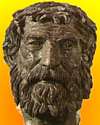
 (source)
|
Empedocles
(c. 492 B.C. - c. 432 B.C.)
Greek philosopher.
|
Science Quotes by Empedocles (7 quotes)
[On the volcano.] And many a fire there burns beneath the ground.
— Empedocles
Fragment 52. In The Fragments of Empedocles, translated by William Ellery Leonard, (1908), 35.
But come, hear my words, for truly learning causes the mind to grow. For as I said before in declaring the ends of my words … at one time there grew to be the one alone out of many, and at another time it separated so that there were many out of the one; fire and water and earth and boundless height of air, and baneful Strife apart from these, balancing each of them, and Love among them, their equal in length and breadth.
— Empedocles
From The Fragments, Bk. 1, line 74. In Arthur Fairbanks (ed., trans.), Quotations from The First Philosophers of Greece (1898), 167-168.
Earth’s sweat, the sea.
— Empedocles
Fragment 55. In The Fragments of Empedocles, translated by William Ellery Leonard, (1908), 36.
Iris from sea brings wind or mighty rain.
— Empedocles
Fragment 50. In The Fragments of Empedocles, translated by William Ellery Leonard, (1908), 35.
Many races of living creatures must have been unable to continue their breed: for in the case of every species that now exists, either craft, or courage, or speed, has from the beginning of its existence protected and preserved it.
— Empedocles
Various accounts of Empedocles’ death are given in ancient sources. His enemies said that his desire to be thought a god led him to throw himself into the crater of Mount Etna so that he might vanish from the world completely and thus lead men to believe he had achieved apotheosis. Unfortunately the volcano defeated his design by throwing out one of the philosopher’s sandals.
— Empedocles
As described in Clifton Fadiman (ed.), André Bernard (ed.), Bartlett's Book of Anecdotes (2000), 193, citing Oxford Classical Dictionary.
What is right may well be said even twice.
— Empedocles
Fragment 25, as translated by John Burnet in Oliver Joseph Thatcher (ed.) The Library of Original Sources (1907), Vol. 2, 162. Also translated as “What must be said, may well be said twice o’er”, in William Ellery Leonard (trans.), The Fragments of Empedocles (1908), 27.
Quotes by others about Empedocles (3)
At first sight nothing seems more obvious than that everything has a beginning and an end, and that everything can be subdivided into smaller parts. Nevertheless, for entirely speculative reasons the philosophers of Antiquity, especially the Stoics, concluded this concept to be quite unnecessary. The prodigious development of physics has now reached the same conclusion as those philosophers, Empedocles and Democritus in particular, who lived around 500 B.C. and for whom even ancient man had a lively admiration.
'Development of the Theory of Electrolytic Dissociation', Nobel Lecture, 11 December 1903. In Nobel Lectures: Chemistry 1901-1921 (1966), 45.
For even they who compose treatises of medicine or natural philosophy in verse are denominated Poets: yet Homer and Empedocles have nothing in common except their metre; the former, therefore, justly merits the name of the Poet; while the other should rather be called a Physiologist than a Poet.
Aristotle’s Treatise on Poetry, I:2, trans. Thomas Twining (1957), 103
Great Empedocles, that ardent soul,
Leapt into Etna and was roasted whole.
Leapt into Etna and was roasted whole.
As quoted, from an unknown poet, in Bertrand Russell, A History of Western Philosophy (1946), 60.
 In science it often happens that scientists say, 'You know that's a really good argument; my position is mistaken,' and then they would actually change their minds and you never hear that old view from them again. They really do it. It doesn't happen as often as it should, because scientists are human and change is sometimes painful. But it happens every day. I cannot recall the last time something like that happened in politics or religion.
(1987) --
In science it often happens that scientists say, 'You know that's a really good argument; my position is mistaken,' and then they would actually change their minds and you never hear that old view from them again. They really do it. It doesn't happen as often as it should, because scientists are human and change is sometimes painful. But it happens every day. I cannot recall the last time something like that happened in politics or religion.
(1987) -- 




