 (source)
|
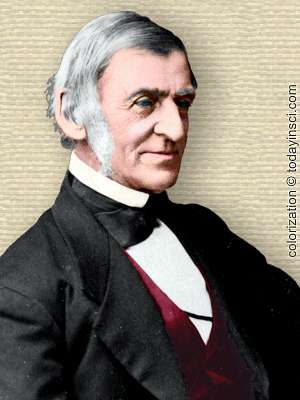
Ralph Waldo Emerson
(25 May 1803 - 27 Apr 1882)
American essayist and philosopher whose transcendental philosophy combined strains of European Romanticism, Oriental supernaturalism, American optimism and practicality. Later he participated in national issues and delivered many antislavery speeches, even welcoming the beginning of Civil War.
|
Science Quotes by Ralph Waldo Emerson (165 quotes)
...sometimes a scream is better than a thesis.
— Ralph Waldo Emerson
Journal entry (23 Apr 1838), Ralph Waldo Emerson and Joel Porte (ed.), Emerson in His Journals (1960, 1982), 185.
’Tis a short sight to limit our faith in laws to those of gravity, of chemistry, of botany, and so forth. Those laws do not stop where our eyes lose them, but push the same geometry and chemistry up into the invisible plane of social and rational life, so that, look where we will, in a boy's game, or in the strifes of races, a perfect reaction, a perpetual judgment keeps watch and ward.
— Ralph Waldo Emerson
From 'Worship', The Conduct of Life (1860) collected in The Complete Works of Ralph Waldo Emerson (1866), Vol.2, 401.
[Napoleon] directed Bourrienne to leave all his letters unopened for three weeks, and then observed with satisfaction how large a part of the correspondence had thus disposed of itself, and no longer required an answer.
— Ralph Waldo Emerson
Lecture, 'Napoleon', collected in Representative Men (1850), 177.
[W]e pity our fathers for dying before steam and galvanism, sulphuric ether and ocean telegraphs, photograph and spectrograph arrived, as cheated out of their human estate.
— Ralph Waldo Emerson
'Works and Days', Emerson's Complete Works (1883), 152.
Πάντα ῥεῖ : all things are in flux. It is inevitable that you are indebted to the past. You are fed and formed by it. The old forest is decomposed for the composition of the new forest. The old animals have given their bodies to the earth to furnish through chemistry the forming race, and every individual is only a momentary fixation of what was yesterday another’s, is today his and will belong to a third to-morrow. So it is in thought.
— Ralph Waldo Emerson
In Lecture, second in a series given at Freeman Place Chapel, Boston (Mar 1859), 'Quotation and Originality', collected in Letters and Social Aims (1875, 1917), 200. The Greek expression, “panta rei” is a quote from Heraclitus.
Nature, in the common sense, refers to essences unchanged by man; space, the air, the river, the leaf.
— Ralph Waldo Emerson
From 'Introduction' in his first published book (at first, anonymously), Nature (1836), 7.
A foolish consistency is the hobgoblin of little minds, adored by little statesmen and philosophers and divines.
— Ralph Waldo Emerson
From 'Self-Reliance', collected in The Complete Works of Ralph Waldo Emerson (1903), 57.
A great man quotes bravely, and will not draw on his invention when his memory serves him with a word as good.
— Ralph Waldo Emerson
In Lecture, second in a series given at Freeman Place Chapel, Boston (Mar 1859), 'Quotation and Originality', collected in Letters and Social Aims (1875, 1917), 183.
A man should carry nature in his head.
— Ralph Waldo Emerson
'Concord Walks'. The Complete Works of Ralph Waldo Emerson (1904), Vol. 12, 176.
A sufficient measure of civilization is the influence of good women.
— Ralph Waldo Emerson
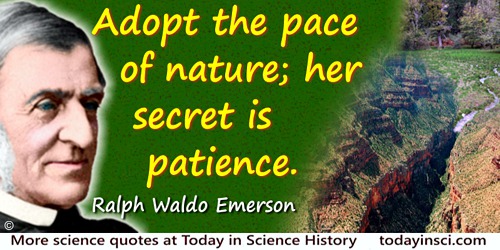
Adopt the pace of nature; her secret is patience.
— Ralph Waldo Emerson
In 'Education', The Works of Ralph Waldo Emerson: Vol X: Lectures and Biographical Sketches (1883), 152.
All is riddle, and the key to a riddle is another riddle.
— Ralph Waldo Emerson
In 'Illusions,' The Conduct of Life (1860).
All minds quote. Old and new make the warp and woof of every moment. There is no thread that is not a twist of these two strands.
— Ralph Waldo Emerson
In Lecture, second in a series given at Freeman Place Chapel, Boston (Mar 1859), 'Quotation and Originality', Letters and Social Aims (1875, 1917), 178.
All science has one aim, namely, to find a theory of nature.
— Ralph Waldo Emerson
In Nature (1849), 2.
All successful men have agreed to one thing,—they were causationists. They believed that things went not by luck, but by law; that there was not a weak or a cracked link in the chain that joins the first and last of things.
— Ralph Waldo Emerson
From 'Power', The Conduct of Life (1860), collected in The Prose Works of Ralph Waldo Emerson (1870), 343.
All the earths are burnt metals.
— Ralph Waldo Emerson
In 'Perpetual Forces', North American Review (1877), No. 125. Collected in Ralph Waldo Emerson and James Elliot Cabot (ed.), Lectures and Biographical Sketches (1883), 60.
All thoughts of a turtle are turtles, and of a rabbit, rabbits.
— Ralph Waldo Emerson
In Lecture (1870) at Harvard University, 'The Natural History of Intellect', collected in Natural History of Intellect: And Other Papers (1893), 50.
An institution is the lengthened shadow of one man.
— Ralph Waldo Emerson
From 'Self-Reliance', collected in The Complete Works of Ralph Waldo Emerson (1903), 61.
And all their botany is Latin names.
— Ralph Waldo Emerson
As Arkwright and Whitney were the demi-gods of cotton, so prolific Time will yet bring an inventor to every plant. There is not a property in nature but a mind is born to seek and find it.
— Ralph Waldo Emerson
In Fortune of the Republic (1878), 3.
As plants convert the minerals into food for animals, so each man converts some raw material in nature to human use. The inventors of fire, electricity, magnetism, iron, lead, glass, linen, silk, cotton; the makers of tools; the inventor of decimal notation, the geometer, the engineer, the musician, severally make an easy way for all, through unknown and impossible confusions.
— Ralph Waldo Emerson
In 'Uses of Great Men', Representative Men (1850), 5-6.
Astronomy is a cold, desert science, with all its pompous figures,—depends a little too much on the glass-grinder, too little on the mind. ’Tis of no use to show us more planets and systems. We know already what matter is, and more or less of it does not signify.
— Ralph Waldo Emerson
In 'Country Life', collected in The Complete Works of Ralph Waldo Emerson (1904), Vol. 12, 166.
Astronomy taught us our insignificance in Nature.
— Ralph Waldo Emerson
In 'Historic Notes of Life and Letters in New England', Emerson's Complete Works: Lectures and Biographical Sketches (1883), 317.
Bad times have a scientific value. These are occasions a good learner would not miss.
— Ralph Waldo Emerson
In 'Considerations by the Way', The Conduct of Life (1860) collected in The Works of Ralph Waldo Emerson: Comprising His Essays, Lectures, Poems and Orations (1882), Vol. 2, 420.
Beware when the great God lets loose a thinker on this planet. Then all things are at risk. ... There is not a piece of science, but its flank may be turned to-morrow.
— Ralph Waldo Emerson
From 'Circles', collected in The Complete Works of Ralph Waldo Emerson (1903), 308.
Coal … We may well call it black diamonds. Every basket is power and civilization; for coal is a portable climate. … Watt and Stephenson whispered in the ear of mankind their secret, that a half-ounce of coal will draw two tons a mile, and coal carries coal, by rail and by boat, to make Canada as warm as Calcutta, and with its comforts bring its industrial power.
— Ralph Waldo Emerson
In chapter 3, 'Wealth', The Conduct of Life (1860), collected in Emerson’s Complete Works (1892), Vol. 6, 86.
Come, see the north-wind’s masonry,
Out of an unseen quarry evermore
Furnished with tile, the fierce artificer
Curves his white bastions with projected roof
Round every windward stake, or tree, or door.
Speeding, the myriad-handed, his wild work
So fanciful, so savage, naught cares he
For number or proportion.
Out of an unseen quarry evermore
Furnished with tile, the fierce artificer
Curves his white bastions with projected roof
Round every windward stake, or tree, or door.
Speeding, the myriad-handed, his wild work
So fanciful, so savage, naught cares he
For number or proportion.
— Ralph Waldo Emerson
From 'The Snow-Storm', Poems of R. W. Emerson (1847), 65-66.
Common sense is as rare as genius—is the basis of genius and experience is the hands and feet to every enterprise.
— Ralph Waldo Emerson
In essay, 'Experience', Essays: Second Series (1844), collected in Works of Ralph Waldo Emerson: Essays First and Second Series (1883), 97. A half-century later, Arthur Handly Marks incorporated the quote (without attribution) as “a first-rate article of common sense is as rare as genius”, in his Address (6 Jun 1892), 'Common Sense' at the Commencement of Prior Institute, Jasper, Tennessee, collected in Igerne and Other Writings of Arthur Handly Marks (1897), 348.
Conversation in society is found to be on a platform so low as to exclude science, the saint, and the poet.
— Ralph Waldo Emerson
In Ralph Waldo Emerson and J.E. Cabot (ed.), Emerson's Complete Works (1884), Vol. 7, 218.
Dare to live the life you have dreamed for yourself. Go forward and make your dreams come true.
— Ralph Waldo Emerson
…...

Do not go where the path may lead, go instead where there is no path and leave a trail.
— Ralph Waldo Emerson
…...
Do what we can, summer will have its flies.
— Ralph Waldo Emerson
…...
Drive out Nature with a fork, she comes running back.
— Ralph Waldo Emerson
Emerson's translation of a much earlier saying, as given in 'Compensation', collected in The Complete Works of Ralph Waldo Emerson (1903), 105. A note on p.399 shows the same sentiment in the original Latin by Horace in his Epistles, i, x, 24: “Naturam expelles furca, tamen usque recurret,/Et mala perrumpet furtim fastidia victrix.” The first part of the couplet translates as above; the second part adds “And will burst through your foolish contempt, triumphant.” More examples, predating Emerson, are given in George Latimer Apperson and Martin H. Manser, The Concise Dictionary of English Etymology (1993, 2006), 158.
Each science and law is … prospective and fruitful. Astronomy is not yet astronomy, whilst it only counts the stars in the sky. It must come nearer, and be related to men and their life.
— Ralph Waldo Emerson
From Notes to 'Progress of Culture' in The Complete Works of Ralph Waldo Emerson: Letters and Social Aims (1875, 1904), Vol. 8, 409.

Earth laughs in flowers.
— Ralph Waldo Emerson
From poem, 'Hamareya', collected in Poems of Ralph Waldo Emerson (1847), 39.
English science … isolates the reptile or mollusk it assumes to explain; whilst reptile or mollusk only exists in system, in relation.
— Ralph Waldo Emerson
In essay, 'Literature', English Traits (1856), collected in Works of Ralph Waldo Emerson: Essays First and Second Series (1883), 341.
Every appearance in nature corresponds to some state of the mind, and that state of the mind can only be described by presenting that natural appearance as its picture. An enraged man is a lion, a cunning man is a fox, a firm man is a rock, a learned man is a torch. A lamb is innocence; a snake is subtle spite; flowers express to us the delicate affections. Light and darkness are our familiar expressions for knowledge and ignorance ; and heat for love. Visible distance behind and before us, is respectively our image of memory and hope.
— Ralph Waldo Emerson
In essay, 'Language', collected in Nature: An Essay ; And, Lectures on the Times (1844), 23-24.
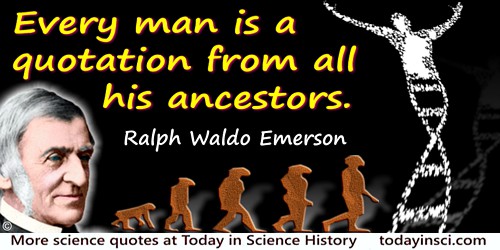
Every book is a quotation; and every house is a quotation out of all forests and mines and stone-quarries; and every man is a quotation from all his ancestors.
— Ralph Waldo Emerson
Epigraph for chapter 'Quotation and Originality', in Letters and Social Aims (1875, 1917), 176.
Every chemical substance, every plant, every animal in its growth, teaches the unity of the cause, the variety of appearance.
— Ralph Waldo Emerson
In 'History,' Essays: First Series (1841).
Every natural fact is a symbol of some spiritual fact.
— Ralph Waldo Emerson
In essay, 'Language', collected in Nature: An Essay ; And, Lectures on the Times (1844), 23.
Everything in nature contains all the powers of nature. Everything is made of one hidden stuff.
— Ralph Waldo Emerson
In James Wood, Dictionary of Quotations from Ancient and Modern, English and Foreign Sources (1893), 94:24.
Everything in nature goes by law, and not by luck.
— Ralph Waldo Emerson
In James Wood, Dictionary of Quotations from Ancient and Modern, English and Foreign Sources (1893), 94:25.
Everything in nature is bipolar, or has a positive and a negative pole.
— Ralph Waldo Emerson
From essay, 'Character', collected in Ralph Waldo Emerson and J.E. Cabot (ed.), Emerson's Complete Works: Essays, Second Series (1884), Vol. 3, 96.
For the world was built in order,
And the atoms march in tune.
And the atoms march in tune.
— Ralph Waldo Emerson
In poem, 'Monadnock', collected in Works of Ralph Waldo Emerson (1883), 533.

Geology itself is only chemistry with the element of time added.
— Ralph Waldo Emerson
In 'Progress of Culture', an address read to the Phi Beta Kappa Society at Cambridge, 18 July 1867. Collected in Works of Ralph Waldo Emerson (1883), 475.
Great men are they who see that spiritual is stronger than any material force—that thoughts rule the world.
— Ralph Waldo Emerson
In James Elliot Cabot (ed.), Emerson's Complete Works: Letters and Social Aims (1883), Vol. 8, 217.
Guard well your spare moments. They are like uncut diamonds. Discard them and their value will never be known. Improve them and they will become the brightest gems in a useful life.
— Ralph Waldo Emerson
…...
He who knows what sweets and virtues are in the ground, the waters, the plants, the heavens, and how to come at these enchantments, is the rich and royal man.
— Ralph Waldo Emerson
From 'Nature', collected in Essays, Second Series (1844), 188.
Human society is made up of partialities. Each citizen has an interest and a view of his own, which, if followed out to the extreme, would leave no room for any other citizen.
— Ralph Waldo Emerson
I with my hammer pounding evermore
The rocky coast, smite Andes into dust.
Strewing my bed and, in another age.
Rebuild a continent for better men.
The rocky coast, smite Andes into dust.
Strewing my bed and, in another age.
Rebuild a continent for better men.
— Ralph Waldo Emerson
Poem, 'Seashore' (1857), published in The Boatswain’s Whistle (Boston 18 Nov 1864). Collected in Percy H. Boynton (ed.), American poetry (1921), 217. The blank verse of this poem was recast from a prose passage he wrote in his journal (3 Jul 1857), the day after a two-week visit to Cap Ann.
If a man would be alone, let him look at the stars. … One might think the atmosphere was made transparent with this design, to give man, in the heavenly bodies, the perpetual presence of the sublime.
— Ralph Waldo Emerson
In 'Nature', The Prose Works of Ralph Waldo Emerson (1870), Vol. 1, Chap 1, 7.
If a man write a better book, preach a better sermon, or make a better mouse-trap than his neighbour, tho' he build his house in the woods, the world will make a beaten path to his door.
— Ralph Waldo Emerson
Attributed to Emerson by Sarah S. B. Yule, in her book Borrowings (compiled 1889, published 1893). Mrs Yule was quoted in The Docket (Feb 1912), that she wrote this in her notebook of memorable statements during an Emerson address. The Docket thus disproved Elbert Hubbard's claim to its authorship.
If we walk in the woods, we must feed mosquitoes.
— Ralph Waldo Emerson
From 'Prudence', Essays, First Series (1847, 1869), 205.
Immortality. I notice that as soon as writers broach this question they begin to quote. I hate quotation. Tell me what you know.
May 1849:
— Ralph Waldo Emerson
From his Journal (May 1849). Collected in Journals of Ralph Waldo Emerson, 1820-1872 (1876, 1912), Vol. 8, 20.
In a library we are surrounded by many hundreds of dear friends, but they are imprisoned by an enchanter in these paper and leathern boxes; and though they know us, and have been waiting two, ten, or twenty centuries for us,—some of them,—and are eager to give us a sign and unbosom themselves, it is the law of their limbo that they must not speak until spoken to; and as the enchanter has dressed them, like battalions of infantry, in coat and jacket of one cut, by the thousand and ten thousand, your chance of hitting on the right one is to be computed by the arithmetical rule of Permutation and Combination,—not a choice out of three caskets, but out of half a million caskets, all alike.
— Ralph Waldo Emerson
In essay 'Books', collected in Society and Solitude (1870, 1871), 171
In every work of genius we recognize our own rejected thoughts; they come back to us with a certain alienated majesty.
— Ralph Waldo Emerson
In 'Self-Reliance', The Prose Works of Ralph Waldo Emerson (1870), Vol. 1, 241.
In modern Europe, the Middle Ages were called the Dark Ages. Who dares to call them so now? … Their Dante and Alfred and Wickliffe and Abelard and Bacon; their Magna Charta, decimal numbers, mariner’s compass, gunpowder, glass, paper, and clocks; chemistry, algebra, astronomy; their Gothic architecture, their painting,—are the delight and tuition of ours. Six hundred years ago Roger Bacon explained the precession of the equinoxes, and the necessity of reform in the calendar; looking over how many horizons as far as into Liverpool and New York, he announced that machines can be constructed to drive ships more rapidly than a whole galley of rowers could do, nor would they need anything but a pilot to steer; carriages, to move with incredible speed, without aid of animals; and machines to fly into the air like birds.
— Ralph Waldo Emerson
In 'Progress of Culture', an address read to the Phi Beta Kappa Society at Cambridge, 18 July 1867. Collected in Works of Ralph Waldo Emerson (1883), 475.
In science we have to consider two things: power and circumstance.
— Ralph Waldo Emerson
In James Wood, Dictionary of Quotations from Ancient and Modern, English and Foreign Sources (1893), 189:44.
In this great society wide lying around us, a critical analysis would find very few spontaneous actions. It is almost all custom and gross sense.
— Ralph Waldo Emerson
Intellect is void of affection and sees an object as it stands in the light of science, cool and disengaged. The intellect goes out of the individual, floats over its own personality, and regards it as a fact, and not as I and mine.
— Ralph Waldo Emerson
From 'Intellect', collected in The Complete Works of Ralph Waldo Emerson (1903), 326.
Invention breeds invention.
— Ralph Waldo Emerson
Invention breeds invention. No sooner is the electric telegraph devised than gutta-percha, the very material it requires, is found. The aeronaut is provided with gun-cotton, the very fuel he wants for his balloon.
— Ralph Waldo Emerson
In Ralph Waldo Emerson and J.E. Cabot (ed.), Emerson's Complete Works (1884), Vol. 7, 161.
It is better to teach the child arithmetic and Latin grammar than rhetoric and moral philosophy, because they require exactitude of performance it is made certain that the lesson is mastered, and that power of performance is worth more than knowledge.
— Ralph Waldo Emerson
In Lecture on 'Education'. Collected in J.E. Cabot (ed.), The Complete Works of Ralph Waldo Emerson: Lectures and Biographical Sketches (1883), 145.
It is frivolous to fix pedantically the date of particular inventions. They have all been invented over and over fifty times. Man is the arch machine, of which all these shifts drawn from himself are toy models. He helps himself on each emergency by copying or duplicating his own structure, just so far as the need is.
— Ralph Waldo Emerson
It is much better to learn the elements of geology, of botany, or ornithology and astronomy by word of mouth from a companion than dully from a book.
— Ralph Waldo Emerson
'Concord Walks'. The Complete Works of Ralph Waldo Emerson (1904), Vol. 12, 176.
Language is the archives of history… . Language is fossil poetry.
— Ralph Waldo Emerson
From 'The Poet', Essays: Second Series, Essays & Lectures (1983), 457.
Language is the city to the building of which every human being brought a stone.
— Ralph Waldo Emerson
Let us make education brave and preventive. Politics is an afterwork, a poor patching. We are always a little late… We shall one day learn to supercede politics by education… We must begin higher up, namely in Education.
— Ralph Waldo Emerson
Culture (1860). Quoted in Bruce A. Kimball, The True Professional Ideal in America: A History (1996), 198.
Life is girt all round with a zodiac of sciences, the contributions of men who have perished to add their point of light to our sky. ... These road-makers on every hand enrich us. We must extend the area of life and multiply our relations. We are as much gainers by finding a property in the old earth as by acquiring a new planet.
— Ralph Waldo Emerson
In James Wood, Dictionary of Quotations from Ancient and Modern, English and Foreign Sources (1893), 247:34.
Line in Nature is not found;
Unit and Universe are round.
Unit and Universe are round.
— Ralph Waldo Emerson
Poem, 'Uriel', collected in The Complete Works of Ralph Waldo Emerson: Poems (), 14
Magic and all that is ascribed to it is a deep presentiment of the powers of science. The shoes of swiftness, the sword of sharpness, the power of subduing the elements, of using the secret virtues of minerals, of understanding the voices of birds, are the obscure efforts of the mind in a right direction.
— Ralph Waldo Emerson
From 'History', collected in The Complete Works of Ralph Waldo Emerson (1903), 34.
Man carries the world in his head, the whole astronomy and chemistry suspended in a thought. Because the history of nature is charactered in his brain, therefore he is the prophet and discoverer of her secrets. Every known fact in natural science was divined by the presentiment of somebody, before it was actually verified.
— Ralph Waldo Emerson
Essay, 'Nature', in Ralph Waldo Emerson, Alfred Riggs Ferguson (ed.) and Jean Ferguson Carr (ed.), The Collected Works of Ralph Waldo Emerson, Volume III, Essays: Second Series (1984), 106-107.
Man was born to be rich, or, inevitably grows rich by the use of his faculties; by the union of thought with nature. Property is an intellectual production. The game requires coolness, right reasoning, promptness, and patience in the players. Cultivated labor drives out brute labor. An infinite number of shrewd men, in infinite years, have arrived at certain best and shortest ways of doing, and this accumulated skill in arts, cultures, harvestings, curings, manufactures, navigations, exchanges, constitutes the worth of our world to-day.
— Ralph Waldo Emerson
In 'Wealth', Power, Wealth, Illusions (1860, 1875), 56-57.

Men love to wonder, and that is the seed of our science.
— Ralph Waldo Emerson
From 'Works and Days' in Society and Solitude (1870). Collected in Emerson's Complete Works (1883), Vol. 7, 152.
More than the diamond Koh-i-noor, which glitters among their crown jewels, they prize the dull pebble which is wiser than a man, whose poles turn themselves to the poles of the world, and whose axis is parallel to the axis of the world. Now, their toys are steam and galvanism.
— Ralph Waldo Emerson
English Traits (1856), 47. The “dull pebble” refers to lodestone and its magnetic properties.
Nature arms each man with some faculty which enables him to do easily some feat impossible to any other.
— Ralph Waldo Emerson
In 'Wealth', Power, Wealth, Illusions (1860, 1875), 70.
Nature is a mutable cloud which is always and never the same.
— Ralph Waldo Emerson
In Essay 1, 'History', Essays by R.W. Emerson (1841), 11.
Nature is an endless combination and repetition of very few laws. She hums the old well-known air through innumerable variations.
— Ralph Waldo Emerson
Essays, Lectures and Orations (1851), 7.
Nature may be as selfishly studied as trade. Astronomy to the selfish becomes astrology; psychology, mesmerism (with intent to show where our spoons are gone); and anatomy and physiology become phrenology and palmistry.
— Ralph Waldo Emerson
Essay, 'Nature', in Ralph Waldo Emerson, Alfred Riggs Ferguson (ed.) and Jean Ferguson Carr (ed.), The Collected Works of Ralph Waldo Emerson, Volume III, Essays: Second Series (1984), 13.
Nature never wears a mean appearance. Neither does the wisest man extort her secret, and lose his curiosity by finding out all her perfection.
— Ralph Waldo Emerson
In Emerson’s Complete Works: Volume 1, Nature, Addresses and Lectures (1855, 1889), 13-14.
Nature tells every secret once.
— Ralph Waldo Emerson
From 'Behavior', collected in The Complete Works of Ralph Waldo Emerson, Volume 6: The Conduct of Life (1860), 169.
Nature will be reported. Everything in nature is engaged in writing its own history; the planet and the pebble are attended by their shadows, the rolling rock leaves its furrows on the mountain-side, the river its channel in the soil; the animal, its bones in the stratum; the fern and leaf, their modest epitaph in the coal.
— Ralph Waldo Emerson
In The Prose Works of Ralph Waldo Emerson (1847, 1872), Vol. 2, 141.
Newton and Laplace need myriads of ages and thick-strewn celestial areas. One may say a gravitating solar system is already prophesied in the nature of Newton’s mind.
— Ralph Waldo Emerson
In Essay on History.
No facts are to me sacred; none are profane; I simply experiment, an endless seeker, with no past at my back.
— Ralph Waldo Emerson
No great man ever complains of want of opportunity.
— Ralph Waldo Emerson
…...
No one can read the history of astronomy without perceiving that Copernicus, Newton, Laplace, are not new men, or a new kind of men, but that Thales, Anaximenes, Hipparchus, Empodocles, Aristorchus, Pythagorus, Oenipodes, had anticipated them.
— Ralph Waldo Emerson
In The Conduct of Life (1904), 18.
Nothing astonishes men so much as common sense and plain dealing.
— Ralph Waldo Emerson
In Art (1841), collected in Nature and Art (1896), 40.
https://books.google.com/books?id=
Ralph Waldo Emerson - 1896
Nothing great was ever achieved without enthusiasm
— Ralph Waldo Emerson
…...
Nothing is rich but the inexhaustible wealth of nature. She shows us only surfaces, but she is a million fathoms deep.
— Ralph Waldo Emerson
In 'Resources', Letters and Social Aims (1875, 1894), 113.
Now that is the wisdom of a man, in every instance of his labor, to hitch his wagon to a star, and see his chore done by the gods themselves. That is the way we are strong, by borrowing the might of the elements. The forces of steam, gravity, galvanism, light, magnets, wind, fire, serve us day by day and cost us nothing.
— Ralph Waldo Emerson
From Chap. 2, 'Civilization', in Society and Solitude (1870), 24.
Of the two eminent engineers in the recent construction of railways in England, Mr. Brunel went straight from terminus to terminus, through mountains, over streams, crossing highways, cutting ducal estates in two, and shooting through this man’s cellar, and that man’s attic window, and so arriving at his end, at great pleasure to geometers, but with cost to his company. Mr. Stephenson, on the contrary, believing that the river knows the way, followed his valley, as implicitly as our Western Railroad follows the Westfield River, and turned out to be the safest and cheapest engineer.
— Ralph Waldo Emerson
In 'Wealth', Power, Wealth, Illusions (1860, 1875), 80.
Old and new put their stamp to everything in Nature. The snowflake that is now falling is marked by both. The present moment gives the motion and the color of the flake, Antiquity its form and properties. All things wear a lustre which is the gift of the present, and a tarnish of time.
— Ralph Waldo Emerson
Epigraph for chapter 'Quotation and Originality', in Letters and Social Aims (1875, 1917), 175.
One definition of man is “an intelligence served by organs.”
— Ralph Waldo Emerson
From 'Works and Days' in Society and Solitude (1870). Collected in Emerson's Complete Works (1883), Vol. 7, 151.
Only an inventor knows how to borrow, and every man is or should be an inventor.
— Ralph Waldo Emerson
Our age is retrospective. It builds the sepulchres of the fathers. It writes biographies, histories, and criticism. The foregoing generations beheld God and nature face to face; we, through their eyes. Why should not we also enjoy an original relation to the universe.
— Ralph Waldo Emerson
Opening sentences of his first published book (at first, anonymously), 'Introduction', Nature (1836), 5.
Our knowledge is the amassed thought and experience of innumerable minds.
— Ralph Waldo Emerson
In Hialmer Day Gould, New Practical Spelling (1905), 15.
Science always goes abreast with the just elevation of the man, keeping step with religion and metaphysics; or, the state of science is an index of our self-knowledge.
— Ralph Waldo Emerson
In James Wood, Dictionary of Quotations from Ancient and Modern, English and Foreign Sources (1893), 382:23.
Science corrects the old creeds, sweeps away, with every new perception, our infantile catechisms, and necessitates a faith commensurate with the grander orbits and universal laws which it discloses yet it does not surprise the moral sentiment that was older and awaited expectant these larger insights.
— Ralph Waldo Emerson
Hialmer Day Gould and Edward Louis Hessenmueller, Best Thoughts of Best Thinkers (1904), 330.
Science does not know its debt to imagination.
— Ralph Waldo Emerson
In 'Letters and Social Aims: Poetry and Imagination', Prose works of Ralph Waldo Emerson (1880), Vol. 3, 199.
Science finds it methods.
— Ralph Waldo Emerson
Journal excerpt in 'Notes', collected in The Complete Works of Ralph Waldo Emerson (1903), 380.
Science in England, in America, is jealous of theory, hates the name of love and moral purpose. There's revenge for this humanity. What manner of man does science make? The boy is not attracted. He says, I do not wish to be such a kind of man as my professor is.
— Ralph Waldo Emerson
In essay. 'Beauty', collected in The Conduct of Life (1860), 250.
Science is a search after identity, and the scientific whim is lurking in all corners.
— Ralph Waldo Emerson
In 'Illusions', Power, Wealth, Illusions (1860, 1875) 94.
Science surpasses the old miracles of mythology, to fly with them over the sea, and to send their messages under it.
— Ralph Waldo Emerson
In 'Progress of Culture', an address read to the Phi Beta Kappa Society at Cambridge, 18 July 1867. Collected in Works of Ralph Waldo Emerson (1883), 473.
Science surpasses the old miracles of mythology.
— Ralph Waldo Emerson
'Progress of Culture', an address read to the Phi Beta Kappa Society at Cambridge, 18 July 1867. In Emerson's Complete Works (1883), Vol. 8, 197.
Science was false by being unpoetical. It assumed to explain a reptile or a mollusk, and isolated it—which is hunting for life in graveyards. Reptile or mollusk or man or angel only exists in system, in relation.
— Ralph Waldo Emerson
In 'Letters and Social Aims: Poetry and Imagination', Prose works of Ralph Waldo Emerson (1880), Vol. 3, 199.
Science, Nature,—O, I’ve yearned to open some page.
— Ralph Waldo Emerson
In 'Mary Moody Emerson', Emerson's Complete Works: Lectures and Biographical Sketches (1883), 401.
So use all that is called Fortune. Most men gamble with her, and gain all, and lose all, as her wheel rolls. But do thou leave as unlawful these winnings, and deal with Cause and Effect, the Chancellors of God.
— Ralph Waldo Emerson
From 'Self-Reliance', collected in The Complete Works of Ralph Waldo Emerson (1903), 89.
Society does not love its unmaskers.
— Ralph Waldo Emerson
Society will pardon much to genius and special gifts; but, being in its nature conventional, it loves what is conventional, or what belongs to coming together.
— Ralph Waldo Emerson
Something is wanting to science until it has been humanised.
— Ralph Waldo Emerson
In James Wood, Dictionary of Quotations from Ancient and Modern, English and Foreign Sources (1893), 399:18.

Steam is no stronger now than it was a hundred years ago, but it is put to better use.
— Ralph Waldo Emerson
In chapter 3, 'Wealth', The Conduct of Life (1860), collected in Emerson’s Complete Works (1892), Vol. 6, 86.
Teach me your mood,
O patient stars.
Who climb each night,
the ancient sky.
leaving on space no shade, no scars,
no trace of age, no fear to die.
O patient stars.
Who climb each night,
the ancient sky.
leaving on space no shade, no scars,
no trace of age, no fear to die.
— Ralph Waldo Emerson
…...
The astronomers said, ‘Give us matter and a little motion and we will construct the universe. It is not enough that we should have matter, we must also have a single impulse, one shove to launch the mass and generate the harmony of the centrifugal and centripetal forces.’ ... There is no end to the consequences of the act. That famous aboriginal push propagates itself through all the balls of the system, and through every atom of every ball.
— Ralph Waldo Emerson
From essay, 'Nature', collected in Ralph Waldo Emerson and J.E. Cabot (ed.), Emerson's Complete Works: Essays, Second Series (1884), Vol. 3, 176-177.
The book of Nature is the book of Fate. She turns the gigantic pages,—leaf after leaf,—never re-turning one. One leaf she lays down, a floor of granite; then a thousand ages, and a bed of slate; a thousand ages, and a measure of coal; a thousand ages, and a layer of marl and mud: vegetable forms appear; her first misshapen animals, zoophyte, trilobium, fish; then, saurians,—rude forms, in which she has only blocked her future statue, concealing under these unwieldy monsters the fine type of her coming king. The face of the planet cools and dries, the races meliorate, and man is born. But when a race has lived its term, it comes no more again.
— Ralph Waldo Emerson
From 'Fate', collected in The Complete Works of Ralph Waldo Emerson, Volume 6: The Conduct of Life (1860), 15. This paragraph is the prose version of his poem, 'Song of Nature'.
The coal on your grate gives out in decomposing to-day exactly the same amount of light and heat which was taken from the sunshine in its formation in the leaves and boughs of the antediluvian tree.
— Ralph Waldo Emerson
In 'Perpetual Forces', North American Review (1877), No. 125. Collected in Ralph Waldo Emerson and James Elliot Cabot (ed.), Lectures and Biographical Sketches (1883), 60.

The creation of a thousand forests is in one acorn.
— Ralph Waldo Emerson
From 'History', collected in Essays (1838, 1876), First Series, Essay 1, 11.
The dice of God are always loaded.
[A fragment from a lost play of Sophocles, “Ever the dice of Zeus fall well.”]
[A fragment from a lost play of Sophocles, “Ever the dice of Zeus fall well.”]
— Ralph Waldo Emerson
A colloquial translation, presumably ironic, from the original Greek phrase (preceding it), as given in 'Compensation', collected in The Complete Works of Ralph Waldo Emerson (1903), 102. The more literal translation of the original Greek is discussed in the added Notes section by Joseph Slater in The Collected Works of Ralph Waldo Emerson: First Series, Essays (1979), 234. Fragment translation from Paul Shorey, 'The Influence of Classics on American Literature', The Chautauquan (1906), 43, 129.
The field cannot be well seen from within the field. The astronomer must have his diameter of the earth's orbit as a base to fix the parallax of any other star
— Ralph Waldo Emerson
In James Wood, Dictionary of Quotations from Ancient and Modern, English and Foreign Sources (1893), 427:37.
The field cannot well be seen from within the field. The astronomer must have his diameter of the earth’s orbit as a base to find the parallax of any star.
— Ralph Waldo Emerson
In Essay 10, 'Circles', Essays by R.W. Emerson (1841), 314.
The first quality we know in matter is centrality,—we call it gravity,—which holds the universe together, which remains pure and indestructible in each mote, as in masses and planets, and from each atom rays out illimitable influence. To this material essence answers Truth, in the intellectual world,—Truth, whose centre is everywhere, and its circumference nowhere, whose existence we cannot disimagine,—the soundness and health of things, against which no blow can be struck but it recoils on the striker,—Truth, on whose side we always heartily are. And the first measure of a mind is its centrality, its capacity of truth, and its adhesion to it.
— Ralph Waldo Emerson
In 'Progress of Culture', an address read to the Phi Beta Kappa Society at Cambridge, 18 July 1867. Collected in Works of Ralph Waldo Emerson (1883), 477.
The first steps in Agriculture, Astronomy, Zoology, (those first steps which the farmer, the hunter, and the sailor take,) teach that nature's dice are always loaded; that in her heaps and rubbish are concealed sure and useful results.
— Ralph Waldo Emerson
In Nature (1849), 36.
The forest is my loyal friend
A Delphic shrine to me.
A Delphic shrine to me.
— Ralph Waldo Emerson
'Waldeinsamkeit', Works of Ralph Waldo Emerson (1876), Vol. 4, 157.
The Good Spirit never cared for the colleges, and though all men and boys were now drilled in Greek, Latin, and Mathematics, it had quite left these shells high on the beach, and was creating and feeding other matters [science] at other ends of the world.
— Ralph Waldo Emerson
The Prose Works of Ralph Waldo Emerson (1870), 553.
The greatest delight which the fields and woods minister, is the suggestion of an occult relation between man and the vegetable. I am not alone and unacknowledged. They nod to me, and I to them. The waving of the boughs in the storm, is new to me and old. It takes me by surprise, and yet is not unknown. Its effect is like that of a higher thought or a better emotion coming over me, when I deemed I was thinking justly or doing right.
— Ralph Waldo Emerson
In Nature: An Essay, to Which is Added, Orations, Lectures, and Addresses (1845), 5.
The idiot, the Indian, the child and unschooled farmer’s boy stand nearer to the light by which nature is to be read, than the dissector or the antiquary.
— Ralph Waldo Emerson
Concluding sentence in 'History', collected in The Complete Works of Ralph Waldo Emerson (1903), 41.
The journeying atoms,
Primordial wholes
Firmly draw, firmly drive
By their animate poles.
Primordial wholes
Firmly draw, firmly drive
By their animate poles.
— Ralph Waldo Emerson
In 'The Sphinx', first published in The Dial (Jan 1841) and placed first, as the Sphinx presiding over, in Emerson’s collection, Poems (1847), 8.
The language of the street is always strong. What can describe the folly and emptiness of scolding like the word jawing?
— Ralph Waldo Emerson
The law of nature is alternation for evermore. Each electrical state superinduces the opposite.
— Ralph Waldo Emerson
In Self-Reliance (1888, 1991), 111.
The laws of light and of heat translate each other;—so do the laws of sound and colour; and so galvanism, electricity and magnetism are varied forms of this selfsame energy.
— Ralph Waldo Emerson
In 'Letters and Social Aims: Poetry and Imagination', Prose works of Ralph Waldo Emerson (1880), Vol. 3, 198.
The lessons of science should be experimental also. The sight of a planet through a telescope is worth all the course on astronomy; the shock of the electric spark in the elbow outvalues all theories; the taste of the nitrous oxide, the firing of an artificial volcano, are better than volumes of chemistry.
— Ralph Waldo Emerson
The Prose Works of Ralph Waldo Emerson (1870), 552.
The lightning fell and the storm raged, and strata were deposited and uptorn and bent back, and Chaos moved from beneath, to create and flavor the fruit on your table to-day.
— Ralph Waldo Emerson
In 'Perpetual Forces', North American Review (1877), No. 125. Collected in Ralph Waldo Emerson and James Elliot Cabot (ed.), Lectures and Biographical Sketches (1883), 60.
The most advanced nations are always those who navigate the most.
— Ralph Waldo Emerson
In 'Society and Solitude: Civilization', The Prose Works of Ralph Waldo Emerson (1870, 1880), Vol. 3, 14.
The narrow sectarian cannot read astronomy with impunity. The creeds of his church shrivel like dried leaves at the door of the observatory.
— Ralph Waldo Emerson
In 'Progress of Culture', an address read to the Phi Beta Kappa Society at Cambridge, 18 July 1867. Collected in Works of Ralph Waldo Emerson (1883), 474.
The oldest empires,—what we called venerable antiquity, now that we have true measures of duration, show like creations of yesterday. … The old six thousand years of chronology become a kitchen clock,—no more a measure of time than an hour-glass or an egg-glass,—since the duration of geologic periods has come into view.
— Ralph Waldo Emerson
In 'Progress of Culture', an address read to the Phi Beta Kappa Society at Cambridge, 18 July 1867. Collected in Works of Ralph Waldo Emerson (1883), 475.
The Patent-Office Commissioner knows that all machines in use have been invented and re-invented over and over; that the mariner’s compass, the boat, the pendulum, glass, movable types, the kaleidoscope, the railway, the power-loom, etc., have been many times found and lost, from Egypt, China and Pompeii down; and if we have arts which Rome wanted, so also Rome had arts which we have lost; that the invention of yesterday of making wood indestructible by means of vapor of coal-oil or paraffine was suggested by the Egyptian method which has preserved its mummy-cases four thousand years.
— Ralph Waldo Emerson
In Lecture, second in a series given at Freeman Place Chapel, Boston (Mar 1859), 'Quotation and Originality', Letters and Social Aims (1875, 1917), 178-179.
The poet alone knows astronomy, chemistry, vegetation, and animation, for he does not stop at these facts, but employs them as signs. He knows why the plain, or meadow of space, was strown with these flowers we call suns, and moons, and stars; why the deep is adorned with animals, with men, and gods; for, in every word he speaks he rides on them as the horses of thought.
— Ralph Waldo Emerson
Essay, 'The Poet', in Ralph Waldo Emerson, Alfred Riggs Ferguson (ed.) and Jean Ferguson Carr (ed.), The Collected Works of Ralph Waldo Emerson, Volume III, Essays: Second Series (1984), 104.
The pulpit and the press have many commonplaces denouncing the thirst for wealth; but
if men … leave off aiming to be rich, the moralists would rush to rekindle at all hazards this love of power in the people, lest civilization should be undone. Men are urged by their ideas to acquire the command over nature.
— Ralph Waldo Emerson
In 'Wealth', Wealth, Power and Illusions (1860, 1875), 52-53.
The reader of Humboldt’s “Cosmos” follows the marches of a man whose eyes, ears, and mind are armed by all the science, arts, and implements which mankind have any- where accumulated, and who is using these to add to the stock.
— Ralph Waldo Emerson
In 'Wealth', Power, Wealth, Illusions (1860, 1875), 51
The Religion that is afraid of science dishonours God and commits suicide. It acknowledges that it is not equal to the whole of truth, that it legislates, tyrannizes over a village of God's empires but is not the immutable universal law. Every influx of atheism, of skepticism is thus made useful as a mercury pill assaulting and removing a diseased religion and making way for truth.
— Ralph Waldo Emerson
(4 Mar 1831). In William H. Gilman (ed.) The Journals and Miscellaneous Notebooks of Ralph Waldo Emerson: Vol III, 1826-1832 (1963), 239.
The sciences, even the best,—mathematics and astronomy,—are like sportsmen, who seize whatever prey offers, even without being able to make any use of it.
— Ralph Waldo Emerson
Emerson's Complete Works (1883),62.
The solar system has no anxiety about its reputation.
— Ralph Waldo Emerson
In Lily Splane, Quantum Consciousness (2004),307
The soul of God is poured into the world through the thoughts of men.
— Ralph Waldo Emerson
In 'Perpetual Forces', North American Review (1877), No. 125. Collected in Ralph Waldo Emerson and James Elliot Cabot (ed.), Lectures and Biographical Sketches (1883), 73.
The sun has lost no beams, the earth no elements ; gravity is as adhesive, heat as expansive, light as joyful, air as virtuous, water as medicinal as on the first day. There is no loss, only transference. When the heat is less here it is not lost, but more heat is there.
— Ralph Waldo Emerson
In 'Perpetual Forces', North American Review (1877), No. 125. Collected in Ralph Waldo Emerson and James Elliot Cabot (ed.), Lectures and Biographical Sketches (1883), 61.
The universe does not jest with us, but is in earnest.
— Ralph Waldo Emerson
Journal, 1841.
The world looks like a multiplication-table, or a mathematical equation, which, turn it how you will, balances itself.
— Ralph Waldo Emerson
From 'Compensation', collected in The Complete Works of Ralph Waldo Emerson (1903), 102.
This knot of nature is so well tied that nobody was ever cunning enough to find the two ends.
— Ralph Waldo Emerson
From 'Fate', collected in The Complete Works of Ralph Waldo Emerson, Volume 6: The Conduct of Life (1860), 36.
This time like all times is a very good one if we but know what to do with it
— Ralph Waldo Emerson
…...
To a sound judgment, the most abstract truth is the most practical. Whenever a true theory appears, it will be its own evidence. Its test is, that it will explain all phenomena.
— Ralph Waldo Emerson
In 'Introduction', Nature: Addresses, and Lectures (1849), 2.
To be great is to be misunderstood
— Ralph Waldo Emerson
…...
We are impressed and even daunted by the immense Universe to be explored. “What we know is a point to what we do not know.”
— Ralph Waldo Emerson
In Emerson’s Complete Works: Volume 1, Nature, Addresses and Lectures (1855, 1889), 45.
We do not listen with the best regard to the verses of a man who is only a poet, nor to his problems if he is only an algebraist; but if a man is at once acquainted with the geometric foundation of things and with their festal splendor, his poetry is exact and his arithmetic musical.
— Ralph Waldo Emerson
In 'Works and Days', Society and Solitude (1883), Chap. 7, 171.
We have theories of races and of functions, but scarcely yet a remote approach to an idea of creation. We are now so far from the road to truth, that religious teachers dispute and hate each other, and speculative men are esteemed unsound and frivolous.
— Ralph Waldo Emerson
In 'Introduction', Nature: Addresses, and Lectures (1849), 2.
We quote not only books and proverbs, but arts, sciences, religion, customs and laws; nay, we quote temples and houses, tables and chairs by imitation.
— Ralph Waldo Emerson
In Lecture, second in a series given at Freeman Place Chapel, Boston (Mar 1859), 'Quotation and Originality', Letters and Social Aims (1875, 1917), 178-179.
We think our civilization near its meridian, but we are yet only at the cock-crowing and the morning star.
— Ralph Waldo Emerson
Wealth is in applications of mind to nature, and the art of getting rich consists not in industry, much less in saving, but in a better order, in timeliness, in being at the right spot. … Steam is no stronger now, than it was a hundred years ago; but is put to better use.
— Ralph Waldo Emerson
In 'Wealth', Power, Wealth, Illusions (1860, 1975), 42.
What agencies of electricity, gravity, light, affinity combine to make every plant what it is, and in a manner so quiet that the presence of these tremendous powers is not ordinarily suspected. Faraday said, “A grain of water is known to have electric relations equivalent to a very powerful flash of lightning.”
— Ralph Waldo Emerson
In 'Perpetual Forces', North American Review (1877), No. 125. Collected in Ralph Waldo Emerson and James Elliot Cabot (ed.), Lectures and Biographical Sketches (1883), 60.
What is a weed? A plant whose virtues have not been discovered.
— Ralph Waldo Emerson
From Lecture delivered at the Old South Church (30 Mar 1878), published as a booklet, Fortune of the Republic (1878), 3.
What terrible questions we are learning to ask! The former men believed in magic, by which temples, cities, and men were swallowed up, and all trace of them gone. We are coming on the secret of a magic which sweeps out of men's minds all vestige of theism and beliefs which they and their fathers held and were framed upon.
— Ralph Waldo Emerson
In 'Illusions', The Atlantic Monthly (Nov 1858), 1, 60.
When Nature has work to be done, she creates a genius to do it
— Ralph Waldo Emerson
…...
Who are the farmer’s servants? … Geology and Chemistry, the quarry of the air, the water of the brook, the lightning of the cloud, the castings of the worm, the plough of the frost.
— Ralph Waldo Emerson
From 'Farming' in Society and Solitude (1870). Collected in Emerson's Complete Works (1883), Vol. 7, 138.
Who saw what ferns and palms were pressed
Under the tumbling mountain’s breast,
In the safe herbal of the coal?
But when the quarried means were piled,
All is waste and worthless, till
Arrives the wise selecting Will,
And, out of slime and chaos, Wit
Draws the threads of fair and fit
Then temples rose, and towns, and marts,
The shop of toil, the hall of arts;
Then flew the sail across the seas
To feed the North from tropic trees;
The storm-wind wove, the torrent span,
Where they were bid the rivers ran;
New slaves fulfilled the poet’s dream.
Galvanic wire, strong-shouldered steam.
Under the tumbling mountain’s breast,
In the safe herbal of the coal?
But when the quarried means were piled,
All is waste and worthless, till
Arrives the wise selecting Will,
And, out of slime and chaos, Wit
Draws the threads of fair and fit
Then temples rose, and towns, and marts,
The shop of toil, the hall of arts;
Then flew the sail across the seas
To feed the North from tropic trees;
The storm-wind wove, the torrent span,
Where they were bid the rivers ran;
New slaves fulfilled the poet’s dream.
Galvanic wire, strong-shouldered steam.
— Ralph Waldo Emerson
Poem, 'Wealth', collected in The Complete Works of Ralph Waldo Emerson: The Conduct of Life (1859), 83-84.
Whoever looks at the insect world, at flies, aphides, gnats and innumerable parasites, and even at the infant mammals, must have remarked the extreme content they take in suction, which constitutes the main business of their life. If we go into a library or newsroom, we see the same function on a higher plane, performed with like ardor, with equal impatience of interruption, indicating the sweetness of the act. In the highest civilization the book is still the highest delight.
— Ralph Waldo Emerson
In Lecture, second in a series given at Freeman Place Chapel, Boston (Mar 1859), 'Quotation and Originality', in Letters and Social Aims (1875, 1917), 177.
Why should we grope among the dry bones of the past, or put the living generation into masquerade out of its faded wardrobe? … There are new lands, new men, new thoughts.
— Ralph Waldo Emerson
From 'Introduction' in his first published book (at first, anonymously), Nature (1836), 5-6.
Wise men put their trust in ideas and not in circumstances.
— Ralph Waldo Emerson
In Lecture, Boston, (Mar 1838). Printed in E. P. Peabody (ed.), Aesthetic Papers (1849). Collected in 'War', Complete Works (1883), Vol. 2, 190.
With the key of the secret he marches faster
From strength to strength, and for night brings day,
While classes or tribes too weak to master
The flowing conditions of life, give way.
From strength to strength, and for night brings day,
While classes or tribes too weak to master
The flowing conditions of life, give way.
— Ralph Waldo Emerson
From poem 'Rex' from one of his Poetry Notebooks, used as epigraph to 'Education', The Works of Ralph Waldo Emerson: Vol X: Lectures and Biographical Sketches (1883), 123.
Quotes by others about Ralph Waldo Emerson (3)
The belief that mathematics, because it is abstract, because it is static and cold and gray, is detached from life, is a mistaken belief. Mathematics, even in its purest and most abstract estate, is not detached from life. It is just the ideal handling of the problems of life, as sculpture may idealize a human figure or as poetry or painting may idealize a figure or a scene. Mathematics is precisely the ideal handling of the problems of life, and the central ideas of the science, the great concepts about which its stately doctrines have been built up, are precisely the chief ideas with which life must always deal and which, as it tumbles and rolls about them through time and space, give it its interests and problems, and its order and rationality. That such is the case a few indications will suffice to show. The mathematical concepts of constant and variable are represented familiarly in life by the notions of fixedness and change. The concept of equation or that of an equational system, imposing restriction upon variability, is matched in life by the concept of natural and spiritual law, giving order to what were else chaotic change and providing partial freedom in lieu of none at all. What is known in mathematics under the name of limit is everywhere present in life in the guise of some ideal, some excellence high-dwelling among the rocks, an “ever flying perfect” as Emerson calls it, unto which we may approximate nearer and nearer, but which we can never quite attain, save in aspiration. The supreme concept of functionality finds its correlate in life in the all-pervasive sense of interdependence and mutual determination among the elements of the world. What is known in mathematics as transformation—that is, lawful transfer of attention, serving to match in orderly fashion the things of one system with those of another—is conceived in life as a process of transmutation by which, in the flux of the world, the content of the present has come out of the past and in its turn, in ceasing to be, gives birth to its successor, as the boy is father to the man and as things, in general, become what they are not. The mathematical concept of invariance and that of infinitude, especially the imposing doctrines that explain their meanings and bear their names—What are they but mathematicizations of that which has ever been the chief of life’s hopes and dreams, of that which has ever been the object of its deepest passion and of its dominant enterprise, I mean the finding of the worth that abides, the finding of permanence in the midst of change, and the discovery of a presence, in what has seemed to be a finite world, of being that is infinite? It is needless further to multiply examples of a correlation that is so abounding and complete as indeed to suggest a doubt whether it be juster to view mathematics as the abstract idealization of life than to regard life as the concrete realization of mathematics.
In 'The Humanization of Teaching of Mathematics', Science, New Series, 35, 645-46.
By Emerson scientific conceptions are continually transmuted into the finer forms and warmer hues of an ideal world. Our present theme is touched upon in the lines—
“The journeying atoms, primordial wholes
Firmly draw, firmly drive by their animate poles.”
“The journeying atoms, primordial wholes
Firmly draw, firmly drive by their animate poles.”
Referring to Ralph Walso Emerson’s couplet from his poem, 'The Sphinx'. Tyndall’s comment was first published in 'Martineau and Materialism', Popular Science Monthly (Dec 1875), 142. Later repeated in his Fragments of Science (5th ed., 1884), Introduction to Part II, 345.
A liberal education may be had at a very slight cost of time …[with] ten books which you may make close friends.
I. Old and New Testament.
II. Shakespeare.
III. Montaigne.
IV. Plutarch’s Lives.
V. Marcus Aurelius.
VI. Epictetus.
VII. Religio Medici.
VIII. Don Quixote.
IX. Emerson
X. Oliver Wendell Holmes—Breakfast-Table Series.
I. Old and New Testament.
II. Shakespeare.
III. Montaigne.
IV. Plutarch’s Lives.
V. Marcus Aurelius.
VI. Epictetus.
VII. Religio Medici.
VIII. Don Quixote.
IX. Emerson
X. Oliver Wendell Holmes—Breakfast-Table Series.
From 'Bed-Side Reading List For Medical Students', final page of Aequanimitas and Other Addresses (1904, 1906), 475.

See also:
- Origin of the Build a Better Mousetrap Quotation - Ralph Waldo Emerson, is there proof?
 In science it often happens that scientists say, 'You know that's a really good argument; my position is mistaken,' and then they would actually change their minds and you never hear that old view from them again. They really do it. It doesn't happen as often as it should, because scientists are human and change is sometimes painful. But it happens every day. I cannot recall the last time something like that happened in politics or religion.
(1987) --
In science it often happens that scientists say, 'You know that's a really good argument; my position is mistaken,' and then they would actually change their minds and you never hear that old view from them again. They really do it. It doesn't happen as often as it should, because scientists are human and change is sometimes painful. But it happens every day. I cannot recall the last time something like that happened in politics or religion.
(1987) --