 (source)
|
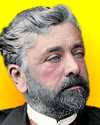
Gustave Eiffel
(15 Dec 1832 - 28 Dec 1923)
French civil engineer who specialized in metal structures, known especially for the Eiffel Tower in Paris, iron bridges and the framework within the Statue of Liberty in New York harbor.
|
Science Quotes by Gustave Eiffel (11 quotes)
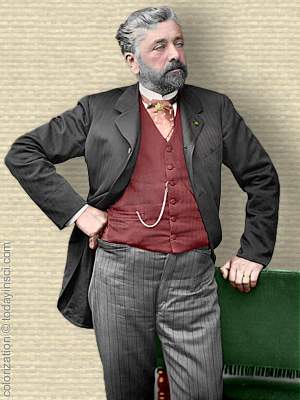
[It has been ascertained by statistical observation that in engineering enterprises one man is killed for every million francs that is spent on the works.] Supposing you have to build a bridge at an expense of one hundred million francs, you must be prepared for the death of one hundred men. In building the Eiffel Tower, which was a construction costing six million and a half, we only lost four men, thus remaining below the average. In the construction of the Forth Bridge, 55 men were lost in over 45,000,000 francs’ worth of work. That would appear to be a large number according to the general rule, but when the special risks are remembered, this number shows as a very small one.
— Gustave Eiffel
As quoted in 'M. Eiffel and the Forth Bridge', The Tablet (15 Mar 1890), 75, 400. Similarly quoted in Robert Harborough Sherard, Twenty Years in Paris: Being Some Recollections of a Literary Life (1905), 169, which adds to the end “, and reflects very great credit on the engineers for the precautions which they took on behalf of their men.” Sherard gave the context that Eiffel was at the inauguration [4 Mar 1890] of the Forth Bridge, and gave this compliment when conversing there with the Prince of Wales.
Being the most striking manifestation of the art of metal structures by which our engineers have shown in Europe, it [the Eiffel Tower] is one of the most striking of our modern national genius.
— Gustave Eiffel
English version by Webmaster using Google Translate, from the original French, “Étant la plus saisissante manifestation de l’art des constructions métalliques par lesquelles nos ingénieurs se sont illustrés en Europe, elle est une des formes les plus frappantes de notre génie national moderne.” From interview of Eiffel by Paul Bourde, in the newspaper Le Temps (14 Feb 1887). Reprinted in 'Au Jour le Jour: Les Artistes Contre la Tour Eiffel', Gazette Anecdotique, Littéraire, Artistique et Bibliographique (Feb 1887), 126, and in Gustave Eiffel, Travaux Scientifiques Exécutés à la Tour de 300 Mètres de 1889 à 1900 (1900), 14. Also quoted in review of the Gustave Eiffel’s book La Tour Eiffel (1902), in Nature (30 Jan 1902), 65, 292.
Can one think that because we are engineers, beauty does not preoccupy us or that we do not try to build beautiful, as well as solid and long lasting structures? Aren’t the genuine functions of strength always in keeping with unwritten conditions of harmony? … Besides, there is an attraction, a special charm in the colossal to which ordinary theories of art do not apply.
— Gustave Eiffel
As translated in Henry Petroski, Remaking the World: Adventures in Engineering (1998), 173. From the original French in interview of Eiffel by Paul Bourde, in the newspaper Le Temps (14 Feb 1887). Quoted in 'Au Jour le Jour: Les Artistes Contre la Tour Eiffel', Gazette Anecdotique, Littéraire, Artistique et Bibliographique (Feb 1887), 126, and in Gustave Eiffel, Travaux Scientifiques Exécutés à la Tour de 300 Mètres de 1889 à 1900 (1900), 14. “Parce que nous sommes des ingénieurs, croit-on donc que la beauté ne nous préoccupe pas dans nos constructions et qu'en même temps que nous faisons solide et durable nous ne nous efforçons pas rletfaire élégant? Est-ce que les véritables conditions de la force ne sont pas toujours conformes aux conditions secrètes de l'harmonie?.… Il y a du reste dans le colossal une attraction, un charme propre auxquels les théories d'art ordinaires ne sont guère applicables.
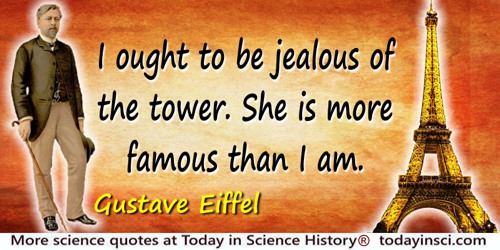
I ought to be jealous of the tower. She is more famous than I am.
— Gustave Eiffel
Attributed. In Peter Yapp, The Travellers' Dictionary of Quotation: Who Said What, About Where? (1983), 183.
It seems to me that it had no other rationale than to show that we are not simply the country of entertainers, but also that of engineers and builders called from across the world to build bridges, viaducts, stations and major monuments of modern industry, the Eiffel Tower deserves to be treated with more consideration.
— Gustave Eiffel
English version by Webmaster using Google Translate, from the original French, “Il me semble que, n’eût elle pas d’autre raison d’être que de montrer que nous ne sommes pas simplement le pays des amuseurs, mais aussi celui des ingénieurs et des constructeurs qu’on appelle de toutes les régions du monde pour édifier les ponts, les viaducs, les gares et les grands monuments de l’industrie moderne, la Tour Eiffel mériterait d’être traitée avec plus de consideration.” From interview of Eiffel by Paul Bourde, in the newspaper Le Temps (14 Feb 1887). Reprinted in 'Au Jour le Jour: Les Artistes Contre la Tour Eiffel', Gazette Anecdotique, Littéraire, Artistique et Bibliographique (Feb 1887), 126-127, and in Gustave Eiffel, Travaux Scientifiques Exécutés à la Tour de 300 Mètres de 1889 à 1900 (1900), 16. Also quoted in review of the Gustave Eiffel’s book La Tour Eiffel (1902), in Nature (30 Jan 1902), 65, 292.
The first principle of architectural beauty is that the essential lines of a construction be determined by a perfect appropriateness to its use.
— Gustave Eiffel
From translation in J. Harriss, The Tallest Tower: Eiffel and the Belle Epoque (1975), 20, as quoted and cited by David P. Billington, 'Bridges and the New Art of Structural Engineering,' in National Research Council (U.S.). Transportation Research Board Subcommittee on Bridge Aesthetics, Bridge Aesthetics Around the World (1991), 67. From the original French in interview of Eiffel by Paul Bourde, in the newspaper Le Temps (14 Feb 1887). Reprinted in 'Au Jour le Jour: Les Artistes Contre la Tour Eiffel', Gazette Anecdotique, Littéraire, Artistique et Bibliographique (Feb 1887), 126, and in Gustave Eiffel, Travaux Scientifiques Exécutés à la Tour de 300 Mètres de 1889 à 1900 (1900), 14. “Le premier principe de l'esthétique architecturale est que les lignes essentielles d’un monument soient déterminées par la parfaite appropriation à sa destination.”
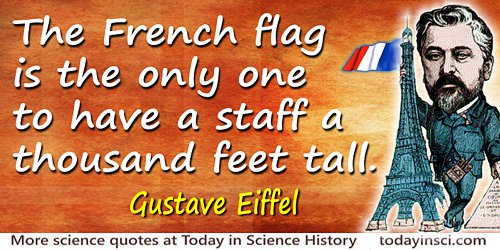
The French flag is the only one to have a staff a thousand feet tall.
— Gustave Eiffel
Written by Eiffel on one fold of a souvenir fan he had created for his sister, as described by Jill Jonnes, Eiffel's Tower: And the World's Fair where Buffalo Bill Beguiled Paris, the Artists Quarreled, and Thomas Edison Became a Count (2009), 237.
The fundamental idea of these pylons, or great archways, is based on a method of construction peculiar to me, of which the principle consists in giving to the edges of the pyramid a curve of such a nature that this pyramid shall be capable of resisting the force of the wind without necessitating the junction of the edges by diagonals as is usually done.
— Gustave Eiffel
Writing of his tower after its completion in 1889. As quoted (translated) in 'Eiffel’s Monument His Famous Tower', New York Times (6 Jan 1924), X8.
There is an attraction and a charm inherent in the colossal that is not subject to ordinary theories of art … The tower will be the tallest edifice ever raised by man. Will it therefore be imposing in its own way?
— Gustave Eiffel
Quoted in J. Harriss, The Tallest Tower: Eiffel and the Belle Epoque (1975), 25. Cited by David P. Billington, 'Bridges and the New Art of Structural Engineering,' in National Research Council (U.S.). Transportation Research Board Subcommittee on Bridge Aesthetics, Bridge Aesthetics Around the World (1991), 67. From the original French in interview of Eiffel by Paul Bourde, in the newspaper Le Temps (14 Feb 1887). Reprinted in 'Au Jour le Jour: Les Artistes Contre la Tour Eiffel', Gazette Anecdotique, Littéraire, Artistique et Bibliographique (Feb 1887), 126, and in Gustave Eiffel, Travaux Scientifiques Exécutés à la Tour de 300 Mètres de 1889 à 1900 (1900), 14. “Il y a du reste dans le colossal une attraction, un charme propre auxquels les théories d’art ordinaires ne sont guère applicables. … Ma tour sera le plus haut édifice qu'aient jamais élevé les hommes. Ne serat-elle donc pas grandiose aussi a sa façon?
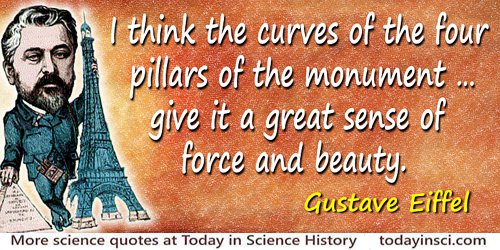
Well, I think the curves of the four pillars of the monument, as the calculations have provided them,… give it a great sense of force and beauty.
— Gustave Eiffel
From the original French, “Eh bien! je prétends que les courbes des quatre arêtes du monument, telles que le calcul les a fournies,… donneront une grand impression de force et de beauté,” in interview with Paul Bourde, in the newspaper Le Temps (14 Feb 1887), rebutting the protestations of many artists against the tower. Reprinted in 'Au Jour le Jour: Les Artistes Contre la Tour Eiffel', Gazette Anecdotique, Littéraire, Artistique et Bibliographique (Feb 1887), 126, and in Gustave Eiffel, Travaux Scientifiques Exécutés à la Tour de 300 Mètres de 1889 à 1900 (1900), 13-14. Also an epigraph, in French and with English translation, in Horst Hamann, Paris Vertical, (2004, 2006), 26.
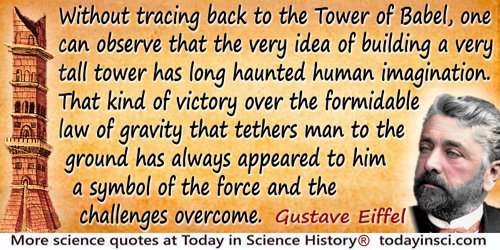
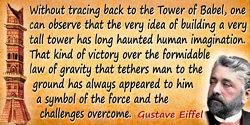
Without tracing back to the Tower of Babel, one can observe that the very idea of building a very tall tower has long haunted human imagination. That kind of victory over the formidable law of gravity that tethers man to the ground has always appeared to him a symbol of the force and the challenges overcome.
— Gustave Eiffel
From the original French, “Sans remonter à la Tour de Babel, on peut observer que l’idée même de la construction d’une tour de très grande hauteur a depuis longtemps hanté l'imagination des hommes. Celle sorte de victoire sur cette terrible loi de la pesanteur qui attache l’homme au sol lui a toujours paru un symbole de la force et des difficultés vaincues.” First sentences of Chap. 1, in Travaux Scientifiques Exécutés à la Tour de 300 Mètres de 1889 à 1900 (1900), 1. English translation by Webmaster using online resources.
Quotes by others about Gustave Eiffel (1)
To Monsieur Eiffel the Engineer, the brave builder of so gigantic and original a specimen of modern Engineering from one who has the greatest respect and admiration for all Engineers including the Great Engineer the Bon Dieu.
As stated by Joseph Harriss in The Tallest Tower (2004), 95. The author wrote that Edison was displaying his phonograph at the Paris World's Fair for which the Eiffel Tower was built as a centrepiece. On one of his visits to ascend the tower, Edison presented to Eiffel a phograph and a recording of “The Marseillaise.” On that occasion, Edison signed the guest book with the quoted remark.
See also:
 In science it often happens that scientists say, 'You know that's a really good argument; my position is mistaken,' and then they would actually change their minds and you never hear that old view from them again. They really do it. It doesn't happen as often as it should, because scientists are human and change is sometimes painful. But it happens every day. I cannot recall the last time something like that happened in politics or religion.
(1987) --
In science it often happens that scientists say, 'You know that's a really good argument; my position is mistaken,' and then they would actually change their minds and you never hear that old view from them again. They really do it. It doesn't happen as often as it should, because scientists are human and change is sometimes painful. But it happens every day. I cannot recall the last time something like that happened in politics or religion.
(1987) -- 





