 (source)
|
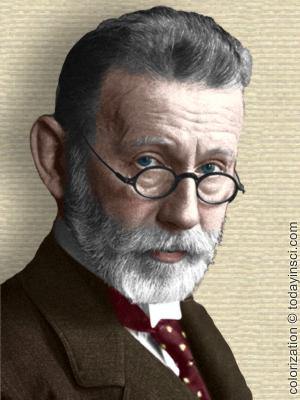
Paul Ehrlich
(14 Mar 1854 - 20 Aug 1915)
German bacteriologist, hematologist and immunologist who discovered Salvarsan, the first effective treatment for syphilis. He shared the 1908 Nobel Prize for Physiology or Medicine with Élie Metchnikoff.
|
Science Quotes by Paul Ehrlich (8 quotes)
If Lovelock hadn’t detected those CFCs [in the atmosphere above Antarctica] we’d all be living under the ocean in snorkels and fins to escape that poisonous sun.
— Paul Ehrlich
As quoted in Jeff Goodell, How to Cool the Planet: Geoengineering and the Audacious Quest to Fix Earth’s Climate (2010), 95. Goodell noted that Nobel Prize-winning scientists Rowland and Molina hypothesized that sunlight split apart CFC molecules, releasing reactive chlorine atoms, that would burn a hole in the protective ozone layer of the atmosphere, increasing danger from more ultraviolet light penetrating to the earth. When the ozone hole was experimentally verified over Antarctica, the potential destruction to the planet on a grand scale was realized, CFCs were banned, and ozone depletion was halted. Rowland and Molina shared a 1995 Nobel Prize. Although earlier, Lovelock had recognized “no conceivable hazard” from CFCs in the earth’s atmosphere, he was nevertheless the first to detect them in the atmosphere over Antarctica. For this critical evidence, Lovelock was at least mentioned in the Nobel Prize press release.
In order to pursue chemotherapy successfully we must look for substances which possess a high affinity and high lethal potency in relation to the parasites, but have a low toxicity in relation to the body, so that it becomes possible to kill the parasites without damaging the body to any great extent. We want to hit the parasites as selectively as possible. In other words, we must learn to aim and to aim in a chemical sense. The way to do this is to synthesize by chemical means as many derivatives as possible of relevant substances.
— Paul Ehrlich
'Ueber den jetzigen Stand der Chemotherapie'. Berichte der Deutschen Chemischen Gesellschagt, 1909, 42, 17-47. Translated in B. Holmstedt and G. Liljestrand (eds.), Readings in Pharmacology (1963), 286.
It has been shown to be possible, by deliberately planned and chemotherapeutic approach, to discover curative agents which act specifically and aetiologically against diseases due to protozoal infections, and especially against the spirilloses, and amongst these against syphilis in the first place. Further evidence for the specificity of the action of dihydroxydiaminoarsenobenzene [Salvarsan ‘606’] is the disappearance of the Wasserman reaction, which reaction must … be regarded as indicative of a reaction of the organism to the constituents of the spirochaetes.
— Paul Ehrlich
P. Ehrlich and S. Hata, 'Closing Notes to the Experimental Chemotherapy of Spirilloses', 1910. Reprinted in F. Himmelweit (ed.), The Collected Papers of Paul Ehrlich (1957), Vol. 3, 302.

Success in research needs four Gs: Glück, Geduld, Geschick und Geld. Luck, patience, skill and money.
— Paul Ehrlich
Quoted in M. Perutz, 'Rita and the Four Gs', Nature, 1988, 332, 791.

The first rule of intelligent tinkering is to save all the parts.
— Paul Ehrlich
With co-author John P. Holdren, in Saturday Review (5 June 1971), 54, 59. Ehrlich is making his own paraphrase of an earlier quote, citing Aldo Leopold: “To keep every cog and wheel is the first precaution of intelligent tinkering.” See the Aldo Leopold Quotes page of this website. These refer to the importance of supporting an ecosystem by keeping all its parts - saving all the species.

The history of the knowledge of the phenomena of life and of the organized world can be divided into two main periods. For a long time anatomy, and particularly the anatomy of the human body, was the α and ω of scientific knowledge. Further progress only became possible with the discovery of the microscope. A long time had yet to pass until through Schwann the cell was established as the final biological unit. It would mean bringing coals to Newcastle were I to describe here the immeasurable progress which biology in all its branches owes to the introduction of this concept of the cell concept. For this concept is the axis around which the whole of the modern science of life revolves.
— Paul Ehrlich
Nobel Lecture (11 Dec 1908) 'Partial Cell Functions.' Collected in Nobel Lectures: Physiology or Medicine 1901-1921 (1967), 304.
The organism possesses certain contrivances by means of which the immunity reaction, so easily produced by all kinds of cells, is prevented from acting against the organism’s own elements and so giving rise to auto toxins … so that one might be justified in speaking of a “horror autotoxicus” of the organism. These contrivances are naturally of the highest importance for the existence of the individual.
— Paul Ehrlich
P. Ehrlich and J. Morgenroth, 'Studies On Haemolysins: Fifth Communication', Berliner klin. Wochenschrift (1901), No. 10. Reprinted in Collected Studies on Immunity (1906), 82.
We may regard the cell quite apart from its familiar morphological aspects, and contemplate its constitution from the purely chemical standpoint. We are obliged to adopt the view, that the protoplasm is equipped with certain atomic groups, whose function especially consists in fixing to themselves food-stuffs, of importance to the cell-life. Adopting the nomenclature of organic chemistry, these groups may be designated side-chains. We may assume that the protoplasm consists of a special executive centre (Leistungs-centrum) in connection with which are nutritive side-chains… The relationship of the corresponding groups, i.e., those of the food-stuff, and those of the cell, must be specific. They must be adapted to one another, as, e.g., male and female screw (Pasteur), or as lock and key (E. Fischer).
— Paul Ehrlich
Croonian Lecture, 'On Immunity with Special Reference to Cell Life', Proceedings of the Royal Society of London, 1900, 66, 433-434.
Quotes by others about Paul Ehrlich (1)
In recent years it has become impossible to talk about man’s relation to nature without referring to “ecology” … such leading scientists in this area as Rachel Carson, Barry Commoner, Eugene Odum, Paul Ehrlich and others, have become our new delphic voices … so influential has their branch of science become that our time might well be called the “Age of Ecology”.
In opening paragraph of Preface, Nature’s Economy: A History of Ecological Ideas (1994), 14.



See also:
- 14 Mar - short biography, births, deaths and events on date of Ehrlich's birth.
 In science it often happens that scientists say, 'You know that's a really good argument; my position is mistaken,' and then they would actually change their minds and you never hear that old view from them again. They really do it. It doesn't happen as often as it should, because scientists are human and change is sometimes painful. But it happens every day. I cannot recall the last time something like that happened in politics or religion.
(1987) --
In science it often happens that scientists say, 'You know that's a really good argument; my position is mistaken,' and then they would actually change their minds and you never hear that old view from them again. They really do it. It doesn't happen as often as it should, because scientists are human and change is sometimes painful. But it happens every day. I cannot recall the last time something like that happened in politics or religion.
(1987) -- 





.jpg)