 (source)
|
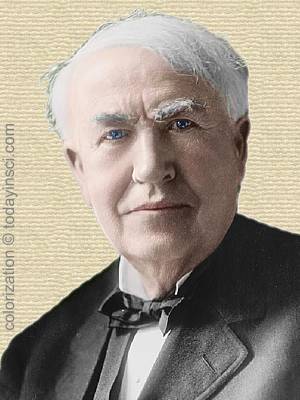
Thomas Edison
(11 Feb 1847 - 18 Oct 1931)
American inventor who was known internationally as “the Wizard of Menlo Park,” for the huge number of innovations coming from there, the world's first industrial research laboratory.
|
Science Quotes by Thomas Edison (62 quotes)
>> Click for Thomas Edison Quotes on | Experiment | Genius | Invention | Phonograph | Thinking |
>> Click for Thomas Edison Quotes on | Experiment | Genius | Invention | Phonograph | Thinking |
“There is no expedient to which a man will not resort to avoid the real labor of thinking.
Sir Joshua Reynolds.”
Sir Joshua Reynolds.”
— Thomas Edison
Sign motto used by Edison in his plant. It is a compacted paraphrase of an original quote by the painter, Joshua Reynolds, (which can been seen on the Reynolds quote page on this site). This form of the quote, was published by B.C. Forbes in The American Magazine (Jan 1921), 10. Forbes wrote about his visit to the Edison’s office, where he was shown a placard bearing the motto and attribution to Sir Joshua Reynolds, and told by Edison that he intended to have copies “put all over the plant.”
[A] quality of an inventor is imagination, because invention is a leap of the imagination from what is known to what has never been before.
— Thomas Edison
As quoted in French Strother, 'The Modern Profession of Inventing', World's Work and Play (Jul 1905), 6, No. 32, 187.
M.A. Rosanoff: Mr. Edison, please tell me what laboratory rules you want me to observe.
Edison: Hell! There ain’t no rules around here! We’re trying to accomplish somep’n.
Edison: Hell! There ain’t no rules around here! We’re trying to accomplish somep’n.
— Thomas Edison
In Martin André Rosanoff, 'Edison in His Laboratory', Harper’s Magazine (Sep 1932), 403.
~~[No known source]~~ There is no substitute for hard work.
— Thomas Edison
One of those scurrilous Edison-sounding quotes in common circulation, but no source has been identified for this wording. It might be a writer’s summary of Edison’s other known comments on work ethic. Webmaster believes it is proverbial, in general circulation before Edison’s time, and should be better attributed to “Anonymous” and not to Edison. The aphorism was used in 1882 by John S. Kennedy in a letter to George Stephen, quoted in Joseph Gilpin Pyle, 'James J. Hill’s Rules of Business Success', The World's Work: A History of Our Time (1917), 33, 281.
A minor invention every ten days, and a big one every six months or so.
— Thomas Edison
Expressing his production goals his new laboratory.
An essential [of an inventor] is a logical mind that sees analogies. No! No! not mathematical. No man of a mathematical habit of mind ever invented anything that amounted to much. He hasn’t the imagination to do it. He sticks too close to the rules, and to the things he is mathematically sure he knows, to create anything new.
— Thomas Edison
As quoted in French Strother, 'The Modern Profession of Inventing', World's Work and Play (Jul 1905), 6, No. 32, 187.
Every man has some forte something he can do better than he can do anything else. Many men, however, never find the job they are best fitted for. And often this is because they do not think enough. Too many men drift lazily into any job, suited or unsuited for them; and when they don’t get along well they blame everybody and everything except themselves.
— Thomas Edison
As quoted from an interview by B.C. Forbes in The American Magazine (Jan 1921), 10.
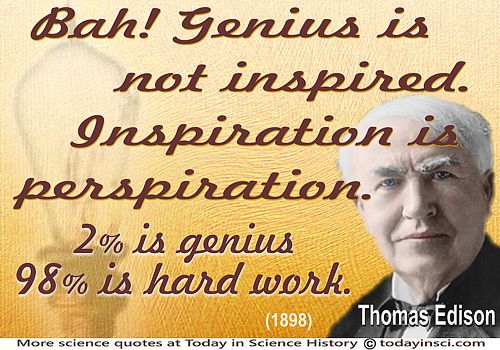
Genius is not inspired. Inspiration is perspiration.
— Thomas Edison
As quoted in 'The Anecdotal Side of Edison', Ladies Home Journal (Apr 1898), 8.
Genius is one per cent inspiration and ninety-nine per cent perspiration.
— Thomas Edison
In Life (1932).
Genius is two percent inspiration, ninety-eight percent perspiration.
— Thomas Edison
Francis Arthur Jones, The Life of Thomas Alva Edison: Sixty Years of an Inventor’s Life (1932), 371.
Grouches are nearly always pinheads, small men who have never made any effort to improve their mental capacity.
— Thomas Edison
As quoted from an interview by B.C. Forbes in The American Magazine (Jan 1921), 10.
Hard work and for ever sticking to a thing till it’s done, are the main things an inventor needs.
— Thomas Edison
As quoted in French Strother, 'The Modern Profession of Inventing', World's Work and Play (Jul 1905), 6, No. 32, 186.
I am afraid of radium and polonium ... I don’t want to monkey with them.
— Thomas Edison
Quoted in 'Edison Fears Hidden Perils of the X-Rays', New York World (3 Aug 1903), 1.
I am more of a sponge than an inventor. I absorb ideas from every source. I take half-matured schemes for mechanical development and make them practical. I am a sort of middleman between the long-haired and impractical inventor and the hard-headed businessman who measures all things in terms of dollars and cents. My principal business is giving commercial value to the brilliant but misdirected ideas of others.
— Thomas Edison
…...
I believe that the science of chemistry alone almost proves the existence of an intelligent creator.
— Thomas Edison
…...
I can’t recall a single problem in my life, of any sort, that I ever started on that I didn't solve, or prove that I couldn’t solve it. I never let up, until I had done everything that I could think of, no matter how absurd it might seem as a means to the end I was after.
— Thomas Edison
As quoted in French Strother, 'The Modern Profession of Inventing', World's Work and Play (Jul 1905), 6, No. 32, 186.
I don’t know anything about mathematics; can’t even do proportion. But I can hire all the good mathematicians I need for fifteen dollars a week.
— Thomas Edison
As quoted in French Strother, 'The Modern Profession of Inventing', World's Work and Play (Jul 1905), 6, No. 32, 187.
I find out what the world needs, then I proceed to invent. My main purpose in life is to make money so that I can afford to go on creating more inventions.
— Thomas Edison
…...
I have a peculiar theory about radium, and I believe it is the correct one. I believe that there is some mysterious ray pervading the universe that is fluorescing to it. In other words, that all its energy is not self-constructed but that there is a mysterious something in the atmosphere that scientists have not found that is drawing out those infinitesimal atoms and distributing them forcefully and indestructibly.
— Thomas Edison
Quoted in 'Edison Fears Hidden Perils of the X-Rays', New York World (3 Aug 1903), 1.
I have always consistently opposed high-tension and alternating systems of electric lighting, not only on account of danger, but because of their general unreliability and unsuitability for any general system of distribution.
— Thomas Edison
In 'The Dangers of Electric Lighting', North American Review (Nov 1889), 149, No. 396, 633.
I have not failed. I’ve just found 10,000 ways that won’t work.
— Thomas Edison
…...
I never allow myself to become discouraged under any circumstances. … After we had conducted
thousands of experiments on a certain project without solving the problem, … we had learned something. For we had learned for a certainty that the thing couldn’t be done that way, and that we would have to try some other way. We sometimes learn a lot from our failures if we have put into the effort the best thought and work we are capable of.
— Thomas Edison
As quoted from an interview by B.C. Forbes in The American Magazine (Jan 1921), 89.
I never did anything worth doing entirely by accident and none of my inventions came about totally by accident. They came about by hard work.
— Thomas Edison
…...
I never pick up an item without thinking of how I might improve it. I never perfected an invention that I did not think about in terms of the service it might give others. I want to save and advance human life, not destroy it. I am proud of the fact that I never invented weapons to kill. The dove is my emblem.
— Thomas Edison
…...
I said that there is something every man can do, if he can only find out what that something is. Henry Ford has proved this. He has installed in his vast organization a system for taking hold of a man who fails in one department, and giving him a chance in some other department. Where necessary every effort is made to discover just what job the man is capable of filling. The result has been that very few men have had to be discharged, for it has been found that there was some kind of work each man could do at least moderately well. This wonderful system
adopted by my friend Ford has helped many a man to find himself. It has put many a fellow on his feet. It has taken round pegs out of square holes and found a round hole for them. I understand that last year only 120 workers out of his force of 50,000 were discharged.
— Thomas Edison
As quoted from an interview by B.C. Forbes in The American Magazine (Jan 1921), 10.
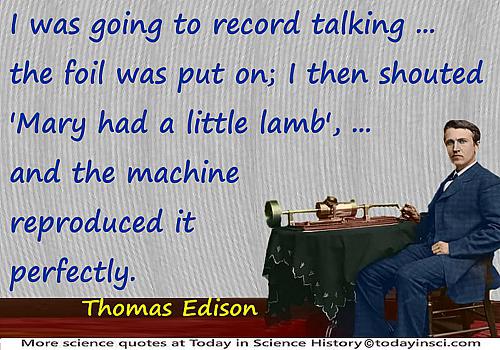
I told [Kruesi] I was going to record talking, and then have the machine talk back. He thought it absurd. However, it was finished, the foil was put on; I then shouted “Mary had a little lamb,” etc. I adjusted the reproducer, and the machine reproduced it perfectly.
On first words spoken on a phonograph.
On first words spoken on a phonograph.
— Thomas Edison
Byron M. Vanderbilt, Thomas Edison, Chemist (1971), 99.
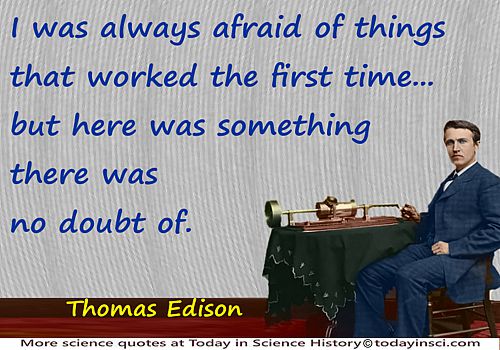
I was always afraid of things that worked the first time. Long experience proved that there were great drawbacks found generally before they could be got commercial; but here was something there was no doubt of.
[Recalling astonishment when his tin-foil cylinder phonograph first played back his voice recording of “Mary had a little lamb.”]
[Recalling astonishment when his tin-foil cylinder phonograph first played back his voice recording of “Mary had a little lamb.”]
— Thomas Edison
Quoted in Frank Lewis Dyer, Thomas Commerford Martin, Edison: His Life and Inventions (1910), 208.
If there is such a thing as luck, then I must be the most unlucky fellow in the world. I’ve never once made a lucky strike in all my life. When I get after something that I need, I start finding everything in the world that I don’t need—one damn thing after another. I find ninety-nine things that I don’t need, and then comes number one hundred, and that—at the very last—turns out to be just what I had been looking for.
— Thomas Edison
In Martin André Rosanoff, 'Edison in His Laboratory', Harper’s Magazine (Sep 1932), 406.
In fact, I’ve come to the conclusion that I never did know anything about it [electricity].
— Thomas Edison
In working out an invention, the most important quality is persistence. Nearly every man who develops an idea works it up to the point where it looks impossible, and then he gets discouraged. That’s not the place to become discouraged, that's the place to get interested.
— Thomas Edison
As quoted in French Strother, 'The Modern Profession of Inventing', World's Work and Play (Jul 1905), 6, No. 32, 186.
It has been just so in all my inventions. The first step is an intuition—and comes with a burst, then difficulties arise. This thing that gives out and then that—“Bugs” as such little faults and difficulties are called show themselves and months of anxious watching, study and labor are requisite before commercial success—or failure—is certainly reached.
— Thomas Edison
Describing his invention of a storage battery that involved 10,296 experiments. Note Edison’s use of the term “Bug” in the engineering research field for a mechanical defect greatly predates the use of the term as applied by Admiral Grace Murray Hopper to a computing defect upon finding a moth in the electronic mainframe.] Letter to Theodore Puskas (18 Nov 1878). In The Yale Book of Quotations (2006), 226.
It is apparent to me that the possibilities of the aeroplane, which two or three years ago were thought to hold the solution to the [flying machine] problem, have been exhausted, and that we must turn elsewhere.
— Thomas Edison
…...
It is very different to make a practical system and to introduce it. A few experiments in the laboratory would prove the practicability of system long before it could be brought into general use. You can take a pipe and put a little coal in it, close it up, heat it and light the gas that comes out of the stem, but that is not introducing gas lighting. I'll bet that if it were discovered to-morrow in New York that gas could be made out of coal it would be at least five years before the system would be in general use.
— Thomas Edison
From the New York Herald (30 Jan 1879), as cited in Leslie Tomory, 'Building the First Gas Network, 1812-1820', Technology and Culture (Jan 2011), 52, No. 1, 75-102.
It usually takes me from five to seven years to perfect a thing. Some things I have been working on for twenty-five years—and some of them are still unsolved. My average would be about seven years. The incandescent light was the hardest one of all: it took many years not only of concentrated thought but also of world-wide research. The storage battery took eight years. It took even longer to perfect the phonograph.
— Thomas Edison
As quoted from an interview by B.C. Forbes in The American Magazine (Jan 1921), 86.
It was necessary to invent everything. Dynamos, regulators, meters, switches, fuses, fixtures, underground conductors with their necessary connecting boxes, and a host of other detail parts, even down to insulating tape.
— Thomas Edison
Concerning the electrical system to power his customers’ electric lights.
Just as certain as death, Westinghouse will kill a customer within six months after he puts in a [alternating current] system of any size.
— Thomas Edison
Found in Jonathan R. T. Hughes, The Vital Few: American Economic Progress and Its Protagonists (1965), 194. The author did not use quotation marks, or footnote any source, but did skip to the next line and use indented lines, when he stated Edison’s stubborn (and rather malicious) opposition to alternating current for home service. [Webmaster, as yet, has not found any earlier use of these words attributed to Edison, and is therefore fairly skeptical, and doubts that this is a verbatim quote, because it seems to have no earlier provenance. But this book may have been used by others to repeat these words as a quote. For example, without citation, in Isaac Asimov, Isaac Asimov's Book of Science and Nature Quotations (1988), 71. Can you help identify a primary source?]
Many inventions are not suitable for the people at large because of their carelessness. Before a thing can be marketed to the masses, it must be made practically fool-proof. Its operation must be made extremely simple. That is one reason, I think, why the phonograph has been so universally adopted. Even a child can operate it. … Another reason is that people are far more willing to pay for being amused than for anything else.
— Thomas Edison
As quoted from an interview by B.C. Forbes in The American Magazine (Jan 1921), 86.
Many of life’s failures are people who did not realize how close they were to success when they gave up.
— Thomas Edison
…...
Mary had a little lamb, whose fleece was white as snow!
— Thomas Edison
(1877) The first words he reproduced from his phonograph.
Most inventors who have an idea never stop to think whether their invention will be saleable when they get it made. Unless a man has plenty of money to throw away, he will find that making inventions is about the costliest amusement he can find.
— Thomas Edison
As quoted in French Strother, 'The Modern Profession of Inventing', World's Work and Play (Jul 1905), 6, No. 32, 186.
Of all my inventions, I liked the phonograph best. Life’s most soothing things are sweet music and a child’s goodnight.
— Thomas Edison
…...
Oh these mathematicians make me tired! When you ask them to work out a sum they take a piece of paper, cover it with rows of A’s, B’s, and X's and Y’s … scatter a mess of flyspecks over them, and then give you an answer that’s all wrong!
— Thomas Edison
Matthew Josephson, Edison (1959), 283.
Problems in human engineering will receive during the coming years the same genius and attention which the nineteenth century gave to the more material forms of engineering.
We have laid good foundations for industrial prosperity, now we want to assure the happiness and growth of the workers through vocational education, vocational guidance, and wisely managed employment departments. A great field for industrial experimentation and statemanship is opening up.
We have laid good foundations for industrial prosperity, now we want to assure the happiness and growth of the workers through vocational education, vocational guidance, and wisely managed employment departments. A great field for industrial experimentation and statemanship is opening up.
— Thomas Edison
Letter printed in Engineering Magazine (Jan 1917), cover. Quoted in an article by Meyer Bloomfield, 'Relation of Foremen to the Working Force', reproduced in Daniel Bloomfield, Selected Articles on Employment Management (1919), 301.
Restlessness and discontent are the first necessities of Progress.
— Thomas Edison
In Dagobert David Runes (ed.), The Diary and Sundry Observations of Thomas Alva Edison (1948), 110.
Results! Why, man, I have gotten a lot of results. I know several thousand things that won’t work.
— Thomas Edison
…...
Say I have lost all faith in patents, judges, and everything relating to patents.
— Thomas Edison
Someday man will harness the rise and fall of the tides, imprison the power of the sun, and release atomic power.
— Thomas Edison
…...
The brain can be developed just the same as the muscles can be developed, if one will only take the pains to train the mind to think. Why do so many men never amount to anything? Because they don't think!
— Thomas Edison
As quoted from an interview by B.C. Forbes in The American Magazine (Jan 1921), 10.
The brain that isn’t used rusts. The brain that is used responds. The brain is exactly like any other part of the body: it can be strengthened by proper exercise, by proper use. Put your arm in a sling and keep it there for a considerable length of time, and, when you take it out, you find that you can’t use it. In the same way, the brain that isn’t used suffers atrophy.
— Thomas Edison
As quoted from an interview by B.C. Forbes in The American Magazine (Jan 1921), 10.
The injurious agent in cigarettes comes principally from the burning paper wrapper. The substance thereby formed is called “acrolein.” It has a violent action on the nerve centers, producing degeneration of the cells of the brain, which is quite rapid among boys. Unlike most narcotics, this degeneration is permanent and uncontrollable. I employ no person who smokes cigarettes.
[From the Laboratory of Thomas A. Edison, Orange, N.J., April 26, 1914.]
[From the Laboratory of Thomas A. Edison, Orange, N.J., April 26, 1914.]
— Thomas Edison
Quoted in Henry Ford, The Case Against the Little White Slaver (1914), Vol. 1, 5.
The point in which I am different from most inventors is that I have, besides the usual inventor’s make-up, the bump of practicality as a sort of appendix, the sense of the business, money value of an invention. Oh, no, I didn’t have it naturally. It was pounded into me by some pretty hard knocks.
— Thomas Edison
As quoted in French Strother, 'The Modern Profession of Inventing', World's Work and Play (Jul 1905), 6, No. 32, 186.
There is no plea which will justify the use of high-tension and alternating currents, either in a scientific or a commercial sense. They are employed solely to reduce investment in copper wire and real estate.
— Thomas Edison
In 'The Dangers of Electric Lighting', North American Review (Nov 1889), 149, No. 396, 633.
There will one day spring from the brain of science a machine or force so fearful in its potentialities, so absolutely terrifying, that even man, the fighter, who will dare torture and death in order to inflict torture and death, will be appalled, and so abandon war forever.
— Thomas Edison
…...
Thinking, after a while, becomes the most pleasurable thing in the world. Give me a satchel and a fishing rod, and I could hie myself off and keep busy at thinking forever. I don't need anybody to amuse me. It is the same way with my friends John Burroughs, the naturalist, and Henry Ford, who is a natural-born mechanic. We can derive the most satisfying kind of joy from thinking and thinking and thinking.
— Thomas Edison
As quoted from an interview by B.C. Forbes in The American Magazine (Jan 1921), 86.
To Monsieur Eiffel the Engineer, the brave builder of so gigantic and original a specimen of modern Engineering from one who has the greatest respect and admiration for all Engineers including the Great Engineer the Bon Dieu.
— Thomas Edison
As stated by Joseph Harriss in The Tallest Tower (2004), 95. The author wrote that Edison was displaying his phonograph at the Paris World's Fair for which the Eiffel Tower was built as a centrepiece. On one of his visits to ascend the tower, Edison presented to Eiffel a phograph and a recording of “The Marseillaise.” On that occasion, Edison signed the guest book with the quoted remark.
Two per cent. is genius, and ninety-eight per cent. is hard work.
— Thomas Edison
As quoted in 'The Anecdotal Side of Edison', Ladies Home Journal (Apr 1898), 8.
Until man duplicates a blade of grass, nature can laugh at his so-called scientific knowledge.
— Thomas Edison
Seen in several books, attributed without citation, for example, in Ann Wimore, The Wheatgrass Book (1985). If you know a primary source, please contact Webmaster.
We are like tenant farmers chopping down the fence around our house for fuel when we should be using Natures inexhaustible sources of energy — sun, wind and tide. ... I'd put my money on the sun and solar energy. What a source of power! I hope we don't have to wait until oil and coal run out before we tackle that.
— Thomas Edison
Edison in conversation Henry Ford and Harvey Firestone (1931), quoted as a recollection of the author, in James Newton, Uncommon Friends: Life with Thomas Edison, Henry Ford, Harvey Firestone, Alexis Carrel & Charles Lindbergh (1987), 31. The quote is not cited from a print source. However, in the introduction the author said he “kept a diary in which I noted times and places, key phrases, and vivid impressions.” He also “relied on publications by and about my friends, which jogged my memory.” Webmaster has found no earlier record of this quote, and thus suggests the author may have the gist of what Edison said, but is not quoting the exact words uttered by Edison, although quote marks are used to state what Edison said.
What progress individuals could make, and what progress the world would make, if thinking were given proper consideration! It seems to me that not one man in a thousand appreciates what can be accomplished by training the mind to think.
— Thomas Edison
As quoted from an interview by B.C. Forbes in The American Magazine (Jan 1921), 10.
What we call man is a mechanism made up of … uncrystallized matter … all the colloid matter of his mechanism is concentrated in a countless number of small cells. … [T]hese cells [are] dwelling places, communes, a walled town within which are many citizens. ... [T]hese are the units of life and when they pass out into space man as we think we know him is dead, a mere machine from which the crew have left,so to speak. ... [T]hese units are endowed with great intelligence. They have memories, they must be divided into countless thousands of groups, most are workers, there are directing groups. Some are chemists, they manufacture the most complicated chemicals that are secreted by the glands.
— Thomas Edison
Diary and Sundry Observations of Thomas Alva Edison (1948), 203-44. In Mark Seltzer, Serial Killers (1998), 215-6.
Which do I consider my greatest invention? … I like the phonograph best … because I love music. And then it has brought so much joy into millions of homes all over this country, and, indeed, all over the world.
— Thomas Edison
As quoted from an interview by B.C. Forbes in The American Magazine (Jan 1921), 86.
X-rays ... I am afraid of them. I stopped experimenting with them two years ago, when I came near to losing my eyesight and Dally, my assistant practically lost the use of both of his arms.
— Thomas Edison
Quoted in 'Edison Fears Hidden Perils of the X-Rays', New York World (3 Aug 1903), 1.
Quotes by others about Thomas Edison (23)
The attitude which the man in the street unconsciously adopts towards science is capricious and varied. At one moment he scorns the scientist for a highbrow, at another anathematizes him for blasphemously undermining his religion; but at the mention of a name like Edison he falls into a coma of veneration. When he stops to think, he does recognize, however, that the whole atmosphere of the world in which he lives is tinged by science, as is shown most immediately and strikingly by our modern conveniences and material resources. A little deeper thinking shows him that the influence of science goes much farther and colors the entire mental outlook of modern civilised man on the world about him.
Reflections of a Physicist (1950), 81.
When I examine the conclusion [on experiments with the electric light bulb experiments published in the Herald] which everyone acquainted with the subject will recognize as a conspicuous failure, trumpeted as a wonderful success, I [conclude]... that the writer ... must either be very ignorant, and the victim of deceit, or a conscious accomplice in what is nothing less than a fraud upon the public.
Letter to the Sanitary Engineer (22 Dec 1880). Quoted in Charles Bazermanl, The Languages of Edison's Light (2002), 186.
Mr. Thomas A. Edison recently came into this office, placed a little machine on our desk, turned a crank, and the machine enquired as to our health, asked how we liked the phonograph, informed us that it was well, and bid us a cordial good night. These remarks were not only perfectly audible to ourselves, but to a dozen or more persons gathered around.
Scientific American (22 Dec 1877). Quoted in By John Henry Pepper, The Boy's Playbook of Science, Revised (1881), 251.
If Thomas Edison had gone to business school, we would all be reading by larger candles.
What They Don't Teach You at Harvard Business School (1984).
Mr Edison gave America just what was needed at that moment in history. They say that when people think of me, they think of my assembly line. Mr. Edison, you built an assembly line which brought together the genius of invention, science and industry.
Henry Ford in conversation Thomas Edison and Harvey Firestone (1931), quoted as a recollection of the author, in James Newton, Uncommon Friends: Life with Thomas Edison, Henry Ford, Harvey Firestone, Alexis Carrel & Charles Lindbergh (1987), 31. The quote is not cited from a print source. However, in the introduction the author said he “kept a diary in which I noted times and places, key phrases, and vivid impressions.” He also “relied on publications by and about my friends, which jogged my memory.&rdquo. Webmaster has found no earlier record of this quote, and thus suggests the author may have the gist of what Ford said, but is not quoting the exact words uttered by Ford, although quote marks are used to state Ford's remark.
Is science visionary? Is it not the hardest-headed intellectual discipline we know? How, then, does science look at this universe? Always as a bundle of possibilities. Habitually the scientist looks at this universe and every area in it as a bundle of possibilities, with no telling what might come if we fulfilled the conditions. Thomas Edison was no dreamer. He was a seer. The possibilities that he brought out were factually there. They were there before he saw them. They would have been there if he never had seen them. Always the possibilities are part of the actualities in any given situation.
In 'Don't Lose Faith in Human Possibilities', collected in Living Under Tension: Sermons On Christianity Today (1941), 15.
![Nikola Tesla quote: If he [Thomas Edison] had a needle to find in a haystack, he would not stop to reason where it was most like](https://todayinsci.com/T/Tesla_Nikola/TeslaNikola-Haystack500x250px.jpg)
If he [Thomas Edison] had a needle to find in a haystack, he would not stop to reason where it was most likely to be, but would proceed at once with the feverish diligence of a bee, to examine straw after straw until he found the object of his search. … [J]ust a little theory and calculation would have saved him ninety percent of his labor.
As quoted in 'Tesla Says Edison Was an Empiricist', The New York Times (19 Oct 1931), 25. In 1884, Tesla had moved to America to assist Edison in the designing of motors and generators.
Edison was by far the most successful and, probably, the last exponent of the purely empirical method of investigation. Everything he achieved was the result of persistent trials and experiments often performed at random but always attesting extraordinary vigor and resource. Starting from a few known elements, he would make their combinations and permutations, tabulate them and run through the whole list, completing test after test with incredible rapidity until he obtained a clue. His mind was dominated by one idea, to leave no stone unturned, to exhaust every possibility.
As quoted in 'Tesla Says Edison Was an Empiricist', The New York Times (19 Oct 1931), 25.
I came from Paris in the Spring of 1884, and was brought in intimate contact with him [Thomas Edison]. We experimented day and night, holidays not excepted. His existence was made up of alternate periods of work and sleep in the laboratory. He had no hobby, cared for no sport or amusement of any kind and lived in utter disregard of the most elementary rules of hygiene. There can be no doubt that, if he had not married later a woman of exceptional intelligence, who made it the one object of her life to preserve him, he would have died many years ago from consequences of sheer neglect. So great and uncontrollable was his passion for work.
As quoted in 'Tesla Says Edison Was an Empiricist', The New York Times (19 Oct 1931), 25.
His [Thomas Edison] method was inefficient in the extreme, for an immense ground had to be covered to get anything at all unless blind chance intervened and, at first, I was almost a sorry witness of his doings, knowing that just a little theory and calculation would have saved him 90 per cent of the labor. But he had a veritable contempt for book learning and mathematical knowledge, trusting himself entirely to his inventor's instinct and practical American sense. In view of this, the truly prodigious amount of his actual accomplishments is little short of a miracle.
As quoted in 'Tesla Says Edison Was an Empiricist', The New York Times (19 Oct 1931), 25. In 1884, Tesla had moved to America to assist Edison in the designing of motors and generators.
The recurrence of a phenomenon like Edison is not very likely. The profound change of conditions and the ever increasing necessity of theoretical training would seem to make it impossible. He will occupy a unique and exalted position in the history of his native land, which might well be proud of his great genius and undying achievements in the interest of humanity.
As quoted in 'Tesla Says Edison Was an Empiricist', The New York Times (19 Oct 1931), 25. In 1884, Tesla had moved to America to assist Edison in the designing of motors and generators.
I’m one of those people that think Thomas Edison and the light bulb changed the world more than Karl Marx ever did.
Expressing his reason for having no interest in a public sector role in politics. Interview with Rolling Stone writer, Steven Levy (late Nov 1983). As quoted in Nick Bilton, 'The 30-Year-Old Macintosh and a Lost Conversation With Steve Jobs' (24 Jan 2014), on New York Times blog web page. Levy appended a transcript of the interview to an updated Kindle version of his book, Insanely Great: The Life and Times of Macintosh, the Computer that Changed Everything.
We owe a lot to Thomas Edison—if it wasn't for him, we'd be watching television by candlelight.
As quoted in a sidebar in Forbes (1989), 143, Nos. 1-4, 344.
The way of pure research is opposed to all the copy-book maxims concerning the virtues of industry and a fixed purpose, and the evils of guessing, but it is damned useful when it comes off. It is the diametrical opposite of Edison’s reputed method of trying every conceivable expedient until he hit the right one. It requires, not diligence, but experience, information, and a good nose for the essence of a problem.
Letter to Paul de Kruif (3 Aug 1933), as quoted in Nathan Reingold, Science in America: A Documentary History 1900-1939 (1981), 409.
When Thomas Edison worked late into the night on the electric light, he had to do it by gas lamp or candle. I’m sure it made the work seem that much more urgent.
In Napalm and Silly Putty (2002), 128.
[Edison] definitely ended the distinction between the theoretical man of science and the practical man of science, so that today we think of scientific discoveries in connection with their possible present or future application to the needs of man. He took the old rule-of-thumb methods out of industry and substituted exact scientific knowledge, while, on the other hand, he directed scientific research into useful channels.
In My Friend Mr. Edison (1930). Quoted in Dyson Carter, If You Want to Invent (1939), 110.
His [Edison’s] greatest invention was that of the industrial research laboratory, turning out inventions as a business.
In The Human Use of Human Beings: Cybernetics and Society (1950), 127.
How can he [Thomas Edison] call it a wonderful success when everyone acquainted with the subject will recognize it as a conspicuous failure?
In The New York Herald, (18 Dec 1879). As quoted and cited in Rob Kaplan (ed.), Science Says (2001), 200.
The next difficulty is in the economical production of small lights by electricity. This is what is commonly meant by the phrase, ‘dividing the electric light.’ Up to the present time, and including Mr. Edison’s latest experiments, it appears that this involves an immense loss of efficiency. Next comes the difficulty of distributing on any large scale the immense electric currents which would be needed.
In 'A Scientific View of It: Prof. Henry Morton Not Sanguine About Edison’s Success', New York Times (28 Dec 1879), 1.
Kin Hubbard is dead. To us folks that attempt to write a little humor his death is just like Edison's would be to the world of invention. No man in our generation was within a mile of him, and I am so glad that I didn't wait for him to go to send flowers. I have said it from the stage and in print for twenty years. … Just think — only two lines a day, yet he expressed more original philosophy in ’em than all the rest of the paper combined. What a kick Twain and all that gang will get out of Kin.
In 'Will Rogers Pays Tribute To Hubbard and His Humor', The New York Times (27 Dec 1930), 15.
I know two people who have found it [the secret of success]. … Getting ready. Getting prepared. There were Edison and Lindbergh,—they both got ready before they started. I had to find that out too. I had to stop for ten years after I had started; I had to stop for ten years and get ready. I made my first car in 1893, but it was 1903 before I had it ready to sell. It is these simple things that young men ought to know, and they are hardest to grasp. Before everything else, get ready.
From Henry Ford and Ralph Waldo Trine, The Power that Wins (1929), 147. Often seen paraphrased as “Before everything else, getting ready is the secret of success,” for example, in Connie Robertson (ed.), The Wordsworth Dictionary of Quotations (1998), 129.
How many Edisons does it take to screw in a light bulb? Who cares. He stole the idea and doesn’t deserve his own joke.
Found widely on the internet.
This morning’s messages announce the death oF Thomas Alva Edison, the great American inventor who for two generations has been an almost legendary figure. … He seemed to belong to a past which was already becoming remote, a past, without the incandescent electric light, and without the phonograph, and without other gifts with which his ingenuity and persistence endowed the world. … In the philosophical, theoretical sense he [Thomas Edison] was not a scientific man. To the understanding of electricity, with the use of which most of his inventions are concerned, he contributed little or nothing. Yet no man discovered more, or more ingenious, ways of using electricity for practical purposes.
In 'Thomas Edison', The Times (19 Oct 1931), 13.
See also:
- 11 Feb - short biography, births, deaths and events on date of Edison's birth.
- Thomas Edison Quote “Mary Had A Little Lamb” - Illustrated quote with Tinfoil Phonograph - Large 800 x 600px
- The Talking Phonograph - Thomas Edison's invention of his tinfoil phonograph - article in Scientific American (22 Dec 1877) - with illustrated quote, medium 500px.
- Thomas Edison Quote “Something there was no doubt of” - Illustrated quote + tinfoil phonograph engraving 800px
- Edison Fears Hidden Perils of the X-Rays - from New York World (3 Aug 1903).
- Thomas Edison - context of quote “Genius is not inspired. Inspiration is perspiration.” - Medium image (500 x 350 px)
- Thomas Edison - context of quote “Genius is not inspired. Inspiration is perspiration.” - Large image (800 x 600 px)
- First Thomas Edison Lamp Factory - from Edisonia (1904)
- Thomas Edison Quote “Something there was no doubt of” - Illustrated quote + tinfoil phonograph engraving 500px
- Thomas Edison Quote “Mary Had A Little Lamb” - Illustrated quote with Tinfoil Phonograph - Medium 500 x 350px
- 1 Oct - short biography, births, deaths and events on date of opening of Edison's Menlo Park lamp factory.
- Edison: A Biography, by Matthew Josephson. - book suggestion.
- Booklist for Thomas Edison.
 In science it often happens that scientists say, 'You know that's a really good argument; my position is mistaken,' and then they would actually change their minds and you never hear that old view from them again. They really do it. It doesn't happen as often as it should, because scientists are human and change is sometimes painful. But it happens every day. I cannot recall the last time something like that happened in politics or religion.
(1987) --
In science it often happens that scientists say, 'You know that's a really good argument; my position is mistaken,' and then they would actually change their minds and you never hear that old view from them again. They really do it. It doesn't happen as often as it should, because scientists are human and change is sometimes painful. But it happens every day. I cannot recall the last time something like that happened in politics or religion.
(1987) -- 





