 (source)
|
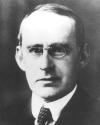
Sir Arthur Stanley Eddington
(28 Dec 1882 - 22 Nov 1944)
known for his work on the motion, distribution, evolution and structure of stars. He also interpreted Einstein's general theory of relativity. He was one of the first to suggest (1917) conversion of matter into radiation powered the stars.
|
Science Quotes by Sir Arthur Stanley Eddington (129 quotes)
>> Click for Sir Arthur Stanley Eddington Quotes on | Atom | Electron | Entropy | Knowledge | Nature | Star | Theory | Universe |
>> Click for Sir Arthur Stanley Eddington Quotes on | Atom | Electron | Entropy | Knowledge | Nature | Star | Theory | Universe |
…The present revolution of scientific thought follows in natural sequence on the great revolutions at earlier epochs in the history of science. Einstein’s special theory of relativity, which explains the indeterminateness of the frame of space and time, crowns the work of Copernicus who first led us to give up our insistence on a geocentric outlook on nature; Einstein's general theory of relativity, which reveals the curvature or non-Euclidean geometry of space and time, carries forward the rudimentary thought of those earlier astronomers who first contemplated the possibility that their existence lay on something which was not flat. These earlier revolutions are still a source of perplexity in childhood, which we soon outgrow; and a time will come when Einstein’s amazing revelations have likewise sunk into the commonplaces of educated thought.
— Sir Arthur Stanley Eddington
In The Theory of Relativity and its Influence on Scientific Thought (1922), 31-32
[Experimental Physicist] Phys. I cannot imagine myself perceiving non-Euclidean space!
Math. Look at the reflection of the room in a polished doorknob, and imagine yourself one of the actors in what you see going on there.
Math. Look at the reflection of the room in a polished doorknob, and imagine yourself one of the actors in what you see going on there.
— Sir Arthur Stanley Eddington
In Space, Time and Gravitation: An Outline of the General Relativity Theory (1920, 1921), 11.
[Experimental Physicist] Phys. I know that it is often a help to represent pressure and volume as height and width on paper; and so geometry may have applications to the theory of gases. But is it not going rather far to say that geometry can deal directly with these things and is not necessarily concerned with lengths in space?
[Mathematician] Math. No. Geometry is nowadays largely analytical, so that in form as well as in effect, it deals with variables of an unknown nature. …It is literally true that I do not want to know the significance of the variables x, y, z, t that I am discussing. …
Phys. Yours is a strange subject. You told us at the beginning that you are not concerned as to whether your propositions are true, and now you tell us you do not even care to know what you are talking about.
Math. That is an excellent description of Pure Mathematics, which has already been given by an eminent mathematician [Bertrand Russell].
[Mathematician] Math. No. Geometry is nowadays largely analytical, so that in form as well as in effect, it deals with variables of an unknown nature. …It is literally true that I do not want to know the significance of the variables x, y, z, t that I am discussing. …
Phys. Yours is a strange subject. You told us at the beginning that you are not concerned as to whether your propositions are true, and now you tell us you do not even care to know what you are talking about.
Math. That is an excellent description of Pure Mathematics, which has already been given by an eminent mathematician [Bertrand Russell].
— Sir Arthur Stanley Eddington
In Space, Time and Gravitation: An Outline of the General Relativity Theory (1920, 1921), 14.
[Relativist] Rel. There is a well-known proposition of Euclid which states that “Any two sides of a triangle are together greater than the third side.” Can either of you tell me whether nowadays there is good reason to believe that this proposition is true?
[Pure Mathematician] Math. For my part, I am quite unable to say whether the proposition is true or not. I can deduce it by trustworthy reasoning from certain other propositions or axioms, which are supposed to be still more elementary. If these axioms are true, the proposition is true; if the axioms are not true, the proposition is not true universally. Whether the axioms are true or not I cannot say, and it is outside my province to consider.
[Pure Mathematician] Math. For my part, I am quite unable to say whether the proposition is true or not. I can deduce it by trustworthy reasoning from certain other propositions or axioms, which are supposed to be still more elementary. If these axioms are true, the proposition is true; if the axioms are not true, the proposition is not true universally. Whether the axioms are true or not I cannot say, and it is outside my province to consider.
— Sir Arthur Stanley Eddington
In Space, Time and Gravitation: An Outline of the General Relativity Theory (1920, 1921), 1.
![Arthur Stanley Eddington quote: [When thinking about the new relativity and quantum theories] I have felt a homesickness for the](https://todayinsci.com/E/Eddington_Arthur/EddingtonArthur-Handrails500x250px.jpg)
[When thinking about the new relativity and quantum theories] I have felt a homesickness for the paths of physical science where there are more or less discernible handrails to keep us from the worst morasses of foolishness.
— Sir Arthur Stanley Eddington
The Nature Of The Physical World (1928), 343.
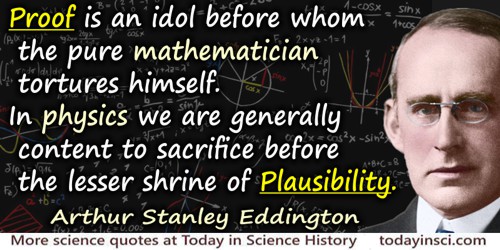
Proof is an idol before whom the pure mathematician tortures himself. In physics we are generally content to sacrifice before the lesser shrine of Plausibility.
— Sir Arthur Stanley Eddington
In Gifford Lecture (1927), Edinburgh, as collected in 'Science and Mysticism', The Nature of the Physical World (1928), 337.
A proposal…to bore a hole in the crust of the Earth and discover the conditions deep down below the surface…may remind us that the most secret places of Nature are, perhaps, not 10 to the n-th miles above our heads, but 10 miles below our feet.
— Sir Arthur Stanley Eddington
From Presidential address to Section A of the British Association at Cardiff (24 Aug 1920). Published in 'The Internal Constitution of the Stars', The Observatory: A Monthly Review of Astronomy (Oct 1920), 43, No. 557, 341.
A star is drawing on some vast reservoir of energy by means unknown to us. This reservoir can scarcely be other than the subatomic energy which, it is known exists abundantly in all matter; we sometimes dream that man will one day learn how to release it and use it for his service. The store is well nigh inexhaustible, if only it could be tapped. There is sufficient in the Sun to maintain its output of heat for 15 billion years.
— Sir Arthur Stanley Eddington
Address to the British Association in Cardiff, (24 Aug 1920), in Observatory (1920), 43 353. Reprinted in Foreward to Arthur S. Eddington, The Internal Constitution of the Stars (1926, 1988), x.
Accordingly the primordial state of things which I picture is an even distribution of protons and electrons, extremely diffuse and filling all (spherical) space, remaining nearly balanced for an exceedingly long time until its inherent instability prevails. We shall see later that the density of this distribution can be calculated; it was about one proton and electron per litre. There is no hurry for anything to begin to happen. But at last small irregular tendencies accumulate, and evolution gets under way. The first stage is the formation of condensations ultimately to become the galaxies; this, as we have seen, started off an expansion, which then automatically increased in speed until it is now manifested to us in the recession of the spiral nebulae.
As the matter drew closer together in the condensations, the various evolutionary processes followed—evolution of stars, evolution of the more complex elements, evolution of planets and life.
As the matter drew closer together in the condensations, the various evolutionary processes followed—evolution of stars, evolution of the more complex elements, evolution of planets and life.
— Sir Arthur Stanley Eddington
The Expanding Universe (1933), 56-57.
All change is relative. The universe is expanding relatively to our common material standards; our material standards are shrinking relatively to the size of the universe. The theory of the “expanding universe” might also be called the theory of the “shrinking atom”. …
:Let us then take the whole universe as our standard of constancy, and adopt the view of a cosmic being whose body is composed of intergalactic spaces and swells as they swell. Or rather we must now say it keeps the same size, for he will not admit that it is he who has changed. Watching us for a few thousand million years, he sees us shrinking; atoms, animals, planets, even the galaxies, all shrink alike; only the intergalactic spaces remain the same. The earth spirals round the sun in an ever-decreasing orbit. It would be absurd to treat its changing revolution as a constant unit of time. The cosmic being will naturally relate his units of length and time so that the velocity of light remains constant. Our years will then decrease in geometrical progression in the cosmic scale of time. On that scale man’s life is becoming briefer; his threescore years and ten are an ever-decreasing allowance. Owing to the property of geometrical progressions an infinite number of our years will add up to a finite cosmic time; so that what we should call the end of eternity is an ordinary finite date in the cosmic calendar. But on that date the universe has expanded to infinity in our reckoning, and we have shrunk to nothing in the reckoning of the cosmic being.
We walk the stage of life, performers of a drama for the benefit of the cosmic spectator. As the scenes proceed he notices that the actors are growing smaller and the action quicker. When the last act opens the curtain rises on midget actors rushing through their parts at frantic speed. Smaller and smaller. Faster and faster. One last microscopic blurr of intense agitation. And then nothing.
:Let us then take the whole universe as our standard of constancy, and adopt the view of a cosmic being whose body is composed of intergalactic spaces and swells as they swell. Or rather we must now say it keeps the same size, for he will not admit that it is he who has changed. Watching us for a few thousand million years, he sees us shrinking; atoms, animals, planets, even the galaxies, all shrink alike; only the intergalactic spaces remain the same. The earth spirals round the sun in an ever-decreasing orbit. It would be absurd to treat its changing revolution as a constant unit of time. The cosmic being will naturally relate his units of length and time so that the velocity of light remains constant. Our years will then decrease in geometrical progression in the cosmic scale of time. On that scale man’s life is becoming briefer; his threescore years and ten are an ever-decreasing allowance. Owing to the property of geometrical progressions an infinite number of our years will add up to a finite cosmic time; so that what we should call the end of eternity is an ordinary finite date in the cosmic calendar. But on that date the universe has expanded to infinity in our reckoning, and we have shrunk to nothing in the reckoning of the cosmic being.
We walk the stage of life, performers of a drama for the benefit of the cosmic spectator. As the scenes proceed he notices that the actors are growing smaller and the action quicker. When the last act opens the curtain rises on midget actors rushing through their parts at frantic speed. Smaller and smaller. Faster and faster. One last microscopic blurr of intense agitation. And then nothing.
— Sir Arthur Stanley Eddington
In The Expanding Universe (1933) , 90-92.
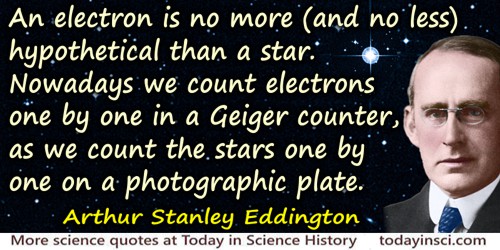
An electron is no more (and no less) hypothetical than a star. Nowadays we count electrons one by one in a Geiger counter, as we count the stars one by one on a photographic plate.
— Sir Arthur Stanley Eddington
Messenger Lectures (1934), New Pathways in Science (1935), 21.
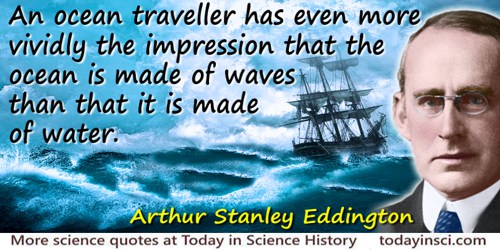
An ocean traveller has even more vividly the impression that the ocean is made of waves than that it is made of water.
— Sir Arthur Stanley Eddington
Gifford Lecture at the University of Edinburgh (Mar 1927). In The Nature of the Physical World (1929, reprint 2005), 242.
As truly as the mystic, the scientist is following a light; and it is not a false or an inferior light.
— Sir Arthur Stanley Eddington
Swarthmore Lecture (1929) at Friends’ House, London, printed in Science and the Unseen World (1929), 41.
Asked in 1919 whether it was true that only three people in the world understood the theory of general relativity, [Eddington] allegedly replied: “Who's the third?”
— Sir Arthur Stanley Eddington
As described in Brian Stableford, Science Fact and Science Fiction: An Encyclopedia (2006), 150.
At terrestrial temperatures matter has complex properties which are likely to prove most difficult to unravel; but it is reasonable to hope that in the not too distant future we shall be competent to understand so simple a thing as a star.
— Sir Arthur Stanley Eddington
The Internal Constitution of Stars, Cambridge. (1926, 1988), 393.
But it is necessary to insist more strongly than usual that what I am putting before you is a model—the Bohr model atom—because later I shall take you to a profounder level of representation in which the electron instead of being confined to a particular locality is distributed in a sort of probability haze all over the atom.
— Sir Arthur Stanley Eddington
Messenger Lectures (1934), New Pathways in Science (1935), 34.
By introspection we drag out the truth for external survey.
— Sir Arthur Stanley Eddington
In 'Science and Mysticism', The Nature of the Physical World (1928), 321.
Consciousness is not sharply defined, but fades into sub-consciousness; and beyond that we must postulate something indefinite but yet continuous with our mental nature. This I take it be the world-stuff.
— Sir Arthur Stanley Eddington
From Gifford Lecture, Edinburgh, (1927), 'Reality', collected in The Nature of the Physical World (1928), 280.
Consciousness is not wholly, nor even primarily a device for receiving sense-impressions. …there is another outlook than the scientific one, because in practice a more transcendental outlook is almost universally admitted. …who does not prize these moments that reveal to us the poetry of existence?
— Sir Arthur Stanley Eddington
Swarthmore Lecture (1929) at Friends’ House, London, printed in Science and the Unseen World (1929), 44.
Entropy is time’s arrow.
— Sir Arthur Stanley Eddington
Even if religion and morality are dismissed as illusion, the word “Ought” still has sway.
— Sir Arthur Stanley Eddington
Swarthmore Lecture (1929) at Friends’ House, London, printed in Science and the Unseen World (1929), 55.
Every body continues in its state of rest or uniform motion in a straight line, except in so far as it doesn’t. … The suggestion that the body really wanted to go straight but some mysterious agent made it go crooked is picturesque but unscientific.
— Sir Arthur Stanley Eddington
Paraphasing Newton’s First Law of Motion. In a Gifford Lecture delivered at the University of Edinburgh (1927), 'Gravitation: The Law', The Nature of the Physical World (1928), 124.
For if those who hold that there must be a physical basis for everything hold that these mystical views are nonsense, we may ask—What then is the physical basis of nonsense? ... In a world of ether and electrons we might perhaps encounter nonsense; we could not encounter damned nonsense.
— Sir Arthur Stanley Eddington
…...
For the truth of the conclusions of physical science, observation is the supreme Court of Appeal. It does not follow that every item which we confidently accept as physical knowledge has actually been certified by the Court; our confidence is that it would be certified by the Court if it were submitted. But it does follow that every item of physical knowledge is of a form which might be submitted to the Court. It must be such that we can specify (although it may be impracticable to carry out) an observational procedure which would decide whether it is true or not. Clearly a statement cannot be tested by observation unless it is an assertion about the results of observation. Every item of physical knowledge must therefore be an assertion of what has been or would be the result of carrying out a specified observational procedure.
— Sir Arthur Stanley Eddington
In ’Scientific Epistemology', The Philosophy of Physical Science (1938, 2012), 9.
However closely we may associate thought with the physical machinery of the brain, the connection is dropped as irrelevant as soon as we consider the fundamental property of thought—that it may be correct or incorrect. …that involves recognising a domain of the other type of law—laws which ought to be kept, but may be broken.
— Sir Arthur Stanley Eddington
Swarthmore Lecture (1929) at Friends’ House, London, printed in Science and the Unseen World (1929), 57-58.
Human life is proverbially uncertain; few things are more certain than the solvency of a life-insurance company.
— Sir Arthur Stanley Eddington
In The Nature of the Physical World (1928), 300.
I believe there are
15,747,724,136,275,002,577,605,653,961,181,555,468,044,717,
914,527,116,709,366,231,025,076,185,631,031,296
protons in the universe, and the same number of electrons.
15,747,724,136,275,002,577,605,653,961,181,555,468,044,717,
914,527,116,709,366,231,025,076,185,631,031,296
protons in the universe, and the same number of electrons.
— Sir Arthur Stanley Eddington
From Tarner Lecture (1938), 'The Physical Universe', in The Philosophy of Physical Science (1939, 2012), 170. Note: the number is 136 x 2256.
I think it is not irreligion but a tidiness of mind, which rebels against the idea of permeating scientific research with a religious implication.
— Sir Arthur Stanley Eddington
Swarthmore Lecture (1929) at Friends’ House, London, printed in Science and the Unseen World (1929), 24-25.
I think that science would never have achieved much progress if it had always imagined unknown obstacles hidden round every corner. At least we may peer gingerly round the corner, and perhaps we shall find there is nothing very formidable after all.
— Sir Arthur Stanley Eddington
In Stars and Atoms (1927), 20.
I will give you a “celestial multiplication table.” We start with a star as the unit most familiar to us, a globe comparable to the sun. Then—
A hundred thousand million Stars make one Galaxy;
A hundred thousand million Galaxies make one Universe.
The figures may not be very trustworthy, but I think they give a correct impression.
A hundred thousand million Stars make one Galaxy;
A hundred thousand million Galaxies make one Universe.
The figures may not be very trustworthy, but I think they give a correct impression.
— Sir Arthur Stanley Eddington
In The Expanding Universe (1933), 4.
If God is as real as the shadow of the Great War on Armistice Day, need we seek further reason for making a place for God in our thoughts and lives? We shall not be concerned if the scientific explorer reports that he is perfectly satisfied that he has got to the bottom of things without having come across either.
— Sir Arthur Stanley Eddington
Swarthmore Lecture (1929) at Friends’ House, London, printed in Science and the Unseen World (1929), 67.
If in a community of the blind one man suddenly received the gift of sight, he would have much to tell which would not be at all scientific.
— Sir Arthur Stanley Eddington
Swarthmore Lecture (1929) at Friends’ House, London, printed in Science and the Unseen World (1929), 79.
If our so-called facts are changing shadows, they are shadows cast by the light of constant truth. So too in religion we are repelled by that confident theological doctrine… but we need not turn aside from the measure of light that comes into our experience showing us a Way through the unseen world.
— Sir Arthur Stanley Eddington
Swarthmore Lecture (1929) at Friends’ House, London, printed in Science and the Unseen World (1929), 91.
If the kind of controversy which so often springs up between modernism and traditionalism in religion were applied to more commonplace affairs of life we might see some strange results. …It arises, let us say, from a passage in an obituary notice which mentions that the deceased had loved to watch the sunsets from his peaceful country home.. …it is forgotten that what the deceased man looked out for each evening was an experience and not a creed.
— Sir Arthur Stanley Eddington
Swarthmore Lecture (1929) at Friends’ House, London, printed in Science and the Unseen World (1929), 84-85.
If to-day you ask a physicist what he has finally made out the æther or the electron to be, the answer will not be a description in terms of billiard balls or fly-wheels or anything concrete; he will point instead to a number of symbols and a set of mathematical equations which they satisfy. What do the symbols stand for? The mysterious reply is given that physics is indifferent to that; it has no means of probing beneath the symbolism. To understand the phenomena of the physical world it is necessary to know the equations which the symbols obey but not the nature of that which is being symbolised. …this newer outlook has modified the challenge from the material to the spiritual world.
— Sir Arthur Stanley Eddington
Swarthmore Lecture (1929) at Friends’ House, London, printed in Science and the Unseen World (1929), 30.
In ancient days two aviators procured to themselves wings. Daedalus flew safely through the middle air and was duly honored on his landing. Icarus soared upwards to the sun till the wax melted which bound his wings and his flight ended in fiasco. In weighing their achievements, there is something to be said for Icarus. The classical authorities tell us that he was only “doing a stunt,” but I prefer to think of him as the man who brought to light a serious constructional defect in the flying machines of his day.
— Sir Arthur Stanley Eddington
In the most modern theories of physics probability seems to have replaced aether as “the nominative of the verb ‘to undulate’.”
— Sir Arthur Stanley Eddington
Messenger Lectures (1934), New Pathways in Science (1935), 110.
In the world of physics we watch a shadowgraph performance of the drama of familiar life. The shadow of my elbow rests on the shadow table as the shadow ink flows over the shadow paper. It is all symbolic, and as a symbol the physicist leaves it. ... The frank realization that physical science is concerned with a world of shadows is one of the most significant of recent advances.
— Sir Arthur Stanley Eddington
In The Nature of the Physical World (1928, 2005), xiv-xv.
Infinite space cannot be conceived by anybody; finite but unbounded space is difficult to conceive but not impossible. … [We] are using a conception of space which must have originated a million years ago and has become rather firmly imbedded in human thought. But the space of Physics ought not to be dominated by this creation of the dawning mind of an enterprising ape."
— Sir Arthur Stanley Eddington
In The Nature of the Physical World (1929), 80-81.
It is also a good rule not to put overmuch confidence in the observational results that are put forward until they are confirmed by theory.
— Sir Arthur Stanley Eddington
New Pathways in Science (1935), 211.
It is an astonishing feat of deciphering that we should have been able to infer an orderly scheme of natural knowledge from such indirect communication.
— Sir Arthur Stanley Eddington
Swarthmore Lecture (1929) at Friends’ House, London, printed in Science and the Unseen World (1929), 34.
It is difficult for the matter-of-fact physicist to accept the view that the substratum of everything is of mental character. But no one can deny that mind is the first and most direct thing in our experience, and all else is remote inference—inference either intuitive or deliberate.
— Sir Arthur Stanley Eddington
From Gifford Lecture, Edinburgh, (1927), 'Reality', collected in The Nature of the Physical World (1928), 281.
It is impossible to trap modern physics into predicting anything with perfect determinism because it deals with probabilities from the outset.
— Sir Arthur Stanley Eddington
New Pathways in Science (1935), 105.
It is of interest to inquire what happens when the aviator’s speed… approximates to the velocity of light. Lengths in the direction of flight become smaller and smaller, until for the speed of light they shrink to zero. The aviator and the objects accompanying him shrink to two dimensions. We are saved the difficulty of imagining how the processes of life can go on in two dimensions, because nothing goes on. Time is arrested altogether. This is the description according to the terrestrial observer. The aviator himself detects nothing unusual; he does not perceive that he has stopped moving. He is merely waiting for the next instant to come before making the next movement; and the mere fact that time is arrested means that he does not perceive that the next instant is a long time coming.
— Sir Arthur Stanley Eddington
In Space, Time and Gravitation: An Outline of the General Relativity Theory (1920, 1921), 26.
It is perhaps difficult sufficiently to emphasise Seeking without disparaging its correlative Finding. But I must risk this, for Finding has a clamorous voice that proclaims its own importance; it is definite and assured, something that we can take hold of —that is what we all want, or think we want. Yet how transitory it proves.
The finding of one generation will not serve for the next. It tarnishes rapidly except it be reserved with an ever-renewed spirit of seeking.
The finding of one generation will not serve for the next. It tarnishes rapidly except it be reserved with an ever-renewed spirit of seeking.
— Sir Arthur Stanley Eddington
Swarthmore Lecture (1929) at Friends’ House, London, printed in Science and the Unseen World (1929), 87-88.
It is the reciprocity of these appearances—that each party should think the other has contracted—that is so difficult to realise. Here is a paradox beyond even the imagination of Dean Swift. Gulliver regarded the Lilliputians as a race of dwarfs; and the Lilliputians regarded Gulliver as a giant. That is natural. If the Lilliputians had appeared dwarfs to Gulliver, and Gulliver had appeared a dwarf to the Lilliputians—but no! that is too absurd for fiction, and is an idea only to be found in the sober pages of science. …It is not only in space but in time that these strange variations occur. If we observed the aviator carefully we should infer that he was unusually slow in his movements; and events in the conveyance moving with him would be similarly retarded—as though time had forgotten to go on. His cigar lasts twice as long as one of ours. …But here again reciprocity comes in, because in the aviator’s opinion it is we who are travelling at 161,000 miles a second past him; and when he has made all allowances, he finds that it is we who are sluggish. Our cigar lasts twice as long as his.
— Sir Arthur Stanley Eddington
In Space, Time and Gravitation: An Outline of the General Relativity Theory (1920, 1921), 23-24.
It remains a real world if there is a background to the symbols—an unknown quantity which the mathematical symbol x stands for. We think we are not wholly cut off from this background. It is to this background that our own personality and consciousness belong, and those spiritual aspects of our nature not to be described by any symbolism… to which mathematical physics has hitherto restricted itself.
— Sir Arthur Stanley Eddington
Swarthmore Lecture (1929) at Friends’ House, London, printed in Science and the Unseen World (1929), 37-38.
Just now nuclear physicists are writing a great deal about hypothetical particles called neutrinos supposed to account for certain peculiar facts observed in β-ray disintegration. We can perhaps best describe the neutrinos as little bits of spin-energy that have got detached. I am not much impressed by the neutrino theory. In an ordinary way I might say that I do not believe in neutrinos… But I have to reflect that a physicist may be an artist, and you never know where you are with artists. My old-fashioned kind of disbelief in neutrinos is scarcely enough. Dare I say that experimental physicists will not have sufficient ingenuity to make neutrinos? Whatever I may think, I am not going to be lured into a wager against the skill of experimenters under the impression that it is a wager against the truth of a theory. If they succeed in making neutrinos, perhaps even in developing industrial applications of them, I suppose I shall have to believe—though I may feel that they have not been playing quite fair.
— Sir Arthur Stanley Eddington
From Tarner Lecture, 'Discovery or Manufacture?' (1938), in The Philosophy of Physical Science (1939, 2012), 112.
Let us draw an arrow arbitrarily. If as we follow the arrow we find more and more of the random element in the state of the world, then the arrow is pointing towards the future; if the random element decreases the arrow points towards the past … I shall use the phrase “time's arrow” to express this one-way property of time which has no analogue in space.
— Sir Arthur Stanley Eddington
Gifford Lectures (1927), The Nature of The Physical World (1928), 69.
Let us suppose that an ichthyologist is exploring the life of the ocean. He casts a net into the water and brings up a fishy assortment. Surveying his catch, he proceeds in the usual manner of a scientist to systematise what it reveals. He arrives at two generalisations:
(1) No sea-creature is less than two inches long.
(2) All sea-creatures have gills.
These are both true of his catch, and he assumes tentatively that they will remain true however often he repeats it.
In applying this analogy, the catch stands for the body of knowledge which constitutes physical science, and the net for the sensory and intellectual equipment which we use in obtaining it. The casting of the net corresponds to observation; for knowledge which has not been or could not be obtained by observation is not admitted into physical science.
An onlooker may object that the first generalisation is wrong. “There are plenty of sea-creatures under two inches long, only your net is not adapted to catch them.” The icthyologist dismisses this objection contemptuously. “Anything uncatchable by my net is ipso facto outside the scope of icthyological knowledge. In short, what my net can't catch isn't fish.” Or—to translate the analogy—“If you are not simply guessing, you are claiming a knowledge of the physical universe discovered in some other way than by the methods of physical science, and admittedly unverifiable by such methods. You are a metaphysician. Bah!”
(1) No sea-creature is less than two inches long.
(2) All sea-creatures have gills.
These are both true of his catch, and he assumes tentatively that they will remain true however often he repeats it.
In applying this analogy, the catch stands for the body of knowledge which constitutes physical science, and the net for the sensory and intellectual equipment which we use in obtaining it. The casting of the net corresponds to observation; for knowledge which has not been or could not be obtained by observation is not admitted into physical science.
An onlooker may object that the first generalisation is wrong. “There are plenty of sea-creatures under two inches long, only your net is not adapted to catch them.” The icthyologist dismisses this objection contemptuously. “Anything uncatchable by my net is ipso facto outside the scope of icthyological knowledge. In short, what my net can't catch isn't fish.” Or—to translate the analogy—“If you are not simply guessing, you are claiming a knowledge of the physical universe discovered in some other way than by the methods of physical science, and admittedly unverifiable by such methods. You are a metaphysician. Bah!”
— Sir Arthur Stanley Eddington
In 'Selective Subjectivism', The Philosophy of Physical Science (1938, 2012), 16.
Looking back over the geological record it would seem that Nature made nearly every possible mistake before she reached her greatest achievement Man—or perhaps some would say her worst mistake of all. ... At last she tried a being of no great size, almost defenseless, defective in at least one of the more important sense organs; one gift she bestowed to save him from threatened extinction—a certain stirring, a restlessness, in the organ called the brain.
— Sir Arthur Stanley Eddington
…...
Man is slightly nearer to the atom than to the star. … From his central position man can survey the grandest works of Nature with the astronomer, or the minutest works with the physicist. … [K]nowledge of the stars leads through the atom; and important knowledge of the atom has been reached through the stars.
— Sir Arthur Stanley Eddington
Lecture 1. Stars and Atoms (1928, 2007), 9.
Materialism in its literal sense is long since dead. …It is …belief in the universal dominance of scientific law which is nowadays generally meant by materialism.
— Sir Arthur Stanley Eddington
Swarthmore Lecture (1929) at Friends’ House, London, printed in Science and the Unseen World (1929), 50-51.
Matter and all else that is in the physical world have been reduced to a shadowy symbolism.
— Sir Arthur Stanley Eddington
Swarthmore Lecture (1929) at Friends’ House, London, printed in Science and the Unseen World (1929), 33.
Mind is the first and most direct thing in our experience; all else is remote inference.
— Sir Arthur Stanley Eddington
Swarthmore Lecture (1929) at Friends’ House, London, printed in Science and the Unseen World (1929), 37.
Motion with respect to the universal ocean of aether eludes us. We say, “Let V be the velocity of a body through the aether”, and form the various electromagnetic equations in which V is scattered liberally. Then we insert the observed values, and try to eliminate everything which is unknown except V. The solution goes on famously; but just as we have got rid of all the other unknowns, behold! V disappears as well, and we are left with the indisputable but irritating conclusion —
0 = 0
This is a favourite device that mathematical equations resort to, when we propound stupid questions.
0 = 0
This is a favourite device that mathematical equations resort to, when we propound stupid questions.
— Sir Arthur Stanley Eddington
From Gifford Lecture, Edinburgh, (1927), 'Relativity', collected in The Nature of the Physical World (1928), 30.
Natural law is not applicable to the unseen world behind the symbols, because it is unadapted to anything except symbols, and its perfection is a perfection of symbolic linkage. You cannot apply such a scheme to the parts of our personality which are not measurable by symbols any more than you can extract the square root of a sonnet.
— Sir Arthur Stanley Eddington
Swarthmore Lecture (1929) at Friends’ House, London, printed in Science and the Unseen World (1929), 53.
Never mind what two tons refers to. What is it? How has it entered in so definite a way into our exprerience? Two tons is the reading of the pointer when the elephant was placed on a weighing machine. Let us pass on. … And so we see that the poetry fades out of the problem, and by the time the serious application of exact science begins we are left only with pointer readings.
— Sir Arthur Stanley Eddington
From Gifford Lecture, Edinburgh, (1927), 'Pointer Readings', collected in The Nature of the Physical World (1928), 252.
Ninety-nine people out of a hundred have not seriously considered what they mean by the term “exist” nor how a thing qualifies itself to be labelled real.
— Sir Arthur Stanley Eddington
Swarthmore Lecture (1929) at Friends’ House, London, printed in Science and the Unseen World (1929), 69.
Objections to religious mysticism lose their force if they can equally be turned against natural mysticism.
— Sir Arthur Stanley Eddington
Swarthmore Lecture (1929) at Friends’ House, London, printed in Science and the Unseen World (1929), 47.
On one occasion when [William] Smart found him engrossed with his fundamental theory, he asked Eddington how many people he thought would understand what he was writing—after a pause came the reply, 'Perhaps seven.'
— Sir Arthur Stanley Eddington
A. V. Douglas, The Life of Arthur Stanley Eddington (1956), 110.
Only the inertia of tradition keeps the contraction hypothesis alive—or rather, not alive, but an unburied corpse. But if we decide to inter the corpse, let us frankly recognize the position in which we are left. A star is drawing on some vast reservoir of energy by means unknown to us. This reservoir can scarcely be other than the subatomic energy which, it is known, exists abundantly in all matter.
— Sir Arthur Stanley Eddington
From Presidential address to Section A of the British Association at Cardiff (24 Aug 1920). Published in 'The Internal Constitution of the Stars', The Observatory: A Monthly Review of Astronomy (Oct 1920), 43, No. 557, 353.
Our environment may and should mean something towards us which is not to be measured with the tools of the physicist or described by the metrical symbols of the mathematician.
— Sir Arthur Stanley Eddington
Swarthmore Lecture (1929) at Friends’ House, London, printed in Science and the Unseen World (1929), 47.
Our model of Nature should not be like a building—a handsome structure for the populace to admire, until in the course of time some one takes away a corner stone and the edifice comes toppling down. It should be like an engine with movable parts. We need not fix the position of any one lever; that is to be adjusted from time to time as the latest observations indicate. The aim of the theorist is to know the train of wheels which the lever sets in motion—that binding of the parts which is the soul of the engine.
— Sir Arthur Stanley Eddington
In 'The Internal Constitution of the Stars', The Scientific Monthly (Oct 1920), 11, No. 4, 302.
Our story of evolution ended with a stirring in the brain-organ of the latest of Nature’s experiments; but that stirring of consciousness transmutes the whole story and gives meaning to its symbolism. Symbolically it is the end, but looking behind the symbolism it is the beginning.
— Sir Arthur Stanley Eddington
Swarthmore Lecture (1929) at Friends’ House, London, printed in Science and the Unseen World (1929), 38.
Our system of philosophy is itself on trial; it must stand or fall according as it is broad enough to find room for this experience as an element of life.
— Sir Arthur Stanley Eddington
Swarthmore Lecture (1929) at Friends’ House, London, printed in Science and the Unseen World (1929), 46.
Our ultimate analysis of space leads us not to a “here” and a “there,” but to an extension such as that which relates “here” and “there.” To put the conclusion rather crudely—space is not a lot of points close together; it is a lot of distances interlocked.
— Sir Arthur Stanley Eddington
The Mathematical Theory of Relativity (1923), 10.
Physical science comes nearest to that complete system of exact knowledge which all sciences have before them as an ideal. Some fall far short of it. The physicist who inveighs against the lack of coherence and the indefiniteness of theological theories, will probably speak not much less harshly of the theories of biology and psychology. They also fail to come up to his standard of methodology. On the other side of him stands an even superior being—the pure mathematician—who has no high opinion of the methods of deduction used in physics, and does not hide his disapproval of the laxity of what is accepted as proof in physical science. And yet somehow knowledge grows in all these branches. Wherever a way opens we are impelled to seek by the only methods that can be devised for that particular opening, not over-rating the security of our finding, but conscious that in this activity of mind we are obeying the light that is in our nature.
— Sir Arthur Stanley Eddington
Swarthmore Lecture (1929) at Friends’ House, London, printed in Science and the Unseen World (1929), 77-78.
Physics has in the main contented itself with studying the abridged edition of the book of nature.
— Sir Arthur Stanley Eddington
In 'A Generalization of Weyl's Theory of the Electromagnetic and Gravitational Fields' in Proceedings of the Royal Society of London (1921), 99, Series A, 108.
Physics most strongly insists that its methods do not penetrate behind the symbolism.
— Sir Arthur Stanley Eddington
Swarthmore Lecture (1929) at Friends’ House, London, printed in Science and the Unseen World (1929), 36.
Religious creeds are a great obstacle to any full sympathy between the outlook of the scientist and the outlook which religion is so often supposed to require … The spirit of seeking which animates us refuses to regard any kind of creed as its goal. It would be a shock to come across a university where it was the practice of the students to recite adherence to Newton's laws of motion, to Maxwell's equations and to the electromagnetic theory of light. We should not deplore it the less if our own pet theory happened to be included, or if the list were brought up to date every few years. We should say that the students cannot possibly realise the intention of scientific training if they are taught to look on these results as things to be recited and subscribed to. Science may fall short of its ideal, and although the peril scarcely takes this extreme form, it is not always easy, particularly in popular science, to maintain our stand against creed and dogma.
— Sir Arthur Stanley Eddington
Swarthmore Lecture (1929), Science and the Unseen World (1929), 54-56.
Schrodinger’s wave-mechanics is not a physical theory but a dodge—and a very good dodge too.
— Sir Arthur Stanley Eddington
Gifford Lectures (1927), The Nature of the Physical World (1928), 219.
Science aims at constructing a world which shall be symbolic of the world of commonplace experience. It is not at all necessary that every individual symbol that is used should represent something in common experience or even something explicable in terms of common experience. The man in the street is always making this demand for concrete explanation of the things referred to in science; but of necessity he must be disappointed. It is like our experience in learning to read. That which is written in a book is symbolic of a story in real life. The whole intention of the book is that ultimately a reader will identify some symbol, say BREAD, with one of the conceptions of familiar life. But it is mischievous to attempt such identifications prematurely, before the letters are strung into words and the words into sentences. The symbol A is not the counterpart of anything in familiar life.
— Sir Arthur Stanley Eddington
From 'Introduction', The Nature of the Physical World (1928), xiii.
Science has an important part to play in our everyday existence, and there is far too much neglect of science; but its intention is to supplement not to supplant the familiar outlook.
— Sir Arthur Stanley Eddington
Swarthmore Lecture (1929) at Friends’ House, London, printed in Science and the Unseen World (1929), 83.
Shuffling is the only thing which Nature cannot undo.
— Sir Arthur Stanley Eddington
From Gifford Lecture, Edinburgh, (1927), 'The Running-Down of the Universe', collected in The Nature of the Physical World (1928), 64.
So far as physics is concerned, time’s arrow is a property of entropy alone.
— Sir Arthur Stanley Eddington
Gifford Lectures (1927), The Nature of the Physical World (1928), 80.
Something unknown is doing we don’t know what—that is what our theory amounts to.
— Sir Arthur Stanley Eddington
Expressing the quantum theory description of an electron has no familiar conception of a real form. In The Nature Of The Physical World (1928), 291.
Spherical space is not very easy to imagine. We have to think of the properties of the surface of a sphere—the two-dimensional case—and try to conceive something similar applied to three-dimensional space. Stationing ourselves at a point let us draw a series of spheres of successively greater radii. The surface of a sphere of radius r should be proportional to r2; but in spherical space the areas of the more distant spheres begin to fall below the proper proportion. There is not so much room out there as we expected to find. Ultimately we reach a sphere of biggest possible area, and beyond it the areas begin to decrease. The last sphere of all shrinks to a point—our antipodes. Is there nothing beyond this? Is there a kind of boundary there? There is nothing beyond and yet there is no boundary. On the earth’s surface there is nothing beyond our own antipodes but there is no boundary there
— Sir Arthur Stanley Eddington
In Space, Time and Gravitation: An Outline of the General Relativity Theory (1920, 1921), 158-159.
Study of the scientific world cannot prescribe the orientation of something which is excluded from the scientific world.
— Sir Arthur Stanley Eddington
Swarthmore Lecture (1929) at Friends’ House, London, printed in Science and the Unseen World (1929), 43.
Suppose that you are in love with a lady on Neptune and that she returns the sentiment. It will be some consolation for the melancholy separation if you can say to yourself at some possibly pre-arranged moment, “She is thinking of me now.” Unfortunately a difficulty has arisen because we have had to abolish Now. There is no absolute Now, but only the various relative Nows, differing according to their reckoning of different observers and covering the whole neutral wedge which at the distance of Neptune is about eight hours thick. She will have to think of you continuously for eight hours on end in order to circumvent the ambiguity “Now.”
— Sir Arthur Stanley Eddington
In The Nature of the Physical World (1929), 49.
Take the living human brain endowed with mind and thought. …. The physicist brings his tools and commences systematic exploration. All that he discovers is a collection of atoms and electrons and fields of force arranged in space and time, apparently similar to those found in inorganic objects. He may trace other physical characteristics, energy, temperature, entropy. None of these is identical with thought. … How can this collection of ordinary atoms be a thinking machine? … The Victorian physicist felt that he knew just what he was talking about when he used such terms as matter and atoms. … But now we realize that science has nothing to say as to the intrinsic nature of the atom. The physical atom is, like everything else in physics, a schedule of pointer readings.
— Sir Arthur Stanley Eddington
From a Gifford Lecture, University of Edinburgh (1927), published in 'Pointer Readings: Limits of Physical Knowledge', The Nature of the Physical World (1929), 258-259.
The chairs and tables around us which broadcast to us incessantly those signals which affect our sight and touch cannot in their nature be like unto the signals or to the sensations which the signals awake at the end of their journey.
— Sir Arthur Stanley Eddington
Swarthmore Lecture (1929) at Friends’ House, London, printed in Science and the Unseen World (1929), 36.
The desire for truth so prominent in the quest of science, a reaching out of the spirit from its isolation to something beyond, a response to beauty in nature and art, an Inner Light of conviction and guidance—are these as much a part of our being as our sensitivity to sense impressions?
— Sir Arthur Stanley Eddington
Swarthmore Lecture (1929) at Friends’ House, London, printed in Science and the Unseen World (1929), 42-43.
The electron, as it leaves the atom, crystallises out of Schrödinger’s mist like a genie emerging from his bottle.
— Sir Arthur Stanley Eddington
Gifford Lectures (1927), The Nature of the Physical World (1928), 199.
The essential difference, which we meet in entering the realm of spirit and mind, seems to hang round the word “Ought.”
— Sir Arthur Stanley Eddington
Swarthmore Lecture (1929) at Friends’ House, London, printed in Science and the Unseen World (1929), 54.
The exploration of the external world by the methods of physical science leads not to a concrete reality but to a shadow world of symbols, beneath which those methods are unadapted for penetrating.
— Sir Arthur Stanley Eddington
Swarthmore Lecture (1929) at Friends’ House, London, printed in Science and the Unseen World (1929), 73.
The external world of physics has … become a world of shadows. In removing our illusions we have removed the substance, for indeed we have seen that substance is one of the greatest of our illusions. Later perhaps we may inquire whether in our zeal to cut out all that is unreal we may not have used the knife too ruthlessly. Perhaps, indeed, reality is a child which cannot survive without its nurse illusion. But if so, that is of little concern to the scientist, who has good and sufficient reasons for pursuing his investigations in the world of shadows and is content to leave to the philosopher the determination of its exact status in regard to reality.
— Sir Arthur Stanley Eddington
In Introduction to The Nature of the Physical World (1928), xiv.
The helium which we handle must have been put together at some time and some place. We do not argue with the critic who urges that the stars are not hot enough for this process; we tell him to go and find a hotter place.
— Sir Arthur Stanley Eddington
The Internal Constitution of the Stars (1926), 301.
The idealistic tinge in my conception of the physical world arose out of mathematical researches on the relativity theory. In so far as I had any earlier philosophical views, they were of an entirely different complexion.
From the beginning I have been doubtful whether it was desirable for a scientist to venture so far into extra-scientific territory. The primary justification for such an expedition is that it may afford a better view of his own scientific domain.
From the beginning I have been doubtful whether it was desirable for a scientist to venture so far into extra-scientific territory. The primary justification for such an expedition is that it may afford a better view of his own scientific domain.
— Sir Arthur Stanley Eddington
From 'Introduction', The Nature of the Physical World (1928), vi.
The law that entropy always increases—the Second Law of Thermodynamics—holds, I think, the supreme position among the laws of Nature. If someone points out to you that your pet theory of the universe is in disagreement with Maxwell’s equations—then so much the worse for Maxwell’s equations. If it is found to be contradicted by observation—well these experimentalists do bungle things sometimes. But if your theory is found to be against the second law of thermodynamics I can give you no hope; there is nothing for it but to collapse in deepest humiliation.
— Sir Arthur Stanley Eddington
Gifford Lectures (1927), The Nature of the Physical World (1928), 74.
The law that entropy increases—the Second Law of Thermodynamics—holds, I think, the supreme position among the laws of Nature.
— Sir Arthur Stanley Eddington
Gifford Lectures (1927), The Nature of the Physical World (1928), 74.
The laws of logic do not prescribe the way our minds think; they prescribe the way our minds ought to think.
— Sir Arthur Stanley Eddington
Swarthmore Lecture (1929) at Friends’ House, London, printed in Science and the Unseen World (1929), 55.
The mathematics is not there till we put it there.
— Sir Arthur Stanley Eddington
In 'The Concept of Structure', The Philosophy of Physical Science (1938, 2012), 137.
The mind has an outlook which transcends the natural law by which it functions.
— Sir Arthur Stanley Eddington
Swarthmore Lecture (1929) at Friends’ House, London, printed in Science and the Unseen World (1929), 56.
The mind-stuff is not spread in space and time. But we must presume that in some other way or aspect it can be differentiated into parts. Only here and there does it arise to the level of consciousness, but from such islands proceeds all knowledge. The latter includes our knowledge of the physical world.
— Sir Arthur Stanley Eddington
From Gifford Lecture, Edinburgh, (1927), 'Reality', collected in The Nature of the Physical World (1928), 277.
The problem of experiences is not limited to the interpretation of sense-impressions.
— Sir Arthur Stanley Eddington
Swarthmore Lecture (1929) at Friends’ House, London, printed in Science and the Unseen World (1929), 40.
The quest of the absolute leads into the four-dimensional world.
— Sir Arthur Stanley Eddington
From Gifford Lecture, Edinburgh, (1927), 'Relativity', collected in The Nature of the Physical World (1928), 26.
The scientific answer is relevant so far as concerns the sense-impressions… For the rest the human spirit must turn to the unseen world to which it itself belongs.
— Sir Arthur Stanley Eddington
Swarthmore Lecture (1929) at Friends’ House, London, printed in Science and the Unseen World (1929), 43.
The symbol A is not the counterpart of anything in familiar life. To the child the letter A would seem horribly abstract; so we give him a familiar conception along with it. “A was an Archer who shot at a frog.” This tides over his immediate difficulty; but he cannot make serious progress with word-building so long as Archers, Butchers, Captains, dance round the letters. The letters are abstract, and sooner or later he has to realise it. In physics we have outgrown archer and apple-pie definitions of the fundamental symbols. To a request to explain what an electron really is supposed to be we can only answer, “It is part of the A B C of physics”.
— Sir Arthur Stanley Eddington
In Introduction to The Nature of the Physical World (1928), xiv.
The understanding between a non-technical writer and his reader is that he shall talk more or less like a human being and not like an Act of Parliament. I take it that the aim of such books must be to convey exact thought in inexact language... he can never succeed without the co-operation of the reader.
— Sir Arthur Stanley Eddington
Messenger Lectures (1934), New Pathways in Science (1935), 279.
The universe is of the nature of a thought or sensation in a universal Mind… To put the conclusion crudely—the stuff of the world is mind-stuff. As is often the way with crude statements, I shall have to explain that by “mind” I do not exactly mean mind and by “stuff” I do not at all mean stuff. Still that is about as near as we can get to the idea in a simple phrase. The mind-stuff of the world is something more general than our individual conscious minds; but we may think of its nature as not altogether foreign to feelings in our consciousness… Having granted this, the mental activity of the part of world constituting ourselves occasions no great surprise; it is known to us by direct self-knowledge, and we do not explain it away as something other than we know it to be—or rather, it knows itself to be.
— Sir Arthur Stanley Eddington
From Gifford Lecture, Edinburgh, (1927), 'Reality', collected in The Nature of the Physical World (1928), 276.
The whole subject-matter of exact science consists of pointer readings and similar indications.
— Sir Arthur Stanley Eddington
From Gifford Lecture, Edinburgh, (1927), 'The New Quantum Theory', collected in The Nature of the Physical World (1928), 219.
Theological or anti-theological argument to prove or disprove the existence of a deity seems to me to occupy itself largely with skating among the difficulties caused by our making a fetish of this word [existence].
— Sir Arthur Stanley Eddington
Swarthmore Lecture (1929) at Friends’ House, London, printed in Science and the Unseen World (1929), 69.
There is another passage from the Old Testament that comes nearer to my own sympathies—“And behold the Lord passed by, and a great and strong wind rent the mountains, and brake in pieces the rocks before the Lord; but the Lord was not in the wind: and after the wind an earthquake; but the Lord was not in the earthquake: and after the earthquake a fire; but the Lord was not in the fire: and after the fire a still small voice. …And behold there came a voice unto him, and said. What doest thou here, Elijah?”
— Sir Arthur Stanley Eddington
Swarthmore Lecture (1929) at Friends’ House, London, printed in Science and the Unseen World (1929), 25-26.
There is no space without aether, and no aether which does not occupy space.
— Sir Arthur Stanley Eddington
Messenger Lectures (1934), New Pathways in Science (1935), 39.
There is only one law of Nature—the second law of thermodynamics—which recognises a distinction between past and future more profound than the difference of plus and minus. It stands aloof from all the rest. … It opens up a new province of knowledge, namely, the study of organisation; and it is in connection with organisation that a direction of time-flow and a distinction between doing and undoing appears for the first time.
— Sir Arthur Stanley Eddington
In The Nature of the Physical World (1928, 2005), 67-68.
There once was a brainy baboon,
Who always breathed down a bassoon,
For he said, “It appears
That in billions of years
I shall certainly hit on a tune”.
Who always breathed down a bassoon,
For he said, “It appears
That in billions of years
I shall certainly hit on a tune”.
— Sir Arthur Stanley Eddington
New Pathways in Science (1935), 62.
There was a time when we wanted to be told what an electron is. The question was never answered. No familiar conceptions can be woven around the electron; it belongs to the waiting list.
— Sir Arthur Stanley Eddington
The Nature Of The Physical World (1928), 290.
To the pure geometer the radius of curvature is an incidental characteristic—like the grin of the Cheshire cat. To the physicist it is an indispensable characteristic. It would be going too far to say that to the physicist the cat is merely incidental to the grin. Physics is concerned with interrelatedness such as the interrelatedness of cats and grins. In this case the “cat without a grin” and the “grin without a cat” are equally set aside as purely mathematical phantasies.
— Sir Arthur Stanley Eddington
In 'The Universe and the Atom' The Expanding Universe. (1933), 103.
To those who have any intimate acquaintance with the laws of chemistry and physics the suggestion that the spiritual world could be ruled by laws of allied character is as preposterous as the suggestion that a nation could be ruled by laws like the laws of grammar.
— Sir Arthur Stanley Eddington
Swarthmore Lecture (1929) at Friends’ House, London, printed in Science and the Unseen World (1929), 54.
Unless the structure of the nucleus has a surprise in store for us, the conclusion seems plain—there is nothing in the whole system if laws of physics that cannot be deduced unambiguously from epistemological considerations. An intelligence, unacquainted with our universe, but acquainted with the system of thought by which the human mind interprets to itself the contents of its sensory experience, and should be able to attain all the knowledge of physics that we have attained by experiment.
— Sir Arthur Stanley Eddington
In Clive William Kilmister, Eddington's Search for a Fundamental Theory (1994), 202.
We are a bit of stellar matter gone wrong. We are physical machinery—puppets that strut and talk and laugh and die as the hand of time pulls the strings beneath. But there is one elementary inescapable answer. We are that which asks the question.
— Sir Arthur Stanley Eddington
…...
We are no longer tempted to condemn the spiritual aspects of our nature as illusory because of their lack of concreteness.
— Sir Arthur Stanley Eddington
Swarthmore Lecture (1929) at Friends’ House, London, printed in Science and the Unseen World (1929), 33.
We can see that, the constant in the law of gravitation being fixed, there may be some upper limit to the amount of matter possible; as more and more matter is added in the distant parts, space curves round and ultimately closes; the process of adding more matter must stop, because there is no more space, and we can only return to the region already dealt with. But there seems nothing to prevent a defect of matter, leaving space unclosed. Some mechanism seems to be needed, whereby either gravitation creates matter, or all the matter in the universe conspires to define a law of gravitation.
— Sir Arthur Stanley Eddington
In Space, Time and Gravitation: An Outline of the General Relativity Theory (1920, 1921), 163.
We do not want a religion that deceives us for our own good.
— Sir Arthur Stanley Eddington
Swarthmore Lecture (1929) at Friends’ House, London, printed in Science and the Unseen World (1929), 68.
We have found that where science has progressed the farthest, the mind has but regained from nature that which the mind has put into nature.
We have found a strange foot-print on the shores of the unknown. We have devised profound theories, one after another, to account for its origin. At last, we have succeeded in reconstructing the creature that made the foot-print. And Lo! it is our own.
We have found a strange foot-print on the shores of the unknown. We have devised profound theories, one after another, to account for its origin. At last, we have succeeded in reconstructing the creature that made the foot-print. And Lo! it is our own.
— Sir Arthur Stanley Eddington
Concluding sentences in Space, Time and Gravitation: An Outline of the General Relativity Theory (1921), 200-201
We have to build the spiritual world out of symbols taken from our own personality, as we build the scientific world out of the symbols of the mathematician.
— Sir Arthur Stanley Eddington
Swarthmore Lecture (1929) at Friends’ House, London, printed in Science and the Unseen World (1929), 82.
We have travelled far from the standpoint which identifies the real with the concrete. Even the older philosophy found it necessary to admit exceptions; for example, time must be admitted to be real, although no one could attribute to it a concrete nature.
— Sir Arthur Stanley Eddington
Swarthmore Lecture (1929) at Friends’ House, London, printed in Science and the Unseen World (1929), 33.
We have two kinds of knowledge which I call symbolic knowledge and intimate knowledge. I do not know whether it would be correct to say that reasoning is only applicable to symbolic knowledge, but the more customary forms of reasoning have been developed for symbolic knowledge only. The intimate knowledge will not submit to codification and analysis; or, rather, when we attempt to analyse it the intimacy is lost and it is replaced by symbolism. … Experience is intimate knowledge.
— Sir Arthur Stanley Eddington
In 'Science and Mysticism', The Nature of the Physical World (1928), 321-322.
We often think that when we have completed our study of one we know all about two, because “two” is “one and one.” We forget that we still have to make a study of “and.”
— Sir Arthur Stanley Eddington
…...
We should not argue with the blind man who maintained that sight was an illusion to which some abnormal people were subject. Therefore in speaking of religious experience I do not attempt to prove the existence of religious experience…
— Sir Arthur Stanley Eddington
Swarthmore Lecture (1929) at Friends’ House, London, printed in Science and the Unseen World (1929), 48-49.
We used to think that if we knew one, we knew two, because one and one are two. We are finding that we must learn a great deal more about “and”.
— Sir Arthur Stanley Eddington
As quoted in John Michael Cohen and Mark J. Cohen (eds.), The Penguin Dictionary of Modern Quotations (1971), 106.
What I may attempt is to dispel the feeling that in using the eye of the body or the eye of the soul, and incorporating what is thereby revealed in our conception of reality, we are doing something irrational and disobeying the leading of truth which as scientists we are pledged to serve.
— Sir Arthur Stanley Eddington
Swarthmore Lecture (1929) at Friends’ House, London, printed in Science and the Unseen World (1929), 49.
When alpha rays are photographed, the plate is all cluttered up with traces of rays which fail to reach their objective inside the atom and usually they hide the most interesting part of the picture. In the case of neutrons, [the advantage is that they are not seen, so] the photograph gives clear evidence of the disrupted atom.
— Sir Arthur Stanley Eddington
In Ferdinand Kuhn Jr., 'Chadwick calls Neutron ‘Difficult Catch’; His Find Hailed as Aid in Study of Atom, New York Times (29 Feb 1932), 8.
When an investigator has developed a formula which gives a complete representation of the phenomena within a certain range, he may be prone to satisfaction. Would it not be wiser if he should say “Foiled again! I can find out no more about Nature along this line.”
— Sir Arthur Stanley Eddington
Quoted in Astro-Physical Journal, 1945, 101, 133.
When I hear to-day protests against the Bolshevism of modern science and regrets for the old-established order, I am inclined to think that Rutherford, not Einstein, is the real villain of the piece. When we compare the universe as it is now supposed to be with the universe as we had ordinarily preconceived it, the most arresting change is not the rearrangement of space and time by Einstein but the dissolution of all that we regard as most solid into tiny specks floating in void. That gives an abrupt jar to those who think that things are more or less what they seem. The revelation by modern physics of the void within the atom is more disturbing than the revelation by astronomy of the immense void of interstellar space.
— Sir Arthur Stanley Eddington
In The Nature of the Physical World (1928, 2005), 1.
Who will observe the observers?
— Sir Arthur Stanley Eddington
…...
Wind, earthquake, fire—meteorology, seismology, physics—pass in review, as we have been reviewing the natural forces of evolution; the Lord was not in them. Afterwards, a stirring, an awakening in the organ of the brain, a voice which asks “What doest thou here?”
— Sir Arthur Stanley Eddington
Swarthmore Lecture (1929) at Friends’ House, London, printed in Science and the Unseen World (1929), 26.
You will understand the true spirit neither of science nor of religion unless seeking is placed in the forefront.
— Sir Arthur Stanley Eddington
Swarthmore Lecture (1929) at Friends’ House, London, printed in Science and the Unseen World (1929), 88.
Quotes by others about Sir Arthur Stanley Eddington (6)
It will be noticed that the fundamental theorem proved above bears some remarkable resemblances to the second law of thermodynamics. Both are properties of populations, or aggregates, true irrespective of the nature of the units which compose them; both are statistical laws; each requires the constant increase of a measurable quantity, in the one case the entropy of a physical system and in the other the fitness, measured by m, of a biological population. As in the physical world we can conceive the theoretical systems in which dissipative forces are wholly absent, and in which the entropy consequently remains constant, so we can conceive, though we need not expect to find, biological populations in which the genetic variance is absolutely zero, and in which fitness does not increase. Professor Eddington has recently remarked that “The law that entropy always increases—the second law of thermodynamics—holds, I think, the supreme position among the laws of nature.” It is not a little instructive that so similar a law should hold the supreme position among the biological sciences. While it is possible that both may ultimately be absorbed by some more general principle, for the present we should note that the laws as they stand present profound differences—-(1) The systems considered in thermodynamics are permanent; species on the contrary are liable to extinction, although biological improvement must be expected to occur up to the end of their existence. (2) Fitness, although measured by a uniform method, is qualitatively different for every different organism, whereas entropy, like temperature, is taken to have the same meaning for all physical systems. (3) Fitness may be increased or decreased by changes in the environment, without reacting quantitatively upon that environment. (4) Entropy changes are exceptional in the physical world in being irreversible, while irreversible evolutionary changes form no exception among biological phenomena. Finally, (5) entropy changes lead to a progressive disorganization of the physical world, at least from the human standpoint of the utilization of energy, while evolutionary changes are generally recognized as producing progressively higher organization in the organic world.
The Genetical Theory of Natural Selection (1930), 36.
[At high school in Cape Town] my interests outside my academic work were debating, tennis, and to a lesser extent, acting. I became intensely interested in astronomy and devoured the popular works of astronomers such as Sir Arthur Eddington and Sir James Jeans, from which I learnt that a knowledge of mathematics and physics was essential to the pursuit of astronomy. This increased my fondness for those subjects.
'Autobiography of Allan M. Cormack,' Les Prix Nobel/Nobel Lectures 1979, editted by Wilhelm Odelberg.
All that Eddington and Millikan achieve, when they attempt their preposterous reconciliation of science and theology, is to prove that they themselves, for all their technical skill, are scientists only by trade, not by conviction. They practice science diligently and to some effect, but only in the insensate way in which Blind Tom played the piano. … they can’t get rid of a congenital incredulity. Science, to them, remains a bit strange and shocking. They are somewhat in the position of a Christian clergyman who finds himself unable to purge himself of a suspicion that Jonah, after all, probably did not swallow the whale.
Minority Report (1956, 2006 reprint), 140.
Sir Arthur Eddington deduces religion from the fact that atoms do not obey the laws of mathematics. Sir James Jeans deduces it from the fact that they do.
In The Scientific Outlook (1931, 2009), 77.
I count Maxwell and Einstein, Eddington and Dirac, among “real” mathematicians. The great modern achievements of applied mathematics have been in relativity and quantum mechanics, and these subjects are at present at any rate, almost as “useless” as the theory of numbers.
In A Mathematician's Apology (1940, 2012), 131.
For, in mathematics or symbolic logic, reason can crank out the answer from the symboled equations—even a calculating machine can often do so—but it cannot alone set up the equations. Imagination resides in the words which define and connect the symbols—subtract them from the most aridly rigorous mathematical treatise and all meaning vanishes. Was it Eddington who said that we once thought if we understood 1 we understood 2, for 1 and 1 are 2, but we have since found we must learn a good deal more about “and”?
In 'The Biological Basis of Imagination', American Thought: 1947 (1947), 81.
See also:
- 28 Dec - short biography, births, deaths and events on date of Eddington's birth.
- The Eddington Enigma, by David Evans, David S. Evans. - book suggestion.
 In science it often happens that scientists say, 'You know that's a really good argument; my position is mistaken,' and then they would actually change their minds and you never hear that old view from them again. They really do it. It doesn't happen as often as it should, because scientists are human and change is sometimes painful. But it happens every day. I cannot recall the last time something like that happened in politics or religion.
(1987) --
In science it often happens that scientists say, 'You know that's a really good argument; my position is mistaken,' and then they would actually change their minds and you never hear that old view from them again. They really do it. It doesn't happen as often as it should, because scientists are human and change is sometimes painful. But it happens every day. I cannot recall the last time something like that happened in politics or religion.
(1987) -- 





