 (source)
|
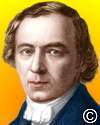
Jean-Baptiste-André Dumas
(14 Jul 1800 - 10 Apr 1884)
French chemist who was a pioneer in organic chemistry, and laid the foundations for Kekulé's later work. He established quantitative organic analysis. He later entered politics, and became Master of the Mint.
|
Science Quotes by Jean-Baptiste-André Dumas (8 quotes)
Ces détails scientifiques qui effarouchent les fabricans d’un certain âge, ne seront qu’un
jeu pour leurs enfans, quand ils auront apprit dans leurs collèges un peu plus de mathématiques et un peu moins de Latin; un peu plus de Chimie, et un peu moins de Grec!
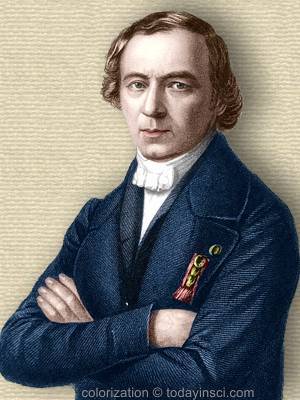
The scientific details which now terrify the adult manufacturer will be mere trifles to his children when they shall be taught at school, a little more Mathematics and a little less Latin, a little more Chemistry, and a little less Greek.
The scientific details which now terrify the adult manufacturer will be mere trifles to his children when they shall be taught at school, a little more Mathematics and a little less Latin, a little more Chemistry, and a little less Greek.
— Jean-Baptiste-André Dumas
As quoted in 'Sketches From Life of Some Eminent Foreign Scientific Lecturers: Dumas', Magazine of Popular Science, and Journal of the Useful Arts (1836). Vol. 1, 177.
I have seen many phases of life; I have moved in imperial circles, I have been a Minister of State; but if I had to live my life again, I would always remain in my laboratory, for the greatest joy of my life has been to accomplish original scientific work, and, next to that, to lecture to a set of intelligent students.
— Jean-Baptiste-André Dumas
Quoted in Ralph Oesper, The Human Side of Scientists (1975), 55.
I would efface the word atoms from science, persuaded that it goes further than experience... In chemistry we should never go further than experience. Could there be any hope of ever identifying the minuscule entities?
— Jean-Baptiste-André Dumas
Quoted, without citation, in Nick Herbert, Quantum Reality: Beyond the New Physics, (1985), 9.
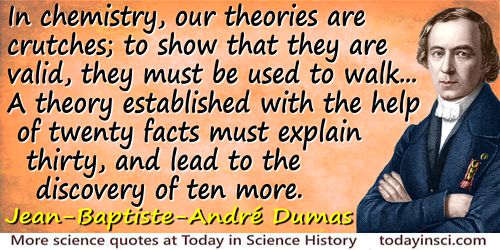
In chemistry, our theories are crutches; to show that they are valid, they must be used to walk... A theory established with the help of twenty facts must explain thirty, and lead to the discovery of ten more.
— Jean-Baptiste-André Dumas
Leçons sur la Philosophie Chimique (1837), 60. Trans. S. Kapoor, 'Dumas and Organic Classification', Ambix, 1969, 16, 4.
In inorganic chemistry the radicals are simple; in organic chemistry they are compounds—that is the sole difference.
— Jean-Baptiste-André Dumas
Joint paper with Liebig, but written by Dumas, Comptes Rendus 1837, 5, 567. Trans. J. R. Partington, A History of Chemistry, Vol. 4, 351.
In organic chemistry there exist certain types which are conserved even when, in place of hydrogen, equal volumes of chlorine, of bromine, etc. are introduced.
— Jean-Baptiste-André Dumas
Comptes Rendus, 1839, 8, 609-22. Trans. J. R. Partington, A History of Chemistry, Vol. 4, 364.
One of the most immediate consequences of the electrochemical theory is the necessity of regarding all chemical compounds as binary substances. It is necessary to discover in each of them the positive and negative constituents... No view was ever more fitted to retard the progress of organic chemistry. Where the theory of substitution and the theory of types assume similar molecules, in which some of the elements can be replaced by others without the edifice becoming modified either in form or outward behaviour, the electrochemical theory divides these same molecules, simply and solely, it may be said, in order to find in them two opposite groups, which it then supposes to be combined with each other in virtue of their mutual electrical activity... I have tried to show that in organic chemistry there exist types which are capable, without destruction, of undergoing the most singular transformations according to the nature of the elements.
— Jean-Baptiste-André Dumas
Traité de Chemie Appliquée aux Arts, Vol. I (1828), 53. Trans. J. R. Partington, A History of Chemistry, Vol. 4, 366.
The chemical compounds are comparable to a system of planets in that the atoms are held together by chemical affinity. They may be more or less numerous, simple or complex in composition, and in the constitution of the materials, they play the same role as Mars and Venus do in our planetary system, or the compound members such as our earth with its moon, or Jupiter with its satellites... If in such a system a particle is replaced by one of different character, the equilibrium can persist, and then the new compound will exhibit properties similar to those shown by the original substance.
— Jean-Baptiste-André Dumas
Quoted in Ralph Oesper, The Human Side of Scientists (1975), 55.
Quotes by others about Jean-Baptiste-André Dumas (1)
Originally a pupil of Liebig, I became a pupil of Dumas, Gerhardt and Williamson: I no longer belonged to any school.
J. R. Partington, A History of Chemistry (1970), Vol. 4, 533.
See also:
- 14 Jul - short biography, births, deaths and events on date of Dumas's birth.
 In science it often happens that scientists say, 'You know that's a really good argument; my position is mistaken,' and then they would actually change their minds and you never hear that old view from them again. They really do it. It doesn't happen as often as it should, because scientists are human and change is sometimes painful. But it happens every day. I cannot recall the last time something like that happened in politics or religion.
(1987) --
In science it often happens that scientists say, 'You know that's a really good argument; my position is mistaken,' and then they would actually change their minds and you never hear that old view from them again. They really do it. It doesn't happen as often as it should, because scientists are human and change is sometimes painful. But it happens every day. I cannot recall the last time something like that happened in politics or religion.
(1987) -- 





