 (source)
|
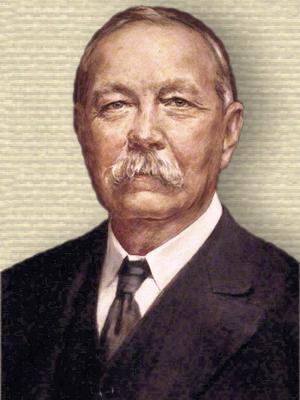
Sir Arthur Conan Doyle
(22 May 1859 - 7 Jul 1930)
Scottish author and physician who introduced the legendary character, Sherlock Holmes, in A Study in Scarlet (1887). Although he began a medical practice in 1882, it was his writings that became his career. Late in his life he became interested in spiritualism.
|
Science Quotes by Sir Arthur Conan Doyle (26 quotes)
![Arthur Conan Doyle quote: [Sherlock Holmes:] The temptation to form premature theories upon insufficient data is the bane of our](https://todayinsci.com/D/Doyle_Arthur/DoyleArthur-Bane500x250px.jpg)
“I had,” said he, “come to an entirely erroneous conclusion which shows, my dear Watson, how dangerous it always is to reason from insufficient data.”
— Sir Arthur Conan Doyle
From 'VIII—The Adventure of the Speckled Band', Adventures of Sherlock Holmes, in The Strand Magazine: An Illustrated Monthly (Feb 1892), Vol. 3, 156.
“I should have more faith,” he said; “I ought to know by this time that when a fact appears opposed to a long train of deductions it invariably proves to be capable of bearing some other interpretation.”
— Sir Arthur Conan Doyle
Spoken by character, Sherlock Holmes, in A Study in Scarlet (1887), in Works of Arthur Conan Doyle (1902), Vol. 11, 106.
“Men die of the diseases which they have studied most,” remarked the surgeon, snipping off the end of a cigar with all his professional neatness and finish. “It’s as if the morbid condition was an evil creature which, when it found itself closely hunted, flew at the throat of its pursuer. If you worry the microbes too much they may worry you. I’ve seen cases of it, and not necessarily in microbic diseases either. There was, of course, the well-known instance of Liston and the aneurism; and a dozen others that I could mention.”
— Sir Arthur Conan Doyle
First lines of 'The Surgeon Talks', in Round the Red Lamp: Being Facts and Fancies of Medical Life (1894), 316.
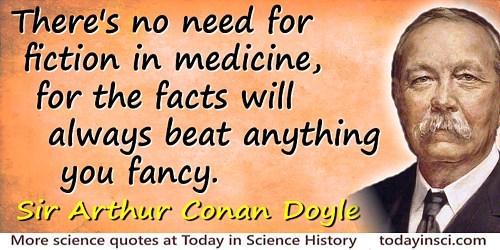
“There’s no need for fiction in medicine,” remarks Foster, “for the facts will always beat anything you fancy.”
— Sir Arthur Conan Doyle
'A Medical Document', in Round the Red Lamp: Being Facts and Fancies of Medical Life (1894), 199-200.
[Colonel Ross:] “Is there any point to which you would wish to draw my attention?”
[Sherlock Holmes:] “To the curious incident of the dog in the night-time.”
“The dog did nothing in the night-time.”
“That was the curious incident.”
[Sherlock Holmes:] “To the curious incident of the dog in the night-time.”
“The dog did nothing in the night-time.”
“That was the curious incident.”
— Sir Arthur Conan Doyle
Fiction from 'XIII—The Adventure of the Silver Blaze', Adventures of Sherlock Holmes, in The Strand Magazine: An Illustrated Monthly (Dec 1892), Vol. 4, 656-657.
[Sherlock Holmes:] The temptation to form premature theories upon insufficient data is the bane of our profession.
— Sir Arthur Conan Doyle
In The Valley of Fear (1914), 43.
A man loses his fortune; he gains earnestness. His eyesight goes; it leads him to a spirituality... We think we are pushing our own way bravely, but there is a great Hand in ours all the time.
— Sir Arthur Conan Doyle
Quoted in Kim Lim (ed.), 1,001 Pearls of Spiritual Wisdom: Words to Enrich, Inspire, and Guide Your Life (2014), 20
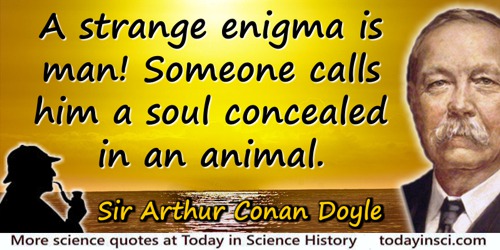
A strange enigma is man! Someone calls him a soul concealed in an animal.
— Sir Arthur Conan Doyle
Remark by the fictional Sherlock Holmes and Dr. Watson’s reply. In The Sign of the Four (1890), 196.
Data! Data! Data! … I can’t make bricks without clay!
— Sir Arthur Conan Doyle
In The Adventure of the Copper Beeches, collected in Adventures of Sherlock Holmes (1892), 289.
Detection is, or ought to be, an exact science, and should be treated in the same cold unemotional manner. You have attempted to tinge it with romanticism, which produces the same effect as if you worked a love-story into the fifth proposition of Euclid.
— Sir Arthur Conan Doyle
By Sherlock Holmes to Dr. Watson, fictional characters in The Sign of Four (1890), 6.
Do you remember what Darwin says about music? He claims that the power of producing and appreciating it existed among the human race long before the power of speech was arrived at. Perhaps that is why we are so subtly influenced by it. There are vague memories in our souls of those misty centuries when the world was in its childhood.
— Sir Arthur Conan Doyle
Spoken by character, Sherlock Holmes, in A Study in Scarlet (1887), Chap. 5. Collected in Works of Arthur Conan Doyle (1902), Vol. 11, 68-69.
From a drop of water a logician could predict an Atlantic or a Niagara without having seen or heard of one or the other. So all life is a great chain, the nature of which is known whenever we are shown a single link of it.
— Sir Arthur Conan Doyle
In A Study in Scarlet (1887, 1892), 27.
His [Sherlock Holmes] ignorance was as remarkable as his knowledge. … he was ignorant of the Copernican Theory and of the composition of the Solar System. … “But the Solar System!" I protested. “What the deuce is it to me?” he interrupted impatiently; “you say that we go round the sun. If we went round the moon it would not make a pennyworth of difference to me or to my work.”
— Sir Arthur Conan Doyle
In 'The Science Of Deduction', A Study In Scarlet (1887, 1904), 15-16.
How often have I said to you that when you have eliminated the impossible, whatever remains, however improbable, must be the truth?
— Sir Arthur Conan Doyle
From Chapter 6, 'Sherlock Holmes Gives a Demonstration', The Sign of Four; or, The Problem of the Sholtos, in Lippincott’s Magazine (Feb 1890), Vol. 45, 172.
I am glad of all details … whether they seem to you to be relevant or not.
— Sir Arthur Conan Doyle
In The Adventure of the Copper Beeches, collected in Adventures of Sherlock Holmes (1892), 294.
I consider that a man’s brain originally is like a little empty attic, and you have to stock it with such furniture as you choose. A fool takes in all the lumber of every sort that he comes across, so that the knowledge which might be useful to him gets crowded out, or at best is jumbled up with a lot of other things so that he has a difficulty in laying his hands upon it. Now the skilful workman is very careful indeed as to what he takes into his brain-attic. He will have nothing but the tools which may help him in doing his work, but of these he has a large assortment, and all in the most perfect order. It is a mistake to think that that little room has elastic walls and can distend to any extent. Depend upon it there comes a time when for every addition of knowledge you forget something that you knew before. It is of the highest importance, therefore, not to have useless facts elbowing out the useful ones.
— Sir Arthur Conan Doyle
In 'The Science Of Deduction', A Study In Scarlet (1887, 1904), 15-16.
I could not help laughing at the ease with which he explained his process of deduction. “When I hear you give your reasons,” I remarked, “the thing always appears to me to be so ridiculously simple that I could easily do it myself, though at each successive instance of your reasoning I am baffled, until you explain your process. And yet I believe that my eyes are as good as yours.”
“Quite so,” he answered, lighting a cigarette, and throwing himself down into an arm-chair. “You see, but you do not observe. The distinction is clear. For example, you have frequently seen the steps which lead up from the hall to this room.”
“Frequently.”
“How often?”
“'Well, some hundreds of times.”
“Then how many are there?”
“How many! I don't know.”
“Quite so! You have not observed. And yet you have seen. That is just my point. Now, I know that there are seventeen steps, because I have both seen and observed.”
“Quite so,” he answered, lighting a cigarette, and throwing himself down into an arm-chair. “You see, but you do not observe. The distinction is clear. For example, you have frequently seen the steps which lead up from the hall to this room.”
“Frequently.”
“How often?”
“'Well, some hundreds of times.”
“Then how many are there?”
“How many! I don't know.”
“Quite so! You have not observed. And yet you have seen. That is just my point. Now, I know that there are seventeen steps, because I have both seen and observed.”
— Sir Arthur Conan Doyle
From 'Adventure I.—A Scandal in Bohemia', Adventures of Sherlock Holmes, in The Strand Magazine: An Illustrated Monthly (Jul 1891), 2, 62.
I never guess. It is a shocking habit—destructive to the logical faculty.
— Sir Arthur Conan Doyle
Spoken by fictitious character Sherlock Holmes in The Sign of Four (1890), 17.
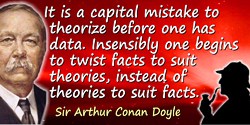
It is a capital mistake to theorize before one has data. Insensibly one begins to twist facts to suit theories, instead of theories to suit facts.
— Sir Arthur Conan Doyle
A Scandal in Bohemia (1891) in Adventures of Sherlock Holmes (1892), 5.
It is a capital mistake to theorize before you have all the evidence. It biases the judgment.
— Sir Arthur Conan Doyle
A Study in Scarlet (1887), in Works of Arthur Conan Doyle (1902), Vol. 11, 39.
It is a great thing to start life with a small number of really good books which are your very own.
— Sir Arthur Conan Doyle
In Through the Magic Door (1908), Chap. 2, 24.
It seems very strange … that in the course of the world’s history so obvious an improvement should never have been adopted. … The next generation of Britishers would be the better for having had this extra hour of daylight in their childhood.
— Sir Arthur Conan Doyle
In Report, and Special Report, from the Select Committee on the Daylight Saving Bill: Minutes of Evidence (1908), 116.
One’s ideas must be as broad as Nature if they are to interpret Nature.
— Sir Arthur Conan Doyle
Spoken by character, Sherlock Holmes, in A Study in Scarlet (1887), Chap. 5. Collected in Works of Arthur Conan Doyle (1902), Vol. 11, 69.
When a doctor does go wrong he is the first of criminals. He has nerve and he has knowledge.
— Sir Arthur Conan Doyle
The Adventure of the Speckled Band. In The Strand Magazine (1892), 3, 154.
When we think how narrow and devious this path of nature is, how dimly we can trace it, for all our lamps of science, and how from the darkness which girds it round great and terrible possibilities loom ever shadowly upwards, it is a bold and a confident man who will put a limit to the strange by-oaths into which the human spirit may wander.
— Sir Arthur Conan Doyle
Lot No. 249 (1892)
Winwood Reade … remarks that while a man is an insoluble puzzle, in the aggregate he becomes a mathematical certainty. You can, for example, never foretell what any one man will do, but you can say with precision what an average number will be up to. Individuals vary, but percentages remain constant. So says the statistician.
— Sir Arthur Conan Doyle
Character Sherlock Holmes recommends Winwood Reade’s book The Martyrdom of Man to Dr. Watson in The Sign of the Four (1890), 196. Earlier in the novel, Holmes calls Reade’s book “one of the most remarkable ever penned.” Reade is a real person and his book was published in 1872. The actual statement in it reads: “As a single atom man is an enigma: as a whole he is a mathematical problem.”
Quotes by others about Sir Arthur Conan Doyle (1)
The one [favourite fictional scientist] I can think of is Conan Doyle’s Professor Challenger, but he was a very irascible character and not a good role model.
From 'Interview: Of Mind and Matter: David Attenborough Meets Richard Dawkins', The Guardian (11 Sep 2010).
See also:
- 22 May - short biography, births, deaths and events on date of Doyle's birth.
- Sir Arthur Conan Doyle gave evidence on a proposed Daylight Saving Bill to a Parliamentary Select Committee hearing witnesses.
- Arthur Conan Doyle - context of quote “No need for fiction in medicine” - Medium image (500 x 250 px)
- Arthur Conan Doyle - context of quote “No need for fiction in medicine” - Large image (800 x 400 px)
- Arthur Conan Doyle - context of quote “Extra hour of daylight” - Medium image (500 x 250 px)
- Arthur Conan Doyle - context of quote “Extra hour of daylight” - Large image (800 x 400 px)
- Booklist for Arthur Conan Doyle.
 In science it often happens that scientists say, 'You know that's a really good argument; my position is mistaken,' and then they would actually change their minds and you never hear that old view from them again. They really do it. It doesn't happen as often as it should, because scientists are human and change is sometimes painful. But it happens every day. I cannot recall the last time something like that happened in politics or religion.
(1987) --
In science it often happens that scientists say, 'You know that's a really good argument; my position is mistaken,' and then they would actually change their minds and you never hear that old view from them again. They really do it. It doesn't happen as often as it should, because scientists are human and change is sometimes painful. But it happens every day. I cannot recall the last time something like that happened in politics or religion.
(1987) -- 




