 (source)
|
George A. Dorsey
(6 Feb 1868 - 29 Mar 1931)
American anthropologist and ethnographer who was an early U.S. ethnographer of North American.
|
Science Quotes by George A. Dorsey (6 quotes)
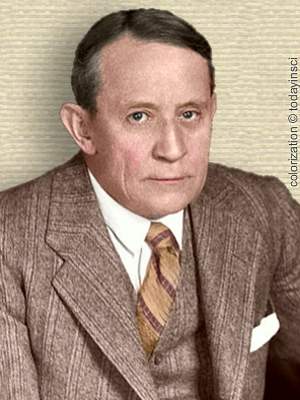
As one recalls some of the monstrous situations under which human beings have lived and live their lives, one marvels at man’s meekness and complacency. It can only be explained by the quality of flesh to become calloused to situations that if faced suddenly would provoke blisters and revolt.
— George A. Dorsey
From Why We Behave Like Human Beings (1925), 469
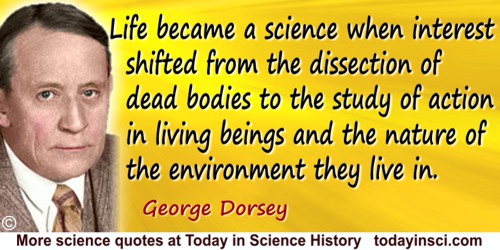
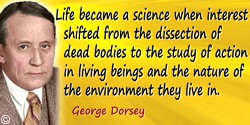
Life became a science when interest shifted from the dissection of dead bodies to the study of action in living beings and the nature of the environment they live in.
— George A. Dorsey
From Why We Behave Like Human Beings (1925), Preface, xiv.
Man is a free moral agent and can be magnanimous and deal disinterestedly, humanity is a definite goal, social justice is desirable and possible, individual lives may be gloriously diversified, uniquely individualized, and yet socially useful; or, these are mere phrases, snares to catch gulls, soothing syrup for our troubled souls.
— George A. Dorsey
From Why We Behave Like Human Beings (1925), 476.
The drive behind life has lost none of its power; proof that, impelled by that drive, man can build as well as destroy; that in his nature is more of Vishnu the Creator than of Siva the Destroyer.
— George A. Dorsey
From Why We Behave Like Human Beings (1925), 479.
They [the Haida] are a doomed race. Wars, smallpox, gross immorality, a change from old ways to new ways their fate is the common fate of the American, whether he sails the sea in the North, gallops over the plain in the West, or sleeps in his hammock in the forests of Brazil.
— George A. Dorsey
From Lecture on the Haida Indian Nation, delivered at the Field Columbian Museum (6 Nov 1897). Reproduced in 'A Cruise among Haida and Tlingit Villages About Dixon’s Entrance', Popular Science Monthly (Jun 1898), 164.
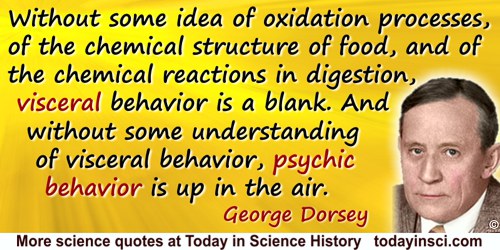
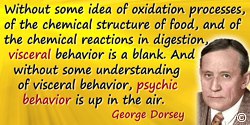
Without some idea of oxidation processes, of the chemical structure of food, and of the chemical reactions in digestion, visceral behavior is a blank. And without some understanding of visceral behavior, psychic behavior is up in the air.
— George A. Dorsey
From Why We Behave Like Human Beings (1925), xiv.
See also:
- 6 Feb - short biography, births, deaths and events on date of Dorsey's birth.
- The Story of Civilization: Man's Own Show, by George Amos Dorsey. - book suggestion.
- Booklist for George Amos Dorsey.
 In science it often happens that scientists say, 'You know that's a really good argument; my position is mistaken,' and then they would actually change their minds and you never hear that old view from them again. They really do it. It doesn't happen as often as it should, because scientists are human and change is sometimes painful. But it happens every day. I cannot recall the last time something like that happened in politics or religion.
(1987) --
In science it often happens that scientists say, 'You know that's a really good argument; my position is mistaken,' and then they would actually change their minds and you never hear that old view from them again. They really do it. It doesn't happen as often as it should, because scientists are human and change is sometimes painful. But it happens every day. I cannot recall the last time something like that happened in politics or religion.
(1987) -- 




