 (source)
|
Sir James Dewar
(20 Sep 1842 - 27 Mar 1923)
Scottish chemist and physicist whose research with materials at low-temperature led him to devise the Dewar vacuum-insulated double-walled flask, now familiar as the thermos bottle. He also was a co-inventor of cordite smokeless explosive powder.
|
SOLID AIR
from The Manufacturer and Builder (1893)
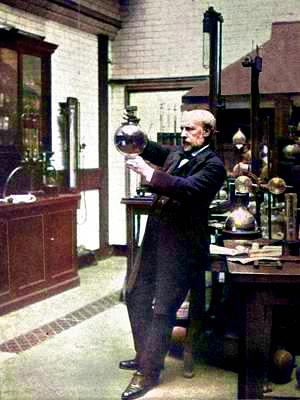
Professor Dewar communicated to the Royal Society at its meeting on Thursday, March 9, [1893] a most interesting development of his experiments upon air at very low temperatures. Our readers are already familiar with the fact that he has liquefied air at ordinary atmospheric pressure. He has now succeeded in freezing it into a clear, transparent solid.
The precise nature of this solid is at present doubtful, and can be settled only by further research. It maybe a jelly of solid nitrogen containing liquid oxygen, much as calves’ foot jelly contains water diffused in solid gelatine, or it may be a true ice of liquid air, in which both oxygen and nitrogen exist in the solid form. The doubt arises from the fact that Professor Dewar has not been able by his utmost efforts to solidify pure oxygen, which, unlike other gases, resists the cold produced by its own evaporation under the air pump.
Nitrogen, on the other hand, can be frozen with comparative ease. It has already been proved that in the evaporation of liquid air nitrogen boils off first. Consequently the liquid is continually becoming richer in that constituent which has hitherto resisted solidification. It thus becomes a question whether the cold produced is sufficiently great to solidify oxygen, or whether its mixture with oxygen raises its freezing point, or whether it is not really frozen at all, but merely entangled among the particles of solid nitrogen, like the rose water in cold cream.
The result, whatever may be its precise nature, has been attained by use of the most powerful appliances at command—a double set of the vacuum screens already described in our columns, combined with two powerful air pumps. Upon either view of its constitution, the new solid is in the highest degree interesting and hopeful.
- Science Quotes by Sir James Dewar.
- 20 Sep - short biography, births, deaths and events on date of Dewar's birth.
- James Dewar - Biography from Scientific American (1910).
- Air: Scientific Discoveries and Inventions - from Haydn's Dictionary of Dates (1904).
- Air: Scientific Discoveries and Inventions - from Haydn's Dictionary of Dates (1904).





