 (source)
|
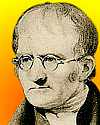
John Dalton
(c. 6 Sep 1766 - 27 Jul 1844)
English chemist, physicist, meteorologist and teacher.
|
Berzelius' symbols are horrifying. A young student in chemistry might as soon learn Hebrew as make himself acquainted with them... They appear to me equally to perplex the adepts in science, to discourage the learner, as well as to cloud the beauty and simplicity of the atomic theory.
— John Dalton
Quoted in H. E. Roscoe, 'Presidential Address', Reports of the British Association for the Advancement of Science, 57th report, 1887, 7.
Chemical analysis and synthesis go no farther than to the separation of particles one from another, and to their reunion. No new creation or destruction of matter is within the reach of chemical agency. We might as well attempt to introduce a new planet into the solar system, or to annihilate one already in existence, as to create or destroy a particle of hydrogen.
— John Dalton
A New System of Chemical Philosophy (1808), Vol. 1, 212.
I was introduced to Mr. Davy, who has rooms adjoining mine (in the Royal Institution); he is a very agreeable and intelligent young man, and we have interesting conversation in an evening; the principal failing in his character as a philosopher is that he does not smoke.
— John Dalton
Letter to John Rothwell, January 1804. Quoted in J. P. Millington, John Dalton (1906), 141.
In all chemical investigations, it has justly been considered an important object to ascertain the relative weights of the simples which constitute a compound. But unfortunately the enquiry has terminated here; whereas from the relative weights in the mass, the relative weights of the ultimate particles or atoms of the bodies might have been inferred, from which their number and weight in various other compounds would appear, in order to assist and to guide future investigations, and to correct their results. Now it is one great object of this work, to shew the importance and advantage of ascertaining the relative weights of the ultimate particles, both of simple and compound bodies, the number of simple elementary particles which constitute one compound particle, and the number of less compound particles which enter into the formation of one more compound particle.
If there are two bodies, A and B, which are disposed to combine, the following is the order in which the combinations may take place, beginning with the most simple: namely,
1 atom of A + 1 atom of B = 1 atom of C, binary
1 atom of A + 2 atoms of B = 1 atom of D, ternary
2 atoms of A + 1 atom of B = 1 atom of E, ternary
1 atom of A + 3 atoms of B = 1 atom of F, quaternary
3 atoms of A and 1 atom of B = 1 atom of G, quaternary
If there are two bodies, A and B, which are disposed to combine, the following is the order in which the combinations may take place, beginning with the most simple: namely,
1 atom of A + 1 atom of B = 1 atom of C, binary
1 atom of A + 2 atoms of B = 1 atom of D, ternary
2 atoms of A + 1 atom of B = 1 atom of E, ternary
1 atom of A + 3 atoms of B = 1 atom of F, quaternary
3 atoms of A and 1 atom of B = 1 atom of G, quaternary
— John Dalton
A New System of Chemical Philosophy (1808), Vol. 1, 212-3.
Matter, though divisible in an extreme degree, is nevertheless not infinitely divisible. That is, there must be some point beyond which we cannot go in the division of matter. ... I have chosen the word “atom” to signify these ultimate particles.
— John Dalton
Dalton's Manuscript Notes, Royal Institution Lecture 18 (30 Jan 1810). In Ida Freund, The Study of Chemical Composition: An Account of its Method and Historical Development (1910), 288.
The cause of rain is now, I consider, no longer an object of doubt. If two masses of air of unequal temperatures, by the ordinary currents of the winds, are intermixed, when saturated with vapour, a precipitation ensues. If the masses are under saturation, then less precipitation takes place, or none at all, according to the degree. Also, the warmer the air, the greater is the quantity of vapour precipitated in like circumstances. ... Hence the reason why rains are heavier in summer than in winter, and in warm countries than in cold.
— John Dalton
Memoirs of the Literary and Philosophical Society of Manchester (1819), 3, 507. Quoted in George Drysdale Dempsey and Daniel Kinnear Clark, On the Drainage of Lands, Towns, & Buildings (1887), 246.
The ultimate particles of all homogeneous bodies are perfectly alike in weight, figure &c.
— John Dalton
A New System of Chemical Philosophy (1808), Vol. 1, 143.
There are three distinctions in the kinds of bodies, or three states, which have more especially claimed the attention of philosophical chemists; namely, those which are marked by the terms elastic fluids, liquids, and solids. A very familiar instance is exhibited to us in water, of a body, which, in certain circumstances, is capable of assuming all the three states. In steam we recognise a perfectly elastic fluid, in water, a perfect liquid, and in ice of a complete solid. These observations have tacitly led to the conclusion which seems universally adopted, that all bodies of sensible magnitude, whether liquid or solid, are constituted of a vast number of extremely small particles, or atoms of matter bound together by a force of attraction.
— John Dalton
A New System of Chemical Philosophy (1808), Vol. 1, 141.
We do not know that any one of the bodies denominated elementary absolutely indecomposable.
— John Dalton
In A New System of Chemical Philosophy (1808), 221-222.
We should scarcely be excused in concluding this essay without calling the reader's attention to the beneficent and wise laws established by the author of nature to provide for the various exigencies of the sublunary creation, and to make the several parts dependent upon each other, so as to form one well-regulated system or whole.
— John Dalton
'Experiments and Observations to Determine whether the Quantity of Rain and Dew is Equal to the Quantity of Water carried off by the Rivers and Raised by Evaporation', Memoirs Manchester Literary and Philosophical Society, 1803, 5, part 2, 372.
When an element A has an affinity for another substance B, I see no mechanical reason why it should not take as many atoms of B as are presented to it, and can possibly come into contact with it (which may probably be 12 in general), except so far as the repulsion of the atoms of B among themselves are more than a match for the attraction of an atom of A. Now this repulsion begins with 2 atoms of B to 1 atom of A, in which case the 2 atoms of B are diametrically opposed; it increases with 3 atoms of B to 1 of A, in which case the atoms are only 120° asunder; with 4 atoms of B it is still greater as the distance is then only 90; and so on in proportion to the number of atoms. It is evident from these positions, that, as far as powers of attraction and repulsion are concerned (and we know of no other in chemistry), binary compounds must first be formed in the ordinary course of things, then ternary and so on, till the repulsion of the atoms of B (or A, whichever happens to be on the surface of the other), refuse to admit any more.
— John Dalton
Observations on Dr. Bostock's Review of the Atomic Principles of Chemistry', Nicholson's Journal, 1811, 29, 147.
Quotes by others about John Dalton (14)
[John] Dalton was a man of regular habits. For fifty-seven years he walked out of Manchester every day; he measured the rainfall, the temperature—a singularly monotonous enterprise in this climate. Of all that mass of data, nothing whatever came. But of the one searching, almost childlike question about the weights that enter the construction of these simple molecules—out of that came modern atomic theory. That is the essence of science: ask an impertinent question, and you are on the way to the pertinent answer.
The Ascent of Man (1973), 153.
Atoms are round balls of wood invented by Dr. Dalton.
Answer given by a pupil to a question on atomic theory, as reported by Sir Henry Enfield Roscoe.
Answer given by a pupil to a question on atomic theory, as reported by Sir Henry Enfield Roscoe.
Reports of the British Association for the Advancement of Science, 57th report, 1887, 7.
Mr. Dalton's aspect and manner were repulsive. There was no gracefulness belonging to him. His voice was harsh and brawling; his gait stiff and awkward; his style of writing and conversation dry and almost crabbed. In person he was tall, bony, and slender. He never could learn to swim: on investigating this circumstance he found that his spec. grav. as a mass was greater than that of water; and he mentioned this in his lectures on natural philosophy in illustration of the capability of different persons for attaining the art of swimming. Independence and simplicity of manner and originality were his best qualities. Though in comparatively humble circumstances he maintained the dignity of the philosophical character. As the first distinct promulgator of the doctrine that the elements of bodies unite in definite proportions to form chemical compounds, he has acquired an undying fame.
Dr John Davy's (brother of Humphry Davy) impressions of Dalton written in c.1830-31 in Malta.
Dr John Davy's (brother of Humphry Davy) impressions of Dalton written in c.1830-31 in Malta.
Quoted in W. C. Henry, Memoirs of the Life and Scientific Researches of John Dalton (1854), 217-8.
John Dalton was a very singular Man, a quaker by profession & practice: He has none of the manners or ways of the world. A tolerable mathematician He gained his livelihood I believe by teaching the mathematics to young people. He pursued science always with mathematical views. He seemed little attentive to the labours of men except when they countenanced or confirmed his own ideas... He was a very disinterested man, seemed to have no ambition beyond that of being thought a good Philosopher. He was a very coarse Experimenter & almost always found the results he required.—Memory & observation were subordinate qualities in his mind. He followed with ardour analogies & inductions & however his claims to originality may admit of question I have no doubt that he was one of the most original philosophers of his time & one of the most ingenious.
J. Z. Fullmer, 'Davy's Sketches of his Contemporaries', Chymia, 1967, 12, 133-134.
It can happen to but few philosophers, and but at distant intervals, to snatch a science, like Dalton, from the chaos of indefinite combination, and binding it in the chains of number, to exalt it to rank amongst the exact. Triumphs like these are necessarily 'few and far between.'
Reflections on the Decline of Science in England (1830), 22.
What chemists took from Dalton was not new experimental laws but a new way of practicing chemistry (he himself called it the “new system of chemical philosophy”), and this proved so rapidly fruitful that only a few of the older chemists in France and Britain were able to resist it.
The Structure of Scientific Revolutions (1962), 133.
John Dalton's records, carefully preserved for a century, were destroyed during the World War II bombing of Manchester. It is not only the living who are killed in war.
In Anu Garg, Another Word a Day (2005), 210. If you know a primary print source, please contact Webmaster.
As pilgrimages to the shrines of saints draw thousands of English Catholics to the Continent, there may be some persons in the British Islands sufficiently in love with science, not only to revere the memory of its founders, but to wish for a description of the locality and birth-place of a great master of knowledge—John Dalton—who did more for the world’s civilisation than all the reputed saints in Christendom.
In The Worthies of Cumberland (1874), 25.
In the vestibule of the Manchester Town Hall are placed two life-sized marble statues facing each other. One of these is that of John Dalton … the other that of James Prescott Joule. … Thus honour is done to Manchester’s two greatest sons—to Dalton, the founder of modern Chemistry and of the Atomic Theory, and the laws of chemical-combining proportions; to Joule, the founder of modern Physics and the discoverer of the Law of Conservation of Energy. The one gave to the world the final and satisfactory proof … that in every kind of chemical change no loss of matter occurs; the other proved that in all the varied modes of physical change, no loss of energy takes place.
In John Dalton and the Rise of Modern Chemistry (1895), 7.
Our most distinguished “man of science” was the then veteran John Dalton. He was rarely absent from his seat in a warm corner of the room during the meetings of the Literary and Philosophical Society. Though a sober-minded Quaker, he was not devoid of some sense of fun; and there was a tradition amongst us, not only that he had once been a poet, but that, although a bachelor, two manuscript copies were still extant of his verses on the subject of matrimonial felicity; and it is my belief there was foundation for the tradition. The old man was sensitive on the subject of his age. Dining one day ... he was placed between two ladies ... [who] resolved to extract from him some admission on the tender point, but in vain. Though never other than courteous, Dalton foiled all their feminine arts and retained his secret. ... Dalton's quaint and diminutive figure was a strongly individualized one.
In Reminiscences of a Yorkshire Naturalist (1896), 73-74.
Wollaston may be compared to Dalton for originality of view & was far his superior in accuracy. He was an admirable manipulator, steady, cautious & sure. His judgement was cool.—His views sagacious.—His inductions made with care, slowly formed & seldom renounced. He had much of the same spirit of Philosophy as Cavendish, he applied science to purposes of profit & for many years sold manufactured platinum. He died very rich.
In J. Z. Fullmer, 'Davy's Sketches of his Contemporaries', Chymia (1967), 12, 134.
Newton’s passage from a falling apple to a falling moon was an act of the prepared imagination. Out of the facts of chemistry the constructive imagination of Dalton formed the atomic theory. Davy was richly endowed with the imaginative faculty, while with Faraday its exercise was incessant, preceding, accompanying and guiding all his experiments. His strength and fertility as a discoverer are to be referred in great part to the stimulus of the imagination.
In 'The Scientific Use of the Imagination', Fragments of Science: A Series of Detached Essays, Addresses, and Reviews (1892), Vol. 2, 104.
There have been men, like Dalton, of humble origin and retiring habits, unable to command the advantages of a public position, and scantily provided with the means for private research, who by speculation and experiment confined to some one branch have reached the highest eminence in science, and discovered laws of nature with which their names are thenceforth connected.
In obituary, Benjamin Silliman, Benjamin Silliman Jr., and James D. Dana (eds.), Art. XXXI, 'Heinrich Rose', American Journal of Science and Arts (Nov 1864), s2-38, No. 114, 305. The article title gives no author name, but it ends with a one-letter signature, “D.”, [For attribution, Webmaster has assumed this is the initial identifying one of the journal editors, of which only the name James Dana corresponds.]
It is very interesting to observe how high the rank may be in the world of science, without the aid of wealth. I have before me a letter of the late Dr. Dalton, who, notwithstanding his great reputation as a chemist, until a late period of his life was a teacher of mathematics. He remarks in this note, that if the price of mercury continues so dear he shall not be able to afford the expense of filling the barometers which he requires for some experiments.
In Education and Manufactures (1863), 44-45.
See also:
- 6 Sep - short biography, births, deaths and events on date of Dalton's birth.
- John Dalton - Biography - from Worthies of Science>/i> (1879)
- John Dalton and the Atomic Theory: The Biography of a Natural Philosopher, by Elizabeth C. Patterson. - book suggestion.
- Booklist for John Dalton.
 In science it often happens that scientists say, 'You know that's a really good argument; my position is mistaken,' and then they would actually change their minds and you never hear that old view from them again. They really do it. It doesn't happen as often as it should, because scientists are human and change is sometimes painful. But it happens every day. I cannot recall the last time something like that happened in politics or religion.
(1987) --
In science it often happens that scientists say, 'You know that's a really good argument; my position is mistaken,' and then they would actually change their minds and you never hear that old view from them again. They really do it. It doesn't happen as often as it should, because scientists are human and change is sometimes painful. But it happens every day. I cannot recall the last time something like that happened in politics or religion.
(1987) -- 




