 (source)
|
Leonardo da Vinci
(15 Apr 1452 - 2 May 1519)
Italian painter, sculptor, draftsman, physicist, engineer and architect whose notebooks have preserved his inventive ideas, understanding of scientific enquiry, and insights into constructing forts and war machines. DaVinci is well-known for his paintings such as Mona Lisa and The Last Supper.
|
Science Quotes by Leonardo da Vinci (78 quotes)
>> Click for Leonardo da Vinci Quotes on | Mountain | Nature |
>> Click for Leonardo da Vinci Quotes on | Mountain | Nature |
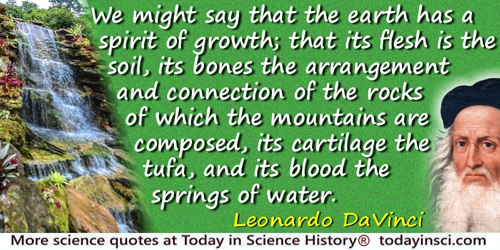
... we might say that the earth has a spirit of growth; that its flesh is the soil, its bones the arrangement and connection of the rocks of which the mountains are composed, its cartilage the tufa, and its blood the springs of water.
— Leonardo da Vinci
…...
[1155] Mechanics are the Paradise of mathematical science, because here we come to the fruits of mathematics.
— Leonardo da Vinci
Notebook E (1513), folio 8 back. In the original Italian: “La meccanica è il paradiso delle sciētie matematiche, perchè cō quella si viene al frutto matematico.” English and Italian in Jean Paul Richter (trans.), 'Philosophical Maxims: Of Mechanics', The Literary Works of Leonardo da Vinci (1883), Vol. 1, Part 2, 289, Aphorism 1155. [Note: da Vinci wrote ē=en, ō=on] Also translated as “Mechanics is the paradise of the mathematical sciences, because by means of it one comes to the fruits of mathematics,” in Edward McCurdy, The Notebooks of Leonardo Da Vinci (1939, 1958), Vol. 1, 613.
[1157] The man who blames the supreme certainty of mathematics feeds on confusion, and can never silence the contradictions of sophistical sciences which lead to an eternal quackery.
— Leonardo da Vinci
W. An. III. 241 a. From the original Italian: “Chi biasima la soma certezza della matematica, si pasce di confusione mai porrà silentio alle contraditioni delle soffistiche sciētie, colle quali s’inpara vno eterno gridore.” English and Italian in Jean Paul Richter (trans.), 'Philosophical Maxims: Of Mechanics', The Literary Works of Leonardo da Vinci (1883), Vol. 1, Part 2, 289, Aphorism 1157. [Note: Da Vinci writes ē=en.] Also translated beginning, “Those who condemn…”. Also seen translated as “Whoever despises the high wisdom of mathematics nourishes himself on delusion and will never still the sophistic sciences whose only product is an eternal uproar,” in Nicholas J. Rose Mathematical Maxims and Minims (1988).
[1158] There is no certainty in sciences where one of the mathematical sciences cannot be applied, or which are not in relation with these mathematics.
— Leonardo da Vinci
Notebook G (c.1515), sheet 95 back. In the original Italian: “Nessuna certezza delle sciētie è, dove no si può applicare vna delle sciētie matematiche e che non son vnight con esse matematiche.” English and Italian in Jean Paul Richter (trans.), 'Philosophical Maxims: Of Mechanics', The Literary Works of Leonardo da Vinci (1883), Vol. 1, Part 2, 289, Aphorism 1158. [Note: da Vinci wrote ē=en; v=u] The following, found on the web, without citation, seems to be a paraphrase: “No human investigation can be called real science if it cannot be demonstrated mathematically.”
La necessità è maestra e tutrice della natura; La necessità è tema e inventrice della natura e freno e regola eterna.
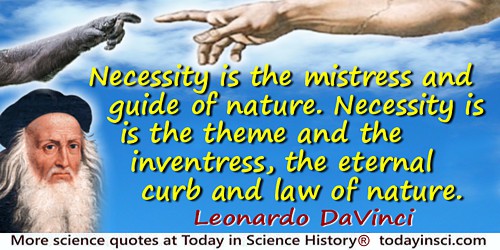
Necessity is the mistress and guide of nature. Necessity is the theme and the inventress, the eternal curb and law of nature.
Necessity is the mistress and guide of nature. Necessity is the theme and the inventress, the eternal curb and law of nature.
— Leonardo da Vinci
S. K. M. III. 49a. As translated by Jean Paul Richter, in 'Philosophical Maxims', The Literary Works of Leonardo da Vinci: Compiled and Edited from the Original Manuscripts (1883), Vol. 2, 285, Maxim 1135.
La verità fu sola figliola del tenpo.
Truth was the only daughter of Time.
Truth was the only daughter of Time.
— Leonardo da Vinci
From manuscript original “Moto, colpo,” 58b, editted and translated by Jean Paul Richter (ed.) compiled in 'Philosphical Maxims, Morals, Polemics and Speculations' The Literary Works of Leonardo da Vinci (1883), Vol. 2, 288, Maxim No. 1152.
Ogni nostra cognitione prīcipia da sentimēti.
All our knowledge has its origin in our preceptions.
All our knowledge has its origin in our preceptions.
— Leonardo da Vinci
Tr. 45. As translated by Jean Paul Richter, in 'Philosophical Maxims', The Literary Works of Leonardo da Vinci: Compiled and Edited from the Original Manuscripts (1883), Vol. 2, 288, Maxim 1147.
~~[No known source]~~ Once you have flown, you will walk the earth with your eyes turned skyward, for there you have been, there you long return.
— Leonardo da Vinci
Best attributed simply to “Anonymous” because there seems to be no known reliable primary source. Another example of a feral quote that is almost certainly not authentic, yet spreads virally like a lexicographic plague. It must be centuries old, but does not show up in major 19th-century quote collections. It is simply too good to be true. Included here to attach this caution.
~~[No known source]~~ The human foot is a masterpiece of engineering and a work of art.
— Leonardo da Vinci
Webmaster has as yet found no primary source, and strongly doubts the authenticity of this quote. Can you help? For such an early author, evidence of this quote should abound, but it does not. It is viral on the web, but Webmaster has so far found no instance with a valid citation. This dubious quote is included here to associate with this caution.
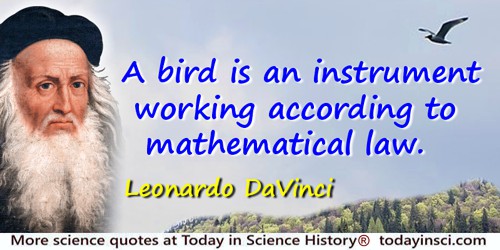
A bird is an instrument working according to mathematical law, which instrument it is within the capacity of man to reproduce with all its movements, but not with a corresponding degree of strength, though it is deficient only in the power of maintaining equilibrium. We may therefore say that such an instrument constructed by man is lacking in nothing except the life of the bird, and this life must needs be supplied from that of man.
— Leonardo da Vinci
'Of the Bird's Movement' from Codice Atlantico 161 r.a., in Leonardo da Vinci's Notebooks, trans. E. MacCurdy (1906), Vol. 1, 153.
A bird maintains itself in the air by imperceptible balancing, when near to the mountains or lofty ocean crags; it does this by means of the curves of the winds which as they strike against these projections, being forced to preserve their first impetus bend their straight course towards the sky with divers revolutions, at the beginning of which the birds come to a stop with their wings open, receiving underneath themselves the continual buffetings of the reflex courses of the winds.
— Leonardo da Vinci
'Flight', in The Notebooks of Leonardo da Vinci, trans. E. MacCurdy (1938), Vol. 1, 471.
A single and distinct luminous body causes stronger relief in the objects than a diffused light; as may be seen by comparing one side of a landscape illuminated by the sun, and one overshadowed by clouds, and illuminated only by the diffused light of the atmosphere.
— Leonardo da Vinci
…...
Although nature commences with reason and ends in experience it is necessary for us to do the opposite, that is to commence as I said before with experience and from this to proceed to investigate the reason.
— Leonardo da Vinci
'Movement and Weight', from The Notebooks of Leonardo da Vinci, trans. E. MacCurdy (1938), Vol. 1, 546.
And ye who wish to represent by words the form of man and all the aspects of his membrification, get away from that idea. For the more minutely you describe, the more you will confuse the mind of the reader and the more you will prevent him from a knowledge of the thing described. And so it is necessary to draw and describe.
— Leonardo da Vinci
From Notebooks (AnA, 14v; Cf. QII, 1), as translated by J. Playfair McMurrich, in Leonardo da Vinci the Anatomist (1930), 76, (Institution Publication 411, Carnegie Institution of Washington).
Ask advice of him who governs himself well.
— Leonardo da Vinci
…...
Common Sense is that which judges the things given to it by other senses.
— Leonardo da Vinci
…...
Experience is never at fault; it is only your judgment that is in error in promising itself such results from experience as are not caused by our experiments. For having given a beginning, what follows from it must necessarily be a natural development of such a beginning, unless it has been subject to a contrary influence, while, if it is affected by any contrary influence, the result which ought to follow from the aforesaid beginning will be found to partake of this contrary influence in a greater or less degree in proportion as the said influence is more or less powerful than the aforesaid beginning.
— Leonardo da Vinci
'Philosophy', in The Notebooks of Leonardo da Vinci, trans. E. MacCurdy (1938), Vol. 1, 70.
Experiment is the interpreter of nature. Experiments never deceive. It is our judgment which sometimes deceives itself because it expects results which experiment refuses. We must consult experiment, varying the circumstances, until we have deduced general rules, for experiment alone can furnish reliable rules.
— Leonardo da Vinci
In Introductory College Physics by Oswald Blackwood (1939).
He who does not punish evil commands it to be done.
— Leonardo da Vinci
…...
He who loves practice without theory is like a seafarer who boards ship without wheel or compass and knows not wither he travels.
— Leonardo da Vinci
From the original Italian: “Quelli che s’inamorā di pratica sāza sciētia, sō come ’l nochiere che ēstra navilio sanza timone o bussola che mai à certezza dove si uada.” Italian and English in Jean Paul Richter (trans), G. 8a, 'General Introduction to the Book on Painting', The Literary Works of Leonardo da Vinci (1883), Vol. 1, 18. Also seen translated as “He who loves practice without theory is like the sailor who boards ship without a rudder and compass and never knows where he may cast,” in Morris Kline, Mathematical Thought From Ancient to Modern Times (1972), 224.
I say that the power of vision extends through the visual rays to the surface of non-transparent bodies, while the power possessed by these bodies extends to the power of vision.
— Leonardo da Vinci
…...
If a man has a tent made of linen of which the apertures have all been stopped up, and be it twelve bracchia across (over twenty-five feet) and twelve in depth, he will be able to throw himself down from any height without sustaining injury. [His concept of the parachute.]
— Leonardo da Vinci
In Isaac Asimov and Jason A. Shulman, Isaac Asimov’s Book of Science and Nature Quotations (1988), 3-4, which notes twelve bracchia is over 25 feet. There are other translations with different units. Da Vinci’s illustration in his notebook showed a pyramid-shaped parachute below which hung a man suspended by a few short cords.
If you are on the side whence the wind is blowing you will see the trees looking much lighter than you would see them on the other sides; and this is due to the fact that the wind turns up the reverse side of the leaves which in all trees is much whiter than the upper side.
— Leonardo da Vinci
…...
If you do not rest on the good foundation of nature, you will labour with little honor and less profit.
— Leonardo da Vinci
As quoted in George Clausen, Six Lectures on Painting: Delivered to the Students of the Royal Arts in London, January, 1904 (1906), 30.
If you throw a stone in a pond... the waves which strike against the shores are thrown back towards the spot where the stone struck; and on meeting other waves they never intercept each other’s course... In a small pond one and the same stroke gives birth to many motions of advance and recoil.
— Leonardo da Vinci
…...
In rivers, the water that you touch is the last of what has passed and the first of that which comes; so with present time.
— Leonardo da Vinci
…...
In the mountains of Parma and Piacenza, multitudes of shells and corals filled with worm-holes may be seen still adhering to the rocks, and when I was making the great horse at Milan a large sack of those which had been found in these parts was brought to my workshop by some peasants... The red stone of the mountains of Verona is found with shells all intermingled, which have become part of this stone... And if you should say that these shells have been and still constantly are being created in such places as these by the nature of the locality or by potency of the heavens in these spots, such an opinion cannot exist in brains possessed of any extensive powers of reasoning because the years of their growth are numbered upon the outer coverings of their shells; and both small and large ones may be seen; and these would not have grown without feeding, or fed without movement, and here [embedded in rock] they would not have been able to move... The peaks of the Apennines once stood up in a sea, in the form of islands surrounded by salt water... and above the plains of Italy where flocks of birds are flying today, fishes were once moving in large shoals.
— Leonardo da Vinci
'Physical Geography', in The Notebooks of Leonardo da Vinci, trans. E. MacCurdy (1938), Vol. 1, 355-6, 359.

Inequality is the cause of all local movements. There is no rest without equality.
— Leonardo da Vinci
From Codex Atlanticus, folio 288 back a. In Edward McCurdy, The Notebooks of Leonardo Da Vinci (1939, 1958), Vol. 1, 89. [Compare with Newton’s Laws of Motion. Da Vinci died in 1519; Newton was born over 120 years later. Webmaster, despite much time looking, has not yet found the corresponding quote in the John Paul Richter translation. Can you help? —Webmaster]
Instrumental or mechanical science is the noblest and above all others, the most useful.
— Leonardo da Vinci
(Sul volo degli Uccelli, 3 r.) In Edward McCurdy (ed., trans.), Leonardo da Vinci’s Note-Books: Arranged and Rendered into English (1908), 47.
Just as eating contrary to the inclination is injurious to the health, so study without desire sports the memory, and it retains nothing that it takes in.
— Leonardo da Vinci
…...
Just as iron rusts from disuse and stagnant water putrefies, or when cold turns to ice, so our intellect wastes unless it is kept in use.
— Leonardo da Vinci
C.A. 289 v. c. In Irma A. Richter and Thereza Wells (eds.), Leonardo da Vinci: Notebooks (1952, 1980), 245. Also translated as “Iron rusts from disuse; stagnant water loses its purity and in cold weather becomes frozen; even so does inaction sap the vigour of the mind,” in Edward McCurdy, The Notebooks of Leonardo Da Vinci (1939), Vol. 1, 89. Translated as “Just as iron rusts unless it is used, and water putrifies or, in cold, turns to ice, so our intellect spoils unless it is kept in use,” in Jean Paul Richter (trans.), The Notebooks of Leonardo Da Vinci (1888), Note 1177.
Learning acquired in youth arrests the evil of old age; and if you understand that old age has wisdom for its food, you will so conduct yourself in youth that your old age will not lack for nourishment.
— Leonardo da Vinci
…...
Life well spent is long.
— Leonardo da Vinci
…...
Music may be called the sister of painting, for she is dependent upon hearing, the sense which comes second and her harmony is composed of the union of proportional parts sounded simultaneously, rising and falling in one or more harmonic rhythms.
— Leonardo da Vinci
…...
Nature being capricious and taking pleasure in creating and producing a continuous sucession of lives and forms because she knows that they serve to increase her terrestrial substance, is more ready and swift in her creating than time is in destroying, and therefore she has ordained that many animals shall serve as food one for the other; and as this does not satisfy her desire she sends forth frequently certain noisome and pestilential vapours and continual plagues upon the vast accumulations and herds of animals and especially upon human beings who increase very rapidly because other animals do not feed upon them.
— Leonardo da Vinci
'Philosophy', in The Notebooks of Leonardo da Vinci, trans. E. MacCurdy (1938), Vol. 1 80.
Nature is a source of truth. Experience does not ever err, it is only your judgment that errs in promising itself results which are not caused by your experiments.
— Leonardo da Vinci
The Notebook. As cited in Edward Schwartz, One Step Forward, Two Steps Backward (2003), 38, with caption “examining objects in all their diversity.” Also quoted in Daniel J. Boorstin, The Discoverers (1983), 350.
Nature is so delightful and abundant in its variations that there would not be one that resembles another, and not only plants as a whole, but among their branches, leaves and fruit, will not be found one which is precisely like another.
— Leonardo da Vinci
…...
Nature never breaks her own laws.
— Leonardo da Vinci
(E 43 r.) In Edward McCurdy (ed., trans.), Leonardo da Vinci’s Note-Books: Arranged and Rendered into English (1908), 55.
No human investigation can be called real science if it cannot be demonstrated mathematically.
— Leonardo da Vinci
In Treatise on Painting (1651).
Now do you not see that the eye embraces the beauty of the whole world? It counsels and corrects all the arts of mankind... it is the prince of mathematics, and the sciences founded on it are absolutely certain. It has measured the distances and sizes of the stars it has discovered the elements and their location... it has given birth to architecture and to perspective and to the divine art of painting.
— Leonardo da Vinci
…...
Obstacles cannot crush me. Every obstacle yields to stern resolve. He who is fixed to a star does not change his mind.
— Leonardo da Vinci
…...
Of several bodies all equally larger and distant, that most brightly illuminated will appear to the eye nearest and largest.
— Leonardo da Vinci
…...
Of the four elements water is the second in weight and the second in respect of mobility. It is never at rest until it unites with the sea…
— Leonardo da Vinci
…...
Perspective is a most subtle discovery in mathematical studies, for by means of lines it causes to appear distant that which is near, and large that which is small.
— Leonardo da Vinci
Attributed.
Poor is the pupil who does not surpass his master.
— Leonardo da Vinci
'Aphorisms', in The Notebooks of Leonardo da Vinci, trans. E. MacCurdy (1938 ), Vol. 1, 98.
Simplicity is the ultimate sophistication.
— Leonardo da Vinci
…...
Study the science of art. Study the art of science. Develop your senses - especially learn how to see. Realize that everything connects to everything else.
— Leonardo da Vinci
…...
Sufficient for us is the testimony of things produced in the salt waters and now found again in the high mountains, sometimes far from the sea.
— Leonardo da Vinci
Manuscript held by the Earl of Leicester, 31 a [R984]. In Edward McCurdy (ed.), Leonardo da Vinci's note-books: arranged and rendered into English with introductions (1908), 109.
The [mechanical] bird I have described ought to be able by the help of the wind to rise to a great height, and this will prove to be its safety; since even if… revolutions [of the winds] were to befall it, it would still have time to regain a condition of equilibrium; provided that its various parts have a great power of resistance, so that they can safely withstand the fury and violence of the descent, by the aid of the defenses which I have mentioned; and its joints should be made of strong tanned hide, and sewn with cords of strong raw silk. And let no one encumber himself with iron bands, for these are very soon broken at the joints or else they become worn out, and consequently it is well not to encumber oneself with them.
— Leonardo da Vinci
'Of the Bird’s Movement' from Sul Voio degli Uccelli, 8 [7] r. in Leonardo da Vinci's Notebooks, trans. E. MacCurdy (1906), 153-4.
The body of the earth is of the nature of a fish... because it draws water as its breath instead of air.
— Leonardo da Vinci
'Philosophy', in The Notebooks of Leonardo da Vinci, trans. E. MacCurdy (1938), Vol. 1 70.
The eye is the window of the human body through which it feels its way and enjoys the beauty of the world.
— Leonardo da Vinci
…...
The eye transmits its own image through the air to all the objects which face it, and also receives them on its own surface, whence the “sensus communis” takes them and considers them.
— Leonardo da Vinci
…...
The eye, the window of the soul, is the chief means whereby the understanding can most fully and abundantly appreciate the infinite works of Nature; and the ear is second.
— Leonardo da Vinci
As quoted in Daniel J. Boorstin, The Discoverers (1983), 350.
The light and heat of the universe comes from the sun, and its cold and darkness from the withdrawal of the sun.
— Leonardo da Vinci
…...
The lover is moved by the thing loved, as the sense is by that which perceives, and it unites with it and they become one and the same thing... when the lover is united with the beloved it finds rest there; when the burden is laid down there it finds rest.
— Leonardo da Vinci
…...
The sun gives spirit and life to the plants and the earth nourishes them with moisture.
— Leonardo da Vinci
…...
There are many occasions when the muscles that form the lips of the mouth move the lateral muscles that are joined to them, and there are an equal number of occasions when these lateral muscles move the lips of this mouth, replacing it where it cannot return of itself, because the function of muscle is to pull and not to push except in the case of the genitals and the tongue.
— Leonardo da Vinci
'Anatomy', in The Notebooks of Leonardoda Vinci, trans. E. MacCurdy (1938), Vol. 1, 152.
There is no certainty where one can neither apply any of the mathematical sciences nor any of those which are based upon the mathematical sciences.
— Leonardo da Vinci
(G 96 v.) In Edward McCurdy (ed., trans.), Leonardo da Vinci’s Note-Books: Arranged and Rendered into English (1908), 54. Also translated elsewhere as, “No knowledge can be certain if it is not based upon mathematics or upon some other knowledge which is itself based upon the mathematical sciences.”
There is no result in nature without a cause; understand the cause and you will have no need of the experiment.
— Leonardo da Vinci
'Philosophy', in The Notebooks of Leonardo da Vinci, trans. E. MacCurdy, (1938) Vol. 1, 70.
There shall be wings! If the accomplishment be not for me, ’tis for some other. The spirit cannot die; and man, who shall know all and shall have wings...
— Leonardo da Vinci
…...
Therefore O students study mathematics and do not build without foundations.
— Leonardo da Vinci
…...
This work should commence with the conception of man, and should describe the nature of the womb, and how the child inhabits it, and in what stage it dwells there, and the manner of its quickening and feeding, and its growth, and what interval there is between one stage of growth and another, and what thing drives it forth from the body of the mother, and for what reason it sometimes emerges from the belly of its mother before the due time.
— Leonardo da Vinci
'Anatomy', in The Notebooks of Leonardo da Vinci, trans. E. MacCurdy (1938), Vol. 1, 139.
Those who are enamoured of practice without science, are like the pilot who embarks in a ship without rudder or compass and who is never certain where he is going.
— Leonardo da Vinci
From original Italian: “Quelli che s'innamorano della pratica senza la diligenza, ovvero scienza, per dir meglio,sono come i nocchieri, che entrano in mare sopra nave senza timone o bussola, che mai hanno certezza dove si vadano,” in Trattato Della Pittura (Treatise on Painting) (1817), Part 2, 69. Translated in Anthony Lejeune, The Concise Dictionary of Foreign Quotations (2001), 234.
Though human ingenuity may make various inventions which, by the help of various machines answering the same end, it will never devise any inventions more beautiful, nor more simple, nor more to the purpose than Nature does; because in her inventions nothing is wanting, and nothing is superfluous, and she needs no counterpoise when she makes limbs proper for motion in the bodies of animals.
— Leonardo da Vinci
W. An. IV. 184a (7). Translated by Jean Paul Richter, in 'Physiology', The Literary Works of Leonardo da Vinci: Compiled and Edited from the Original Manuscripts (1883), Vol. 2, 126, selection 837.
Time stays long enough for anyone who will use it.
— Leonardo da Vinci
…...
To speak of this subject you must... explain the nature of the resistance of the air, in the second the anatomy of the bird and its wings, in the third the method of working the wings in their various movements, in the fourth the power of the wings and the tail when the wings are not being moved and when the wind is favorable to serve as guide in various movements.
— Leonardo da Vinci
…...
Very great charm of shadow and light is to be found in the faces of those who sit in the doors of dark houses. The eye of the spectator sees that part of the face which is in shadow lost in the darkness of the house, and that part of the face which is lit draws its brilliancy from the splendor of the sky. From this intensification of light and shade the face gains greatly in relief and beauty by showing the subtlest shadows in the light part and the subtlest lights in the dark part.
— Leonardo da Vinci
…...
Water is the driver of nature.
— Leonardo da Vinci
From Codex Atlanticus, folio 154 front. As given in Irma A. Richter, Leonardo da Vinci: Notebooks (1952, 2008), 18.
Weight is caused by one element being situated in another; and it moves by the shortest line towards its centre, not by its own choice, not because the centre draws it to itself, but because the other intervening element cannot withstand it.
— Leonardo da Vinci
…...
What induces you, oh man, to depart from your home in town, to leave parents and friends, and go to the countryside over mountains and valleys, if it is not for the beauty of the world of nature?
— Leonardo da Vinci
…...
When the sun is covered by clouds, objects are less conspicuous, because there is little difference between the light and shade of the trees and the buildings being illuminated by the brightness of the atmosphere which surrounds the objects in such a way that the shadows are few, and these few fade away so that their outline is lost in haze.
— Leonardo da Vinci
…...
When you are identifying science of the motion of water, remember to include under each subject its application and use, so that the science will be useful.
— Leonardo da Vinci
…...
When you try to explain the behavior of water, remember to demonstrate the experiment first and the cause next.
— Leonardo da Vinci
As quoted in George H. de Thierry, Journal of the Boston Society of Civil Engineers (Jan 1928), 15, No. 1, 2.
Where the flow carries a large quantity of water, the speed of the flow is greater and vice versa.
— Leonardo da Vinci
As quoted in G.A. Tokaty, A History and Philosophy of Fluid Mechanics (1994), 39. This is a precursor of the continuity equation.
Who would believe that so small a space could contain the images of all the universe?
— Leonardo da Vinci
…...
Whoever despises the high wisdom of mathematics nourishes himself on delusion.
— Leonardo da Vinci
As quoted, without citation, in Nicholas J. Rose, Mathematical Maxims and Minims (1988).
Why are the bones of great fishes, and oysters and corals and various other shells and sea-snails, found on the high tops of mountains that border the sea, in the same way in which they are found in the depths of the sea?
— Leonardo da Vinci
'Physical Geography', in The Notebooks of Leonardo da Vinci, trans. E. MacCurdy (1938), Vol. 1, 361.
Why does the eye see a thing more clearly in dreams than the imagination when awake?
— Leonardo da Vinci
Br. M. 278 b. From the original Italian: “Perchè vede piv certa la cosa l’ochio ne’ sogni che colla imaginatione, stando desto?” English and Italian in Jean Paul Richter (trans.), 'Philosophical Maxims: Of Mechanics', The Literary Works of Leonardo da Vinci (1883), Vol. 1, Part 2, 287, Note 1144.
Quotes by others about Leonardo da Vinci (9)
The modern version of Buridan’s ass [a figurative description of a man of indecision] has a Ph.D., but no time to grow up as he is undecided between making a Leonardo da Vinci in the test tube or planting a Coca Cola sign on Mars.
Voices in the Labyrinth: Nature, Man, and Science (1979), 3.
The pre-Darwinian age had come to be regarded as a Dark Age in which men still believed that the book of Genesis was a standard scientific treatise, and that the only additions to it were Galileo’s demonstration of Leonardo da Vinci’s simple remark that the earth is a moon of the sun, Newton’s theory of gravitation, Sir Humphry Davy's invention of the safety-lamp, the discovery of electricity, the application of steam to industrial purposes, and the penny post.
Back to Methuselah: a Metabiological Pentateuch (1921), viii.
Thou, O God, dost sell unto us all good things at the price of labour.
Quotation credited to Leonardo da Vinci that she chose for her bookplate, and which reflects her outlook on her work.
Quotation credited to Leonardo da Vinci that she chose for her bookplate, and which reflects her outlook on her work.
In Philip D. McMaster and Michael Heidelberger, 'Florence Rena Sabin', National Academy of Sciences, Biographical Memoirs (1960), Vol. 34, 272.
Da Vinci was as great a mechanic and inventor as were Newton and his friends. Yet a glance at his notebooks shows us that what fascinated him about nature was its variety, its infinite adaptability, the fitness and the individuality of all its parts. By contrast what made astronomy a pleasure to Newton was its unity, its singleness, its model of a nature in which the diversified parts were mere disguises for the same blank atoms.
From The Common Sense of Science (1951), 25.
When Da Vinci wanted an effect, he willed, he planned the means to make it happen: that was the purpose of his machines. But the machines of Newton … are means not for doing but for observing. He saw an effect, and he looked for its cause.
From The Common Sense of Science (1951), 25.
I am a cross between Steve Jobs and Leonardo da Vinci.
As quoted by Franz Lidz in 'Dr. NakaMats, the Man With 3300 Patents to His Name', Smithsonian Magazine (Dec 2012).
My interest in Science had many roots. Some came from my mother … while I was in my early teens. She fell in love with science,… [from] classes on the Foundations of Physical Science. … I was infected by [her] professor second hand, through hundreds of hours of conversations at my mother’s knees. It was from my mother that I first learned of Archimedes, Leonardo da Vinci, Galileo, Kepler, Newton, and Darwin. We spent hours together collecting single-celled organisms from a local pond and watching them with a microscope.
From 'Richard E. Smalley: Biographical', collected in Tore Frängsmyr (ed.), Les Prix Nobel: The Nobel Prizes 1996 (1997).
The genius of Leonardo da Vinci imagined a flying machine, but it took the methodical application of science by those two American bicycle mechanics to create it.
In Time/CBS News, 'The Wright Brothers, People of the Century (1999), 42.
It was not alone the striving for universal culture which attracted the great masters of the Renaissance, such as Brunellesco, Leonardo da Vinci, Raphael, Michelangelo and especially Albrecht Dürer, with irresistible power to the mathematical sciences. They were conscious that, with all the freedom of the individual fantasy, art is subject to necessary laws, and conversely, with all its rigor of logical structure, mathematics follows aesthetic laws.
From Lecture (5 Feb 1891) held at the Rathhaus, Zürich, printed as Ueber den Antheil der mathematischen Wissenschaft an der Kultur der Renaissance (1892), 19. (The Contribution of the Mathematical Sciences to the Culture of the Renaissance.) As translated in Robert Édouard Moritz, Memorabilia Mathematica; Or, The Philomath’s Quotation-Book (1914), 183.
See also:
- 15 Apr - short biography, births, deaths and events on date of da Vinci's birth.
- The Science of Leonardo: Inside the Mind of the Great Genius of the Renaissance, by Fritjof Capra. - book suggestion.
- Booklist for Leonardo da Vinci.
 In science it often happens that scientists say, 'You know that's a really good argument; my position is mistaken,' and then they would actually change their minds and you never hear that old view from them again. They really do it. It doesn't happen as often as it should, because scientists are human and change is sometimes painful. But it happens every day. I cannot recall the last time something like that happened in politics or religion.
(1987) --
In science it often happens that scientists say, 'You know that's a really good argument; my position is mistaken,' and then they would actually change their minds and you never hear that old view from them again. They really do it. It doesn't happen as often as it should, because scientists are human and change is sometimes painful. But it happens every day. I cannot recall the last time something like that happened in politics or religion.
(1987) -- 





