|
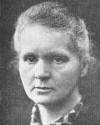
Marie Curie
(7 Nov 1867 - died 4 Jul 1934)
Marie Marja Sklodowska
Curie was a Polish-born French chemist
and physicist. In 1898, her celebrated experiments on uranium
minerals led to discovery of two new elements: polonium and radium.
With Henri Becquerel and her husband, Pierre Curie, she was awarded the
1903 Nobel Prize for Physics. She was then sole winner of a second
Nobel Prize in 1911, this time in Chemistry.
|
“It was like a new world opened to
me, the world of science, which I was at last permitted to know in all
liberty.”
— Marie Curie
As quoted in Marie and Pierre Curie and the
Discovery of Polonium and Radium, Nobel Lecture
“This means that we have here an
entirely separate kind of chemistry for
which the current tool we use is the electrometer, not the balance, and
which we might well call the chemistry of the imponderable.”
— Marie Curie
(11 Dec 1911)
As quoted in Marie and Pierre Curie and the Discovery of Polonium and Radium, Nobel Lecture
As quoted in Marie and Pierre Curie and the Discovery of Polonium and Radium, Nobel Lecture
 In science it often happens that scientists say, 'You know that's a really good argument; my position is mistaken,' and then they would actually change their minds and you never hear that old view from them again. They really do it. It doesn't happen as often as it should, because scientists are human and change is sometimes painful. But it happens every day. I cannot recall the last time something like that happened in politics or religion.
(1987) --
In science it often happens that scientists say, 'You know that's a really good argument; my position is mistaken,' and then they would actually change their minds and you never hear that old view from them again. They really do it. It doesn't happen as often as it should, because scientists are human and change is sometimes painful. But it happens every day. I cannot recall the last time something like that happened in politics or religion.
(1987) --