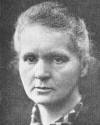
 (source)
|
Marie Curie
(7 Nov 1867 - 4 Jul 1934)
Polish-French chemist and physicist whose celebrated experiments (1898) on uranium minerals led to discovery of two new elements: polonium and radium. With Henri Becquerel and her husband, Pierre Curie, she was awarded the 1903 Nobel Prize for Physics. She was then sole winner of a second Nobel Prize in 1911, this time in Chemistry.
|
Science Quotes by Marie Curie (29 quotes)
>> Click for Marie Curie Quotes on | Radioactivity | Science |
>> Click for Marie Curie Quotes on | Radioactivity | Science |
~~[Anecdote]~~ Be less curious about people and more curious about ideas.
— Marie Curie
Anecdotal response to a reporter’s enquiry. As quoted in Clifton Fadiman and André Bernard, Bartlett’s Book of Anecdotes (2000), 150. As yet, Webmaster has found no primary source for authentication.
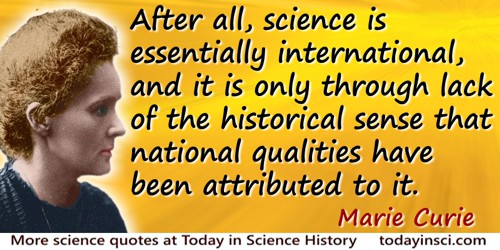
After all, science is essentially international, and it is only through lack of the historical sense that national qualities have been attributed to it.
— Marie Curie
'Memorandum by Madame Curie, Member of the Committee, on the Question of International Scholarships for the advancement of the Sciences and the Development of Laboratories', League of Nations, International Committee on Intellectual Co-operation: Sub-committee of Experts for the Instruction of Children and Youth in the Existence and Aims of the League of Nations. (Recommendations. Preamble): Issue 5, Issues 9-13 (1926), 12.

All my life through, the new sights of Nature made me rejoice like a child.
— Marie Curie
In Pierre Curie (1923), 162.

Humanity certainly needs practical men, who get the most out of their work, and, without forgetting the general good, safeguard their own interests. But humanity also needs dreamers, for whom the disinterested development of an enterprise is so captivating that it becomes impossible for them to devote their care to their own material profit. Without the slightest doubt, these dreamers do not deserve wealth, because they do not desire it. Even so, a well-organised society should assure to such workers the efficient means of accomplishing their task, in a life freed from material care and freely consecrated to research.
— Marie Curie
In Eve Curie, Madame Curie: A Biography by Eve Curie (1938, 2007), 344.
I am among those who think that science has great beauty. A scientist in his laboratory is not only a technician: he is also a child placed before natural phenomena which impress him like a fairy tale. We should not allow it to be believed that all scientific progress can be reduced to mechanisms, machines, gearings, even though such machinery has its own beauty.
— Marie Curie
During a debate in Madrid, ',The Future of Culture' (1933). In Eve Curie Labouisse, Eve Curie and Vincent Sheean, Madame Curie (1937), 341
I am one of those who think, like Nobel, that humanity will draw more good than evil from new discoveries.
— Marie Curie
In Pierre Biquard, Frédéric Joliot-Curie: the Man and his Theories (1966), 11.
I devoted myself especially to the purification of the radium…. It was only after treating one ton of pitchblende residues that I could get definite results. Indeed we know to-day that even in the
best minerals there are not more than a few decigrammes of radium in a ton of raw material.
— Marie Curie
Meanwhile, her husband, Pierre, studied the physical properties of the rays emitted by the new substances. As translated by Charlotte and Vernon Kellogg in Marie Curie, 'Autobiographical Notes', Pierre Curie (1923), 188.
I have no dress except the one I wear every day. If you are going to be kind enough to give me one, please let it be practical and dark so that I can put it on afterwards to go to the laboratory.
[Referring to her wedding dress.]
[Referring to her wedding dress.]
— Marie Curie
In Eve Curie, Madame Curie: a biography by Eve Curie (1937, 2007), 136-37.
I learned easily mathematics and physics, as far as these sciences were taken in consideration in the school. I found in this ready help from my father, who loved science and had to teach it himself. He enjoyed any explanation he could give us about Nature and her ways. Unhappily, he had no laboratory and could not perform experiments.
— Marie Curie
About her childhood schooling. As translated by Charlotte and Vernon Kellogg in Marie Curie, 'Autobiographical Notes', Pierre Curie (1923), 188. [Her father, Władysław Skłodowski, had studied Physics and Mathematics at the St. Petersburg University. For the early years of his career, he was a teacher in Warsaw schools. —Webmaster]]
I shall devote only a few lines to the expression of my belief in the importance of science for mankind…. … [I]t is by…daily striving after knowledge that man has raised himself to the unique position he occupies on earth, and that his power and well-being have continually increased.
— Marie Curie
In opening paragraph of 'Memorandum by Madame Curie, Member of the Committee, on the Question of International Scolarships for the Advancement of the Sciences and the Development of Laboratories' published by the League of Nations, Committee on Intellectual Co-operation, Geneva (16 Jun 1926)
I then [in 1902] possessed one decigramme of very pure radium chloride. It had taken me almost four years to produce the kind of evidence which chemical science demands, that radium is truly a new element. … The demonstration that cost so much effort was the basis of the new science of radioactivity.
— Marie Curie
As translated by Charlotte and Vernon Kellogg in Marie Curie, 'Autobiographical Notes', Pierre Curie (1923), 188.
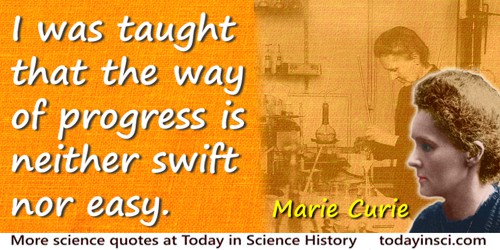
I was taught that the way of progress is neither swift nor easy.
— Marie Curie
In Pierre Curie (1936), 167.
In science we must be interested in things, not in persons.
— Marie Curie
In Eve Curie, Madame Curie (1938), 233.
It was like a new world opened to me, the world of science, which I was at last permitted to know in all liberty.
— Marie Curie
As quoted in Marie and Pierre Curie and the Discovery of Polonium and Radium, Nobel Lecture
It would be impossible, it would be against the scientific spirit. … Physicists should always publish their researches completely. If our discovery has a commercial future that is a circumstance from which we should not profit. If radium is to be used in the treatment of disease, it is impossible for us to take advantage of that.
— Marie Curie
In a discussion with her husband, Pierre, about the patenting of radium, in Marie Curie by Eve Curie (1939).
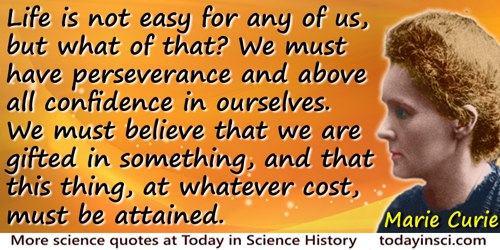
Life is not easy for any of us, but what of that? We must have perseverance and above all confidence in ourselves. We must believe that we are gifted in something, and that this thing, at whatever cost, must be attained.
— Marie Curie
Letter to brother (1894). In Eve Curie, Madame Curie: a Biography by Eve Curie (1937, 2007), 158.
My experiments proved that the radiation of uranium compounds ... is an atomic property of the element of uranium. Its intensity is proportional to the quantity of uranium contained in the compound, and depends neither on conditions of chemical combination, nor on external circumstances, such as light or temperature.
... The radiation of thorium has an intensity of the same order as that of uranium, and is, as in the case of uranium, an atomic property of the element.
It was necessary at this point to find a new term to define this new property of matter manifested by the elements of uranium and thorium. I proposed the word radioactivity which has since become generally adopted; the radioactive elements have been called radio elements.
... The radiation of thorium has an intensity of the same order as that of uranium, and is, as in the case of uranium, an atomic property of the element.
It was necessary at this point to find a new term to define this new property of matter manifested by the elements of uranium and thorium. I proposed the word radioactivity which has since become generally adopted; the radioactive elements have been called radio elements.
— Marie Curie
In Pierre Curie, with the Autobiographical Notes of Marie Curie, trans. Charlotte and Vernon Kellogg (1923), 96. Also in reprint (2012) 45-46.

Nothing in life is to be feared, it is only to be understood. Now is the time to understand more, so that we may fear less.
— Marie Curie
Primary source uncertain. Found widely quoted as two sentences, without citation. For example, in Larry Chang, Wisdom for the Soul (2006), 304. If you have a primary source, please contact Webmaster, who has not yet found it in any large collection or biography, but has seen it mentioned without citation in many books as far back as 1952. Webmaster doubts that the second sentence is by Curie. The quote appears in a 1968 publication as the conclusion of an article, and only the first sentence is given in quotes. The second sentence is outside the quotes. See Glenn T. Seaborg, 'Need We Fear Our Nuclear Future?', Bulletin of the Atomic Scientists (Jan 1968), 24, No. 1, 42. Seaborg's article title, on page 36, is followed by the first sentence only, in quotes, citing Maria Sklodowska-Curie. His article condenses the speech he gave before a symposium in celebration of the Maria Sklodowska-Curie Centenary held in Warsaw, Poland (19 Oct 1967). The first sentence, alone, appears in French as «On ne doit rien craindre dans la vie—il suffit de comprendre,» in Université Laval, Faculté de médecine, Société medicale des hôpitaux universitaires de Québec, Laval médical (1951), 16, 569. This French source gives as context Marie Curie's discovery that she had cancer. The second sentence does not easily share that context, so the Webmaster believes it is solely the words of Glenn T. Seaborg, belonging only as a concluding remark to his article.
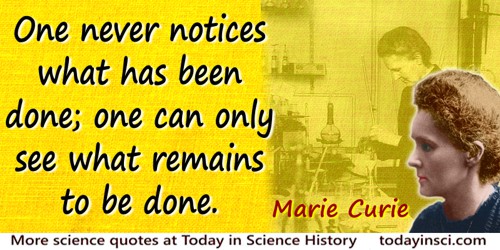
One never notices what has been done; one can only see what remains to be done.
— Marie Curie
Letter to her brother (18 Mar 1894 ). In Eve Curie Labouisse and Eve Curie, trans. by Vincent Sheean, Madame Curie (1937), 116.
One of our joys was to go into our workroom at night; we then perceived on all sides the feebly luminous silhouettes of the bottles or capsules containing our products. It was really a lovely sight and one always new to us. The glowing tubes looked like faint, fairy lights.
— Marie Curie
As translated by Charlotte and Vernon Kellogg in Marie Curie, Pierre Curie (1923), 188.
Sometimes my courage fails me and I think I ought to stop working, live in the country and devote myself to gardening. But I am held by a thousand bonds, and I don't know when I shall be able to arrange things otherwise. Nor do I know whether, even by writing scientific books, I could live without the laboratory.
— Marie Curie
Letter to her sister Bronya, September 1927. In Eve Curie, Madame Curie (1938), 388.
The School of Physics could give us no suitable premises, but for lack of anything better, the Director permitted us to use an abandoned shed which had been in service as a dissecting room of the School of Medicine. Its glass roof did not afford complete shelter against rain; the heat was suffocating in summer, and the bitter cold of winter was only a little lessened by the iron stove, except in its immediate vicinity. There was no question of obtaining the needed proper apparatus in common use by chemists. We simply had some old pine-wood tables with furnaces and gas burners. We had to use the adjoining yard for those of our chemical operations that involved producing irritating gases; even then the gas often filled our shed. With this equipment we entered on our exhausting work. Yet it was in this miserable old shed that we passed the best and happiest years of our life.
— Marie Curie
As translated by Charlotte and Vernon Kellogg in Marie Curie, 'Autobiographical Notes', Pierre Curie (1923), 186. [With her husband, Pierre Curie, it was in this poorly equipped facility that they worked on their discovery of polonium (announced Jul 1898) and radium (announced Dec 1898). —Webmaster]
The various reasons which we have enumerated lead us to believe that the new radio-active substance contains a new element which we propose to give the name of radium.
— Marie Curie
Marie Curie, Pierre Curie and Gustave Bémont, 'Sur une Nouvelle Substance Fortement Radio-Active, Contenue dans las Pechblende', (On a new, strongly radio-active substance, contained in pitchblende), Comptes Rendus (1898). 127, 1217. In Joseph E. Harmon and Alan G. Gross (editors), The Scientific Literature (2007), 151.
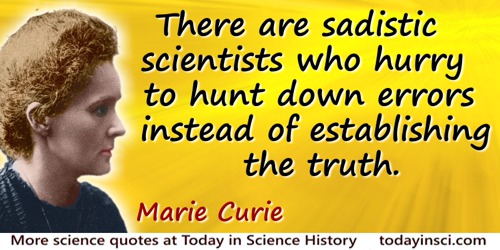
There are sadistic scientists who hurry to hunt down errors instead of establishing the truth.
— Marie Curie
Quotation translated by A.L. Mackay in Alan Lindsay Mackay and Maurice Ebison, The Harvest of a Quiet Eye (1977), 40.
This means that we have here an entirely separate kind of chemistry for which the current tool we use is the electrometer, not the balance, and which we might well call the chemistry of the imponderable.
— Marie Curie
(11 Dec 1911) As quoted in Marie and Pierre Curie and the Discovery of Polonium and Radium, Nobel Lecture
We believe the substance we have extracted from pitch-blende contains a metal not yet observed, related to bismuth by its analytical properties. If the existence of this new metal is confirmed we propose to call it polonium, from the name of the original country of one of us.
— Marie Curie
Proceedings of the Academy of Science (18 July 1898). In Eve Curie, Madame Curie (1937, 2007), 161.
We cannot hope to build a better world without improving the individual. Toward this end, each of us must work for his own highest development, accepting at the same time his share of responsibility in the general life of humanity—our particular duty being to aid those to whom we think we can be most useful.
— Marie Curie
Quoted in Eve Curie Labouisse and Eve Curie, trans. by Vincent Sheean, Madame Curie (1937), 53.
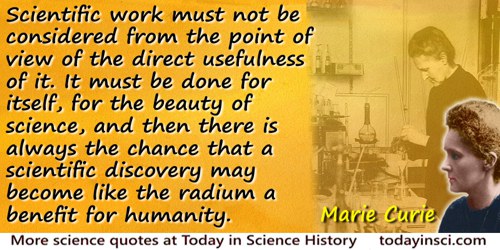
We must not forget that when radium was discovered no one knew that it would prove useful in hospitals. The work was one of pure science. And this is a proof that scientific work must not be considered from the point of view of the direct usefulness of it. It must be done for itself, for the beauty of science, and then there is always the chance that a scientific discovery may become like the radium a benefit for humanity.
— Marie Curie
Lecture at Vassar College, Poughkeepsie, New York (14 May 1921). In Cambridge Editorial Partnership, Speeches that Changed the World, 53.
When one studies strongly radioactive substances special precautions must be taken if one wishes to be able to take delicate measurements. The various objects used in a chemical laboratory and those used in a chemical laboratory, and those which serve for experiments in physics, become radioactive in a short time and act upon photographic plates through black paper. Dust, the air of the room, and one’s clothes all become radioactive.
— Marie Curie
Notebook entry. In Eve Curie, Madame Curie: a Biography by Eve Curie (1937, 2007), 196.
Quotes by others about Marie Curie (8)
At my urgent request the Curie laboratory, in which radium was discovered a short time ago, was shown to me. The Curies themselves were away travelling. It was a cross between a stable and a potato-cellar, and, if I had not seen the worktable with the chemical apparatus, I would have thought it a practical joke.
Wilhelm Ostwald on seeing the Curie's laboratory facilities.
Wilhelm Ostwald on seeing the Curie's laboratory facilities.
In R. Reid, Marie Curie (1974), 95.
It was my good fortune to be linked with Mme. Curie through twenty years of sublime and unclouded friendship. I came to admire her human grandeur to an ever growing degree. Her strength, her purity of will, her austerity toward herself, her objectivity, her incorruptible judgement—all these were of a kind seldom found joined in a single individual… The greatest scientific deed of her life—proving the existence of radioactive elements and isolating them—owes its accomplishment not merely to bold intuition but to a devotion and tenacity in execution under the most extreme hardships imaginable, such as the history of experimental science has not often witnessed.
Out of My Later Years (1950), 227-8.
I have to keep going, as there are always people on my track. I have to publish my present work as rapidly as possible in order to keep in the race. The best sprinters in this road of investigation are Becquerel and the Curies...
Letter to his mother (5 Jan1902). Quoted in A. S. Eve, Rutherford: Being the Life and Letters of the Rt. Hon. Lord Rutherford (1939), 80. In Laurie M. Brown, Abraham Pais and A. B. Pippard, Twentieth Century Physics (1995), 58.
Our Marie Curie. [Referring to Lise Meitner]
Ruth Sime, Lise Meitner: A Life in Physics (1996), 74-5.
Marie Curie is, of all celebrated beings, the only one whom fame has not corrupted.
As quoted in Eve Curie, Madame Curie: a Biography by Eve Curie (1937), xi.
Pierre Curie, a brilliant scientist, happened to marry a still more brilliant one—Marie, the famous Madame Curie—and is the only great scientist in history who is consistently identified as the husband of someone else.
View from a Height (1963), 119.
Madam Curie = Radium came.
— Anagram
From 'The Anagram Hall of Fame' on the wordsmith.org website.
Scientists today are hampered by their low social and economic status. Long gone is the respect and independence given to Lavoisier, Darwin, Faraday, Maxwell, Perkin, Curie and Einstein. Hardly any laboratory scientist anywhere is as free as a good writer can be. Indeed I suspect that the only scientists we know well are those who can write entertaining books; the real contributors to knowledge are mostly unknown.
In The Revenge of Gaia: Earth’s Climate Crisis & The Fate of Humanity (2006, 2007), 93.

See also:
- 7 Nov - short biography, births, deaths and events on date of Curie's birth.
- More for Marie Curie on Today in Science History page.
- Madame Curie: A Biography, by Eve Curie. - book suggestion.
- Booklist for Marie Curie.
 In science it often happens that scientists say, 'You know that's a really good argument; my position is mistaken,' and then they would actually change their minds and you never hear that old view from them again. They really do it. It doesn't happen as often as it should, because scientists are human and change is sometimes painful. But it happens every day. I cannot recall the last time something like that happened in politics or religion.
(1987) --
In science it often happens that scientists say, 'You know that's a really good argument; my position is mistaken,' and then they would actually change their minds and you never hear that old view from them again. They really do it. It doesn't happen as often as it should, because scientists are human and change is sometimes painful. But it happens every day. I cannot recall the last time something like that happened in politics or religion.
(1987) -- 




