 (source)
|
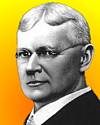
Irving Wightman Colburn
(16 May 1861 - 4 Sep 1917)
bdp=EB
|
Irving W. Colburn
Inventor of Plate Glass Manufacturing Process
In 1899, Irving W. Colburn began his experiments which would eventually lead to mechanizing the continuous production of sheet glass. Within a few years, he had built many machines, progressing from crude results to apparent success. His efforts were sufficiently advanced in 1906 to form the Colburn Machine Glass Co, and by 1908, the company had drawing machines at two factories.
Accounts of the day enthusiastically admired the significance of Colburn's machines. However, in the period between 1905 and 1912, fifteen different machines had been developed, with an expenditure of more than a million dollars. Yet the output was limited to only a few thousand boxes of product, and the the glass was, in reality, of rather poor quality.
Although Colburn was on the right path, by 1911, the technology still needed to be perfected. Expenditures continued while income was elusive. His company went bankrupt. On 8 Feb 1912, its assets were sold by auction. This included the numerous patents Colburn held for his process, and these still had much potential value.
Following the bankruptcy of his company, Colburn's patents were purchased by Edward Libbey, president of the Toledo Glass Company. Shortly thereafter, Libbey showed his confidence in Colburn's ability by hiring him to continue improving his process.
After a further period of experimentation, a machine was built that could indeed successfully produce plate glass in commercial quantities by mechanical means. On Thanksgiving, 25 Nov 1913, the first draw of sheet glass commenced at Toledo Glass Co.
In Colburn's process, the production of sheet glass using began with an iron rod as “bait” immersed lengthwise in a shallow tank of molten glass. This caused some glass to stick to the rod, whereupon an electric motor pulled the rod, drawing a ribbon of glass horizontally over a set of rollers which roughly formed a flat sheet of glass as it continued to be drawn out of the molten reservoir. Its width was controlled by water-cooled side rollers as it approached a flattening table. In the next stage, the glass sheet passed through an annealing oven supported on a train of asbestos-surfaced rollers. The final step was to cut the work into plate glass sheets of the required size.
- 16 May - short biography, births, deaths and events on date of Colburn's birth.





