 (source)
|
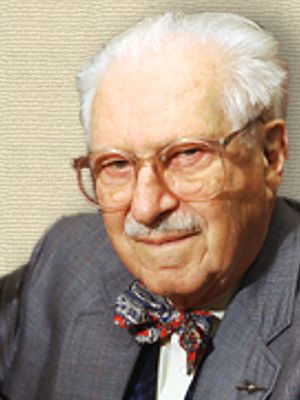
I. Bernard Cohen
(1 Mar 1914 - 20 Jun 2003)
American science historian who was the first American to receive a Ph.D. in history of science. He published many books on the history of science, notably Principia: Mathematical Principles of Natural Philosophy, the first English translation of Newton's work since 1729.
|
Science Quotes by I. Bernard Cohen (13 quotes)
[Howard] Aiken considered Babbage his intellectual “father.”
— I. Bernard Cohen
As stated in Howard Aiken: Portrait of a Computer Pioneer (2000), 61.
All revolutionary advances in science may consist less of sudden and dramatic revelations than a series of transformations, of which the revolutionary significance may not be seen (except afterwards, by historians) until the last great step. In many cases the full potentiality and force of a most radical step in such a sequence of transformations may not even be manifest to its author.
— I. Bernard Cohen
The Newtonian Revolution (1980), 162.
Although few expressions are more commonly used in writing about science than “science revolution,” there is a continuing debate as to the propriety of applying the concept and term “revolution” to scientific change. There is, furthermore, a wide difference of opinion as to what may constitute a revolution. And although almost all historians would agree that a genuine alteration of an exceptionally radical nature (the Scientific Revolution) occurred in the sciences at some time between the late fifteenth (or early sixteenth) century and the end of the seventeenth century, the question of exactly when this revolution occurred arouses as much scholarly disagreement as the cognate question of precisely what it was.
— I. Bernard Cohen
The Newtonian Revolution (1980), 3.
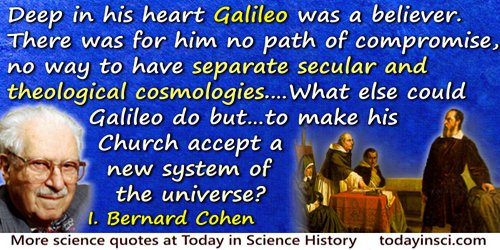
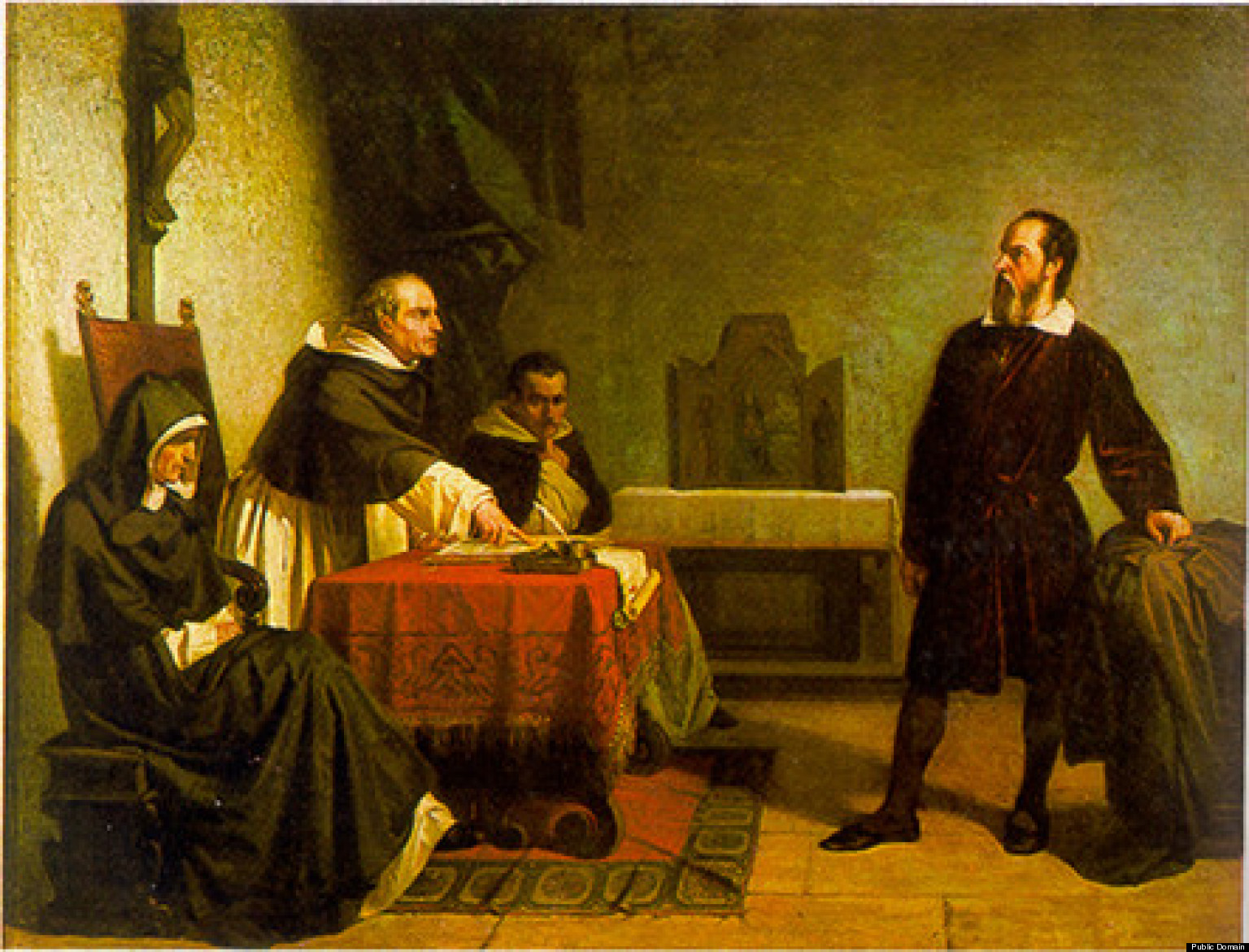
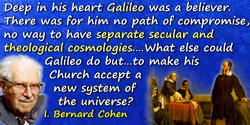
His conflict with the Catholic Church arose because deep in his heart Galileo was a believer. There was for him no path of compromise, no way to have separate secular and theological cosmologies. If the Copernican system was true as he believed, what else could Galileo do but fight with every weapon he had in his arsenal of logic, rhetoric, scientific observation, mathematical theory, and cunning insight, to make his Church accept a new system of the universe?
— I. Bernard Cohen
In The Birth of a New Physics (1960, rev. ed. 1985), 125.
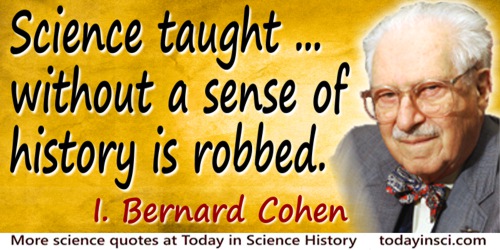
History without the history of science, to alter slightly an apothegm of Lord Bacon, resembles a statue of Polyphemus without his eye—that very feature being left out which most marks the spirit and life of the person. My own thesis is complementary: science taught ... without a sense of history is robbed of those very qualities that make it worth teaching to the student of the humanities and the social sciences.
— I. Bernard Cohen
'The History of Science and the Teaching of Science', in I. Bernard Cohen and Fletcher G. Watson (eds.), General Education in Science (1952), 71.
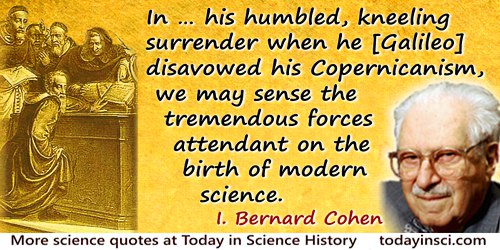
In … his humbled, kneeling surrender when he disavowed his Copernicanism, we may sense the tremendous forces attendant on the birth of modern science.
— I. Bernard Cohen
In The Birth of a New Physics (1960, rev. ed. 1985), 126.
Taken over the centuries, scientific ideas have exerted a force on our civilization fully as great as the more tangible practical applications of scientific research.
— I. Bernard Cohen
From 'The History of Science and the Teaching of Science', collected in I.B. Cohen and F.G. Watson(eds.), General Education in Science (1952), 72.
The Opticks invites … the reader to roam, with great Newton as his guide, through the major unresolved problems of science and even the relation of the whole world of nature to Him who had created it.
— I. Bernard Cohen
From Isaac Newton, Opticks, Or, A Treatise of the Reflections, Refractions, Inflections (1730; Dover edition, 1979), Preface by I. Bernard Cohen, xviii.
The ancients knew a few … numerical laws…. But prior to the Scientific Revolution, the goal of science (or the study of nature) was not to seek laws of nature expressed in terms of numbers or number relations. Those who created the new science of the seventeenth century not only found laws based on numbers but they were also willing to express these laws in terms of higher powers of numbers—squares and cubes.
— I. Bernard Cohen
From The Triumph of Numbers: How Counting Shaped Modern Life (2005), 37. The second ellipsis is for examples of those laws: “the law of reflection of light, the law of the lever, and the law of buoyancy.”
The pioneering practitioners of the new science [of the seventeenth century] knew that they were producing a new kind of knowledge and so they declared this newness in the titles of their books and articles. Thus we have Galileo’s Two New Sciences, Boyle’s New Experiments, Kepler’s New Astronomy, and Tartaglia’s New Science.
— I. Bernard Cohen
From The Triumph of Numbers: How Counting Shaped Modern Life (2005), 36.
The seventeenth century witnessed the birth of modern science as we know it today. This science was something new, based on a direct confrontation of nature by experiment and observation. But there was another feature of the new science—a dependence on numbers, on real numbers of actual experience.
— I. Bernard Cohen
From The Triumph of Numbers: How Counting Shaped Modern Life (2005), 37.
To present science in purely abstract terms as a collection of information or as a system of knowledge, thereby ignoring the place of science in the drama of human history, is simply to rob the students of their own heritage as human beings and to reduce one of the most exciting chapters in the history of mankind to the bare bones of observed fact and the skeletons of dry theories built of them.
— I. Bernard Cohen
From 'The History of Science and the Teaching of Science', collected in I.B. Cohen and F.G. Watson(eds.), General Education in Science (1952), 72.
When Ben Jonson presented a masque entitled “News from the New World,” his new world was not the newly found continent of North America, but the new world of science, the world revealed by the telescope of Galileo.
— I. Bernard Cohen
From The Triumph of Numbers: How Counting Shaped Modern Life (2005), 36.
See also:
- 1 Mar - short biography, births, deaths and events on date of Cohen's birth.
- I. Bernard Cohen - context of quote “Science taught without history” - Medium image (500 x 250 px)
- I. Bernard Cohen - context of quote “Science taught without history” - Large image (800 x 400 px)
- The Triumph of Numbers: How Counting Shaped Modern Life, by Bernard Cohen. - book suggestion.
- Booklist for I. Bernhard Cohen.
 In science it often happens that scientists say, 'You know that's a really good argument; my position is mistaken,' and then they would actually change their minds and you never hear that old view from them again. They really do it. It doesn't happen as often as it should, because scientists are human and change is sometimes painful. But it happens every day. I cannot recall the last time something like that happened in politics or religion.
(1987) --
In science it often happens that scientists say, 'You know that's a really good argument; my position is mistaken,' and then they would actually change their minds and you never hear that old view from them again. They really do it. It doesn't happen as often as it should, because scientists are human and change is sometimes painful. But it happens every day. I cannot recall the last time something like that happened in politics or religion.
(1987) --