 (source)
|
Arthur C. Clarke
(16 Dec 1917 - 19 Mar 2008)
English-Sri Lankan science fiction writer who is known not only for his extensive works of science fiction, but also for scientific and technical writing. It was his 1945 article, Extraterrestrial Relays in which the idea of communications satellites was first proposed. Clarke has written in fields as diverse as underwater diving, space exploration, and scientific extrapolation.
|
Science Quotes by Arthur C. Clarke (47 quotes)
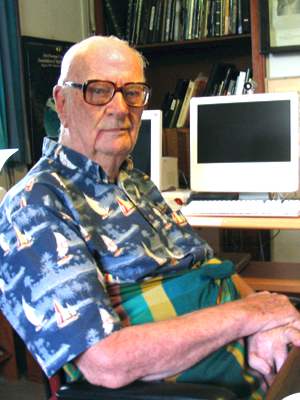
[What verdict would a historian of the year 3000 pass upon our age? Let us hope this will be his judgement:]
“The twentieth century was, without question, the most momentous hundred years in the history of Mankind. It opened with the conquest of the air, and before it had run half its course had presented civilisation with its supreme challenge—the control of atomic energy. Yet even these events, each of which changed the world, were soon to be eclipsed. To us a thousand years later, the whole story of Mankind before the twentieth century seems like the prelude to some great drama, played on the narrow strip of stage before the curtain has risen and revealed the scenery. For countless generations of men, that tiny, crowded stage—the planet Earth—was the whole of creation, and they the only actors. Yet towards the close of that fabulous century, the curtain began slowly, inexorably to rise, and Man realised at last that the Earth was only one of many worlds; the Sun only one among many stars. The coming of the rocket brought to an end a million years of isolation. With the landing of the first spaceship on Mars and Venus, the childhood of our race was over and history as we know it began….”
“The twentieth century was, without question, the most momentous hundred years in the history of Mankind. It opened with the conquest of the air, and before it had run half its course had presented civilisation with its supreme challenge—the control of atomic energy. Yet even these events, each of which changed the world, were soon to be eclipsed. To us a thousand years later, the whole story of Mankind before the twentieth century seems like the prelude to some great drama, played on the narrow strip of stage before the curtain has risen and revealed the scenery. For countless generations of men, that tiny, crowded stage—the planet Earth—was the whole of creation, and they the only actors. Yet towards the close of that fabulous century, the curtain began slowly, inexorably to rise, and Man realised at last that the Earth was only one of many worlds; the Sun only one among many stars. The coming of the rocket brought to an end a million years of isolation. With the landing of the first spaceship on Mars and Venus, the childhood of our race was over and history as we know it began….”
— Arthur C. Clarke
In Chap. 18, 'Concerning Means and Ends', The Exploration of Space (1951), 195. [Clarke wrote this, not knowing there would be a Moon landing just 18 years later, on 20 Jul 1969. In fact, in an earlier chapter, he wrote “On our present knowledge, there is no likelihood of such spaceships for a very long time to come.” —Webmaster]
Clarke's First Law: When a distinguished but elderly scientist states that something is possible, he is almost certainly right. When he states that something is impossible, he is very probably wrong.
— Arthur C. Clarke
'Hazards of Prophecy: The Failure of Imagination'. In the collection. Profiles of the Future: An Enquiry into the Limits of the Possible (1962, rev. 1973), 14.
Clarke's Law of Evolution: It has yet to be proven that intelligence has any survival value.
— Arthur C. Clarke
M. S. Thambirajah, Psychological Basis of Psychiatry (2005), 33.
Clarke's Second Law: The only way of discovering the limits of the possible is to venture a little way past them into the impossible.
— Arthur C. Clarke
Profiles of the Future: An Enquiry into the Limits of the Possible (1962, rev. 1973), 21.
Clarke's Third Law:. Any sufficiently advanced technology is indistinguishable from magic.
— Arthur C. Clarke
In Profiles of the Future: An Enquiry into the Limits of the Possible (1982), 36, footnote.
~~[Atrributed]~~ I’m sure the universe is full of intelligent life. It’s just been too intelligent to come here.
— Arthur C. Clarke
Webmaster doubts the authenticity of this quote. It is all over the web, without any source cited. So far, in books available to search, the earliest instance of the quote Webmaster finds is 2003, also with no source, in New Scientist (2003), 177, 53. If this was an authentic quote, wouldn't it show up somewhere before that, with a source, since he died in 2008? Perhaps it is a paraphrase, or from an interview. Can you help?
~~[Attributed]~~ How inappropriate to call this planet Earth, when clearly it is Ocean.
— Arthur C. Clarke
Referenced in opening paragraph to Chap. 6, 'The Sea', in James E. Lovelock, Gaia: A New Look at Life on Earth (1979) 84. The origin of the Arthur C. Clarke quote is not footnoted therein, and although found widely quoted without citation, in print and on the web, Webmaster has, as yet, been unable to locate a primary source. Lovelock’s quote is also on this website, beginning, “As Arthur C. Clarke has observed:…”. In 1963, G. Carleton Ray made a similar statement, beginning “We call this planet Earth…” and referring to “sea” rather than “Ocean”.
~~[False Attribution]~~ Sometimes I think we’re alone in the universe, and sometimes I think we’re not. In either case, the idea is quite staggering.
— Arthur C. Clarke
Quote Investigator found no authentic source for this quote from Clarke. Thorough discussion here.
A hundred years ago, the electric telegraph made possible—indeed, inevitable—the United States of America. The communications satellite will make equally inevitable a United Nations of Earth; let us hope that the transition period will not be equally bloody.
— Arthur C. Clarke
Neil Armstrong, Michael Collins, Buzz Aldrin, Edwin E. Aldrin et al., First on the Moon (1970), 389.
Anything that is theoretically possible will be achieved in practice, no matter what the technical difficulties are, if it is desired greatly enough.
— Arthur C. Clarke
Hazards of Prophecy: An Arresting Inquiry into the limits of the Possible: Failures of Nerve and Failures of Imagination (1962)
As our own species is in the process of proving, one cannot have superior science and inferior morals. The combination is unstable and self-destroying.
— Arthur C. Clarke
Voices From the Sky: Previews of the Coming Space Age (1967), 156.
As someone once said, “The patent is merely a license to be sued.”
— Arthur C. Clarke
From transcript of Associated Press video of Speech (20 Jul 1999), from Sri Lanka, on 30th anniversary of the Moon landing.
As three laws were good enough for Newton, I have modestly decided to stop there.
Commenting on Clarke's own three laws.
Commenting on Clarke's own three laws.
— Arthur C. Clarke
Profiles of the Future: An Enquiry into the Limits of the Possible (1962, rev. 1973), footnote, 21.
At the present rate of progress, it is almost impossible to imagine any technical feat that cannot be achieved, if it can be achieved at all, within the next five hundred years.
— Arthur C. Clarke
Profiles of the Future (1973), xvi.
Deep beneath the surface of the Sun, enormous forces were gathering. At any moment, the energies of a million hydrogen bombs might burst forth in the awesome explosion…. Climbing at millions of miles per hour, an invisible fireball many times the size of Earth would leap from the Sun and head out across space.
— Arthur C. Clarke
From 'Sunjammer', collected in Harry Harrison (ed.), Worlds of Wonder: Sixteen Tales of Science Fiction (1969), 32-33. Originally published in Boys’ Life (Mar 1964).
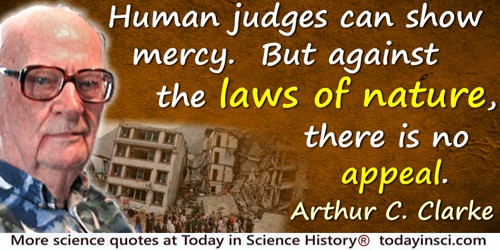
Human judges can show mercy. But against the laws of nature, there is no appeal.
— Arthur C. Clarke
The Wind from the Sun: Stories of the Space Age (1972), 8.
I can never look now at the Milky Way without wondering from which of those banked clouds of stars the emissaries are coming. If you will pardon so commonplace a simile, we have broken the glass of the fire-alarm and have nothing to do but to wait. I do not think we will have to wait for long.
— Arthur C. Clarke
Concluding sentences of short story, 'The Sentinel', collected in Avon 10 Story Fantasy (Spring 1951), 1, No. 1, 47.
I sometimes wonder how we spent leisure time before satellite television and Internet came along…and then I realise that I have spent more than half of my life in the ‘dark ages’!
— Arthur C. Clarke
From interview (5 Dec 2003) days before his 86th birthday with Nalaka Gunawardene, published on the internet sites http://southasia.oneworld.net and arthurcclarke.net.
I think the rocket will end up doing for space travel what the balloon did for air travel: it got us there, but soon was superseded by something better.
— Arthur C. Clarke
In 'A Conversation With Arthur C. Clarke: An Author’s Space Odyssey', New York Times (26 Oct 1999)
I'm sure we would not have had men on the Moon if it had not been for Wells and Verne and the people who write about this and made people think about it. I'm rather proud of the fact that I know several astronauts who became astronauts through reading my books.
— Arthur C. Clarke
Address to US Congress, 1975. Science and Technology Committee, United States Congress, House, Future Space Programs, 1975, Hearings Before the Subcommittee on Space Science and Applications (1975), 206. Also in Arthur C. ClarkeThe View from Serendip (1977), 238.
If there are any gods whose chief concern is man, they cannot be very important gods.
— Arthur C. Clarke
In 'Space Flight and the Spirit of Man', Voices from Sky: Previews of the Coming Space Age (1965), 17.
If we have learned one thing from the history of invention and discovery, it is that, in the long run—and often in the short one—the most daring prophecies seem laughably conservative.
— Arthur C. Clarke
In The Exploration of Space (1951), 111.
In physics, mathematics, and astronautics [elderly] means over thirty; in the other disciplines, senile decay is sometimes postponed to the forties. There are, of course, glorious exceptions; but as every researcher just out of college knows, scientists of over fifty are good for nothing but board meetings, and should at all costs be kept out of the laboratory!
Defining 'elderly scientist' as in Clarke's First Law.
Defining 'elderly scientist' as in Clarke's First Law.
— Arthur C. Clarke
'Hazards of Prophecy: The Failure of Imagination'. In the collection. Profiles of the Future: An Enquiry into the Limits of the Possible (1962, rev. 1973), 14-15.
Information is not knowledge, knowledge is not wisdom, and wisdom is not foresight. Each grows out of the other, and we need them all.
— Arthur C. Clarke
Speech in Sri Lanka (1993). Quoted in Marshall B. Rosenberg and Riane Eisler, Life-Enriching Education (2003), xix. [If you know a primary print source reference, please contact Webmaster.]
It is a good principle in science not to believe any “fact”—however well attested—until it fits into some accepted frame of reference. Occasionally, of course, an observation can shatter the frame and force the construction of a new one, but that is extremely rare. Galileos and Einsteins seldom appear more than once per century, which is just as well for the equanimity of mankind.
— Arthur C. Clarke
In Opening of Chap 14, 'Search', 2061: Odyssey Three (1987, 1989), 62.
It may be that the old astrologers had the truth exactly reversed, when they believed that the stars controlled the destinies of men. The time may come when men control the destinies of stars.
— Arthur C. Clarke
The View from Serendip (1977), 79.
It will be possible in a few more years to build radio controlled rockets which can be steered into such orbits beyond the limits of the atmosphere and left to broadcast scientific information back to the Earth. A little later, manned rockets will be able to make similar flights with sufficient excess power to break the orbit and return to Earth. (1945) [Predicting communications satellites.]
— Arthur C. Clarke
In 'Can Rocket Stations Give Worldwide Coverage?', Wireless World (Oct 1945). Quoted and cited in Arthur C. Clarke, Greetings, Carbon-Based Bipeds!: Collected Essays, 1934-1998, 21.
Mars is the next frontier, what the Old West was, what America was 500 years ago. It’s been 500 years since Columbus. It’s time to strike out anew. There’s a big argument at the moment. The moon is closer, and we’ve got to go back there sometime. But whether it will ever be settled on a large scale is a question. But Mars—there’s no doubt about it. … Everything you need is on Mars.
The characteristic of human nature, and perhaps our simian family group, is curiosity and exploration. When we stop doing that, we won't be human anymore. You say there's been a decline, well, I’ve seen far more happen in my lifetime than I ever dreamed. And the momentary plateau now, well, many of our problems on Earth can only be solved by space technology. … When we get out of the present sort of slump and confusion, well, I mean the next step is space. It's inevitable.
The characteristic of human nature, and perhaps our simian family group, is curiosity and exploration. When we stop doing that, we won't be human anymore. You say there's been a decline, well, I’ve seen far more happen in my lifetime than I ever dreamed. And the momentary plateau now, well, many of our problems on Earth can only be solved by space technology. … When we get out of the present sort of slump and confusion, well, I mean the next step is space. It's inevitable.
— Arthur C. Clarke
Interview in Sri Lanka by Steve Coll for The Washington Post (9 Mar 1992), B1.
Mathematics is not only one of the most valuable inventions—or discoveries—of the human mind, but can have an aesthetic appeal equal to that of anything in art. Perhaps even more so, according to the poetess who proclaimed, “Euclid alone hath looked at beauty bare.”
— Arthur C. Clarke
From 'The Joy of Maths'. Collected in Arthur C. Clarke, Greetings, Carbon-Based Bipeds!: Collected Essays, 1934-1998, 460.
Microprocessors are getting into everything. We won’t be able to pick up a single piece of equipment in the near future, except maybe a broom, that hasn’t got a microprocessor in it.
— Arthur C. Clarke
(1979). Interview with Malcolm Kirk, in the magazine OMNI. Collected in Ben Bova and Don Myrus (eds.), The Best of Omni Science Fiction (1980), Issue 1, 143.
One of the biggest roles of science fiction is to prepare people to accept the future without pain and to encourage a flexibility of the mind. Politicians should read science fiction, not westerns and detective stories.
— Arthur C. Clarke
(1984) Quoted in Jerome Agel (ed.), The Making of Kubrick's 2001 (4th Ed. 1970), 300. In James E. Combs, Polpop: Politics and Popular Culture in America (1984), 147.
One orbit, with a radius of 42,000 kilometers, has a period of exactly 24 hours. A body in such an orbit, if its plane coincided with that of the Earth’s equator, would revolve with the Earth and would thus be stationary above the same spot on the planet. It would remain fixed in the sky of a whole hemisphere ... [to] provide coverage to half the globe, and for a world service three would be required, though more could be readily utilized. (1945) [Predidicting geosynchronous communication satellites]
— Arthur C. Clarke
In 'Can Rocket Stations Give Worldwide Coverage?', Wireless World (Oct 1945). Quoted and cited in Arthur C. Clarke, Greetings, Carbon-Based Bipeds!: Collected Essays, 1934-1998, 22.
Our lifetime may be the last that will be lived out in a technological society.
— Arthur C. Clarke
Interview in The Christian Science Monitor (27 Mar 1974), F1.
Our lifetime may be the last that will be lived out in a technological society. If the world continues to behave as stupidly as it has behaved in the past, we are going to have an increase in population, an increase in violence. We will try to support the population by ripping up earth’s resources, producing pollution at a greater and greater rate, ending, perhaps, in a nuclear war. The earth will have its oil burnt up, most of its most easily available coal used up, its metals distributed thinly over the entire world. We simply won’t have the material basis to build up another technological civilization. The greater the population, the greater the pressure on technology to produce things. Also, there is a great deal of pressure to produce things that don’t directly relate to the quantity of people in the world, but are useless, energy wasting. Socrates is reported to have looked over a bazaar in great wonder and said, “How very many things there are that I do not need.” There are a great many things that we don’t need.
— Arthur C. Clarke
Interview in The Christian Science Monitor (27 Mar 1974), F1.
Perhaps a species that has accumulated … tons of explosive per capita has already demonstrated its biological unfitness beyond any further question.
— Arthur C. Clarke
In 'Prelude to Star Wars', Astounding Days: A Science Fictional Autobiography (1989), 99.
Politicians should read science fiction, not westerns and detective stories.
— Arthur C. Clarke
In Rosemarie Jarski, Words from the Wise: Over 6,000 of the Smartest Things Ever Said (2007), 438.
Science can destroy religion by ignoring it as well as by disproving its tenets. No one ever demonstrated, so far as I am aware, the nonexistence of Zeus or Thor—but they have few followers now.
— Arthur C. Clarke
Childhood's End: a novel (reissue 1987), 15.
The Earth would only have to move a few million kilometers sunward—or starward—for the delicate balance of climate to be destroyed. The Antarctic icecap would melt and flood all low-lying land; or the oceans would freeze and the whole world would be locked in eternal winter. Just a nudge in either direction would be enough.
— Arthur C. Clarke
In Rendezvous With Rama (1973), 9.
The exploration of space—by men and machines, for each complements the other—will be a continuing process with countless goals, but no final end.
— Arthur C. Clarke
In The View from Serendip (1977), 87.
The inspirational value of the space program is probably of far greater importance to education than any input of dollars... A whole generation is growing up which has been attracted to the hard disciplines of science and engineering by the romance of space.
— Arthur C. Clarke
Neil Armstrong, Michael Collins, Buzz Aldrin, Edwin E. Aldrin et al., First on the Moon (1970), 376.
The moon is the first milestone on the road to the stars.
— Arthur C. Clarke
In The View from Serendip (1977), 87.
The only way of finding the limits of the possible is by going beyond them into the impossible.
— Arthur C. Clarke
In The Lost Worlds of 2001 (1972).
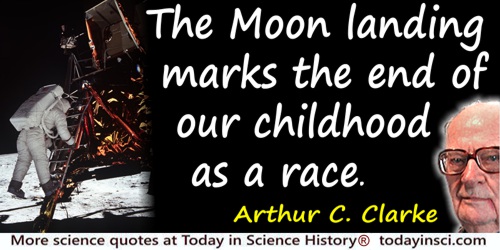
The realization that our small planet is only one of many worlds gives mankind the perspective it needs to realize sooner that our own world belongs to all of its creatures, that the Moon landing marks the end of our childhood as a race and the beginning of a newer and better civilization.
— Arthur C. Clarke
Webmaster, as yet, has not traced a primary source. Although this is widely quoted in print and online, each time is without source cited. An early example is Laurence J. Peter (ed.), Peter’s Quotations (1977, 1979), 539. The moon landing was on 20 Jul 1969, and Clarke may have contributed this quote during an interview after that day. Clarke had previously speculated, in 1951, on the possible words of a historian from the year 3000, “The coming of the rocket brought to an end a million years of isolation. With the landing of the first spaceship on Mars and Venus, the childhood of our race was over and history as we know it began.” In 'Concerning Means and Ends', The Exploration of Space (1951), 195. This is contained in a longer quote on this webpage, beginning: “[What verdict would a historian of the year 3000…].
There is a poignant symbolism in the fact that the giant rockets now stand poised on the edge of the Pacific where the covered wagons halted only two lifetimes ago.
— Arthur C. Clarke
In 'Rocket to the Renaissance', republished in a collection of essays written in 1959-1961, Profiles of the Future (1962), 85.
There is hopeful symbolism in the fact that flags do not wave in a vacuum.
— Arthur C. Clarke
Jason Merchey, Values of the Wise (2004), 31.
Using material ferried up by rockets, it would be possible to construct a “space station” in ... orbit. The station could be provided with living quarters, laboratories and everything needed for the comfort of its crew, who would be relieved and provisioned by a regular rocket service. (1945)
— Arthur C. Clarke
In 'Can Rocket Stations Give Worldwide Coverage?', Wireless World (Oct 1945). Quoted and cited in Arthur C. Clarke, Greetings, Carbon-Based Bipeds!: Collected Essays, 1934-1998, 22. Also quoted in 'Hazards of Communication Satellites', Bulletin of the Atomic Scientists (May 1961), Vol. 17, No. 5, 181, by John R. Pierce Pierce, who then commented, “Clarke thought in terms of manned space stations; today these seem very remote.”
We have already met Darth Vader—and he is us.
— Arthur C. Clarke
In 'Prelude to Star Wars', Astounding Days: A Science Fictional Autobiography (1989), 99.
Quotes by others about Arthur C. Clarke (2)
Clarke's First Law - Corollary: When, however, the lay public rallies round an idea that is denounced by distinguished but elderly scientists and supports that idea with great fervor and emotion—the distinguished but elderly scientists are then, after all, probably right.
'Asimov's Corollary', Fantasy & Science Fiction (Feb 1977). In collection Quasar, Quasar, Burning Bright (1978), 231.
As Arthur C. Clarke has observed: “How inappropriate to call this planet Earth, when clearly it is Ocean.” Nearly three-quarters of the Earth’s surface is sea, which is why those magnificent photographs taken from space show our planet as a sapphire blue globe, flecked with soft wisps of cloud and capped by brilliant white fields of polar ice.
From opening paragraph to Chap. 6, 'The Sea', in James E. Lovelock, Gaia: A New Look at Life on Earth (1979) 84. The origin of the Arthur C. Clarke quote is not cited therein, and Webmaster has, as yet, been unable to locate a primary source, although found widely quoted without citation, in print and on the web. Note that G. Carleton Ray made a similar quote in 1963, naming “sea” rather than “Ocean”. See the web page for Ray on this site for his quote, beginning, “We call this planet Earth…”.
 In science it often happens that scientists say, 'You know that's a really good argument; my position is mistaken,' and then they would actually change their minds and you never hear that old view from them again. They really do it. It doesn't happen as often as it should, because scientists are human and change is sometimes painful. But it happens every day. I cannot recall the last time something like that happened in politics or religion.
(1987) --
In science it often happens that scientists say, 'You know that's a really good argument; my position is mistaken,' and then they would actually change their minds and you never hear that old view from them again. They really do it. It doesn't happen as often as it should, because scientists are human and change is sometimes painful. But it happens every day. I cannot recall the last time something like that happened in politics or religion.
(1987) -- 




