 (source)
|
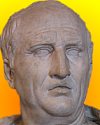
Marcus Tullius Cicero
(3 Jan 106 B.C. - 7 Dec 43 B.C.)
Roman philosopher and statesman who is noted for his exceptional skills in oratory, which began early with a career in law. He introduced Greek philosophy to ancient Rome through his treatises based on Plato, Aristotle, and others. Fifty-eight of his orations and more than nine hundred of his letters have survived, giving one of the clearest pictures of his personality of any Roman.
|
Science Quotes by Marcus Tullius Cicero (30 quotes)
Agri non omnes frugiferi sunt.
Not all fields are fruitful.
Not all fields are fruitful.
— Marcus Tullius Cicero
From Tusculanae Disputationes (Tusculan Disputations) (45 BC), book 2, chap. 5, line 13. As translated in epigraph in Hagen Kleinert, Path Integrals in Quantum Mechanics, Statistics, Polymer Physics, and Financial Markets (2009), 1368. Cicero uses this as a metaphor, to illustrate that all men are not equally susceptible of improvement.
Aristoteles quidem ait: 'Omnes ingeniosos melancholicos esse.'
Aristotle says that all men of genius are melancholy.
Aristotle says that all men of genius are melancholy.
— Marcus Tullius Cicero
From Tusculanae Disputationes, book 1, chap. 33, line 80. As quoted in Hannis Taylor and Mary Lillie Taylor Hunt, Cicero: a Sketch of His Life and Works (2nd Ed., 1918), 597.
Cogitatio in vero exquirendo maxime versatur. Appetitus impellit ad agendum.
The Intellect engages us in the pursuit of Truth. The Passions impel us to Action.
The Intellect engages us in the pursuit of Truth. The Passions impel us to Action.
— Marcus Tullius Cicero
D. H. Barnes (Ed.) De Officiis ad Marcum Filium: Libri Tres (1814), 51.
Dicere enim bene nemo potest, nisi qui prudenter intelligit.
No one can speak well, unless he thoroughly understands his subject.
No one can speak well, unless he thoroughly understands his subject.
— Marcus Tullius Cicero
Brutus VI., 23. In Thomas Benfield Harbottle, Dictionary of Quotations (classical) (3rd Ed., 1906), 45.
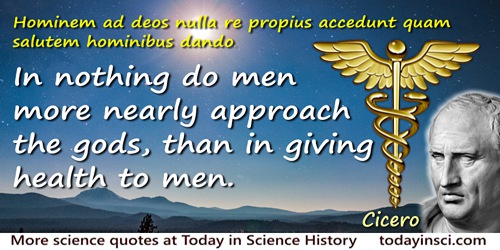
Hominem ad deos nulla re propius accedunt quam salutem hominibus dando,
In nothing do men more nearly approach the gods, than in giving health to men.
In nothing do men more nearly approach the gods, than in giving health to men.
— Marcus Tullius Cicero
Henry Thomas Riley, Dictionary of Latin Quotations, Proverbs, Maxims, and Mottos (1866), 152.
Imprimisque hominis est propria veri inquisitio atque investigatio.
The first duty of man is the seeking after and the investigation of truth.
The first duty of man is the seeking after and the investigation of truth.
— Marcus Tullius Cicero
De Officiis I., 4, 18. In Thomas Benfield Harbottle, Dictionary of Quotations (classical) (3rd Ed., 1906), 98.
In primis, hominis est propria VERI inquisitio atque investigato. Itaque cum sumus negotiis necessariis, curisque vacui, tum avemus aliquid videre, audire, ac dicere, cognitionemque rerum, aut occultarum aut admirabilium, ad benè beatéque vivendum necessariam ducimus; —ex quo intelligitur, quod VERUM, simplex, sincerumque sit, id esse naturæ hominis aptissimum. Huic veri videndi cupiditati adjuncta est appetitio quædam principatûs, ut nemini parere animus benè a naturâ informatus velit, nisi præcipienti, aut docenti, aut utilitatis causâ justè et legitimè imperanti: ex quo animi magnitudo existit, et humanarum rerum contemtio.
Before all other things, man is distinguished by his pursuit and investigation of TRUTH. And hence, when free from needful business and cares, we delight to see, to hear, and to communicate, and consider a knowledge of many admirable and abstruse things necessary to the good conduct and happiness of our lives: whence it is clear that whatsoever is TRUE, simple, and direct, the same is most congenial to our nature as men. Closely allied with this earnest longing to see and know the truth, is a kind of dignified and princely sentiment which forbids a mind, naturally well constituted, to submit its faculties to any but those who announce it in precept or in doctrine, or to yield obedience to any orders but such as are at once just, lawful, and founded on utility. From this source spring greatness of mind and contempt of worldly advantages and troubles.
Before all other things, man is distinguished by his pursuit and investigation of TRUTH. And hence, when free from needful business and cares, we delight to see, to hear, and to communicate, and consider a knowledge of many admirable and abstruse things necessary to the good conduct and happiness of our lives: whence it is clear that whatsoever is TRUE, simple, and direct, the same is most congenial to our nature as men. Closely allied with this earnest longing to see and know the truth, is a kind of dignified and princely sentiment which forbids a mind, naturally well constituted, to submit its faculties to any but those who announce it in precept or in doctrine, or to yield obedience to any orders but such as are at once just, lawful, and founded on utility. From this source spring greatness of mind and contempt of worldly advantages and troubles.
— Marcus Tullius Cicero
In De Officiis, Book 1. Sect. 13. As given in epigraph to John Frederick William Herschel, A Preliminary Discourse on the Study of Natural Philosophy (1830), viii.
In primis, hominis est propria VERI inquisitio atque investigato.
Before all other things, man is distinguished by his pursuit and investigation of TRUTH.
Before all other things, man is distinguished by his pursuit and investigation of TRUTH.
— Marcus Tullius Cicero
In De Officiis, Book 1. Sect. 13. As given in epigraph to John Frederick William Herschel, A Preliminary Discourse on the Study of Natural Philosophy (1830), viii. This is the start of a longer quote on the Cicero quotes page.
Non enim omnis error stultitia est dicenda
We must not say every mistake is a foolish one.
We must not say every mistake is a foolish one.
— Marcus Tullius Cicero
De Divinatione II., 22, 79. In Thomas Benfield Harbottle, Dictionary of Quotations (classical) (3rd Ed., 1906), 169.
Notatio naturae, et animadversio perperit artem
Art is born of the observation and investigation of nature.
Art is born of the observation and investigation of nature.
— Marcus Tullius Cicero
In Jon R. Stone, The Routledge Dictionary of Latin Quotations (2005), 78.
Nulla (enim) res tantum ad dicendum proficit, quantum scriptio
Nothing so much assists learning as writing down what we wish to remember.
Nothing so much assists learning as writing down what we wish to remember.
— Marcus Tullius Cicero
In Jon R. Stone, The Routledge Dictionary of Latin Quotations (2005), 78.
Opinionum commenta delet dies, naturae judicia confirmat
Time obliterates the fictions of opinion and confirms the decisions of nature.
Time obliterates the fictions of opinion and confirms the decisions of nature.
— Marcus Tullius Cicero
De Natura Deorum, II, ii, 5. In Samuel Johnson, W. Jackson Bate, The Selected Essays from the Rambler, Adventurer, and Idler (1968),167
Philosophia vero omnium mater artium.
Philosophy is true mother of the arts [of science].
Philosophy is true mother of the arts [of science].
— Marcus Tullius Cicero
Tusculanarum Disputationum Book 1. In Hoyt's New Cyclopedia of Practical Quotations as revised and expanded by Kate Louise Roberts (1922), 691.
Quod est ante pedes nemo spectat: coeli scrutantur plagas.
No one sees what is before his feet: they scan the tracks of heaven.
No one sees what is before his feet: they scan the tracks of heaven.
— Marcus Tullius Cicero
In Jon R. Stone, The Routledge Dictionary of Latin Quotations (2005), 101.

Ut ager quamvis fertilis sine cultura fructuosus esse non potest, sic sine doctrina animus.
A mind without instruction can no more bear fruit than can a field, however fertile, without cultivation.
A mind without instruction can no more bear fruit than can a field, however fertile, without cultivation.
— Marcus Tullius Cicero
In Hannis Taylor and Mary Lillie Taylor Hunt, Cicero: a Sketch of His Life and Works (2nd Ed., 1918), 597.
How like to us is that filthy beast the ape.
— Marcus Tullius Cicero
From the original Latin, “Simia quam similis, turpissima bestia, nobis!” In De Natura Deorum, i, 35. As translated in Craufurd Tait Ramage, Beautiful Thoughts from Latin Authors, With English Translations (1864), 52. Also seen translated as “What an ugly beast the ape, and how like us.”
I wonder that a soothsayer doesn’t laugh whenever he sees another soothsayer.
— Marcus Tullius Cicero
In so far as the mind is stronger than the body, so are the ills contracted by the mind more severe than those contracted by the body.
— Marcus Tullius Cicero
The Phillipics. In Mortimer Jerome Adler and Charles Lincoln Van Doren, Great Treasury of Western Thought (3rd Ed., 1977), 311.
Mathematics is an obscure field, an abstruse science, complicated and exact; yet so many have attained perfection in it that we might conclude almost anyone who seriously applied himself would achieve a measure of success.
— Marcus Tullius Cicero
In George Edward Martin, The Foundations of Geometry and the Non-Euclidean Plane (1982), 82.
Natural ability without education has more often attained to glory and virtue than education without natural ability.
— Marcus Tullius Cicero
In M. P. Singh, Quote Unquote (2005), 1.
Not to know what has been transacted in former times is to be always a child. If no use is made of the labors of past ages, the world must remain always in the infancy of knowledge.
— Marcus Tullius Cicero
In Samuel Johnson and Arthur Murphy, The works of Samuel Johnson (1837), 237.
The authority of those who profess to teach is often a positive hindrance to those who desire to learn.
— Marcus Tullius Cicero
In De Natura Deorum: Academica (c. 45 B.C.), as translated to English (1933), 13.
The celestial order and the beauty of the universe compel me to admit that there is some excellent and eternal Being, who deserves the respect and homage of men.
— Marcus Tullius Cicero
…...
The contemplation of celestial things will make a man both speak and think more sublimely and magnificently when he descends to human affairs.
— Marcus Tullius Cicero
In Louis Klopsch, Many Thoughts of Many Minds (1896), 18.
The cultivation of the mind is a kind of food supplied for the soul of man.
— Marcus Tullius Cicero
From De Finibus Bonorum et Malorum (45-44 B.C.) Vol. 19. As quoted in Carl Sagan, Broca’s Brain: Reflections on the Romance of Science (1986), 38.
The wise are instructed by reason; ordinary minds by experience; the stupid, by necessity; and brutes by instinct.
— Marcus Tullius Cicero
In Charles Simmons, A Laconic Manual and Brief Remarker (1852), 273.
The works of Nature must all be accounted good.
— Marcus Tullius Cicero
In De Senectute (1st century BC). Translated from the original Latin, “Omnia quae secundam Naturam fiunt sunt habenda in bonis.”
Thou shouldst eat to live; not live to eat.
— Marcus Tullius Cicero
To stumble twice against the same stone is a proverbial disgrace.
— Marcus Tullius Cicero
When you wish to instruct, be brief; that men's minds take in quickly what you say, learn its lesson, and retain it faithfully. Every word that is unnecessary only pours over the side of a brimming mind.
— Marcus Tullius Cicero
In Norbert Guterman, The Anchor Book of Latin Quotations (1990), 193.
Quotes by others about Marcus Tullius Cicero (4)
He [William Harvey] bid me to goe to the Fountain-head, and read Aristotle, Cicero, Avicenna, and did call the Neoteriques shitt-breeches.
Brief Lives (1680), edited by Oliver Lawson Dick (1949), 129.
For between true Science, and erroneous Doctrines, Ignorance is in the middle. Naturall sense and imagination, are not subject to absurdity. Nature it selfe cannot erre: and as men abound in copiousnesses of language; so they become more wise, or more mad than ordinary. Nor is it possible without Letters for any man to become either excellently wise, or (unless his memory be hurt by disease, or ill constitution of organs) excellently foolish. For words are wise men's counters, they do but reckon by them; but they are the money of fools that value them by the authority of an Aristotle, a Cicero, or a Thomas, or any other Doctor whatsoever, if but a man.
Leviathan (1651), ed. C. B. Macpherson (1968), Part 1, Chapter 4, 106.
History of science is a relay race, my painter friend. Copernicus took over his flag from Aristarchus, from Cicero, from Plutarch; and Galileo took that flag over from Copernicus.
From the play Galileo Galilei (2001) .
Why is it that the self-aggrandizements of Cicero, the lecheries and whining of Ovid and the blatherings of that debauched old goose Seneca made it onto the Net before the works that give us solid technical information about what Rome was really good at, viz. the construction of her great buildings and works of engineering?
From headnotes written by Bill Thayer to his online transcription of Vitruvius: On Architecture.

See also:
- More for Marcus Tullius Cicero on Today in Science History page.
- Marcus Tullius Cicero - context of quote “A mind without instruction” - Medium image (500 x 250 px)
- Marcus Tullius Cicero - context of quote “A mind without instruction” - Large image (800 x 400 px)
 In science it often happens that scientists say, 'You know that's a really good argument; my position is mistaken,' and then they would actually change their minds and you never hear that old view from them again. They really do it. It doesn't happen as often as it should, because scientists are human and change is sometimes painful. But it happens every day. I cannot recall the last time something like that happened in politics or religion.
(1987) --
In science it often happens that scientists say, 'You know that's a really good argument; my position is mistaken,' and then they would actually change their minds and you never hear that old view from them again. They really do it. It doesn't happen as often as it should, because scientists are human and change is sometimes painful. But it happens every day. I cannot recall the last time something like that happened in politics or religion.
(1987) -- 




